Category Archives: Irish waterways general

Where is it?

Troll on over to the National Library website and see what you think of this drawing. Click on the thumbnail to expand it; you may then need to click “PRINTABLE VERSION”.

The black object between the sailing boats and the church looks to me like a paddle steamer, but the image is quite blurred so I’m not certain.

If you can identify the location, I would be glad if you left a Comment below.

Byelaws

We learn from WI’s Corporate Plan 2011–2013 [PDF] that it expects to have new draft byelaws available by December 2012.

Northern subsidy?

The Waterways Ireland Corporate Plan 2011–2013 [PDF] tells us how the body is funded:

Waterways Ireland receives grants from money voted by the Northern Ireland Assembly and the Houses of the Oireachtas. At present 15% of recurrent or maintenance funding is provided by the Assembly in Northern Ireland and 85% by the Irish Government reflecting the current distribution of the navigable waterways, while capital development works carried out by Waterways Ireland are funded separately by the jurisdiction where the works are carried out.

This is not new information; I quote it here only for convenience (but note how “the Houses of the Oireachtas” becomes “the Irish Government”).

Now look at these figures from Annex C of the Corporate Plan. They show, for 2011, the proposed budget for current expenditure on each waterway. I have rearranged them in descending order of amount:

  • Grand Canal €4,559,160
  • Shannon Navigation €4,240,398
  • Royal Canal €2,713,052
  • Barrow Navigation €1,296,538
  • Shannon–Erne Waterway €1,269,450
  • Erne System €380,239
  • Lower Bann €375,270.

It would be interesting to compare the value for money offered by each waterway. However, it would be necessary to allow for the non-navigational responsibilities WI has for each waterway: for example, it has to look after a lot more bridges on the Grand Canal than it does on the Erne. I do not have enough information to make valid comparisons.

My immediate interest is in the figures for the Erne and the Lower Bann. Granted, the burdens on WI are in some respects lower than for other waterways. But the two northern waterways are getting a total of €755,509 spent on them out of a waterways total of €14,834,107, which is about 5%. Yet the NI Assembly is paying 15% of WI’s current expenditure.

Perhaps I’m missing something. I would welcome enlightenment.


Waterways Ireland salary reductions

Annex E of the Waterways Ireland Corporate Plan 2011–2013 [PDF] ssets out the Efficiency Savings Delivery Plan:

This Delivery Plan describes the measures Waterways Ireland will implement to achieve its target savings for 2011–2013.

Efficiency Programme

The Body will realise total efficiencies of £5,229,000/€6,377,000 from 2011-2013 as shown in the Total Efficiency Table below. […]

One problem for WI is that it expects to have to increase its pension costs by €1,175,000 over the three years, which means that WI actually has to save about €7.5 million over three years. It is showing a “Reduction in Capital Spend” of €3,102,ooo over the three years, plus reductions in Admin of €1,637,000 and in Resource of €2,813,000.

Here is how WI intends to achieve the Admin savings (€1,637,000 over three years):

Increase control in administration including negotiation of reductions in rates for Back Office Managed Services, new mobile phone contract and overtime control.

And the Resource savings (€2,813,000 over three years):

Controls over maintenance costs including lockkeepers agreement, salary reductions in Ireland and overtime control.

That looks as if most of the Resource savings are going to come from the wages bill; that in turn suggests that other costs have already been cut. The Resource reductions are allocated to waterways. In descending order of size the total figures for the three-year period are:

  • Grand Canal €910,000
  • Shannon Navigation €662,000
  • Royal Canal €503,000
  • Barrow Navigation €387,000
  • Shannon–Erne Waterway €232,000
  • Erne System €70,000
  • Lower Bann €69,000


A slight delay

Keeping up with Waterways Ireland’s corporate publications is a bit of a chore: there doesn’t seem to be any system allowing interested citizens to sign up for alerts, so you have to troll on over to the relevant web page and check for new stuff (I’ll see whether Page2RSS works).

Anyway, I don’t know when the WI Corporate Plan 2011–2013 [PDF] was uploaded, so it may be that everybody has already read it, although it wasn’t approved until October 2011:

This Corporate Plan 2011 – 2013 was approved by the North/South Ministerial Council on 12th October 2011 subject to budgetary considerations by the Northern Ireland Assembly and the Houses of the Oireachtas.

Naturally, I had a look for mentions of the Ulster Canal. It’s still there in Business Objective 2, which includes this:

Progress restoration of the Ulster canal from Upper Lough Erne to Clones.

But what isn’t there is any money (other than small change). Annex B shows these amounts of expenditure:

  • 2011: €390,000
  • 2012: €140,000
  • 2013: €390,000

With an expected total cost of €45,000,000, it seems that there won’t be much progress in the next few years.

Thank goodness.


River Suir showcase seminar

Information from South Tipperary County Council

River Suir Showcase Seminar

Tuesday 31st January, Carrig Hotel, Carrick-on-Suir. Time: 3-7pm

Do you have an interest in or love for the River Suir? If so, you are invited to come along to this first River Suir Showcase seminar in Carrick-on-Suir. As well as short talks on a range of river-related topics, there will be specialists from the various bodies that have responsibility for different aspects of the river on hand to answer any queries. Topics include inland waterways, boating on the Suir, fisheries, water quality, water safety, wildlife, the river navigation, invasive species, community and voluntary activities, and heritage survey projects on the Suir and the Nore.

Everyone is welcome to attend the entire seminar or to drop in for a short time. So come along and meet other river people and find out what activities are going on along the river.

This event is a follow up to requests from local people during the Suir River Cafe during Clonmel Junction Festival and community workshops in Ardfinnan, Cahir, Clonmel and Carrick-on-Suir over the summer undertaken as part of the Waterways Forward project.

It is an opportunity to share river information or just to hear about all the projects that are underway.

To book a free place: please contact: Margo Hayes, Tel: 051 642109 or margo.hayes@southtippcoco.ie

For further details on River Suir projects see [the website]: http://www.southtippheritage.ie/riversuir or contact Labhaoise McKenna, Heritage Officer, South Tipperary County Council heritage@southtippcoco.ie


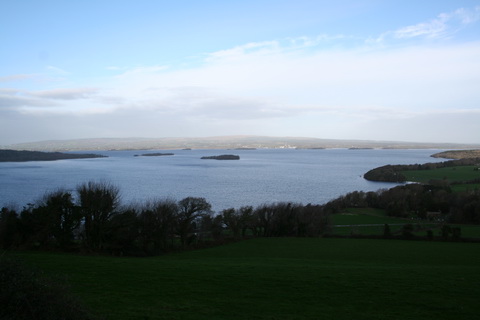
Lough Derg from The Lookout

The cost of royalty

I am attempting to establish the cost of the restoration of the Royal Canal. So far I have established that the government department currently responsible for waterways, the Department of Arts, Heritage and the Gaeltacht, has no information on the matter, so I shall now ask Waterways Ireland.

It will be difficult to estimate the return on capital employed if we don’t know how much capital was employed.


Limerick bridge

Just as Killaloe is to have a new bridge, so too is Limerick. Or perhaps more than one …. This page (on a site whose ownership I do not know) has a map of proposed routes for the proposed Limerick Northern Distributor Road, which is to provide a northern bypass of Limerick. You can read about it on the websites of the promoters, Limerick County Council, Clare County Council and Limerick City Council. You can download stuff. And you will be pleased to hear that there are to be consultations (only not many of them).

This road is to be built in two phases, the first covering the area from west of the city to Parteen and the second from there to the old Dublin road (N7 as was, now demoted to the status of boreen). There are (or were) several options for each section, but the decision to cross the navigation at the Ardnacrusha tailrace, between the power station and the existing bridge, seems to be set in, er, concrete: that is, it seems, where the ESB wants it.
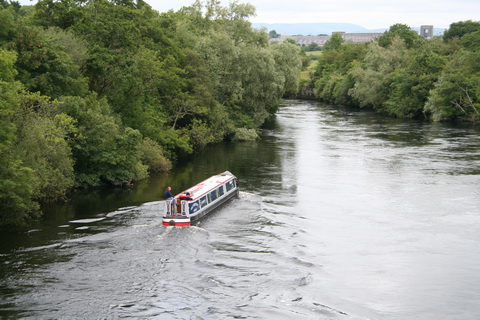
Ardnacrusha and the tailrace seen from the existing bridge at Parteen

The current consultation is about Phase 2, south-east from Parteen. There are several possible routes.

Two of them, B1 and B2, would cross the Shannon downstream of Plassey and the Black Bridge; they would not cross the Plassey–Errina Canal. It would be important to ensure that they did not further damage the towing-path and its artefacts on the Limerick side.
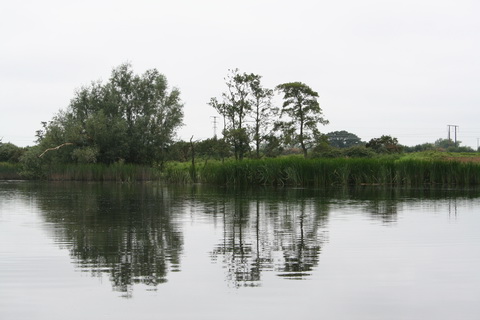
The west bank below Plassey

Four other routes — C1, D1, D2 and E1 — would cross the Plassey–Errina Canal between Gillogue and Wooden Bridge; they would cross the non-navigable Shannon upstream of Plassey, between there and a point just above the confluence of the Mulcair. C1 seems to run very close to Gillogue Lock, although that may be an effect of the scale of the route markings.
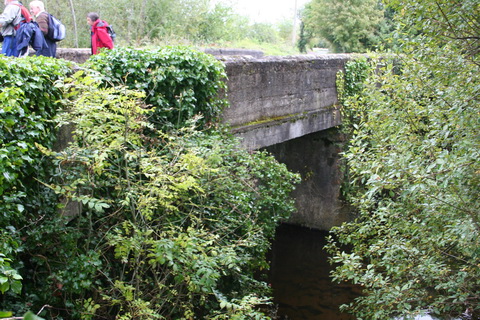
Woodenbridge (which isn't)

I am sure that the ESB will look after the interests of the existing navigation (through Ardnacrusha) and that Waterways Ireland will look after those of the former navigation (the river to Plassey and the canal thence to Errina). However, it might be worthwhile lobbing in a comment to TPTB, first to sttress the heritage value of the abandoned navigation and second to suggest that a new road near Plassey might improve rather than diminish access to that area.

One final thought: this new road seems likely to put the final nail in the coffin of the Limerick Tunnel under the Shannon estuary downstream of Limerick. I very much enjoy using the tunnel, but many folk are deterred by the charges and they drive through the city instead — or, worse, cross the Shannon at O’Briensbridge. As a result, revenue is less than expected, so the traffic guarantee mechanism means that the National Roads Authority has to compensate the tunnel operators.

So now that a new, free, presumably fast road is to link the east and west sides of the city, what will happen to the numbers of vehicles using the tunnel and to the taxpayers who are ultimately paying the compensation? They’ll pay more. The tunnel is on a national primary route, so it’s the NRA’s problem, whereas the new bypass is a regional or local route, which is in the hands of the local authorities.


=p-po-

Killaloe bridge

The Irish Times tells us that the proposed new bridge at Killaloe will be built. The preferred route would cross the canal at Moys, below the breach in the wall,  and, on the Tipperary side, feed into the existing roundabout at the junction of the R494 and R496.

The Preliminary Design Report for the project said:

There is an existing canal alongside the river on the west side, which served a navigational function up to the time of the construction of the Parteen Weir and the raising of the water level in the river. The canal is now inundated by the river as a result of the raising of the water level, and now merely forms a parallel channel alongside the river. A strip of land some 25m wide separates the river from the canal, which is approximately 10m to 12m wide at the bridge site. As the river is now fully navigable, the canal serves no navigational function except that recreational vessels wishing to access properties on the western shore can only do so by entering the canal through certain access points, and travelling along the canal to their desired destination on the shore.

It seems that Waterways Ireland (god bless ’em) insisted that the canal remain navigable:

[…] Waterways Ireland have now requested that passage along the canal be retained, and have advised that they intend to refurbish the canal as a recreational amenity.

A culvert is therefore to be built over the canal, but not a low-level culvert:

[…] Waterways Ireland require that the structure provide a minimum of an 8 metre wide waterway with a 4 metre wide towpath for vehicle and pedestrian access. They require the provision of a minimum headroom of 3.86 metres above normal water level, and a bed level not higher than the downstream cill of the canal lock at Killaloe/Ballina Bridge.

The section of canal will be dewatered during construction work.

These quotations are from Shannon Bridge Crossing Preliminary Design Report Rev F01 by RPS Consulting Engineers in October 2006. I am unable to find, on the Clare County Council website, any later documents that might assure me that the canal crossing provisions still apply. That’s not to say that they don’t; it may just be that the Council doesn’t think citizens need up-to-date information on the matter.