Category Archives: Non-waterway

The Dublin to Galway ship canal

Another h/t to Ewan Duffy for the link to this Galway Independent article about the proposed Dublin to Galway ship canal. I was impressed to note that it covers Edward Watkin‘s late nineteenth century for a Dublin to Galway ship canal, which would save transatlantic steamers from having to go north or south of Ireland when travelling between Britain and America. It was, of course, a completely insane proposal; as some folk pointed out at the time, only Liverpool steamers found Ireland an obstacle and, being capable of 20 knots or so, might actually lose time by having to travel at 3 knots and through locks on a canal instead of steaming north or south about.

Incidentally, the article mentions the Panama Canal, which joins the Atlantic and Pacific Oceans. So which ocean is at its western end?
Revising the Royal

Ewan Duffy of IndustrialHeritageIreland and I have both, in recent times, uncovered new information about the history of the Royal Canal after it was taken over by the Midland Great Western Railway in 1845: a period that, because (I think) of the absence of company archives, is not well covered in published histories of the Royal. Ewan today said that he will be posting new material about the stretch from Lock 1 to Lock 5 on 30 March 2013, so watch that space.

Across the wires the electric message came …

… “He is no better, he is much the same”, as the late poet laureate so well put it. Fuel supply on the Shannon is perhaps of less significance than the illness of one so elevated as a Prince of Wales (despite the Athlone connection), but “much the same” describes the list of holders of marked fuel [green diesel] traders’ licences: I see no change on the latest list.

Clones

From the Clones Regeneration Partnership Ltd website:

PROJECT OFFICER » Unfortunately the Clones Regeneration Partnership Canal Officer post has come to an end ….

Though I disagreed with the case put forward by Gerry Darby, I am sorry to hear of his departure. My main criticisms of the Clones Sheugh proposal are directed at the Irish government.

Wexford

Here is a great account of the development of Wexford Harbour, with a history of its shipping here.

Muffins

I gather that there is, nowadays, a demand for muffins. I’ll bet they’re not advertised as elegantly as were Murphy’s Muffins in the Freeman’s Journal of 22 April 1845.

===========================================

MUFFINS — MUFFINS — MUFFINS

THESE DELECTABLE APPENDAGES to the TEA-TABLE can be had, fresh every day, at 10d per dozen at MURPHY’S BELFAST CONFECTIONARY HOUSE, 157, CAPEL STREET, and 68, DAME-STREET.

NB — MURPHY’s ONLY are GENUINE.

‘Tis custom now, at close of day,
Before the hour of nine,
To take a cup of Congou tea,
With MURPHY’S MUFFINS fine.
His Muffins are both pure and sweet,
At morning, noon and even,
And they are bought in CAPEL-street,
At number ONE-FIVE-SEVEN.
‘Tis pleasure’s task, through time’s career,
To give a zest to life —
The young and innocent to cheer,
The unmarried maid, and wife;
And to enjoy this pleasant treat,
These MUFFINS pure are given,
In MURPHY’s shop, in CAPEL-STREET,
At number ONE-FIVE-SEVEN.
To invalids, whose ailing hours
Bid appetite be still,
The MUFFINS have the happy powers
To meet their anxious will.
And ladies fair, whose tempers sweet
Make earth itself a heaven,
Are pleased to visit CAPEL-street,
At number ONE-FIVE-SEVEN.

157, Capel-street, April 8th, 1845.

===========================================

The compulsory waterways link? Oh, er …. Perhaps this to this.


Lismore to Fermoy

A meeting was held in Fermoy in 1844 to promote a proposal to make the Blackwater navigable from Lismore upstream to Fermoy. Here is the Cork Examiner‘s account of the meeting.

Fermoy railway station opened in 1860.

Sarah Kelly and the Royal Canal

Quite the most remarkable story I’ve come across about the Royal Canal and the Midland Great Western Railway ….

A load of old bollards

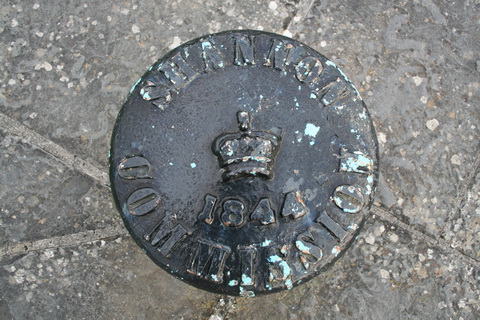
Our London Correspondent reports that the latest and most fashionable souvenir to go on sale there is a reproduction cast-iron “paperweight/doorstop/bookend based on the mooring bollards of Regents Canal”. Available in black or fluorescent red, these items were designed by a designer who was being worked with by another chap who was commissioned by a Creative Agency. The result is a “desirable antidote to the overly-commercial, tacky souvenirs” available elsewhere, it says here.

Shannon Commission bollard 1844_resize

A bollard at Meelick

Well, that’s nice. Maybe Waterways Ireland could commission the same creative types to design a range of reproductions of Irish waterways bollards; folk could be encouraged to collect the entire set.

But one minor drawback does strike me. The artistic merits of these reproduction bollards are of course obvious, but as souvenirs they have one minor drawback. A souvenir is something you buy, while on holiday, to take home to someone else. Nowadays, the steamer services are not what they once were and many folk travel on these new-fangled flying-machines. But according to that nice Mr O’Leary, who operates some such machines, you may take only 10 kg of cabin baggage. These bollards, though, weigh about 1.5 kg each, which rather limits the number of bollards you can carry as souvenirs.

Newcomen Bridge again

Last month I wrote about the lock at Newcomen Bridge on the Royal Canal:

Industrial Heritage Ireland has created a page giving the history of the railway crossing at Newcomen Bridge. However, it would be nice to have some documentary evidence about the resiting of the lock — and about the headroom under the bridge before the lock was moved.

Here it is, from the Freeman’s Journal of 12 April 1873, in an article about the new Spencer Docks:

Above the new metal bridge there is a basin for Canal boats, with a quayage of 450 feet at either side and a depth of six feet. In connection with the new works, the lowering of Newcomen-bridge on the Clontarf-road must be alluded to. To effect this the old lock had to be moved higher up, and the old bridge replaced by one suited for the requirements of the tramway traffic. The arch of the bridge crossing the Canal was lowered five feet, and a new girder iron bridge crosses the railway at the same level. The Main Drainage Board wisely took advantage of the opportunity of the Canal being drained to make a main sewer under the canal and the railway above Newcomen-bridge at the low level required.

Happy, Mick?