Category Archives: Operations

Hurrah for the red, white and orange

Colour discrimination seems to be rampant in Ireland. Of the sets of colours [red, white and blue] and [green, white and orange], there is Official Endorsement of two, green and blue, while red, white and orange are ignored. Even the North/South Ministerial Council has got in on the act, with a whole page on its website about greenways and blueways. They must have been overdosing on the Erne flag. Their page is a list of links, sort of plonked there without context or explanation, but there’s probably some hands-across-the-borderism or something going on.

I read in the Guardian today of a proposal for a greenway on the former railway line between Roscrea and Portumna via Birr. And a jolly good thing too, but how many greenways and blueways can one small island accommodate? How thinly will the tourists be spread? And what about those of us who hate walking, cycling, kayaking and other such energetic pursuits?

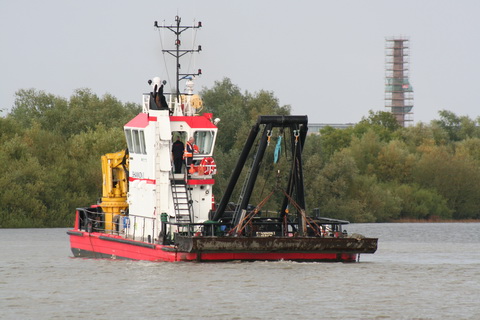
The Shannon One

Copy of IMG_4546_resize

Heading down the estuary past Shannon Airport

Limerick Port dredger Shannon I 3_resize

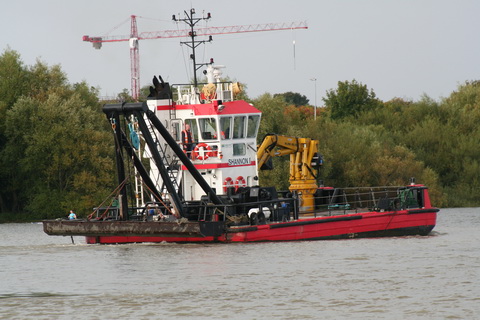
Working in Limerick

Limerick Port dredger Shannon I 4_resize

Almost as much kit as WI’s Swiss Army Knife

Limerick Port dredger Shannon I 5_resize

The big crane, though, is not part of the kit

Limerick Port dredger Shannon I 7_resize

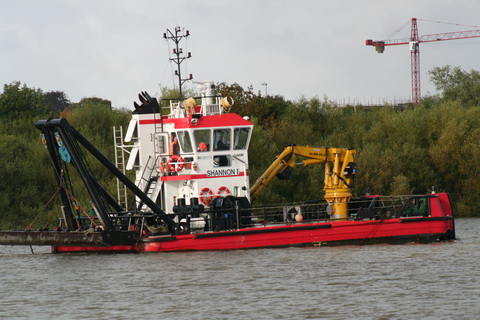
Great view from the cab … er, wheelhouse

Limerick Port dredger Shannon I 11_resize

Pusher bow?

Limerick Port dredger Shannon I 1_resize

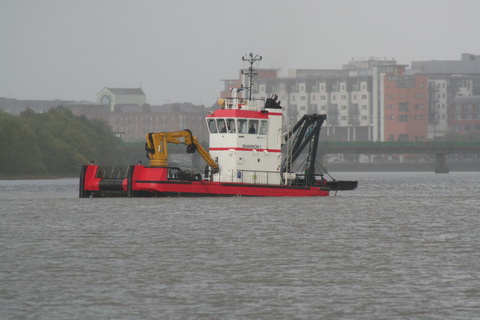
Limerick in the background

Limerick Port old dredger Curraghgour II 3_resize

Shannon 1’s predecessor Curraghgour II


Races on Lough Erne

To the Editor of the Erne Packet

Me Editor — The stir visible amongst the seamen of the Lake, assures a most interesting contest. Four new boats are to enter the lists — their prowess will best prove the merit of those which have on former occasions been exhibited.

To the amateur, the scene cannot fail of proving most interesting, as well from the unrivalled beauty of the sailing ground, as from the superiority of the boats, some of which, built on the Thames, are considered to be superior to any other vessels of any size, for lake sailing.

The mariners of Donegal Bay will not, it is to be hoped, sleep on their oars; if rumour is to be credited, they are not to yield the palm so easily as they did last year. Four boats besides those already mentioned, are reported to be in readiness to invade the lake, from the sea, to assert the superiority of the Donegalian over his fresh-water competitor.

Some experiments are to be tried upon scientific principles,where lightness of draught of water, and form, altogether differing from what, for centuries, has been in use, are to be put into competition with bulk and beam. The well established speed of the Lough Erne cot is also to be tried, a boat being in preparation; these rivals to be pulled by Gentlemen of the lake. Great confidence is expressed by the owners, and any money for hands with good beam and bottom. NB — Dandies not admitted.

To cheer the toils of the seamen, two Balls are in contemplation, where all the rank and fashion of a wide extended country have engaged to attend. A very distinguished party from London, òn a visit to the Lakes and Bundoran, will also be present, and gratify the eye, as they have already done the mind’s eye of most of us.

Besides the beauty of the Lakes, much speculation exists to account for their visit, whether an examination into the minerals and collieries of the neighbourhood, or the general capabilities of Lough Erne, an extension of the navigation, and perhaps a decision of a question which has long barred up our Lake; the choice between a canal to Lough Neagh and Belfast, or one from Ballyshannon. In giving information to these sagacious explorers, Gentlemen will do well to bear in mind, that their evidence should be divested of any private favour, for should it be found to contain more affinity for party purposes than the general object, the benefit of the country, it will instantly, and perhaps not civilly, be rejected as unfit matter to enter into such an important digest.

NOTUS

Enniskillen Chronicle and Erne Packet
12 August 1824

Backtracking the Barrow trackway

Some time ago I put up a page about the Barrow trackway [towing-path]. For some reason, the page disappeared shortly afterwards. I have now recreated it; unless or until it disappears again, it is here.

Theft on Lough Ree …

… in the National Archives of Ireland May 2015 document of the month.

Early water transport

In a piece about the Augustinian Priory at Athassel, near Golden in Co Tipperary, I wrote

But the really extraordinary thing about Athassel, at least from the waterways viewpoint, is that Dundry stone was used for sculptural (but not for structural) work.

Now, that may mean as little to you as it did to me, until I looked it up and found that Dundry is in Somerset, on the Bristol Channel. The stone could have been taken from there to Waterford by sea and it must have been hauled up the Suir from there.

In the last century, the horse-drawn traffic up the Suir to Clonmel ceased, and Carrick-on-Suir became the effective head of the navigation. But Athassel is at least another twenty miles upstream from Clonmel, and cargoes were brought up there seven hundred or so years ago.

However, traffic in materials for religious establishments was not all one way, and I am indebted to John Ditchfield for the information that some of the oak used in the roof of Salisbury Cathedral was felled in Ireland, on or near the east coast, in the spring of 1222 and used by 1225. Timber from 75 trees has been identified and at least one shipment, by William of Dublin, is recorded in 1224.

Inside Salisbury Cathedral (courtesy of John Ditchfield 2015)

Inside Salisbury Cathedral (courtesy of John Ditchfield 2015)

A 2003 story in the Telegraph says

The wood was bought from “William of Dublin” and carted from Bristol or Southampton.

However, in the English Heritage [now Historic England] report from 2002 on The Tree-Ring Dating of the Roof Carpentry of the Eastern Chapels, North Nave Triforium, and North Porch, Salisbury Cathedral, Wiltshire [PDF], I found nothing about how the timber got from the English coast to Salisbury, which is some distance inland.

It may be, of course, that the Patent Rolls for AD 1224 say what English port was used and how the timber was transported from there to Salisbury. I do not, alas, have a copy of the Patent Rolls to hand and Messrs Google don’t seem to have been able to get hold of them for digitising.

But if the Patent Rolls don’t provide evidence to the contrary, my guess would be that the timber was carried up the Avon. And that might enable Rollalot to insert another date between the first and second in the history of Avon navigation on this page; Rollalot, like me, has read Douglas Caffyn on the right to navigate on rivers.


The Boyne’s turf-sided lock

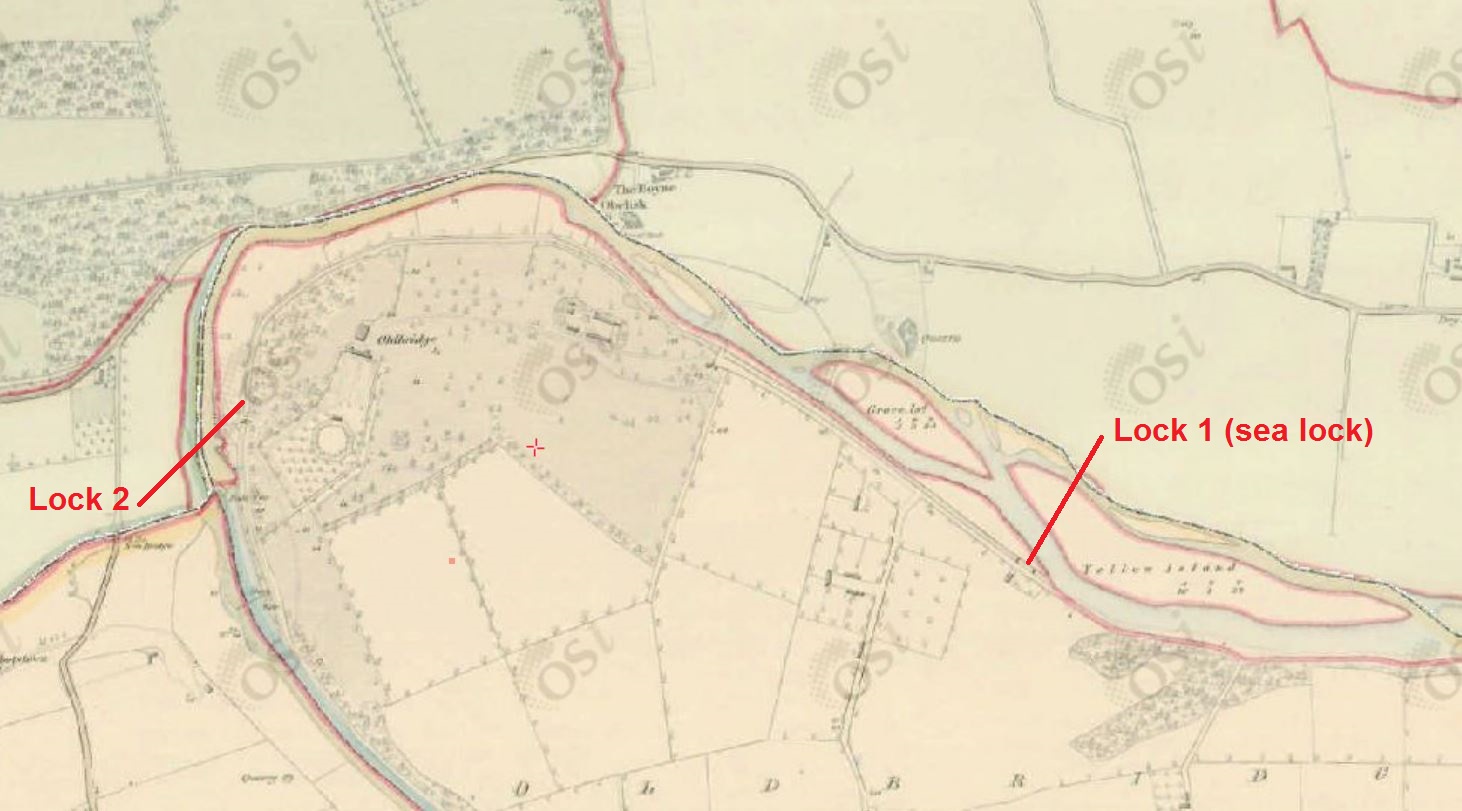
I have a vague recollection of being told that there was no evidence that the turf-sided Lock 2, Oldbridge Guard Lock, on the Boyne Navigation was ever fitted with gates. Or perhaps it was that only a single pair was fitted and that the lock did not operate as a lock.
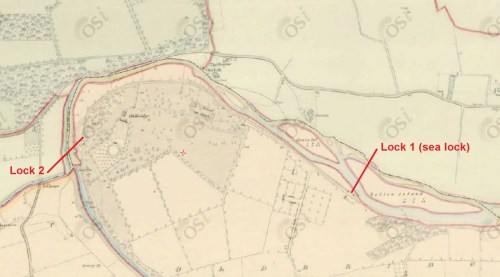
Boyne Locks 1 & 2 (OSI ~1840)

Boyne Locks 1 & 2 (OSI ~1840)

I’m not clear about what I was told but I recall feeling somewhat surprised, given that the lock has stone buttresses at both ends that could have been fitted with gates.
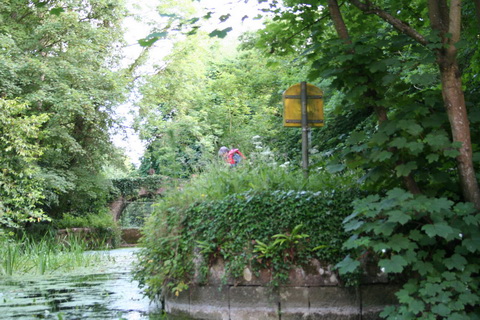
Gate buttresses of turf lock 01_resize_resize

Looking up into the lock past the lower stone buttresses

I should point out that my photos were taken in 2008; much more work has been done since then.
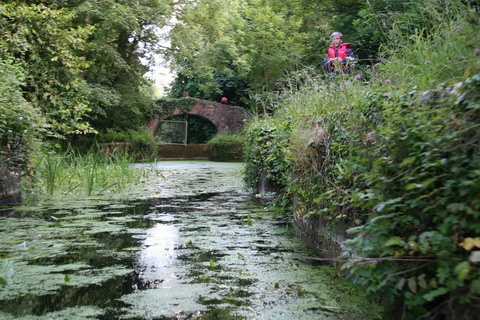
Gate buttresses of turf lock 02_resize_resize

Both sets of buttresses and the bridge
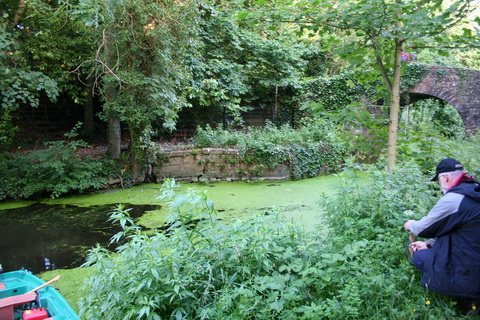
Gate buttresses of turf lock 03_resize_resize

The upper buttresses

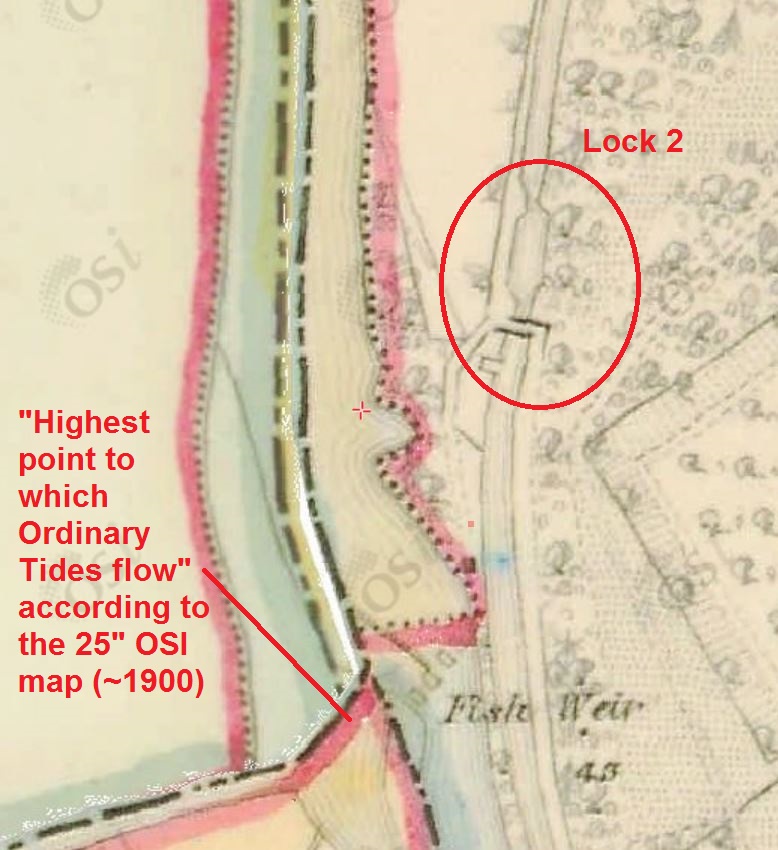
Yet it is true that the 6″ Ordnance Survey map, from around 1840, does not show gates on the lock.
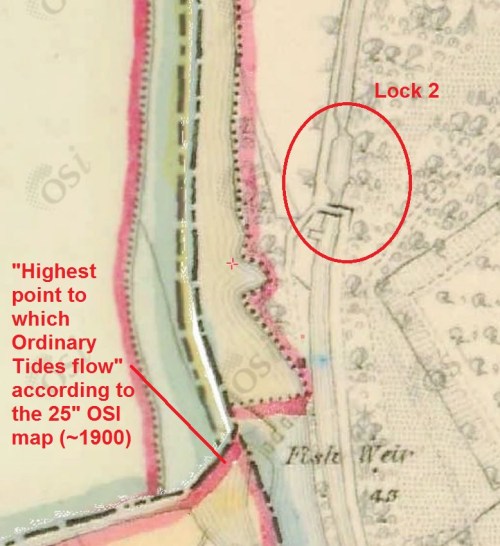
Oldbridge Guard Lock (Lock 2) (OSI ~1840)

Oldbridge Guard Lock (Lock 2) (OSI ~1840)

Unfortunately the relevant section of the 25″ OSI map, from around 1900, is blank at time of writing so I can’t check what it shows.
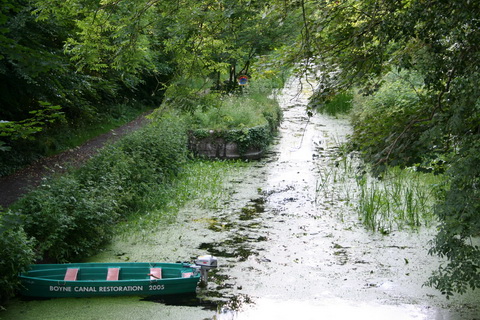
The turf-sided lock on the Boyne

The turf-sided lock on the Boyne

The IWAI Boyne Navigation Branch is currently (March 2015) working towards the installation of gates at the lock but I don’t know whether they’re installing one pair or two pairs.

From reading the reports of the Superintendent for the Boyne Navigation, it is clear that, for at least some part of the period while the navigation was controlled by the Board of [Public] Works, the lock had both top and bottom (breast and tail) gates. Here are some relevant extracts from the reports; I’ve given only enough to make the point.

In January 1869 James Bellew, Superintendent, reported on the works carried out on the Boyne Navigation in 1868. His report, published in the Thirty-seventh Report from the Board of Public Works, Ireland: with the Appendices, for the year 1868 [Alexander Thom for HMSO, Dublin 1869], included this:

Oldbridge Station.

The lock-gates at this station are in excellend working order. The chimney of the lock-keeper’s house has been rebuilt, and some alterations made in the house to render it more comfortable. The guard lock-gates are old, but as they are used only in time of flood, I am of opinion they will last some time longer.

In March 1871, his successor, P J Dodd, wrote in the Thirty-ninth Report:

Oldbridge Guard-lock gates.

The Oldbridge Guard-lock gates are in a very bad state of repair, but new breast gates have been ordered, the contractors have same in hands, and they will be erected during the coming fine season.

And in March 1873 Dodd wrote in the Forty-first Report:

Oldbridge Guard-lock Gates.

The new breast gates of guard-lock [sic] have acted well during the year and heavy flood season, and are in a first class state at present; the tail gates, although old and shaken, are in fair working order, and did very well during the year.

In March 1877 he wrote in the Forty-fifth Report:

Oldbridge Guard Lock-gates.

The breast gates are in very good order; but the tail gates are somewhat shaken, being old.

The gates were tarred in 1878 (Forty-seventh Report); the tail gates had “a slight repair” in 1878 (Forty-eighth Report) and, in April 1881 (Forty-ninth Report), Dodd reported that

These [guard lock] gates require some repairs to sluices and also to the sheeting.

In March 1882 (Fiftieth Report) Dodd wrote:

Oldbridge Guard Locks.

The breast gates are in good repair, tail gates require two new cross rails, sheeting for both folds, and one new balance beam and handrails for both gates.

I do not, of course, know whether there were two pairs of gates at other times.

My OSI logo and permit number for website

And quite right too

From the Dublin Weekly Register Saturday 15 June 1822:

A boy of the name of Thomas Brady was brought into custody to the Head Police Office, on Sunday morning, by James Devereux, Ranger of the Grand Canal, having been found bathing in the canal, at Charlemont-bridge, about the hour of five o’clock on the same morning. He has since been committed to Newgate.

Interesting information about the Ulster Canal …

… as distinct from ministerial reelection photo opportunities.

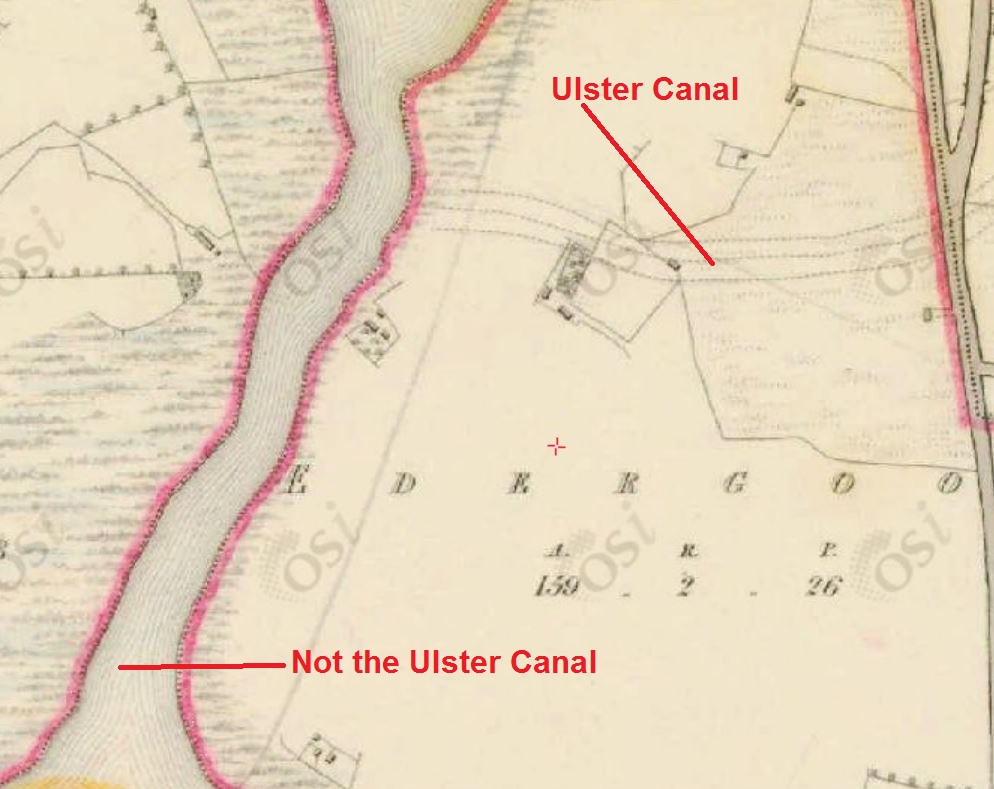
By the way, some folk get confused about the location of the Ulster Canal; this map may help:

Saunderson's Sheugh -v- the Ulster Canal (OSI ~1840)

Saunderson’s Sheugh -v- the Ulster Canal (OSI ~1840)

Anyway, for folk who are interested in weightier matters than ministers talking through portions of their anatomies that they can’t distinguish from their elbows, here is some speculation about opening bridges on the Ulster Canal.

That’s the Ulster Canal Ulster Canal, not the Saunderson’s Sheugh “Ulster Canal”, by the way.

My OSI logo and permit number for website


Big it up for the Kingstown Blazers

Hats off to the Irish Sailing Association for its successful campaign to persuade owners of diesel-powered pleasure craft to pay the Mineral Oil Tax. The ISA reckoned that, if more folk paid up, the nasty foreigners might allow boaters to continue to use patriotic green diesel:

It may already be too late to save the present diesel supply system in Ireland, but the very least we can do is to strengthen the country’s case by paying the tax. If we don’t do that, we won’t have a leg to stand on.

There have been other press releases since then, and the ISA has said that

The issue for leisure sailors is not the price of diesel but its availability.

Which suggests that it’s only a series of misfortunes that has prevented 99.75% of owners from paying the tax they should have paid. Perhaps the dog ate their chequebooks.

But the ISA put its shoulder to the wheel, its nose to the grindstone and its money where its mouth was, calling on other people to pay up. And, by golly, they did. It is no doubt as a result of the ISA’s call that the number of folk paying Mineral Oil Tax in 2015 (for 2014) was …

30%

… up on the previous year’s figure.

Admittedly that just meant it went from 20 to 26, so the non-compliance rate is still around 99.75%, but let us not mock honest effort. If the number continues to increase at six a year, there will be full compliance by the year 3677, which will be good; I look forward to recording the event.

For the record:

Year Payers Litres Amount
2010 for 2009 38 n/a n/a
2011 for 2010 41 n/a n/a
2012 for 2011 22 141,503.29 €53,398.58
2013 for 2012 23 301,674 €113,841.45
2014 for 2013 20 279,842.4 €105,561.74
2015 for 2014 26 289,151 €108,934.80

The income generated by the tax is about 10% of the amount the ISA gets from the state every year.