
-

Waterways and Means by Brian J Goggin available now -
Join 587 other subscribers
RSS links
Pages
- Waterways & past uses
- Saving the nation
- Turf and bog navigations
- The Bog of Allen from the Grand Canal in 1835
- John’s Canal, Castleconnell
- The Canal at the World’s End
- The Finnery River navigation
- The Lough Boora Feeder
- The Little Brosna
- The Lullymore canal as wasn’t
- The Roscrea canals
- The Monivea navigations
- Lacy’s Canal
- The Rockville Navigation page 1
- The Rockville Navigation page 2
- The Rockville Navigation page 3
- Rockingham
- The Colthurst canals
- The Inny navigation
- The lower Shannon
- The piers, quays and harbours of the Shannon Estuary
- Nimmo’s non-existent harbour
- The Doonbeg Ship Canal
- Querrin
- Kilrush and its sector lock
- The Killimer to Tarbert ferry
- The Colleen Bawn at Killimer
- Knock knock. Who’s there?
- Cahircon: not at all boring
- Ringmoylan
- The hidden quay of Latoon
- The stones of Kilteery
- The Maigue
- Sitting on the dock of the Beagh
- Massy’s Quay, Askeaton and the River Deel
- Saleen Pier
- The Lord Lieutenant’s Visit to Limerick — trip down the Shannon [1856]
- The Fergus
- The Limerick Navigation
- The boundaries of the Shannon
- The power of the Shannon
- The locks on the Limerick Navigation
- Plassey
- Worldsend, Castleconnell, Co Limerick
- The bridge at O’Briensbridge
- The Limerick Navigation and the Monmouthshire Canal
- The Limerick Navigation (upper end) in flood November 2009
- The Limerick Navigation (lower end) in flood November 2009
- The Limerick Navigation (tidal section) in flood November 2009
- Floods in Limerick (1850)
- Limerick to Athlone
- The piers, quays and harbours of the Shannon Estuary
- The middle and upper Shannon
- The Grand Canal
- Monasterevan, the Venice of the west
- The Grand Canal lottery
- Grand Canal carrying: some notes
- The dry dock at Sallins
- The Naas Branch
- The Mountmellick Line of the Grand Canal
- Dublin to Ballinasloe by canal
- The Ballinasloe Line
- A Grand Canal lock: Belmont
- South of Moscow, north of Geneva
- Water supply to the Grand Canal
- The Grand Canal Company strike of 1890
- The Royal Canal
- Water supply to the Royal Canal: the feeders
- The Lough Owel feeder
- The proposed Lough Ennell water supply to the Royal Canal
- From Clonsilla to Clew Bay
- Kinnegad and the Royal Canal
- The sinking of the Longford in 1845
- Steamers on the Royal Canal
- Leech of Killucan: horse-drawn boats on the Royal
- Horses on board
- Royal eggs
- Prothero on the Royal
- The whore who held the mortgage on the Royal Canal
- Waterways in Dublin
- The Naller
- Visit Dublin. Walk canals. Drink beer.
- The Broadstone Line of the Royal Canal
- Effin Bridge: its predecessors
- Between the waters
- The abandoned Main Line of the Grand Canal 1
- The abandoned Main Line of the Grand Canal 2
- The abandoned Main Line of the Grand Canal 3
- The abandoned Main Line of the Grand Canal 4
- Waterways of the south-east
- Waterways of Cork and Kerry
- Waterways of the west
- Waterways of Ulster and thereabouts
- People
- Systems & artefacts
- Irish waterways furniture
- Irish waterways operations
- Miscellaneous articles
- Irish inland waterways vessels
- Cots -v- barges: defining Irish waterways
- Waterways Ireland workboats
- Wooden boats on Irish inland waterways
- Traditional boats and replicas
- Non-WI workboats
- Older Irish working boats
- The barge at Plassey
- Dublin, Athlone and Limerick
- Waterford to New Ross by steam
- The steamer Cupid
- Liffey barges 1832
- Steam on the Grand Canal
- The Mystery of the Sunken Barge
- Steam on the Newry Canal
- Guinness Liffey barges 1902
- Up and under: PS Garryowen in 1840
- Watson’s Double Canal Boat
- The Cammoge ferry-boat
- The ’98 barge
- Late C19 Grand Canal Company trade boats
- Chain haulage
- Ballymurtagh
- The Aaron Manby and the Shannon
- A sunken boat in the Shannon
- Sailing boats on Irish inland waterways
- Some boats that are … different
- Square sail
- 4B mooring
- Irish waterways scenery
- Engineering and construction
- Irish navigation authorities
- Opinion
- The folly of restoration
- The Ulster Canal now
- The Ulster Canal 00: overview
- The Ulster Canal 01: background
- The Ulster Canal 02: the southern strategic priority
- The Ulster Canal 03: implementation
- The Ulster Canal 04: Ulster says no
- The Ulster Canal 05: studies and appraisals
- The Ulster Canal 06: the costs
- The Ulster Canal 07: the supposed benefits
- The Ulster Canal 08: the funding
- The Ulster Canal 09: affordability
- The Ulster Canal 10: kill it now
- The Ulster Canal 11: some information from Waterways Ireland (and the budget)
- The Ulster Canal 12: departmental bullshit
- The Ulster Canal 13: an investment opportunity?
- The Ulster Canal 14: my search for truth
- The Ulster Canal 15: spinning in the grave
- The Ulster Canal 16: looking for a stake
- The Ulster Canal 17: the official position in November 2011
- The Ulster Canal 18: Sinn Féin’s canal?
- The Ulster Canal 19: update to February 2012
- The Ulster Canal 20: update to April 2013
- The Ulster Canal 21: update to August 2018
- The Barrow
- A bonfire at Collins Barracks
- Living on the canals
- Waterways tourism
- Guano
- The Park Canal: why it should not be restored
- The Park Canal 01: it says in the papers
- The Park Canal 02: local government
- The Park Canal 03: sinking the waterbus
- The Park Canal 04: the Limerick weir
- The Park Canal 05: cruisers from the Royal Canal
- The Park Canal 06: What is to be done? (V I Lenin)
- The Park Canal 07: another, er, exciting proposal
- Accounting for risk
- Tax-dodging boat-owners
- Rail
- Waterways & past uses
Blogroll
boats
- Canal steamers [UK]
- Chris Deuchar's boating page
- Douglas Self retrotech and steam
- Grace's Guide: British Industrial History
- Heritage Boat Association
- Historic Inland Working Boats
- Irish maritime history
- irish shipwrecks database
- Kilrush & District Historical Society
- Lough Corrib charts and scans
- Railway and Canal Historical Society
Book sales
Industrial heritage
Inland waterways
Ireland
Overseas
Seafaring
Sources
Category Archives: Operations
Erne
As I understand it, the level of Lough Erne, and the occasional need to use its only lock, at Portora, are both determined by the operations of the Lough Erne hydroelectric scheme, although most of the lake, and the lock, are in Northern Ireland, while the hydroelectric stations, at Cliff and Cathaleen’s Fall, are both in the republic. The Erne scheme is less well known, and has been less often written about, than the Shannon scheme at Ardnacrusha, so it is good to note that two Ballyshannon men, Dessie Doyle and Brian Drummond, have written a book about the Erne scheme.
Unfortunately it is not clear from Messrs Lilliput Press’s website whether the book has already been published or is to appear some time in 2014. No publication date is given, but on the other hand it is not in the list of forthcoming books, but that list does not extend beyond November 2013. I would be glad to be able to carry reliable information, but I regret that I am unable to do so.
Posted in Built heritage, Drainage, Economic activities, Engineering and construction, Extant waterways, Foreign parts, Industrial heritage, Ireland, Non-waterway, Operations, Politics, waterways, Waterways management
Tagged Ballyshannon, Belleek, Cathaleen's Fall, Cliff, Enniskillen, Erne, Ireland, Northern Ireland, Portora
Draining Lough Derg
The ESB is currently letting more water down the old course of the Shannon, from Parteen Villa Weir through O’Briensbridge, Castleconnell and the Falls of Doonass. This channel gets the first 10 cubic metres per second from the Shannon; the next 400 go through Ardnacrusha and anything left over is sent down the old course.
The result is to help to reduce the water level on Lough Derg while raising it on the old course.
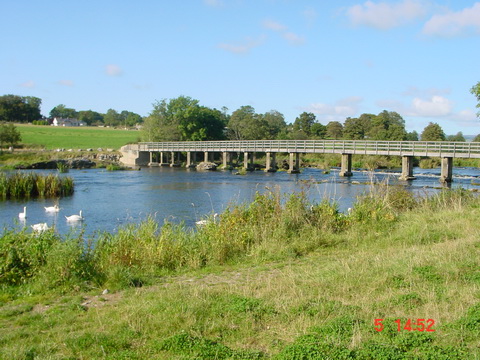
The footbridge in Castleconnell at normal summer level in 2002
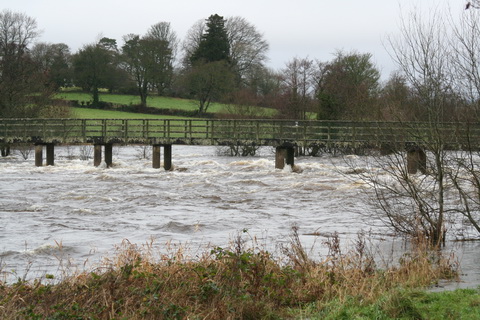
The footbridge on 1 January 2014
Before Ardnacrusha was built, the old channel took the entire flow of the Shannon, so it can take more than it has now.
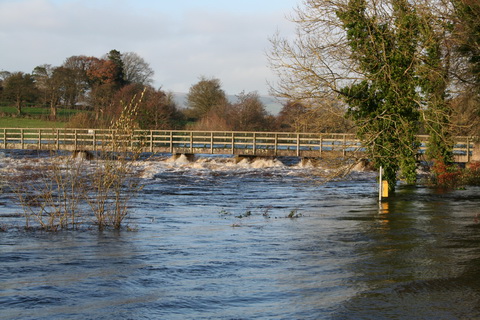
The footbridge in the floods of November 2009
The level is still below that of 2009, when the land around the old channel flooded in several places. But much land is waterlogged: I saw yesterday that the upper reaches of the Nore, the Barrow and other rivers were in flood. And more rain is forecast.
Wouldn’t it be nice if some of that could be sent to Dublin instead? I see that some folk claim (on what looks like a website that hasn’t been updated for a while) that the evil Dublin folk want to extract 350 million litres of water from the Shannon every day; the original idea was to take it from Lough Ree but now it seems that Lough Derg is the preferred source.
Now 350 million litres sounds like a lot, but it’s 350 000 cubic metres per day, 14 583.3 per hour, 243.05 per minute, 4.05 per second, which is less than 1% of normal flow through the two channels draining Lough Derg. There’s a lot more at the moment, and the good citizens of Dublin are welcome to come down and fill their buckets. I suspect that Clare TD Michael McNamara has got things out of proportion.
Addendum: 350 million litres per day, over a lake whose area is 130 square kilometres, would lower the level of the lake (if my calculations are correct) by 2.69 millimetres. If no water entered the lake, the level would be down 983 mm after a year, ignoring evaporation and other abstractions and assuming that the Shannon and other tributaries no longer flowed in and that there was no rain.
Posted in Ashore, Built heritage, Drainage, Economic activities, Engineering and construction, Extant waterways, Industrial heritage, Ireland, Natural heritage, Non-waterway, Operations, People, Politics, Shannon, shannon estuary, Sources, waterways, Waterways management, Weather
Tagged abstraction, Ardnacrusha, boats, canal, Castleconnell, Clare, Dublin, ESB, estuary, floods, flow, Ireland, Killaloe, Lough Derg, O'Briensbridge, Operations, Shannon, water level, waterways
Winter Quarters
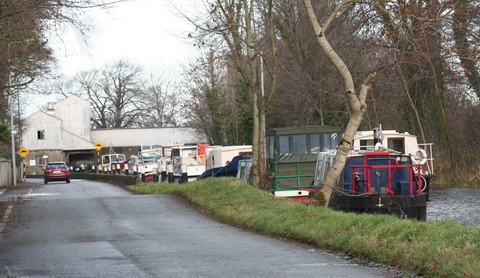
At Leinster Mills, Naas Branch, new year’s eve 2013
Posted in Ashore, Built heritage, Economic activities, Engineering and construction, Extant waterways, Industrial heritage, Ireland, Irish inland waterways vessels, Operations, waterways, Waterways management
Tagged barge, boats, bridge, canal, Grand Canal, Ireland, Naas Branch, Operations, vessels, water level, waterways, Waterways Ireland
Wind and eels
Interesting BBC story about a possible cause for the decline in the number of eels.
Posted in Economic activities, Engineering and construction, Extant waterways, Foreign parts, Ireland, Natural heritage, Non-waterway, Operations, Sea, Shannon, shannon estuary, Sources, The fishing trade, waterways, Waterways management, Weather
Tagged anguilla anguilla, eels, Ireland, Operations, Shannon, waterways
The grunts of Lough Neagh
In The Cookin’ Woman: Irish country recipes (Blackstaff Press, Belfast and Dover New Hampshire, facsimile edition 1986), Florence Irwin says of Lough Neagh:
This lake, 153 square miles, has always provided much sea-food. Eeels [sic], pollan, trout, grunts and their elderly relatives, perch, to mention the most common fish eaten by the loughsiders and sold by them.
No doubt that is true for certain values of “sea”.
She says that the (Irish) pollan is found only in Lough Neagh, but that does not seem to be true. I had not come across the grunt before: earlier, in her chapter on soups, Ms Irwin has a recipe, from Moortown, for grunt soup, which requires 1 dozen grunts; she explains that
Grunts are the young of perch.
Perch we called “grunts” …
which suggests that perch are grunts or vice versa. Wikipedia says
The grunts are a family, Haemulidae, of fishes in the order Perciformes.
The taxonomy set out on its page about Perciformes suggests a relationship between grunts and perch that is more complex than either Ms Irwin or Mr Heaney allows, but says
Classification is controversial.
I am left wondering whether there are still grunts in Lough Neagh and, if so, whether they are of the Haemulidae family or whether the name is simply used locally for perch, young or old.
Here is a page about the Lough Neagh fisheries.
Levels
Folk who have boats tied to fixed jetties on Lough Derg might like to check their ropes: the water level has risen quite a bit and some ropes are bar-taut.
WI lifting boats
Waterways Ireland removed boats from Charlotte Quay in the Grand Canal Dock at Ringsend today.
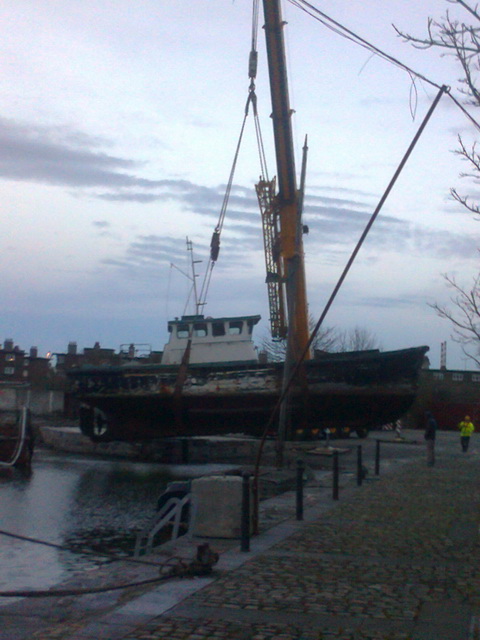
Being lifted
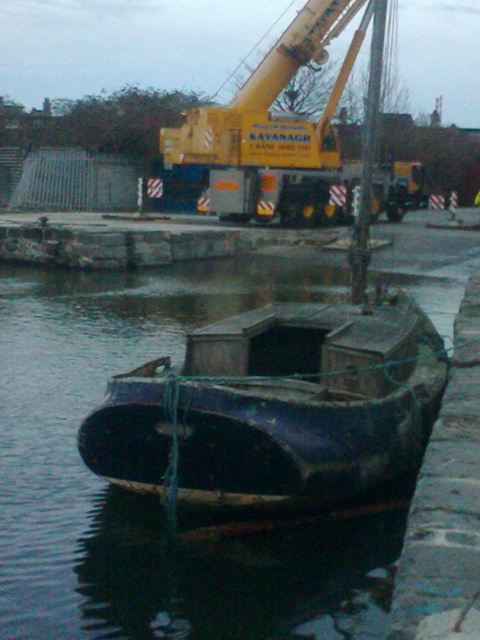
Getting ready
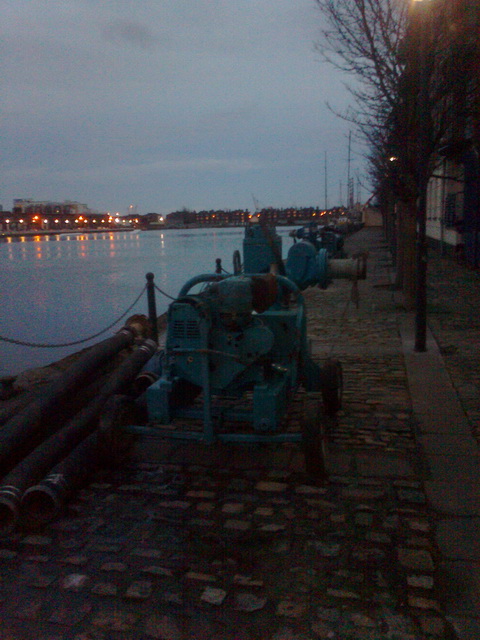
Pumps on the quay
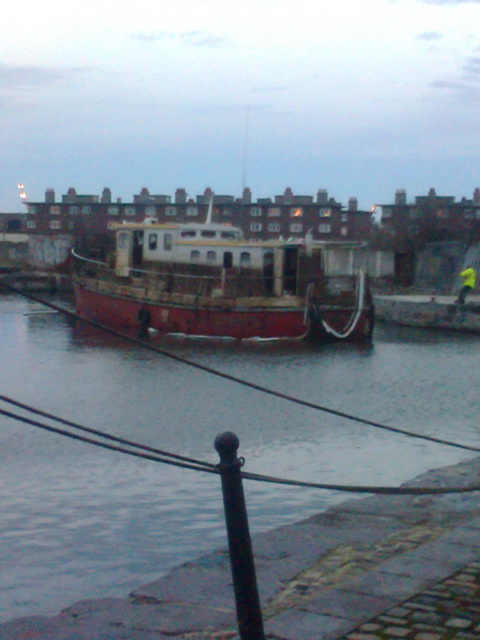
Ready for the slings
Thanks to Paul Quinn for the information and photos.
Posted in Ashore, Economic activities, Engineering and construction, Extant waterways, Ireland, Irish inland waterways vessels, Operations, waterways, Waterways management
Tagged barge, basin, boats, canal, Charlotte Quay, crane, Dublin, Grand Canal, Grand Canal Dock, Ireland, lift, lock, Operations, Ringsend, vessels, waterways, Waterways Ireland
Asking questions
It is always pleasing to learn that powerful folk take an interest in the humble pleasures of the proletariat. Thus, back in 2003, many a plebeian heart leapt with joy on learning that Tha Lord Laird o Artigarvan [as we say in Ulster Scots] was asking questions of Her Majesty’s Government in the House of Lords about Waterways Ireland developments on the River Shannon at Limerick, Boyle, Ballinasloe, Ballyleague, Shannonbridge and Scarriff.
Alas, it seems that Tha Lord Laird, who once had the highest expenses in Their Noble Lordships’ House, may not be asking questions in the House of Lords for some time. He resigned the Unionist whip in June; it appears that he may now be suspended from the House of Lords, whose members he esteems. It really take the biscuit.
 Irish waterways history