Category Archives: Operations

Muffins

I gather that there is, nowadays, a demand for muffins. I’ll bet they’re not advertised as elegantly as were Murphy’s Muffins in the Freeman’s Journal of 22 April 1845.

===========================================

MUFFINS — MUFFINS — MUFFINS

THESE DELECTABLE APPENDAGES to the TEA-TABLE can be had, fresh every day, at 10d per dozen at MURPHY’S BELFAST CONFECTIONARY HOUSE, 157, CAPEL STREET, and 68, DAME-STREET.

NB — MURPHY’s ONLY are GENUINE.

‘Tis custom now, at close of day,
Before the hour of nine,
To take a cup of Congou tea,
With MURPHY’S MUFFINS fine.
His Muffins are both pure and sweet,
At morning, noon and even,
And they are bought in CAPEL-street,
At number ONE-FIVE-SEVEN.
‘Tis pleasure’s task, through time’s career,
To give a zest to life —
The young and innocent to cheer,
The unmarried maid, and wife;
And to enjoy this pleasant treat,
These MUFFINS pure are given,
In MURPHY’s shop, in CAPEL-STREET,
At number ONE-FIVE-SEVEN.
To invalids, whose ailing hours
Bid appetite be still,
The MUFFINS have the happy powers
To meet their anxious will.
And ladies fair, whose tempers sweet
Make earth itself a heaven,
Are pleased to visit CAPEL-street,
At number ONE-FIVE-SEVEN.

157, Capel-street, April 8th, 1845.

===========================================

The compulsory waterways link? Oh, er …. Perhaps this to this.
 

For spatial cadets

Last August I wrote:

Even the misbegotten excuse for a government that published the spatial strategy didn’t take it seriously, so I doubt if it counts for much these days.

I see that Their Current Majesties agree with me and have decided to abolish the thing: the NatSpatStrat will be no more.

Unfortunately Phil Hogan intends to devise a replacement.

Alas, no more!

I can find no additions to the list of Shannon-based holders of licences to sell marked fuel. Could it be that there is some delay in processing the applications of, for instance, some hire firms and marinas? As it stands, only three sellers are listed as being licensed, at Killinure, Lanesborough and Rooskey; the rest of the Shannon has no licensed traders.

The glory that was Greese

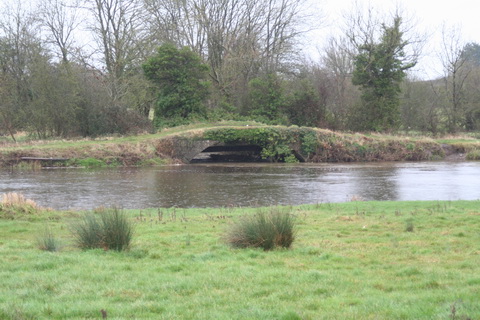
The River Greese is a tributary of the River Barrow, joining it below Maganey Lock. The photo is taken from the road on the west bank of the Barrow.

River Greese joins the Barrow 01_resize

The Greese joins the Barrow: the trackway passes over it on a bridge

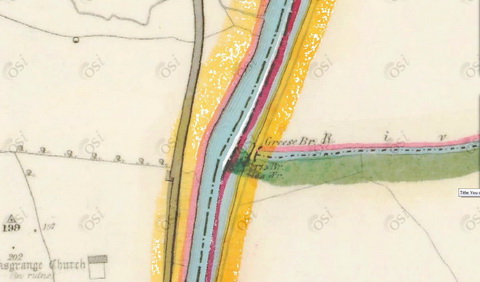
You can locate it on the OSI map by zooming out from here; the extract below shows the confluence.

Greese_resize

The confluence

My OSI logo and permit number for website

The dangers of canal bridges …

… to Her Majesty’s mails.

Lismore to Fermoy

A meeting was held in Fermoy in 1844 to promote a proposal to make the Blackwater navigable from Lismore upstream to Fermoy. Here is the Cork Examiner‘s account of the meeting.

Fermoy railway station opened in 1860.

Sarah Kelly and the Royal Canal

Quite the most remarkable story I’ve come across about the Royal Canal and the Midland Great Western Railway ….

Big it up for Hanley’s Marina

Yes, folks: the high point of your week — the inspection of the updated list of holders of Marked Fuel Trader’s Licences [.xls] — will be even more exciting this week, with a 50% increase in the number of traders licensed to sell green diesel along the Shannon. Welcome Hanley’s Marina at Ballyleague, Lanesborough, to the fold: there are now three places on the Shannon where you can buy green diesel.

Mind you, there are still none south of Killinure, none in Carrick-on-Shannon, none on the [RoI] Erne ….

Flagging enthusiasm

Not a lot of people know that. But I am delighted that, thanks to the inimitable Póló, I now do. This opens up whole new conversational realms for interesting discussions at parties.

And if that topic flags, as it were, I can fall back on reciting the list of holders of Marked Fuel Trader’s Licences, which accountants find so interesting.

Henn, cheese, pickles and Guinness

An Affecting Charge

The following case lately came for trial before Mr Henn QC, the new Recorder of Galway:— George Hamilton, who for twenty-five years had been in the employment of the Midland Great Western Railway Company as station-master, was indicted for stealing from a hamper some goods, the property of Sir Arthur Guinness, which were addressed to Cong, in the county Mayo. For some time a course of pilfering had been carried on, and the directors, in order to find out who were the guilty parties, employed two Dublin detectives, named Stookman and Healy, who arrived in Galway on Aug 31st, and, concealing themselves in the goods-store in empty barrels, remained on the watch all night. About one o’clock next morning they heard a noise, and observed the prisoner entering the place. Having satisfied himself that he was unseen, he took out his penknife and proceeded deliberately to cut the cords of the hamper and extract some of its contents. The detectives waited until he had taken out a bottle of vinegar, a bottle of pickles, and some cheeses, and then tied up the hamper again. They then issued from their hiding-place and seized him. He begged them for God’s sake to have mercy on his wife and family, and to leave the matter between himself and the manager, but they refused to do so, and, having called the police, gave him into custody. About twenty witnesses were examined for the prosecution, and among them the clerk of the goods store, who swore that it had been locked and the key left with the prisoner.

Mr M’Laughlin QC appealed to the sympathies of the jury, and, pointing out some alleged discrepancies in the evidence, pressed them, if they had a doubt that the prisoner took the articles with a guilty intent, to give him the benefit of it.

The Recorder, in his charge, showed that the discrepancies only proved the truth of the charge, and expressed the deep pain he felt at seeing in such a position a man who had held a respectable position, with a salary of £300 a year, and had young ladies whom he saw in court dependent upon him. He finally burst into tears.

The jury retired, and after three hours’ deliberation returned into court and stated that there was no chance of an agreement. His worship sent them back to their room, and, after being absent for another hour, they brought in a verdict of not guilty, which the Recorder stated he could not endorse, but characterised as monstrous.

The Leeds Times 12 October 1878

The Recorder, Mr Henn, was the father of T R Henn and later lived in Paradise. Sir Arthur Guinness, a stout fellow, was a descendant of this chap and had a small holiday house at Cong on Lough Corrib, where his family had many boats.