Category Archives: Restoration and rebuilding

Dialogue

Some time ago I noted that Waterways Ireland was now down wid da kidz in da hood, doing groovy things like social meeja with a Youtube thingie. It features (inter alia) a flight in a helicopter gunship along a restored Clones Sheugh. At least, that’s what I presume was going on, although I couldn’t work out how to fire the rockets at the suspiciously large number of narrowboats found along the way. The scenic highlight of the journey was Clones.

There’s also a Facebook page, from which I learned that there is now a skippered boat available for hire on the Barrow. And there is a Twitter whatsit, which does two interesting things.

First, it has summaries of marine notices, which will be useful to those cruising on the waterways without internet access.

Second, it shows signs of WI’s engaging in public dialogue with users, even when their comments might be critical. This is very welcome; it will be interesting to see the extent to which such public dialogue is permitted to develop.


Bock goes boating …

… on the Shannon Estuary, the second most interesting coast of Clare (the inland coast is the most interesting, the north-west coast the least). Includes nice pics of the Scattery battery.

The Washington gandalow

See here.

Argent Brach

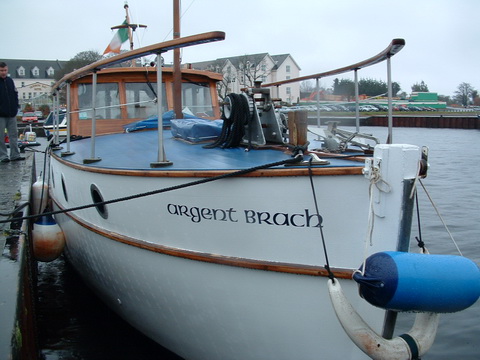
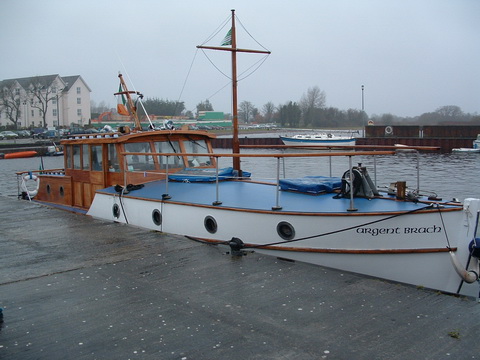
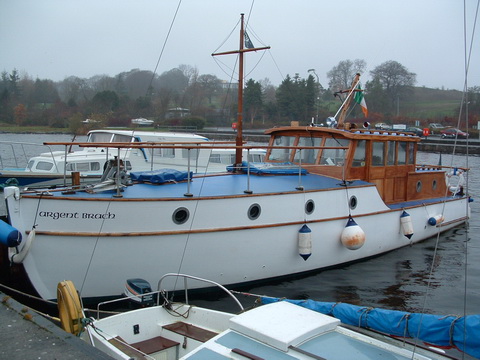
Michael Gill, who owned Argent Brach until 1981, has kindly given me three photos of the boat which he took at Hodson Bay in 2004. The boat has now been reborn as Derrvea; there are photos of her on this page and I have added Michael’s photos just beneath. However, to save you the effort of searching, I reproduce them here.

Argent Brach at Hodson Bay 2004 (Michael Gill) 03_resize

Argent Brach at Hodson Bay 2004 1 (Michael Gill)

Argent Brach at Hodson Bay 2004 (Michael Gill) 02_resize

Argent Brach at Hodson Bay 2004 2 (Michael Gill)

Argent Brach at Hodson Bay 2004 (Michael Gill) 01_resize

Argent Brach at Hodson Bay 2004 3 (Michael Gill)


The mysterious Pill

Some questions and speculations about trade on St John’s Pill in Waterford.

The Ulster Orangeway

I am happy to say that the ineffable Professor Billy McWilliams [Visitin’ Lekturer at the Ulster Scots School o’ Dancin’, Ballymena] has provided the answer to one of WI’s problems. I have pointed out that a walking route along the Clones Sheugh would be much cheaper than a restored canal; Professor McWilliams has shown how to make such a route more attractive to members of the Ulster-Scots Community. WI could adopt his idea from Comber and declare the route to be the Ulster Orangeway.

The decreasing importance of cruising

I wrote here about the continuing decline in the numbers of boats recorded as passing through locks (and moveable bridges) on the Shannon. For the first five months of the year, the total number of recorded passages was jusst over half what it was in 2003. Maybe the current hot weather will increase the numbers, but the long-term trend has been downward for ten years, despite a Celtic-Tiger-inspired spike in usage by private boats.

I don’t know to what extent that decline affects Waterways Ireland’s policy-making. Are the hundreds of economists, marketing gurus, MBAs and other high-powered bods in WI’s marketing department engaged in a major search for new and profitable markets? Certainly its sponsorship programme [can’t find info on the WI website], its lists of events and its descriptions of activities are much broader in scope than mere boating, and even within that category small-boat activities are prominent.

WI is cooperating with other official bodies in developing walking [h/t Industrial Heritage Ireland] and cycling routes [h/t KildareStreet] and. with the Irish Sports Council and Irish Leisure Consultants, it has recently published A Guide to Planning and Developing Small Vessel Water Trails in Ireland [PDF]. WI does not, as far as I know, have a strategy for promoting increasing use of its waterways by cruising boats (private or hired), although I’d be happy to be corrected about that if I’m wrong.

All of this is good stuff, and I’m all in favour of widening the, er, user base (apart from those events for which people dress in fluorescent underwear and run around the streets: I share the late Mrs Patrick Campbell’s concern for the horses).

But three points strike me. The first is that the older waterways businesses — hotel boats, hire firms, marinas — involved capital investment and created reasonable numbers of jobs. I do not know whether Waterways Ireland measures employment, or other economic benefits, as an output of its sponsorship, marketing and organisational activities but it seems to me that it would be nice if it were able to show that the benefits outweigh the costs. It would also be interesting to know to what extent the newer activities can profitably attract tourists from overseas: with the water trails, for instance, is it possible for anyone to make a profitable business out of overseas visitors, given the costs of marketing and selling, or are these trails purely for the domestic market?

The second point is that one sector, that of professional event organisers, may indeed be benefiting from WI’s support. But if that disempowers local or voluntary groups, renders them unable to run events without professional assistance or makes the cost of doing so too high, it may not be an unmixed blessing.

The third is that there is a representative body for owners of inland cruising boats, but these new activities do not have inland-waterway-specific user bodies (if they have user bodies at all). That, I think, must make for a different type of relationship between the service provider, Waterways Ireland, and the users: most inland cruiser owners have nowhere else to go, but canoeists or anglers or walkers can easily switch to the sea or to non-WI inland waters, so WI has to compete for their custom.

This piece is written not to provide answers but to ask some questions.



The Exchequer Bill Loan Commission

I noted the other day that the North South Ministerial Council’s inland waterways meeting discussed how it might get the Irish government off the hook of its rash promise to fund the Clones Sheugh. It noted that:

[…] sponsor departments have agreed to examine the potential social benefits and leveraged funding opportunities in that context.

The interesting point is that the blasted thing wonderful investment opportunity was originally funded, using the same excuse, by a loan from the Exchequer Bill Loan Commission set up under the Poor Employment Act 1817. John Strettell Brickwood, Secretary to the Exchequer Loan Commissioners for Public Works [sic], said* that the Commission’s first £1.5 million was allocated in 1817 and that by 1835 £5.5 million had been advanced.

Of that, £200,000 (at 3¼% interest) was allocated to Ireland in 1827 and the Ulster Canal was allocated £120,000 of that; it drew down £40,000 in 1833 and the same again in 1835. Mr Blackwood said that the Ulster Canal money was issued under an express act of parliament, leaving the commissioners no discretion. There would be no repayment until the canal was complete, with the interest and principal payable only from the prospective income.

Isn’t economic development wonderful?

First and Second Reports from the Select Committee appointed to inquire into the amount of advances made by the Commissioners of Public Works in Ireland with the Minutes of Evidence, Appendix and Index Ordered, by the House of Commons, to be Printed, 26 June and 27 August 1835


Not Grand

Limerick’s SmarterTravel initiative aims to promote cycling, walking, car sharing and public transport. It has a little leaflet (I can’t find a downloadable version) describing five walking and cycling routes and including information on bus routes, a cycle to work scheme and car sharing.

One of the cycling and walking routes is along the towing path of the Limerick Navigation from Limerick to Plassey. It is described thus:

The Tow Path was part of the Grand Canal system stretching to Dublin and was used by the Guinness brewery to bring stout to Limerick.

The towing-path was not part of “the Grand Canal system”, although I suppose it might be described as a facility used by the Grand Canal Company. The Park Canal in Limerick, and the towing-path on the river navigation to Plassey, were not built or owned by the Grand Canal Company; they were part of the independent Limerick Navigation until subsumed into the Shannon Navigation in the 1840s. The Grand Canal Company was permitted to use its vessels on the navigation when it began carrying cargoes, which it did for, amongst others, Guinness; Guinness itself did not own or operate boats on the Shannon Navigation or the Limerick Navigation.


News from the NSMC

The communiqué from the North South Ministerial Council inland waterways meeting held on 19 June 2013 is here. This is my selection of the interesting bits.

The NSMC got reports on WI’s additional moorings (368m during some unspecified period), sponsorship programme, maintenance (“with 99.8% of waterways remaining open during the month of April”), publications (food guide and What’s On 2013) and website.

The WI business plan for 2012 was approved, which seems a bit pointless in the middle of 2013. A budget of €31.15m (£27.10m) was approved for an unspecified year. Then there’s this oddity:

5. They also noted progress on the development of the 2013 Business Plan and budget. Following approval by Sponsor Departments and Finance Ministers the plan will be brought forward for approval at a future NSMC meeting.

This is the middle of 2013. The next NSMC inland waterways meeting will be held in September 2013. What is the point of approving the budget and business plan for 2013 three quarters of the way through the year?

And another point: why is it taking so long? My guess is that, if things were running smoothly, and allocations were easy, the work would have been finished by now, so I deduce that WI’s budget is under pressure, with consequences for its future activity and thus its business plan.

The NSMC “noted” WI’s annual report and draft accounts for 2012; they’re not on its website, so presumably someone else has to note them as well before they can be published.

The unfortunate Bastables seeking treasure to pay for the Clones Sheugh had their second meeting in May 2013 (their first was in September 2012). In the absence of any GB, and with half-sovereigns rather scarce, the Bastables have adopted the “Lo! the poor Indian” strategy:

[…] sponsor departments have agreed to examine the potential social benefits and leveraged funding opportunities in that context.

The NSMC decided that Waterways Ireland won’t have a Board but will think about governance again some time. And it appointed Dawn Livingstone as WI CEO.