Category Archives: shannon estuary

Where is this?

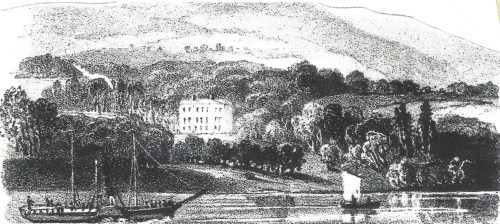
Paul Gauci's 1831 drawing of a Shannon steamer

Paul Gauci’s 1831 drawing of a Shannon steamer

This drawing of a steamer is from an 1831 book called Select Views of Lough Derg and the River Shannon by Paul Gauci. I haven’t seen the book myself, but this illustration is used in a couple of places, including Ruth Delany’s book The Shannon Navigation [The Lilliput Press Ltd, Dublin 2008]. Andrew Bowcock, in his article “Early iron ships on the River Shannon” in The Mariner’s Mirror Vol 92 No 3 August 2006, says of the steamer shown that

The funnel looks to be almost over the paddle shaft, which is artistic license.

But my question is not about the vessel but about the house in the background. If it is drawn without artistic licence, where is it?

It is a very large house, seven bays by three storeys, quite close to the water. Using the Historic 6″ Ordnance Survey map [~1840], I have followed the banks of the Shannon from Shannon Harbour down Lough Derg to Killaloe, then from Limerick down the estuary as far as Tarbert, across the estuary to Doonaha and back up on the Clare side to Limerick, then from Killaloe up the Clare and Galway shores back to Shannon Harbour. Anywhere I found a large house within what seemed the right distance of the shore, I looked it up in the Landed Estates Database and in the National Inventory of Architectural Heritage, with some supplementary googling.

I haven’t been able to find images of all the houses marked on the OSI map, but I found enough to show that houses of the size shown by Gauci were very rare. Within those few, I ruled out some (like Tervoe) because they didn’t seem to match Gauci’s drawing (although alterations could have accounted for that). I ended up with only one house that looked at all like Gauci’s, but the background may not match.

If you can identify the house, I would be glad if you could leave a Comment below.
Dick Gaughan and John Grantham …

… both had an interest in Erin-go-Bragh,

Ballycorick

I’ve updated my page on Ballycorick to take account of information provided in a Comment by Kenin Murphy, to whom I am grateful.

From Kilrush to Carlingford …

ferry interesting news.

SESIFP

Read about the draft Strategic Integrated Framework Plan (SIFP) for the Shannon Estuary here. You can comment on it up to 15 February 2013.

A gratifying display of loyalty

His Excellency the Lord Lieutenant took a trip on the Shannon Estuary in July 1856 on the City of Dublin Steam Packet Company’s vessel Erin-go-Bragh. He was greeted by demonstrations of loyalty from the populace, had dejeuner on board off Scattery Island and heard an address from the proprietary, clergymen, merchants, traders and inhabitants of Kilrush, read to him by Colonel Vandeleur. Here is the Freeman’s Journal‘s account of the trip.

A Limerick/Shannon website

A new-ish site and project here.

The end of a ghost

In the UK, the Statute Law Repeals Bill is working its way through the House of Lords. You can download a PDF list of the bills being repealed. In amongst the turnpikes, Indian railways, benevolent institutions and lotteries, we find Part 4: Ireland (Dublin City). Within that, Group 1 sees the repeal of these statutes:

  • 3 & 4 Will.4 c.cxv (1833) (City of Dublin Steam Packet Company Act)
  • 6 & 7 Will.4 c.c (1836) (Dublin Steam Packet Act)
  • City of Dublin Steam Packet Company’s Act 1860 (23 & 24 Vict. c.xcviii)
  • City of Dublin Steam Packet Company’s (Consolidation of Shares) Act 1861 (24 & 25 Vict. c.iii)
  • City of Dublin Steam Packet Company’s Act 1868 (31 & 32 Vict. c.xxx)
  • City of Dublin Steam Packet Company’s Act 1876 (39 & 40 Vict. c.xi)
  • City of Dublin Steam Packet Company’s Act 1884 (47 & 48 Vict. c.cxxx)
  • City of Dublin Steam Packet Company’s Act 1895 (58 & 59 Vict. c.cxxiii)
  • City of Dublin Steam Packet Company’s Act 1910 (10 Edw.7 & 1 Geo.5 c.vii)
  • City of Dublin Steam Packet Company’s Act 1916 (6 & 7 Geo.5 c.viii)
  • City of Dublin Steam Packet Company’s Act 1920 (10 & 11 Geo.5 c.i).

In a Consultation Paper published in 2008, the Law Commission explained:

The City of Dublin Steam Packet Company was founded by Charles Wye Williams in 1822. From 24 January 1839, the Post Office contracted the company to run the mail service from Dublin to Holyhead. This service was later extended such that the company ran both the day and night service.

During the First World War the company suffered heavy losses, including the sinking of its ship the R.M.S. Leinster by a German submarine on 10 October 1918, resulting in a loss of over 500 lives. A further two ships were sunk during this period. The company never fully recovered from its wartime losses and, in 1924, an order for the winding-up of the City of Dublin Steam Packet Company
was petitioned for and granted by the High Court at Dublin Castle.

In Ireland, the Statute Law Revision Act 2009 repealed the 1833 and 1836 Acts and the Statute Law Revision Act 2012 repealed all the rest — except the 1895 Act. I don’t know where to get a copy of that Act, so I don’t know why it was specifically retained. But, with that exception, it seems that the ghost of the CoDSPCo has been laid to rest.


Theatre steam

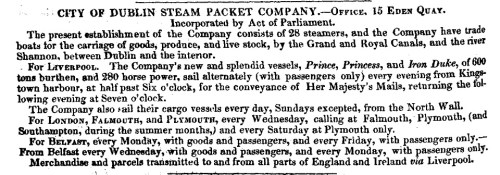
The Abbey Theatre has announced that it has bought Nos 15–17 Eden Quay, Dublin 1. No 15 was the address of the main offices of the City of Dublin Steam Packet Company.

From the Dublin Almanac of 1845

The company crest is said to be still on the wall. Abbey Street Old seems to run between the two premises; no doubt there will be some means of avoiding any problem.

I wish the Abbey Theatre well in its extension, but I hope it will find some way of honouring the memory of the City of Dublin Steam Packet Company and of the underrecognised Charles Wye Williams.

Wordling Repeal

On 22 April 1834 Daniel O’Connell, MP for Dublin but a native of Kerry, argued in the House of Commons at Westminster for, IIRC, five hours in favour of the repeal of the Act of Union. Here is what Wordle makes of his speech.

Daniel O’Connell Wordled

On the following day Thomas Spring-Rice, MP for Cambridge but a native of Limerick, responded for six hours. Here is what Wordle made of it.

Thomas Spring-Rice Wordled