Category Archives: Tourism

Outbreak of sanity in Co Westmeath

Our big thing is to link the Galway Dublin cycleway into Kilbeggan and along the stretch of the old canal to Ballycommon. That’s around a million euro project and the biggest thing in our Vision for Kilbeggan plan.

Thus Dan Scally of Renew Kilbeggan in the Westmeath Examiner.

Canals conference 7 March 2015

Information posted at the request of the organisers


Inland Navigations of Ireland Historical Society
in partnership with
The Heritage Boat Association

The Canals of Ireland

Saturday 7 March 2015

Hugh Lynch’s Function Room, Tullamore, Co Offaly

Programme

Memorial Slides Conor Nolan 09.30
Welcome Gerard Bayly 09.55
Session 1 Chairperson Judie Lambert
The Canals of Europe Mike & Rosaleen Miller 10.00
The Canals of Ireland Colin Becker 10.20
Coffee break 10.40
Saving the Royal Niall Galway 11.00
Fighting for the Grand Mick Kinahan 11.20
Living on a Canal Eric Kemp 11.40
Morning Question Time 12.00
Lunch break 12.30
Session 2 Chairperson Kristina Baker Kenny
Newry Canal Geraldine Foley 13.30
Limerick Navigation Raymie O’Halloran 13.50
John’s River Brian Simpson 14.10
Grand Canal Kilbeggan Branch James Scully 14.30
Boyne Navigation Seamus Costello 14.50
Coffee break 15.10
The Future Joe Treacy 15.25
The Future Brian J Goggin 15.45
The Future Nigel Russell 16.05
Evening Question Time 16.25


Details

Admission:                          €12
Breaks:                                Tea/coffee included
Lunch in room:                   Soup and sandwiches included
Music:                                 Live music session during lunch
HBA:                                   Merchandise for sale
IWAI:                                  Merchandise for sale
Authors:                              Books for sale

Directions

Hugh Lynch’s Pub, Kilbride Street, Tullamore, Co. Offaly

087 250 5422


Irish GIS data

Not good enough, it seems: the Ardnacrusha headrace and tailrace are missing.

Killaloe Regatta

If you enjoyed the account of the 1851 cot race at Plassey, you might also like to read about the 1850 regatta at Killaloe.

The contagious cargo cult

Readers will be saddened to learn that Ireland’s cargo cult, the delusion that canals bring prosperity, is spreading. It may even be that an increasing frequency of political references to Saunderson’s [né the Clones] Sheugh means that the devotees are about to engage in sympathetic magic by attempting to dig a sheugh.

The sheugh was mentioned in both legislative assemblies on the island on 20 January 2015. In Dublin, Gerry Adams [SF, Louth] said:

I remind the House that the peace process is the most important political project on this island at this time and it needs to be nurtured, protected and enhanced. It must be at the top of the Government’s agenda alongside other priorities.

I wonder how many priorities can dance on the head of an agenda ….

I welcome the financial commitments that have been made, including €25 million in annual funding for the A5 road project, which will assist people in Tír Chonaill, Derry, Fermanagh and Tyrone. I welcome additional funding for reconciliation under the European Union’s PEACE and INTERREG programmes and the Government’s renewed commitment to the Narrow Water bridge and Ulster Canal projects. These are important developments which need to be delivered.

If the Shinners are going to prioritise such nitwitted public spending projects, Goldman Sachs will never allow them into government [assuming that Goldman Sachs cares what happens in Ireland, which they might not, pace Peter Sutherland]. Nobody else mentioned the sheugh in that debate, but several Norn Iron politicos seem to have succumbed to the delusion. They had a debate on “Ulster Canal: Tourism Benefits“, which is like having a debate about the nature of unicorn excrement without first checking to see whether unicorns exist.

Note, in what follows, the complete absence of any quantification of benefits, with only a single mention of costs and with an unwavering belief that canals bring prosperity, even if they lack any interesting features (apart from the engine shed in Clones). There is no attempt at identifying why tourists would be attracted to the sheugh, no discussion of the mechanism by which public spending is translated into tourism revenue and then into local or national benefit.

Not that southern politicians are any better, of course.

Anyway, back to the NI Assembly. Sean Lynch [SF] “asked the Minister of Enterprise, Trade and Investment for her assessment of the potential tourism benefits of re-opening the Ulster canal”. Note that he didn’t say how much of the canal he wanted.

Arlene Foster [DUP] [for it was she] said

The waterways of Northern Ireland have the potential to become an integral part of the tourism experience in Northern Ireland. The proposed Ulster canal development could provide opportunities for canal boating as well as supporting infrastructure to support walking and cycling, all of which would benefit our visitors and the local area.

All of which is waffle. She provided no assessment.

Although the project is being led by DCAL, the Northern Ireland Tourist Board (NITB) continues to work with the Ulster canal inter-agency group through the Destination Fermanagh steering group and with the Clones Erne East Blackwater project to try to maximise the tourism benefit that this project could bring.

Nice to hear that the treasure-seekers, the “inter-agency group”, still exist. I wonder what they do.

So far, Arlene seems to be sticking to her script and hasn’t given much away: the sheugh could do this, that or the other, but there’s nothing concrete. But Mr Lynch asks a follow-up question:

I thank the Minister for her somewhat encouraging answer. Does she agree that, because the canal goes through Monaghan, Fermanagh, Cavan and Tyrone, both tourism boards on the island of Ireland should work closely together to ensure that it is a success?

If it were worth doing, why would the tourism boards have to “work closely together”? Would not hundreds of thousands of foreigners, from lands without canals, come flocking to the sheugh and to the irresistible attractions of Clones? What more could the tourism boards do to sell the thing? “Visit a short canal in the middle of nowhere leading to Clones”?

Mr Lynch may just have been trying to trap Ms Foster into agreeing to some tourism crossborderality. But she seems to have been doing a bit of crossborderality of her own:

The TD for Cavan-Monaghan, Heather Humphreys, has taken a particular interest in the matter, as you would imagine. It is in part of her constituency, as it is in part of ours; therefore, she is keen to move the project forward. When I last spoke to her, she again mentioned the need to push ahead on the Ulster canal.

Oh dear.

So, I think, generally, there is support for the project. I suppose that the big challenge for us all is funding. The Northern Ireland Tourist Board — or Tourism Northern Ireland, as we should now call it — will work with its counterparts to assist and make sure that all the tourism benefits are put into any business case that is put forward.

When ministers are asked questions by members of their own parties, I wonder whether the questions were arranged beforehand in order to allow the ministers to make certain points.

William Humphrey [DUP] said “The Minister is quite right that the primary responsibility lies with the Department of Culture, Arts and Leisure.” The minister knew that already. But then he asked two questions. The first was:

Is Fermanagh District Council taking a collaborative approach to the cross-border element?

That might be intended to sell the prospect of further local government crossborderality to DUP supporters. The minister answered:

As I understand it, Fermanagh District Council is part of the Clones Erne East partnership, which seems to be driving this initiative. Of course, the Erne East councillors will be part of that partnership.

Humphrey’s second question, which elicited an interesting answer, was:

Obviously, in the current economic climate, budgets are tight. Has the Department looked at the possibility of funding from the European Union, given that it is a cross-border venture?

Ms Foster said

I simply do not know is the answer, because DCAL leads on this issue. However, I do know, and I have been advised, that some €54 million would be needed to secure the project to get it completed within 21 to 24 months. It is a large sum of money. If there are options to look elsewhere for funding, we would of course be supportive of them being explored.

Now, what is that €54 million for? Irish ministers have been quoting a figure of €35 million for years, even after 2011 when I was given a revised estimate of €45 million [overview of the history here]. That was to get to Clones. Is Clones now to cost €54 million? Or is that to Castle Saunderson? Or to Lough Neagh? Probably not the last. Note that these cost increases have come even before anybody starts digging anything.

Why does Clones deserve €54 million? Its population seems to be slightly below 3000; why not give every man, woman and child €15,000 each to forget about the sheugh, thereby saving €9 million?

Back to the Assembly. Basil McCrea [UUP], who may be the most sensible MLA, suggested, as he has suggested before, that users of inland waterways pay “for example, through a boat tax” something towards the cost of the waterways “provided that the money is used specifically for enhancing inland waterways?” Ms Foster said that was not her business and added

I want to encourage more people to come and use the inland waterways. Of course, I want them to use Lough Neagh and Lough Erne in particular.

I wonder why she omitted the Lower Bann, the Shannon–Erne Waterway and the various derelict navigations — including Saunderson’s Sheugh.



Plassey in 1851

Plassey August 2010 37_resize

Free the Black Bridge

Here is a page about a cot race at Plassey in 1851.


Work in a box in the docks

Waterways Ireland wants a manager (one-year contract) for its visitor centre in Dublin, aka the Box in the Docks.

The Holy Island ferry

After opening Lough Derg, we passed by Holy Island, with its ruins and round tower looming in the distance. The island contains about twenty acres, and so valuable are the feed derivable from the host of penitents who repair to do their stations on the Holy Isle, that the ferry, between it and the main, is rented for a considerable annual sum.

JK [Sir James Emerson Tennent Bart]Letters to the North, from a Traveller in the South Hodgson, Belfast; Milliken and Son, Dublin 1837

Two Limerick footbridges

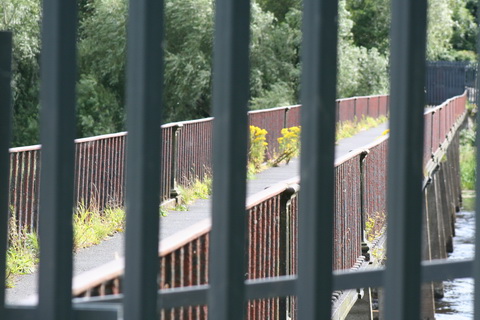
The Black Bridge at Plassey has long had a place in the hearts of Limerick people. It was damaged in the floods of 2009 and has been closed to the public ever since. Limerick Council says it can’t afford to repair it. Limerick Council is, as far as I can see, in breach of the terms of its lease of the bridge from the Department of Finance; the Department of Finance could, but has chosen not to, insist that the Council repair the bridge.

In the meantime, the Minister for Finance, for reasons best known to himself, wants a new, er, iconic footbridge in Limerick city and is prepared to spend €6 million of taxpayers’ money, via Fáilte Ireland, on a structure that can scarcely avoid blocking some of the finest views in the city.

Now, the Limerick Leader tells us, the ghastly edifice is to cost almost €18 million: €6 million from the Minister for Finance (who represents Limerick), €4 million to be borrowed and €7.8 million from the leprechauns’ pot of gold under the thorn bush. Or somewhere. Even Fianna Fáil councillors think this is insane, which is saying something.

This ridiculous proposal should be abandoned immediately and a much smaller sum should be spent instead on repairing the Black Bridge as part of a European Route of Industrial Heritage.

The Minister’s €6 million is a gift-horse that should not only have its teeth inspected: it should be taken out and shot and its carcass sent to the burger factory.

Greyways and the Black Bridge

Martin McGuinness [SF] was asked recently, in the Northern Ireland Assembly, about blueways:

Leslie Cree [UUP]: It was interesting to read that Waterways Ireland has developed this first blueway in the Carrick-on-Shannon area. Can he share with us if, in fact, Waterways Ireland has developed any projects for the Erne waterway itself?

Mr McGuinness said:

These projects are under ongoing consideration by Waterways Ireland, as the development of blueways and greenways could add to our tourist potential. It is clear from how greenways have been used, particularly in the west of Ireland, that they have huge health benefits for those now walking and cycling and involved in physical activity.

There is a proposal for another greenway from Derry city to County Donegal. Blueways and greenways offer important tourist potential, and it is exciting to see that Waterways Ireland is considering the linkage in the Leitrim area and how it can be extended to Lough Erne.

But, if I might remind TPTB, not everybody likes walking, cycling and physical activity; not everybody is going to be rolling around in a kayak or paddling a canoe. There are older folk, there are those who rightly view exercise with the gravest of suspicion and there are those whose interests simply lie elsewhere.

The Greyway concept

It is for such folk that I have developed the Greyway [TM]  concept. It’s the same as a blueway or a greenway but without the sweating or the lurid dayglo clothing.

The basic idea is that you form a “route” or “way” as a marketing concept to get more people using your existing assets. Your expenditure is low: research, product development, marketing and information provision rather than infrastructure; self-guided rather than staffed user experiences. Direct income might be low too, although there may be ways to extract cash from users; there might also be spin-off opportunities for other providers. [All my usual reservations about small-scale providers apply here too.]

There might be Greyways catering for

  • walkers: gentle walks with opportunities for sitting down, drinking tea and getting a taxi back to the start
  • drivers: long-distance routes taking in several sites
  • boaters: most of Waterways Ireland’s sites are accessible by water and by road. Furthermore, some trip boats might use elements of the Greyway material in providing information for their passengers.

Themes

You need a theme to attract people: “come and walk/drive the X Greyway and see all the lovely/interesting Ys”. No doubt there are several possible values for Y: bunnies, trees, fish, bogs, hills …. But the main thing that Waterways Ireland has to sell, and that it does not currently sell, is its industrial heritage. The Shannon, in particular, exists as an improved navigation only because of (a) steam, (b) the British industrial revolution, (c) Irish agriculture and (d) low politics. And industrial heritage is something that interests some at least of the older folk. Package it into routes and sell it for grey pounds, euros or dollars.

There is all sorts of interesting stuff along the Shannon, mostly just lying there, and it should be put to work. The most concentrated section is along the old Limerick Navigation, from Limerick to Killaloe: for instance, last time I looked seven of the original twelve milestones were still present. [The distance was 12 Irish miles, approx 24 km or 15 statute miles.] It’s a walkable route and it includes

  • the neglected Black Bridge at Plassey, whose very existence reflects the Victorian version of Just-in-time delivery
  • the bridge and artefacts at O’Briensbridge
  • the richest waterways heritage site in Ireland at Killaloe.

But there could also be driving tours along the middle Shannon, between Portumna and Athlone, where there is lots to see, and from Lanesborough upwards. Shannon Harbour might eventually house a museum ….

ERIH

What I’m suggesting is that Waterways Ireland should designate the Shannon as the first route (as opposed to site) in Ireland within the European Route of Industrial Heritage [ERIH] framework. ERIH’s website includes descriptions of the route system and of anchor points, which may be too advanced for present use, but why not a European Theme Route in Transport and Communication? Ireland might even make a case for the use of advanced (or at least interesting) transport technology (steamers) in carrying agricultural produce to industrial markets.

Furthermore, if CIE were to cooperate, the railways might be brought in too, and the livestock trade, and Dublin Port, and a regional route linking to Liverpool and the railway to Manchester ….

There is an interesting story to be told about the Shannon and its links to the east coast and beyond; its industrial heritage could be used to attract tourists and entertain natives.