Category Archives: Tourism

Shannon Castle Line

On 1 April 1976 the business name Shannon Castle Line was registered. Its address was Williamstown Harbour, Whitegate, Co Clare. The business number was 57837.

On 6 July 1999 a statement of particulars for the business name Shannon Castle Line was registered. The company Skyline Entertainment Limited had adopted the business name on 11 June 1999; its business was Hire of cruiser fleet.

On 25 April 2005 the business name Shannon Castle Line was registered by a company named Twinross Holdings Limited; its business was as a holding company. The company number was 299191.

On 11 April 2014 the business name Shannon Castle Line was registered by DDL Marine Limited, whose business is the renting of water transport equipment. DDL’s application to register was received by the Companies Registration Office on 7 March 2014.

All companies gave their address as Williamstown Harbour, [Whitegate,] Co Clare.

I am unable to reach the website of Shannon Castle Line, which is a member of the Irish Marine Federation.

There were once four cruiser hire firms on Lough Derg below Portumna Bridge, plus Emerald Star just above it.


DAHG’s other waterway

Yes, folks, the Waterways Ireland waterways are not the only ones that come under the scrutiny of the Department of Arts, Heritage and the Gaeltacht: the Lakes of Killarney are in there too. And the managment system was outlined in the Dáil.

If we had eggs …

… we could cook bacon and eggs, if we had bacon.

What with one thing and another, I haven’t recently been paying much attention to the campaign to keep the decayed former Aran Islands ferry Naomh Éanna from being scrapped. I gather that there is a proposal for spending €1.86 million on the vessel but I found little information online, especially about the proposed sources of capital or the expected return on investment; if the full plan is available anywhere online, I’d welcome a link.

None of the proposed onboard activities seem to require a floating home, none seems to have anything much to add to the heritage or historic value (if any) of the vessel and the only purpose of the heritage tag seems to be to enable the proposed tourism complex to get a berth from Galway Port Company. There is a cheaper floating hotel available elsewhere, which might require less expense; it could be renamed Naomh Éanna II.

I see that the fans of the existing vessel are trying to raise €15000 to have it surveyed. As far as I can gather from a Facebook page, the total raised so far is €1965: €1835 by 16 April and €139 at a beer-tasting. There seems to have been an update on 23 April but, as far as I can see, access is confined to Facebook subscribers.

Of the €1835, €500 came from the Dublin Branch of the Inland Waterways Association of Ireland. I do hope that such a donation is not ultra vires: the preservation of old seagoing vessels does not seem to be within the objectives set out in IWAI’s Memorandum of Association, at least as described under “Goals of the Inland Waterways Association of Ireland” on the IWAI website. Perhaps the page needs updating?

I note that folk have been sending in photos of and other information about the vessel. Now, my interest in this vessel is not in possible uses as a floating brewery or as a tourist attraction in Galway.

First, I want this albatross to be lifted from Waterways Ireland’s neck and, if Galway Port wants to house it, that’s fine by me, as long as they get it out of the inland waterways (and the taxpayer doesn’t have to pay for it).

Second, I want to counter the notion that, because the vessel is old, it is worth preserving. As I wrote here:

Yes, it had some interesting (if minor) historical associations, but the best way of recording them would be to write a book, or create a website, or even make a movie, about the ship’s history. Money spent that way would be a far better investment than money spent on keeping the Naomh Éanna afloat. Its heritage or historical value lies in the associated information, not in the steel.

National Historic Ships UK says:

As with all man-made structures, ships and boats were not built to last forever. However, the issue of dilapidation is especially acute for vessels. Unlike buildings, the accepted working life for most vessels is only some 30 years: they were not and still are not built for the long term. For many vessels of intrinsic historical importance, there will come a time when the cost of conserving or even simply repairing them becomes unaffordable. Unless the burden can be passed to another willing organisation, such vessels have no sustainable future.

That’s from one of the three volumes of its series Understanding Historic Vessels. The first two volumes are published as free PDF downloads from this page:

  • Recording Historic Vessels
  • Deconstructing Historic Vessels [from which I quoted].

Both are well worth reading and the first, in particular, might guide anyone who is actually interested in the heritage or historic value of the Naomh Éanna; it suggests that recording should be done before deconstruction [aka scrapping] but further information can be recorded during the latter process.

The authors suggest drawing up, for each vessel, a two-page Statement of Significance. I note that I have not seen such a statement, or any equivalent, for the Naomh Éanna, which makes me sceptical about the vessel’s value. And, using the National Historic Ships Criteria and Scoring System (which is included in both documents), I fear that the Naomh Éanna would not score highly.

I accept, though, that I do not have complete information about the vessel. It may be that some of the Naomh Éanna enthusiasts are engaged in a structured recording of information about the vessel and that they are building a case — the equivalent of a Statement of Significance — for its preservation on heritage or historic grounds. However, I haven’t yet come across their work; if it exists, I would welcome a link. As it is, though, the preservation campaign seems to me to be based more on sentiment rather than on fact or logic.

Finally, the third volume of Understanding Historic Vessels, called Conserving Historic Vessels, has now been published on dead trees and can be bought through the Royal Museums Greenwich online shop at STG £30; P&P to Ireland is STG £15. Other reference sources are listed here. And here is information about the Dunleary lifeboat.



Shannon history

The African Queen, formerly the first Shannon Princess, is up for sale.

Shannon history in Birmingham

According to the Railway & Canal Historical Society’s Events page, its annual Clinker Memorial Lecture, to be held in Birmingham in October 2014, will be about River Shannon steamers in the second quarter of the nineteenth century:

The 2014 Clinker Memorial Lecture will be held in Birmingham on the afternoon of Saturday 18th October 2014. The speaker will be Brian Goggin, BA (Mod), MA.

Brian graduated from Trinity College, Dublin in Economics and Politics, and spent some years as honorary Editor of the quarterly magazine of the Inland Waterways Association of Ireland. He and his wife Anne have been boating on Irish inland waterways since the late 1970s. He is currently working on a book on the Shannon steamers of the 1830s and 1840s, and the Clinker Lecture will draw on his research.

Before lunch (and independent of the Lecture) there will be a walking tour of central Birmingham, focusing on sites of waterway and railway interest.


WI and the canals

Three important documents [all PDFs] available for download from WI’s site:

  • Action Plan for Grand Canal Dock and Spencer Dock​ here
  • Grand Canal (rural) Product Development Study here
  • Royal Canal (rural) Product Development Study here.

These are lengthy documents [50, 177 and 175 pages respectively] and it will be some time before I can comment on them, but I welcome their publication. I also hope to be able to comment on the presentation Ireland’s Inland Waterways – Building a Tourism Destination which WI made to the recent meeting of the NSMC; I’m told it’s on its way to me but it hasn’t arrived yet.


Waterways [and other] archives

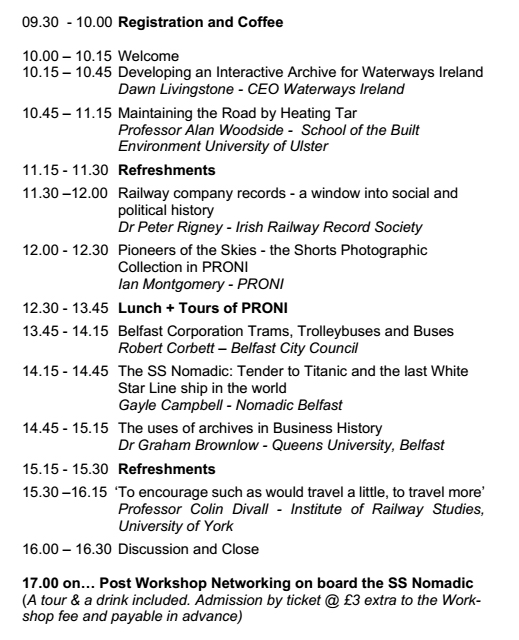
For anyone interested in transport history, there is an interesting-looking workshop scheduled for Belfast on 8 September 2014. It’s being held in the Public Record Office of Northern Ireland [PRONI] in the Titanic Quarter and there’s an optional extra tour and reception on the SS Nomadic afterwards.

The programme covers waterways, roads, railways and flight. For this site, the opening session is of great interest: Dawn Livingstone, CEO of Waterways Ireland, is to talk about an interactive archive for Waterways Ireland.

By air, sea and land

By air, sea and land

The workshop is being organised for PRONI by A²SN, the Archives and Artefacts Study Network, supported by the Historical Model Railway Society, the Business Archives Council and the Postal History Society.

The [two-page PDF] brochure is downloadable here PRONI transport archives workshop. The workshop fee is £20/€25 with an extra £3/€3.50 for the SS Nomadic visit. Sterling cheques are accepted; there is provision for paying in euro by online banking.

While on the subject of archives, I might mention again the Archives & Records Association, Ireland branch, whose [freely downloadable PDF] newsletters often cover topics of interest, and their Learn About Archives site here.

Crossborderality and euroloot

I wrote here about last week’s NSMC meeting. I noted that the inland waterways meeting seemed to have transformed itself into an SEUPB [Euroloot] meeting: it is unusual for spending ministers to represent the government and executive on such occasions and it is also odd that the SEUPB did not have a meeting to itself, given that it is a separate body. I have asked the Department of Public Expenditure and Reform why spending ministers were allowed into the sweetshop unsupervised.

I now learn that this week there will be celebrations of the twentieth anniversary of the reopening of the Junction Canal in the Ballinamore and Ballyconnell Drainage District, now known as the Shannon–Erne Waterway. So watch for messages to the effect that cross-border waterways bring peace and prosperity … improved relationships in these islands … historic visit … peace in our time … as it happens, we have another sheugh up the road … how about it, Angela, another few quid for the other sheugh?


NSMC

The joint communiqué from last week’s North/South Ministerial Council Inland Waterways meeting is now available here. There was an exciting bit:

SECTORAL PRIORITIES

2. Ministers had a discussion on various priorities within their remit and noted that these will be contained in a report to be considered at a future NSMC Institutional meeting as part of the ongoing review into sectoral priorities.

Hmm … what’s cooking there? I do wonder why the NSMC bothers publishing content-free stuff like this. We may have to ask the US NSA to bug the meetings. Oh, hang on ….

Here’s a good bit, though:

PRESENTATION BY WATERWAYS IRELAND

3. Waterways Ireland delivered a presentation to Ministers entitled “Ireland’s Inland Waterways – Building a Tourism Destination”. The presentation provided an overview of the progress being made by Waterways Ireland in placing the waterways and the waterway experience at the centre of the tourism offering both in Ireland and internationally.

Now that is useful and important work. But, as I have pointed out elsewhere [including to Waterways Ireland], the WI draft Corporate Plan 2014–2016 said nothing about tourism. Some years ago, I thought that it was a mistake to have a Marketing & Communications Strategy and a Lakelands tourism initiative that seemed to exist outside the corporate planning process; I am still of the same mind.

I have asked Waterways Ireland for a copy of the presentation, and for a copy of the Strategic Development Plan for the Grand Canal Dock, Spencer Dock and Plot 8 that was mentioned in WI’s progress report. That report also covered:

  • continuing maintenance
  • public consultation on canal bye-laws
  • a Built Heritage Study and a GIS-based navigation guide for the Lower Bann
  • an environmental award for  work in restoring, protecting and promoting the heritage assets that are Spencer Dock and Grand Canal Dock
  • towpath development and work on the cycleway from Ashtown to Castleknock on the Royal
  • donating two barges for “recreational and community use”
  • “partnerships to utilise three unused navigation property for community and recreational use”, which I don’t know anything about.

The important part was this:

BUSINESS PLAN AND BUDGETS 2013 AND 2014 AND CORPORATE PLAN 2014-2016

5. Ministers noted the position with the 2013 Business Plan and budget. They also noted that Waterways Ireland has undertaken a public consultation on the draft Corporate Plan 2014-2016, the preparation of a draft 2014 Business Plan by Waterways Ireland and that the plans will be reviewed after the public consultation is analysed. They also noted that Sponsor Departments will continue to work together with Waterways Ireland to finalise the Business Plans and Budgets for 2014 and the Corporate Plans for 2014-2016 that will be brought forward for approval at a future NSMC meeting.

I read that as showing that the north-south deadlock continues. The 2012 accounts have still not been published and the plans for 2014 won’t be approved until (at the earliest) three quarters of the way through the year.

The NSMC heard something about the Clones Sheugh but has decided not to tell the citizenry anything about it. It agreed to some property disposals and decided to meet again in October. But there was one odd item:

SPECIAL EU PROGRAMMES BODY BUSINESS PLAN AND BUDGET 2014 AND CORPORATE PLAN 2014-16

8. Ministers approved the Special EU Programmes Body Business Plan and Budget 2014 and Corporate Plan 2014-16.

The oddity is that the SEUPB is a separate body and usually gets its own meeting and communiqué. The last six meetings (before this one) have been attended by NI folk from Finance & Personnel and RoI folk from Public Expenditure & Reform (or, before that, Finance).

So who let spending ministers into the sweetshop? And why? Suspicious-minded folk might think that there is a plan to  nick a lot of Euroloot for the Clones Sheugh to get the Irish government off the hook persuade the Europeans of the benefits of investing in the reconstruction of a small portion of the Ulster Canal. We note that, on the previous day, Jimmy Deenihan gave a longer than usual reply to the standard question about the Sheugh, including this:

The Inter-Agency Group has met four times, last meeting on 9 December 2013. The Group continues to examine leveraged funding opportunities for the project. This includes the exploration of EU funding which may be potentially available in the next round of structural funds covering the period 2014–2020.

I have a better idea. Vladimir? There are oppressed Russians in Clones ….


Closing the Shannon in winter

I pointed out some time ago that, in the Dáil on 16 October 2013, Jimmy Deenihan said:

The [budgetary] provision will enable Waterways Ireland to deliver on its core activities and targets, which include keeping the waterways open for navigation during the main boating season and promoting increased use of the waterways resource for recreational purposes.

That was the first time I noticed the suggestion that, in effect, boating in winter might be de-emphasised, as it were; the idea is followed up in the current draft of the Waterways Ireland Corporate Plan 2014–6. The proposal receives some support from the figures for Shannon traffic in the first three months of 2014.

I realise that, as the numbers are small, they can be affected by the high water levels, bad weather or the date of Easter, but those for 2014 are remarkably low. The totals for the first three months [Jan–Mar] since 2003 are:

2003  689
2004  536
2005 2229
2006  683
2007  825
2008 1449
2009  687
2010  567
2011  626
2012  736
2013  753
2014  260

All the usual caveats apply, notably that the figures do not capture boating that is confined to the lakes. Still, the 2014 figure is less than half the next lowest, and it’s the first time since 2003 that the figure has been below 500, 400 or 300.