Category Archives: Tourism

Where is it?

Troll on over to the National Library website and see what you think of this drawing. Click on the thumbnail to expand it; you may then need to click “PRINTABLE VERSION”.

The black object between the sailing boats and the church looks to me like a paddle steamer, but the image is quite blurred so I’m not certain.

If you can identify the location, I would be glad if you left a Comment below.

Prothero on the Erne

The Erne in the 1890s, from the Cruising Club Manual.

The cost of royalty

I am attempting to establish the cost of the restoration of the Royal Canal. So far I have established that the government department currently responsible for waterways, the Department of Arts, Heritage and the Gaeltacht, has no information on the matter, so I shall now ask Waterways Ireland.

It will be difficult to estimate the return on capital employed if we don’t know how much capital was employed.


Killaloe bridge

The Irish Times tells us that the proposed new bridge at Killaloe will be built. The preferred route would cross the canal at Moys, below the breach in the wall,  and, on the Tipperary side, feed into the existing roundabout at the junction of the R494 and R496.

The Preliminary Design Report for the project said:

There is an existing canal alongside the river on the west side, which served a navigational function up to the time of the construction of the Parteen Weir and the raising of the water level in the river. The canal is now inundated by the river as a result of the raising of the water level, and now merely forms a parallel channel alongside the river. A strip of land some 25m wide separates the river from the canal, which is approximately 10m to 12m wide at the bridge site. As the river is now fully navigable, the canal serves no navigational function except that recreational vessels wishing to access properties on the western shore can only do so by entering the canal through certain access points, and travelling along the canal to their desired destination on the shore.

It seems that Waterways Ireland (god bless ’em) insisted that the canal remain navigable:

[…] Waterways Ireland have now requested that passage along the canal be retained, and have advised that they intend to refurbish the canal as a recreational amenity.

A culvert is therefore to be built over the canal, but not a low-level culvert:

[…] Waterways Ireland require that the structure provide a minimum of an 8 metre wide waterway with a 4 metre wide towpath for vehicle and pedestrian access. They require the provision of a minimum headroom of 3.86 metres above normal water level, and a bed level not higher than the downstream cill of the canal lock at Killaloe/Ballina Bridge.

The section of canal will be dewatered during construction work.

These quotations are from Shannon Bridge Crossing Preliminary Design Report Rev F01 by RPS Consulting Engineers in October 2006. I am unable to find, on the Clare County Council website, any later documents that might assure me that the canal crossing provisions still apply. That’s not to say that they don’t; it may just be that the Council doesn’t think citizens need up-to-date information on the matter.


The Strabane Canal and the Foyle

Here is a short account of the Foyle and the Strabane Canal in the 1890s.

The Box in the Docks

From the website of the Dublin City Business Association:

Dublin City Business Association commissioned Jerome Casey and Felim O’Rourke to undertake a study of tourism in Dublin and to make least-cost recommendations for its rejuvenation. The World Tourism Organisation concluded (in relation to Ireland) that “there appears to be very little correlation between marketing spending by National Tourism Organisations and international arrivals”.

Within Ireland, there is a mismatch between the Irish tourism market and the public resources devoted to it.

33 existing tourist attractions in Dublin were reviewed, and low-cost initiatives suggested for their improvement.

From 2000 – 2010 Ireland’s share of world tourism visitors has fallen sharply. In 2004, Ireland changed from being a destination country for incoming tourists to an origin country for Irish, outgoing tourists.

Dublin must move from passive approval of tourist activities to an active development of tourism as a priority industry in regenerating the city’s economy.

As my piece on the Park Canal in Limerick shows, I’m all in favour of low-cost improvements, so I downloaded the full report (PDF: 949.7 kb). Folk interested in waterways might like to proceed directly to page 46, which reviews the Box in the Docks, the Waterways Ireland visitor centre in the Grand Canal Basin at Ringsend.

Some other water-based attractions get much better reviews.


Water feature

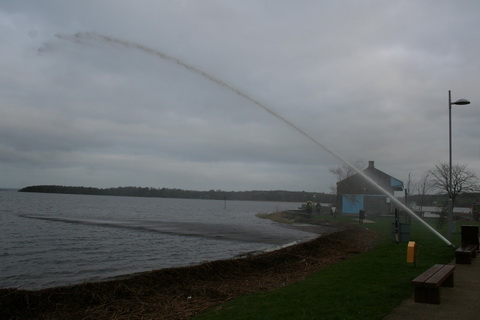
As part of the tourism-oriented improvements at Dromineer, a new water feature is being tested.

Dromineer water feature


Annoying the neighbours

It would be unfair to condemn the proposed opening of a canal to Clones without also condemning the proposed reopening of the Park Canal in Limerick (and the Newry, when I get around to it). The link is to a top-level page; the first substantive page has a lead to the second, the second to the third and so on up to the fifth.

Turning a white elephant into a beagle

That dreadful white elephant the Jeanie Johnston, currently owned by the Dublin Docklands Development Authority (whose purchase of the wretched thing was almost as big a mistake as their involvement in the Irish Glass Bottle site), is sitting in the Liffey acting as a famine museum.

Now the Grauniad tells us of a project to rebuild a replica of HMS Beagle in order to do science. It is not clear why a replica of a small, wooden, early nineteenth century sailing vessel — presumably with high maintenance costs — would provide a better platform for doing science than a modern steel motor vessel, but the promoters have their hearts set (again) on using a barque.

And, as it happens, the Jeanie Johnston is a barque, as was HMS Beagle while Darwin was aboard. Admittedly, the Jeanie Johnston is rather larger, but it might also cost a lot less than building a new Beagle from scratch. In fact, we could perhaps pay the Beagle folk to take it away.

Fracking Leitrim

This morning, on the wireless, I heard two people opposing the use of fracking to find gas around Lough Allen in Co Leitrim. Neither of them was convincing. One started by objecting to big multinationals being given licences to investigate the resources available; it is not clear that there was any ban on small native companies or workers’ cooperatives (or soviets of workers, peasants and soldiers) applying for licences, and presumably they could use traditional Irish implements like sleans if they wanted to.

The general line of argument adopted by the objectors was that anything that could go wrong would go wrong, probably all at the same time, wiping out the whole of Irish agriculture (some of which is not in Leitrim) and, er, eco-tourism. There would, the objectors seemed to suggest, be no preventive or mitigating measures and no insurance and the full cost of every accident would be borne by the residents of the area.
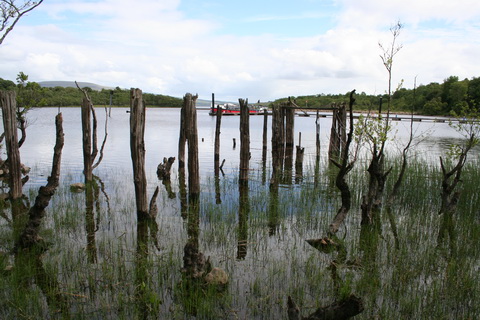
Remains of a pier at the brickworks, Spencer Harbour, Lough Allen


But the bit that really annoyed me was the depiction of the area as one of rural seclusion. Yet Lough Allen had canals, railways, coal mines, dams, iron works and brick works.
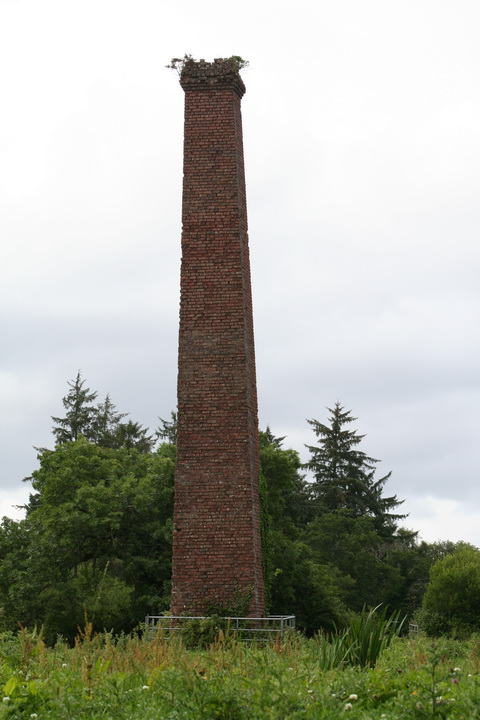
Spencer Harbour on Lough Allen


The very canal linking Lough Allen to the
rest of the Shannon Navigation owes its very existence to the desire
to carry coal from around Lough Allen to Dublin. And one of the most best tourism initiatives in the area, the Arigna Mining Experience, recognises that heritage.
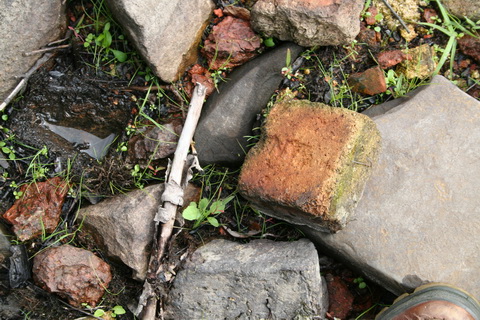
Part of a brick


Insist on proper assessment and management of risk by all means, but don’t exaggerate it — and don’t ignore Leitrim’s industrial heritage.