
Category Archives: Water sports activities

WI’s budget: the minister speaks

I wrote here about the implications of the RoI 2014 budget for Waterways Ireland. The minister, Jimmy Deenihan [FG, Kerry North/West Limerick], spoke about it in the Dáil on Wednesday 16 October 2013 [h/t KildareStreet.com]. At the end of his lengthy contribution he said:

I am committed to developing North-South co-operation within the broader arts, heritage and commemorative activities of the Department as well as through the funding of North-South bodies. A provision of €38.3 million will be made available to support the two North-South implementation bodies, An Foras Teanga, comprising Foras na Gaeilge and the Ulster-Scots Agency, and Waterways Ireland. The provision will enable Waterways Ireland to deliver on its core activities and targets, which include keeping the waterways open for navigation during the main boating season and promoting increased use of the waterways resource for recreational purposes. This expenditure should also assist in developing and promoting the waterways, attracting increased numbers of overseas visitors and stimulating business and regeneration in these areas. Capital funding of almost €4 million will be made available to Waterways Ireland to facilitate the ongoing maintenance and restoration of Ireland’s inland waterways, thereby increasing recreational access along the routes of waterways.

The Government has reaffirmed its commitment to continuing to make progress, to improving the economy, to exiting the bailout, and to helping to create jobs. The Department and the sectors it represents will make a significant contribution to this work over the course of 2014.

I pointed out last year that Waterways Ireland is part of northsouthery and that, at budget time, we don’t get a breakdown of the northsouthery budget between An Foras Teanga and Waterways Ireland. In 2011, WI got roughly 60%, but I don’t know what happened after that. Here’s what I thought was happening last year:

Current spending (WI)

2010 Estimates: €25 585 000
2011 Estimates: € 24 335 000
2012 Estimates: €22 929 600 (60% of €38 216 000)

Capital spending (WI)

2008 Estimates: €11 000 000
2009 Estimates: €10 300 000
2010 Estimates: €8 000 000
2011 Estimates: €6 000 000 (or €6 002 000)
2012 Estimates: €4 500 000 (or €4 502 000) (100%)

In his speech, above, the minister said that northsouthery is going to get €38.3 million and that Waterways Ireland is to get capital funding of €4 million. However, the €4 million is included in the €38.3 million. The expenditure report [PDF; see page 160] gives these details:

  • for 2013 northsouthery had €36 210 000 of current spending; for 2014 it will get €34 425 ooo
  • for 2013 northsouthery had €4 080 000 of capital spending (all, or almost all, of which was for Waterways Ireland}; for 2014 it will get €3 958 000
  • the overall budget for northsouthery is down 5%.

We can calculate that the capital budget is down about 3%; the much larger current budget is down 5%. If WI gets 60% of the total, its current expenditure contribution from RoI will be €20 655 000, down over €2 000 000 from the previous year and about €5 000 000 since 2010, and its total current expenditure (85% RoI, 15% NI) will be €24 300 000.

The other interesting part of the minister’s speech is what WI is expected to do:

  • promoting increased use of the waterways resource for recreational purposes
  • developing and promoting the waterways
  • attracting increased numbers of overseas visitors
  • stimulating business and regeneration in these areas
  • increasing recreational access along the routes of waterways.

That should keep them busy. But I omitted one activity:

  • keeping the waterways open for navigation during the main boating season.

Emphasis mine, but does this mean that winter boating (at least if it involves staff time, eg at locks) will become a thing of the past?
 

The Southern Star

The Southern Star is West Cork’s indispensable source of news and information. I don’t know whether its masthead still proclaims that it incorporates the Skibbereen Eagle, or whether, in the print edition, its news from Bandon is still headed “Bandon Brieflets”, but it is — as we would expect — keeping up with digital technology with a website, a FaceBook thingie and a napp.

It reports today on another “trial flight” by what it terms “A newly formed company, Harbour Flights”, which I wrote about here. The aircraft shown in the photo is EI-CFP [which is registered, incidentally, as a land aeroplane [.xls]], so Harbour Flights does not seem to have acquired a larger plane — or the use of one: the register shows that EI-CFP is owned by Kieran A O’Connor, not by Harbour Flights.

Being ignorant of aviation matters, I don’t know what constitutes a trial flight — or how it is to be distinguished from a promotional flight.

I note a slight contradiction in the Southern Star‘s report:

The company […] has taken five years to grow from its initial concept to become fully operational last July. […]

When it becomes fully operational, Mr Heaps estimated that the company could create up to 50 new Irish jobs […].

So is it, or is it not, “fully operational”? I am confused.


Waterways minister keen on waterways

An exchange from the Northern Ireland Assembly on 7 October 2013, thanks to theyworkforyou.com.

Pam Brown (DUP) asked the Minister of Culture, Arts and Leisure whether inland waterways could be developed to provide a major leisure and recreational activity resource.

Carál Ní Chuilín (Sinn Féin; Minister for Culture, Arts and Leisure): Waterways Ireland is one of the all-Ireland bodies that my Department has responsibility for. You can see the value of the work that it does, particularly in rural areas. I am also working with some councils to improve some of the waterways within their control. I agree with the Member that inland waterways provide brilliant opportunities not just for tourism but for local leisure. They are the economic driver in some towns and villages.

Pam Brown (DUP): I thank the Minister for her answer. She has touched on my supplementary question. Does the Minister agree that the development of inland waterways, while a great source of leisure and recreational activities, can also act as a catalyst for urban and rural regeneration?

Carál Ní Chuilín (Sinn Féin): I agree. I made a statement to the House in July, I think, about some of the events that take place at inland waterways across the island. Those events include festivals and family fun days. Huge numbers attend those events, and they act as economic drivers. Not only are those responsible keen to make sure that they are further developed, but people from other areas visit those festivals in towns and villages to see how they can extract that product for their area. They see the potential and outcome of those events.

That’s good: nice cheap family fun days, not expensive and unnecessary waterway restorations.

Lough Derg Regatta 1849

The Dublin Evening Mail of 19 September 1849 has come to hand.

LOUGH DERG REGATTA

The Regatta on the above-named beautiful lake came off last week. Monday, the 10th of September commenced the annual aquatic sports: the day was tolerably fine, and at two o’clock, PM, the Commodore, the Right Hon Lord Viscount Avonmore, started four yachts for a 30 Guinea Challenge Cup, with £12 added. After a drifting match (for it fell flat calm shortly after three o’clock), they came in as under:—

Gem, 12 tons, James Spaight, Esq
Hero, 8 tons, Dash Gainor, Esq
Iris, 19 tons, Wills C Gason, Esq
Foam, 24 tons, Lord Avonmore.

This was a time race.

While the yachts were absent several cot races came off.

On Tuesday, the 11th, the yachts sailed down in fleet to Killaloe, but the following day it blew a whole gale of wind, and the match that was to have been sailed for on that day was put off till the next; however, in the evening there were some well contested cot races.

The course was as usual — start from the Jetty, over the diagonal wall (built by the Shannon Commissioners to keep the water to a proper level in summer), under the bridge, round Friar’s Island, and back: to a stranger, it is astonishing to see a boat go down an incline nearly four feet high, which they are obliged to do in the race, and what is more extraordinary, any cot that is not rowed at it pretty fast, is almost certain of being upset.

Thursday, the 12th, at the Commodore’s signal, all the yachts got under weigh, and came to anchor off Derry, and at two o’clock, PM, five yachts started for a Silver Cup, valued at £15, witn £5 added. This was a time race for yachts under twelve tons. The wind was WNW, and blew a fine gaff-topsail breeze; at half-past four o’clock the yachts came in as under:—

Hero, 8 tons, Dash Gainor, Esq
Gem, 12 tons, James Spaight, Esq
Willy Wa, 9 tons, Captain Hon F Yelverton
Vampire, 9 tons, Arthur Vincent, Esq
Midge, 7 tons, Bassett W Holmes, Esq.

This was a beautiful race, all the yachts coming in almost together: the Hero only winning by 27 seconds — indeed she may thank the Midge for winning the prize, as going free the first round she got the Gem under her lee, and kept her back some minutes. Shortly after the signal was given to weigh anchor, and start for Portumna, where the fleet arrived at a late hour. In passing Scilly Island the Foam carried away her rudder head, and was near going ashore.

Next day, Friday the 14th, the yachts assembled off Portumna Castle, and at three o’clock, PM, the Commodore started the following boats for a 40 Guinea Challenge Cup, with a purse of Sovereigns added, for all yachts. A handicap race.

Novice, 4 tons, Dash Ryan, Esq
Midge, 7 tons, Bassett W Holmes, Esq
Vampire, 9 tons, Arthur Vincent, Esq
Gem, 12 tons, James Spaight, Esq
Foam, 24 tons, Lord Avonmore
Iris, 18 tons, Wills C Gason, Esq.

This was a most exciting race, and during the first hour it was difficult to tell which would be the winner. Before rounding the second flag boat the Novice put about and gave up the race, and off Church Island, the Midge carried away the jaws of her gaff, and was obliged to give up the race, which she was almost sure of winning — having gained two minutes the first round. The course was a long one, and the race was not over till after eight o’clock, when the four boats came in as follows:—

Iris
Foam
Gem
Vampire.

During each day of the Regatta, the City of Dublin Steam Company placed one of their fine steamers at the disposal of the Sailing Committee, who took out all their friends, and accompanied the yachts each day during the race.

In the evening, after several cot races and other amusements too numerous to relate. The ladies and gentlemen present were entertained at Belle Isle, the beautiful seat and hospitable mansion of Lord Avonmore; and at a later hour assembled some 120 of the elite of Tipperary, Galway, and King’s County, at the Clanricarde Arms, Portumna, where dancing was kept up with spirit until morning.

The population of the Portumna DED declined by 30.46% between 1841 and 1851.

The drowning of Randal M’Donnell

I am indebted to the [London] Standard of 8 February 1858 for alerting me to the sad circumstances reported by Saunders’s Newsletter.

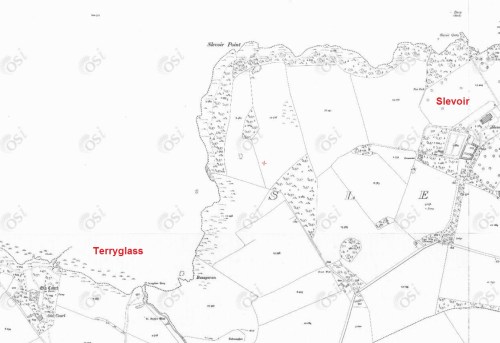
Slevoir OSI ~ 1900

Slevoir OSI ~ 1900

Parsonstown, Friday Evening. — A most distressing accident, which resulted in the death of Randal M’Donnell, Esq, of Slevoir, occurred yesterday. Mr M’Donnell was much devoted to aquatic pursuits, and had made several voyages to Australia and other countries, and had only recently returned from a visit to relations in America.

He was the proprietor of a yacht, which was moored in the River Shannon, opposite Slevoir, in the county Tipperary, and yesterday, as was his habit when at home, he proceeded, it appears, in a small boat, and got on board the yacht. After remaining some time, when stepping into the skiff, to return to Slevoir, it was capsized, and the unfortunate gentleman was thrown into the water. He was very lusty [in the context, this probably means fat], and he soon disappeared.

A peasant from the bank of the river witnessed the fatal occurrence, and ran to Slevoir House and gave the alarm. After some time the body was discovered, but life was quite extinct. It is stated that a brother of the deceased’s also perished some time ago by drowning.

My OSI logo and permit number for website


Too much excitement …

… is bad for me, so I haven’t checked the list of licensed marked fuel traders [.xls] for some time. As a result, I may be late in noting the addition to the list of Shannon Sailing at Dromineer on Lough Derg. This is, I think , the most southerly point on the non-tidal Shannon at which boaters can legally buy green diesel.

London DUKW

A few months ago I wrote about the sinking of a DUKW trip boat in Liverpool. Today (h/t FisherBelfast’s Blog) comes news of a DUKW on fire on the Thames. Happily, nobody died and there were no serious injuries.

Mountshannon seaplane

News from the Clare Champion about the possible cessation of commercial seaplane activities at Mountshannon. The article reports comments by Mr Emelyn Heaps, chief executive officer of Harbour Flights Ireland Ltd.

Harbour Flights

The Companies Registration Office finds four occurrences of the term “Harbour Flights”, all giving their address as 13 Parnell Street, Ennis, Co Clare. One is a business name; the others are:

  • Harbour Flights (Ireland) Limited
  • Harbour Flights (Couriers) Limited
  • Harbour Flights (BES Nominees) Limited.

According to the B1 Annual Return for Harbour Flights (Ireland) Limited to 30 September 2012 [the most recent available], the directors of the company are:

  • Ronan Connolly of Ennis, Co Clare, who is the Secretary; he holds seven other directorships of companies, two of which are Harbour Flights (Couriers) Limited and Harbour Flights (BES Nominees) Limited
  • Emelyn Heaps of Tulla, Co Clare; he holds nine other directorships of companies, two of which are Harbour Flights (Couriers) Limited and Harbour Flights (BES Nominees) Limited.

In the Clare Champion article, Mr Heaps “said the four directors and five shareholders will meet this weekend”; it is to be presumed that the two extra directors have recently joined the Board. The B1 return does say that the company had five shareholders:

  • Mr Heaps with 300000 ordinary shares
  • Mr Connolly with 300000 ordinary shares
  • Mr Adam Cronin of Cobh, Co Cork with 300000 ordinary shares
  • Mr Stewart Curtis of Bodyke, Co Clare with 100000 ordinary shares
  • Harbour Flights (BES Nominees) Limited with 4152 “A” ordinary shares.

The company’s authorised share capital is €105000 made up of half a million “A” ordinary shares at 1c and ten million ordinary shares, also at 1c; the issued share capital is €10041.52, of which €41.52 is the “A” ordinary shares and the rest the one million ordinary shares at 1c.

The financial statement of Harbour Flights (Ireland) Limited

The company has lodged abridged financial statements for the year ending 31 December 2011 [they refer to the company as Harbour Flights Limited, omitting “(Ireland)”].

The independent auditor said:

There is an excess of liabilities over assets, as stated in the Balance Sheet, and, in our opinion, on that basis there did exist at 31 December 2011 a financial situation which under Section 40(1) of the Companies (Amendment) Act 1983 requires the convening of an extraordinary general meeting of the company.

The abridged balance sheet shows a loss of €103944 in 2010 and €295130 in 2011. The Capital and Reserves section showed

  • Called up share capital 10042
  • Share premium account 26946
  • Profit and loss account (295130)
  • Shareholders’ funds (258142).

The other two companies

The balance sheet of Harbour Flights (BES Nominees) Limited as at 31 December 2011 showed current assets of 100 financed by called up share capital of 100. The company had two directors, Mr Connolly and Mr Heaps, and two shareholders, Mr Connolly and Mr Heaps, each with 50 shares.

The balance sheet of Harbour Flights (Couriers) Limited as at 31 December 2011 showed current assets of 100 financed by called up share capital of 100. The company had four directors, Messrs Connolly, Cronin, Curtis and Heaps, and four shareholders, the same four people, each with 25 shares.

Almost 21 months have passed since then and it is possible that all three companies have prospered greatly since 31 December 2011, especially after flights began in July 2013.

Operations

In January 2013 the Irish Independent reported that the company hoped to acquire a seaplane and its own website suggests that it made its first flight in July 2013 and intended to carry 10000 passengers in its first year. However, it seems that the Air Operator Certificate is held by National Flight Centre, Dublin, which says it will be operating the floatplane (seaplane) “in conjunction with Harbour Flights“.

I know nothing of aeroplanes, but the plane seems to be EI-CFP, a Cessna 172, which is said to carry three passengers. Assuming a seven-month tourist season (April to October) and seven-day-a-week operation, there are 214 days available for carrying passengers. The target of 10000 passengers a year would mean carrying 47 passengers a day, which means 16 flights a day, every day.

However, the first year’s operations do not seem to have started until 10 July, leaving only 113 days to carry 10000 passengers. That would mean 89 passengers a day, which would require 30 flights. The shortest flight time is 20 minutes (at €85 a head; longer flights are available) but I imagine that at least ten minutes are required at start and finish for boarding, so the operation must have been working 20-hour days all summer. I haven’t been in Mountshannon for some time, so I was unaware of the frenetic level of activity, but it must have been exciting.

addendum

I see that RTÉ reported, on 3 September 2013, a “test flight” to Galway. Such “test flights” have taken place to other locations, eg Cork, although it is not clear what distinguishes a test flight from, say, a marketing opportunity. RTÉ said that the flight was by a Cessna 206, which takes five passengers, but the photo shows EI-CFP, which is not (as far as I can tell) a Cessna 206 but a smaller Cessna 172.

There have been earlier announcements of services, eg to Limerick, where services were to begin in summer 2011. This website mentions an earlier proposed start. Some folk don’t seem confident of the soundness of the original business model.

Lakeland Seaplane Tours, based on Lough Erne, seems to have ceased operations.


The [non-]Royal Lough Ree Yacht Club

Devoted as this site is to the memory of Her late Majesty Victoria, of the United Kingdom of Great Britain and Ireland Queen, Defender of the Faith, Empress of India, we are always gratified to find evidence of Loyalty to Crown and Empire. Along the Shannon, we are never surprised to find such evidence around Lough Derg (at least in North Tipperary), but we had not realised how well-affected the good people of Lough Ree were towards Royalty, even after the foundation of the Irish Free State and its succession by the state of Ireland.

On 28 October 1947 the Lough Ree Yacht Club wrote to Her Majesty’s Under Secretary of State at the Home Office in London SW1:

Sir

I have been looking over some old papers belonging to this Club.

There was some discussion among members about trying to get it raised to the status of “Royal”.

I should be greatly obliged if you would let me know what would have to be undertaken and what cost would be involved. Also would a club in this country be eligible.

This Club which was founded prior to 1836 is the second oldest in Ireland.

A Home Office Minute of 6 November 1947 said:

The whole of Lough Ree is in Eire and it would seem desirable in the first place to refer the letter to the Commonwealth Relations Office on the question of procedure.

In this country freshwater Yacht Clubs are not now granted the title Royal.

Send a copy semi-officially to the Commonwealth Relations Office for observations regarding procedure.

That was done on 13 November 1947. The covering letter said (amongst other things):

There has been no grant of the Royal Title to a fresh water sailing club in England since 1887 when the practice relating to the grant of the Title Royal was not stabilised.

I wonder whether you could let us have particulars about this club; its membership, reputation, and the number of yachts it owns with their tonnage. We should also welcome any suggestions relating to procedure on the assumption that the application will be pursued.

The Commonwealth Relations Office replied to the Home Office on 6 December 1947 with these (amongst other) paragraphs:

I enclose a copy of a note, prepared in July last year, on the general principles covering the grant of the title “Royal” in the various Commonwealth countries.

You will no doubt appreciate that in the case of Eire, difficulty would arise in the application of these principles. It would appear, however, from paragraph III of the enclosed note that consideration would only be given to applications from institutions similar to the Club in question if exceptional circumstances exist.

We feel that in this particular case no indication should be given in any reply which you may make to the Club of the likelihood or otherwise of any application meeting with success, and that they should only be informed that, being in Eire, the matter should be raised through the appropriate authorities in Eire.

On 17 December 1947 the Home Office wrote to the Club saying:

With reference to your letter of the 28th October last regarding the procedure and the cost involved in making an application for the grant of the title Royal to the Lough Ree Yacht Club, I am directed by the Secretary of State to say that as the Club is in Eire, the matter should be raised through the appropriate authorities in Eire.

Ireland at the time had a Fianna Fáil government, led by George de Valero Éamon de Valera, who was not known for being well-affected towards Crown and Empire.

On 29 April 1948 the Club responded to the Home Office:

Sir

Referring to your letter of 17th December 1947.

We have been in communication with the Irish Government + I enclose their reply, from which I understand that they will not interfere either for or against. I sent their letter to the UK Representative + enclose his letter also.

As the Irish Government has not refused permission for the Club to be raised to the status of Royal would His Majesty therefore be gracious enough to confer on the Club the Title of Royal.

On 10 May 1948 the Home Office replied:

With reference to your letter of the 29th April as to the application for the grant of the title Royal to the Lough Ree Yacht Club, I am directed by the Secretary of State to say that as the Club is situated in Eire, the Secretary of State for the Home Department has no jurisdiction in the matter, and can add nothing to the letter addressed to you on the 21st April, by the United Kingdom representative to Eire.

The enclosures to your letter are returned herewith.

The return of the enclosures has deprived us of the opportunity to see exactly what the Irish government and the UK representative said to the Club.

By then, the Irish general election of 4 February 1948 had returned the First Inter-Party government, led by John A Costello and with Seán MacBride, leader of Clann na Poblachta, as Minister for External Affairs. The Republic of Ireland Act was signed into law on 21 December 1948, depriving the King of Ireland of his last functions in the former Free State — and depriving the Lough Ree Yacht Club of its last chance to acquire the Title Royal.

It would be interesting to know what Seán MacBride, who had been boating on Lough Ree since the 1930s, thought of the Club’s application.

The story is not included in the brief history on the Club’s website or in the more extensive history included in the booklet produced for the LRYC/Waterways Ireland Classic Boats Regatta in 2007, but I have not seen Lough Ree Yacht Club: a memoir, published in 1970.


Erie warning: stuck with a sheugh

New York is a place in the Americas. There is a town of that name and there is also a state, whose economic development in the nineteenth century was assisted by the development of a canal, about which you can learn more on this excellent site. There is a trail along the canal that can be walked or cycled.

The canal is run by the New York State Canal Corporation, which is a subsidiary of the New York State Thruway Authority [a thruway is, it seems, a sort of road]. The canal loses money (naturally). The Thruway Authority sought to increase tolls; the State Controller said it should save money and improve management instead. Inter alia, it should

Commission an independent analysis of the Canal System to examine ways to streamline operations, seek new funding streams, and develop a realistically attainable vision for its future role in the upstate economy.

In his full report [Assessment of the Thruway Authority’s  Finances and Proposed Toll Increase [PDF] Office of the New York State Controller August 2012], the Controller said that

[…] the New York State Constitution forbids the Legislature to sell, abandon or otherwise dispose of the canals […]

but that

[…] choices regarding operational control and financial support for the Canal System are policy matters to be determined by the Governor and the Legislature.

His summary said that

Additional factors in the Thruway Authority‟s current weakened condition include the Authority‟s responsibility for financing and operating the State‟s Canal System as a result of legislation enacted two decades ago. The Canal System has consumed more than $1.1 billion of Thruway resources in the ensuing period. Contrary to the original legislative intent, responsibility for supporting the canals has diminished the Authority‟s ability to pursue its core mission. Moving the Canal System into the Thruway Authority was intended, in part, to stimulate tourism and economic development along the historic
canal corridors. This goal, too, has been elusive; boating activity on the canal has  declined substantially under Thruway control.

Later in the report he said

Second, the Authority‟s financial resources and organizational expertise, along with the then-newly created Canal Recreationway Commission, would position the underused Canal System to improve its facilities and marketing such that new users would be attracted from around the country, and even around the world.

Neither of these hoped-for outcomes has occurred. The Thruway Authority has invested more than $1.1 billion in the Canal System, and this drain of toll resources has also contributed to the deterioration of the Authority’s financial condition over the past decade. Meanwhile, despite major investments and new amenities, pleasure-craft activity on the Canal System in recent years is down by nearly one-third since the period immediately before the Thruway Authority assumed control.

The local media seem to take a somewhat more informed interest in their sheugh than do those in these parts:

Ireland and the United Kingdon could avoid finding themselves in these difficulties by refusing to recreate any more sheughs.