Category Archives: Waterways management

Harry Arnold …

… wins prestigious competition!

Harry Arnold has won the Irish Waterways History Christmas Caption Competition and the magnificent prize of a glass of something. “I’m over the moon,” said the excited winner: “it’s just as good as winning the lottery.”

The competition organisers dismissed rumours that they favoured overseas contestants as they would be less likely to be able to collect their prizes. “Quod scripsi, scripsi,” they said, “and our word is our bond.”

Christmas caption competition

The usual prize of a glass of something or other [and I know the last two prizewinners still have a claim on me] for the best non-libellous caption for this photo, taken today at the launch of WI’s education programme for primary school children. I understand that the materials on WI’s e-learning page are complemented by “an off-line teachers resource pack”, which is what the besuited ones are clutching.
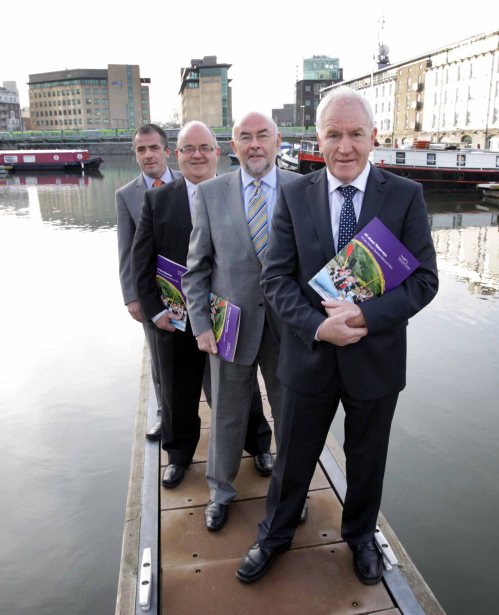
No lifejackets. Photo courtesy of Waterways Ireland, who are not to blame for my decision to use it for a caption competition

Starting at the back, the four chaps are Éanna Rowe, Waterways Ireland’s Marketing Honcho; John Martin, Heid Fector o’ Waterwyes Airlin [as we say in Ulster Scots]*; Ruairi Quinn, Minister for Education and Skills; Jimmy Deenihan, Minister for Arts, Heritage and the Gaeltacht but, on the other hand, a strong personal supporter of the Lartigue Monorail, which is a point in his favour.

Update 4 December 2012: the press release is now on the WI site.

* In its 2008 Annual Report, Waterways Ireland was, in Ulster Scots, Watterweys Airlann on the cover but Watterwyes Irelan in the Foreward bae the Cheif [sic] Executive, who signed himself as Chief [sic] Executive. By 2009, though it was still Watterweys Airlann on the cover, it was Waterwyes Airlan in the Foreward bae the Chief [sic] Executive, who signed himself as Heid Fector, a title I rather like. By 2010, though the cover remained unchanged as Watterweys Airlann, the body was Watterwyes Airlan in the Foreward, but the Heid Fector title had been dropped, alas, and John Martin was Chief Executive in two languages.

But 2008 was not the Heid Fector’s first appearance: in 2007 John Martin signed himself thus, though the foreword was called Twarthy words bae tha heid yin and the body was referred to in the text as Wattherweys [sic] Irelan.

Back in 2006, the foreword was Innin wi tha Heid Fector, and the body was Watterweys Airlann, with an accent, which I can’t reproduce, over the first e. That was the same as in 2005; in both years John Martin signed himself as Heid Fector.

I’m not sure whether I prefer Heid Yin or Heid Fector, but either seems better than Chief or Cheif Executive. But the real problem is the difficulty that this inconsistency causes for us eager students of Ulster Scots. I realise that change is inevitable in a thriving, developing language or dialect, but perhaps the cross-border bodies could give a lead in standardising the vocabulary and spelling.

WI pay 2

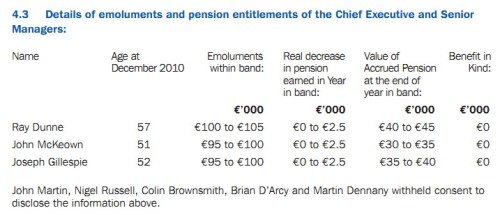
In an earlier posting I provided this extract from WI’s accounts to 31 December 2010:

WI salaries

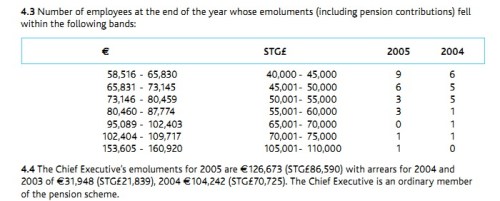
The same message appears in the annual reports for 2009, 2008, 2007 and 2006. However, back in 2005 there was a different message:

WI pay 2005


WI and the tooth fairy

There is a slightly disturbing item in WI’s 2010 accounts [PDF]:

1.5 Deferred Pension Funding

In accordance with accounting practice for  non-commercial State bodies in the Republic of Ireland, Waterways Ireland recognises an asset representing resources to be made available by the UK and Irish Exchequers for the unfunded deferred liability for pensions on the basis of a number of past events. These events include the statutory backing for the superannuation schemes, and the policy and practice in relation to funding public service pensions in both
jurisdictions including the annual estimates  process. While there is no formal agreement and therefore no guarantee regarding these specific amounts with the funding bodies, Waterways Ireland has no evidence that this funding policy will not continue to progressively meet this amount in accordance with current practice. This treatment is inconsistent with  accounting practice for UK Non-Departmental Bodies, where, due to the absence of a formal guarantee, a funding liability is not recognised until the commitment falls due.

IANAA, but an absence of evidence for the non-existence of the tooth fairy would not convince me that it does exist. I suppose it’s the same for any other unfunded pension scheme, and (unlike the UK practice) at least acknowledges the size of the problem, but it’s not exactly reassuring, either to taxpayers or to future pensioners. If I’ve misunderstood it, perhaps some kindly accountant will correct me.

WI pay

In my post about WI finances I referred to Robin Evans, chief executive of the Canal & River Trust, which runs many waterways in England and Wales. A commenter mentioned Evans’s salary. Here is what WI’s Annual Report for the year ended 31 December 2010 [PDF] says about the salaries of senior WI managers.

WI salaries

More mooring locations on the canals

From a WI presser received this afternoon:

The second set of locations offering the E.M.P include the Floating Moorings on the Grand Canal Dock beside the Waterways Ireland Visitor Centre on which a permit will be offered until March 2013. Additionally extended mooring locations will also be opened on the Grand Canal near Lock 34 in Co Offaly, Pike Bridge in Co Kildare and Abbeyshrule in Co Longford. The full details of the locations including the GPS co-ordinates, the Application Form and Guidance Notes will be available on www.waterwaysireland.org from the 3rd December.

Update 4 December 2012: the press release is now on the WI site.

Ireland’s most popular waterways artefact?

The search term most often used to find this site is Ardnacrusha, which scores 1655, almost twice as many as the next term, the generic Waterways (875). But other variants occur too: Ardnacrusha Lock is at position 3 (768), Ardnacrusha power station 18 (274), ESB Ardnacrusha 21 (225), Ardnacrusha ESB 33 (169), Ard na Crusha 43 (140), Ardnacrusha hydroelectric power station 58 (120), Ardnacrusha dam 86 (89); Parteen Weir is at 14 (369).

Thus I deduce that Ardnacrusha is by far the most popular artefact on Irish inland waterways.

Here is the full top twenty.

1 Ardnacrusha 1,655
2 Waterways 875
3 Ardnacrusha lock 768
4 Wooden boat 728
5 Skies 613
6 Athlone 573
7 Strancally castle 483
8 Lough Erne 480
9 Homemade boat 460
10 Wooden boats 453
11 Irish waterways history 451
12 Boats 448
13 Irish waterways 393
14 Parteen Weir 369
15 Flying Fifteen 344
16 Homemade boats 333
17 Pioner Multi 301
18 Ardnacrusha power station 274
19 Johnstown Co Kilkenny 247
20 Ormond Castle 237

Most hits on this site come from searches rather than links.


Shannon traffic

This chart shows the numbers of Shannon lock and bridge passages for the first ten months of the year for ten years from 2003 through 2012.

Figures courtesy of Waterways Ireland

These figures take no account of boats that do not use locks and bridges, eg those that remain on lakes.

The decline continues.

WI finances

Robin Evans, chief executive of the Canal & River Trust, was interviewed in the December 2012 issue of Waterways World. CART, a charitable trust, has taken over from British Waterways in England and Wales, but not in Scotland.

Robin Evans pointed out in the interview that, whereas waterways in Scotland get 98% of their funding from the state, CART’s English and Welsh waterways get only 35%. Amongst other things, CART is seeking donations and getting people to volunteer as lockkeepers and in other roles.

I’ll bet the Irish government is looking on with interest.

Boats to return to Corbally Branch

Well, canoes, but better than nothing.

PS for “upstream” read “downstream”, as far as I can see.