Category Archives: waterways

Theatre steam

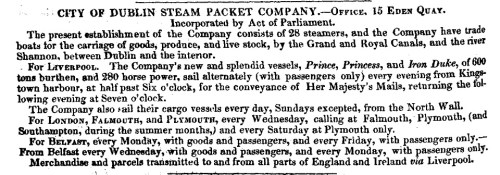
The Abbey Theatre has announced that it has bought Nos 15–17 Eden Quay, Dublin 1. No 15 was the address of the main offices of the City of Dublin Steam Packet Company.

From the Dublin Almanac of 1845

The company crest is said to be still on the wall. Abbey Street Old seems to run between the two premises; no doubt there will be some means of avoiding any problem.

I wish the Abbey Theatre well in its extension, but I hope it will find some way of honouring the memory of the City of Dublin Steam Packet Company and of the underrecognised Charles Wye Williams.

Kilgarvan Quay

On 3 October 1906 Mr Hugh Delaney of Borrisokane, Co Tipperary, gave evidence to the Royal Commission appointed to enquire into and to report on the canals and inland navigations of the United Kingdom. Tipperary (North Riding) County Council had asked him “to give evidence on behalf of the quay at Kilgarvan.”

His evidence became rather confused, as he and his interlocutors misunderstood each other. The source of the problem seems to have been his using the term “the canal” to refer both to the Grand Canal Company and to the canal itself. The main points of his evidence were these:

  • Kilgarvan Quay was “only of recent date: it was only opened in [October] 1891 and it has had an extraordinary effect on the traffic of the district and brought down the railway rates [from Cloughjordan] very considerably”
  • there had been no quay at Kilgarvan before that; there was deep water at the quay
  • the grand jury of the North Riding of Tipperary gave £230 towards the cost and the Grand Canal Company paid the rest, about £579
  • although it was only 104 miles from Kilgarvan Quay to James Street harbour, it took five or six days for barley to reach Dublin
  • he felt that the trip should be done in two days, using steam launches
  • he thought that transhipment at Shannon Harbour caused undue delay
  • people at Terryglass had built a quay and it made a port of call for the Grand Canal Company.

The present quay at Kilgarvan is not on the ~1840 OSI map (though there is a smaller quay near the bend in the road) but it is on the ~1900. I have a photo of the crane on my page about Shannon cranes; I’m no expert, but I wonder whether the crane might be older than the quay.

Canal mooring rules

Waterways Ireland issued two press releases about moorings today. The first was the usual one about winter moorings on the Shannon and the SEW; the second was about the canals. Here, unedited, is the text of the second.

Canal Mooring Rules Coming into Force

Waterways Ireland announced in June 2012 that the Canal Bye-laws on the Grand & Royal Canal and Barrow Navigation are to be enforced from autumn 2012, with an accompanying change in the permit system allowing for year-long mooring permits and locations.

Part of bringing in this new location-based permit has been the identification of locations suitable for extended mooring. This process is now completed and work has begun in some areas to improve accessibility.

Waterways Ireland will roll out Extended Mooring Permit applications by area, rather than giving a date when applications for the permit will open. For boat owners this will mean that enforcement of the maximum stay rule will not commence in an area until after boat owners have had the opportunity to purchase an Extended Mooring Permit.

The initial 12 month Extended Mooring Permit will cost €152 and will only be available to boats already holding a valid annual Mooring and Passage Permit.

Boats that cruise and move (staying at a mooring for up to 5 days) will not be in breach of the Bye-laws or require an Extended Mooring Permit.

Waterways Ireland has proposed a small number of draft amendments to the current Bye-laws which date from 1988. These include proposals to provide a range of charges for mooring permits that reflect the location and services provided throughout the canals and also will take into account the size of boat. These proposals include low cost rural moorings on soft banks to ensure the canals are accessible for everyone who owns a boat and requires a mooring. Boat owners allocated an extended mooring location in key areas in villages or towns or with services should be aware that if the new Bye-laws are approved Waterways Ireland will increase the charges for moorings in the future to reflect the location, services, and size of boat.

Waterways Ireland recognises the current situation whereby a small number of boat owners use their boats as their sole or permanent residence. Proposals to make provision for this use of the navigation property have been included in the Bye-law changes.

Furthermore Waterways Ireland intends to work towards the provision of a small number of serviced house boat moorings on the canal network. Such provision will be subject to finance, land availability and compliance with requisite statutory approvals.

Waterways Ireland recognises that a transition period of a number of years will be required to implement this. In the interim these boat owners should apply for an Extended Mooring Permit.

The draft Bye Law amendments are currently being considered by Waterways Ireland’s sponsor Departments. When Waterways Ireland has Ministerial consent, it will proceed to public consultation on the proposed Bye-law amendments.

Waterways Ireland will continue to contact permit holders regularly to ensure they are kept up to date with the roll-out of the new permit. All queries about the enforcement of the current bye-laws or the Extended Mooring Permit should be directed to Shane Anderson, Assistant Inspector of Navigation: Tel no +353 (0)87 286 5726, Email shane.anderson@waterwaysireland.org . Queries about houseboats should be directed to Property & Legal Section Tel no +44 (0)28 6632 3004.

These changes are necessary steps to improve the management of the canals and waterway amenities for both the navigational and recreational user, so that investment in the new infrastructure and facilities which Waterways Ireland has undertaken is maximised for every user.

The Repealer

Here is a brief account of a trip from Waterford to new Ross by steamer in 1842.

Speeding on canals …

… and the perils thereof:

Having reached the highest level of the great table-land, we traversed a space of fifteen miles without a lock; and here a curious phenomenon, illustrating the incompressibility of water, arrested our attention. About every twenty or thirty minutes, the horses are obliged to stop for five or six minutes, to take breath, the cause of which was this: — The velocity of the boat impelled the water in the canal with such force that it gradually rose so as to approach the summits of the banks, when it began to recoil, so as actually to form a back-water or stream, when the horses were unable to make head, and therefore stopped till the equilibrium of the canal was restored.

James Johnson MD A Tour in Ireland with Meditations and Reflections S Highley, London 1844

Hunting Newbury

In his A Tour in Ireland with Meditations and Reflections [S Highley, London 1844], James Johnson MD describes a flyboat trip on the Grand Canal from Dublin. He says:

At Newbury, a station near Edenderry, I debarked, and spent two or three days at the hospitable mansion of Newbury Hall, with my excellent friend Mr Wolstenholme and family, where I also met my amiable friend, Mrs Evans, of Portrane.

I have been trying to find Newbury. So far, the most likely candidate seems to be Newberry Hall, in Carbury, Co Kildare; the spelling Newberry is given on the ~1840 [Historic 6″] OSI map whereas the ~1900 [Historic 25″] map gives Newbury.

The Hall is indeed fairly close to Edenderry, but if Johnson got off the boat in Edenderry I’d have expected him to refer to it as Edenderry harbour. Looking at the OSI map (link above), the only other sensible point of debarkation would (I think) have been at Ticknevin Bridge, from which there was a road towards Newbury, but I have no evidence that it was Newbury station.

I would welcome enlightenment.

Wordling Repeal

On 22 April 1834 Daniel O’Connell, MP for Dublin but a native of Kerry, argued in the House of Commons at Westminster for, IIRC, five hours in favour of the repeal of the Act of Union. Here is what Wordle makes of his speech.

Daniel O’Connell Wordled

On the following day Thomas Spring-Rice, MP for Cambridge but a native of Limerick, responded for six hours. Here is what Wordle made of it.

Thomas Spring-Rice Wordled

Urination in Co Clare

In County Clare, urination has a long and distinguished history. Here is a piece about one early example: while it was not on inland waters, I hope that the involvement of the Head Pacificator, renowned for his efforts to promote the Shannon, as well as of two authors who provide useful information about the river, will excuse the inclusion.

Praise for Kilrush

Kilrush across the creek

It was highly gratifying to witness the animation that prevailed in Kilrush — the neatness of the little shops, the flagged pathway, and the absence of accumulated dirt, so prominent and offensive a peculiarity of most small towns in Ireland. The people about Kilrush (whose population is 5000) are handsome, and appear considerably more intelligent than in many other places.

Jonathan Binns The Miseries and Beauties of Ireland Vol II Longman, Orme, Brown and Co, London 1837


WI, Clare Daly, Lowtown

Update from Clare Daly TD here.