Category Archives: waterways

The Boyne’s turf-sided lock

I have a vague recollection of being told that there was no evidence that the turf-sided Lock 2, Oldbridge Guard Lock, on the Boyne Navigation was ever fitted with gates. Or perhaps it was that only a single pair was fitted and that the lock did not operate as a lock.
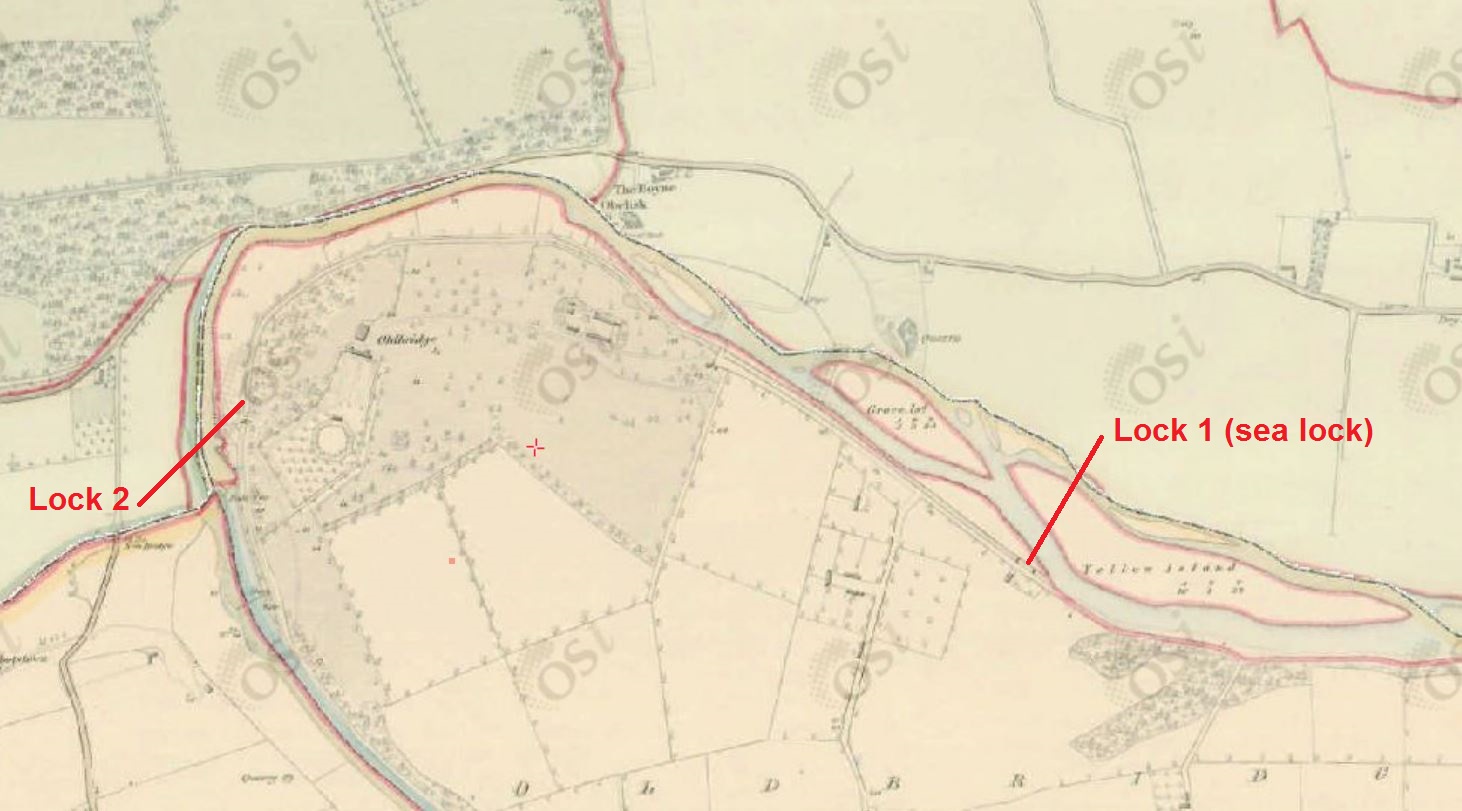
Boyne Locks 1 & 2 (OSI ~1840)

Boyne Locks 1 & 2 (OSI ~1840)

I’m not clear about what I was told but I recall feeling somewhat surprised, given that the lock has stone buttresses at both ends that could have been fitted with gates.
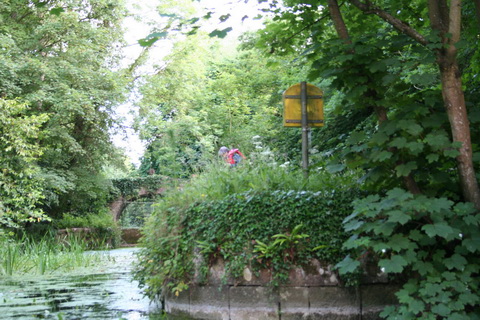
Gate buttresses of turf lock 01_resize_resize

Looking up into the lock past the lower stone buttresses

I should point out that my photos were taken in 2008; much more work has been done since then.
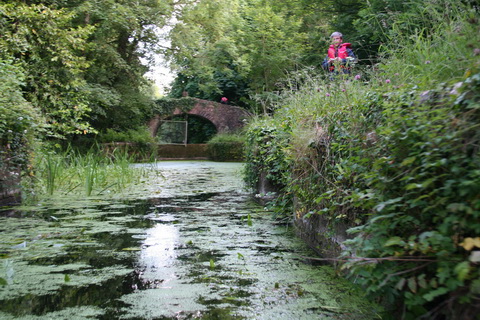
Gate buttresses of turf lock 02_resize_resize

Both sets of buttresses and the bridge
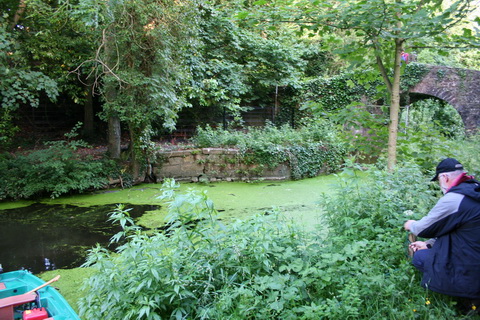
Gate buttresses of turf lock 03_resize_resize

The upper buttresses

Yet it is true that the 6″ Ordnance Survey map, from around 1840, does not show gates on the lock.
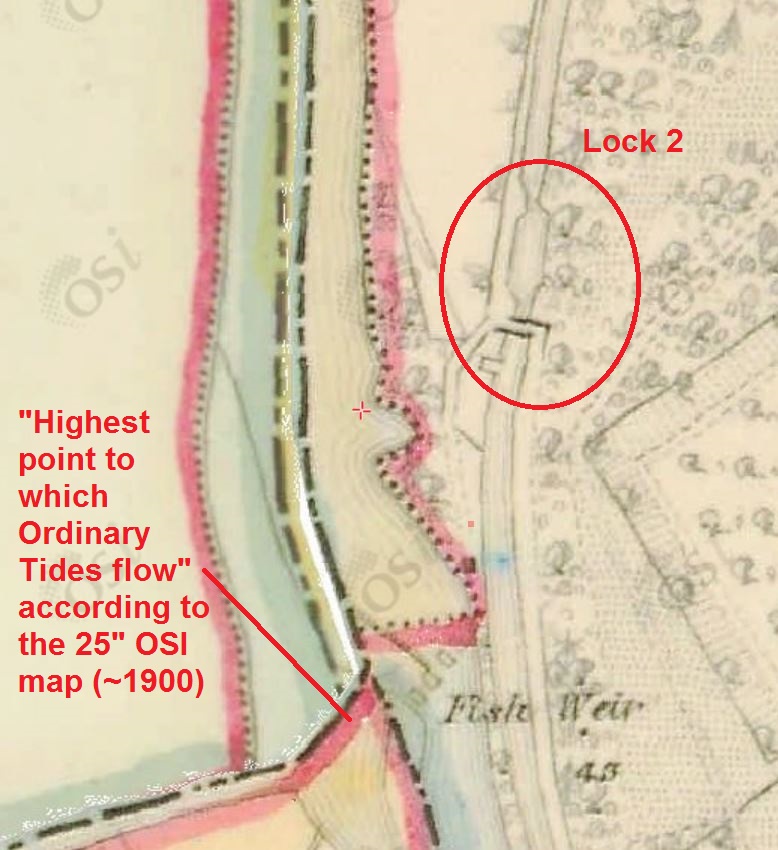
Oldbridge Guard Lock (Lock 2) (OSI ~1840)

Oldbridge Guard Lock (Lock 2) (OSI ~1840)

Unfortunately the relevant section of the 25″ OSI map, from around 1900, is blank at time of writing so I can’t check what it shows.
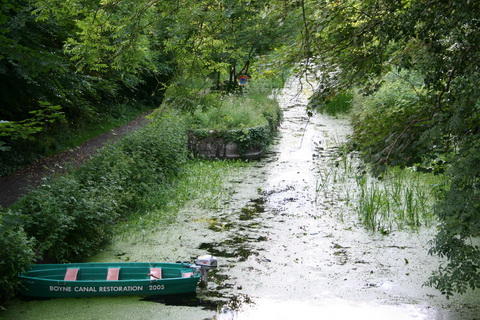
The turf-sided lock on the Boyne

The turf-sided lock on the Boyne

The IWAI Boyne Navigation Branch is currently (March 2015) working towards the installation of gates at the lock but I don’t know whether they’re installing one pair or two pairs.

From reading the reports of the Superintendent for the Boyne Navigation, it is clear that, for at least some part of the period while the navigation was controlled by the Board of [Public] Works, the lock had both top and bottom (breast and tail) gates. Here are some relevant extracts from the reports; I’ve given only enough to make the point.

In January 1869 James Bellew, Superintendent, reported on the works carried out on the Boyne Navigation in 1868. His report, published in the Thirty-seventh Report from the Board of Public Works, Ireland: with the Appendices, for the year 1868 [Alexander Thom for HMSO, Dublin 1869], included this:

Oldbridge Station.

The lock-gates at this station are in excellend working order. The chimney of the lock-keeper’s house has been rebuilt, and some alterations made in the house to render it more comfortable. The guard lock-gates are old, but as they are used only in time of flood, I am of opinion they will last some time longer.

In March 1871, his successor, P J Dodd, wrote in the Thirty-ninth Report:

Oldbridge Guard-lock gates.

The Oldbridge Guard-lock gates are in a very bad state of repair, but new breast gates have been ordered, the contractors have same in hands, and they will be erected during the coming fine season.

And in March 1873 Dodd wrote in the Forty-first Report:

Oldbridge Guard-lock Gates.

The new breast gates of guard-lock [sic] have acted well during the year and heavy flood season, and are in a first class state at present; the tail gates, although old and shaken, are in fair working order, and did very well during the year.

In March 1877 he wrote in the Forty-fifth Report:

Oldbridge Guard Lock-gates.

The breast gates are in very good order; but the tail gates are somewhat shaken, being old.

The gates were tarred in 1878 (Forty-seventh Report); the tail gates had “a slight repair” in 1878 (Forty-eighth Report) and, in April 1881 (Forty-ninth Report), Dodd reported that

These [guard lock] gates require some repairs to sluices and also to the sheeting.

In March 1882 (Fiftieth Report) Dodd wrote:

Oldbridge Guard Locks.

The breast gates are in good repair, tail gates require two new cross rails, sheeting for both folds, and one new balance beam and handrails for both gates.

I do not, of course, know whether there were two pairs of gates at other times.

My OSI logo and permit number for website

News from the Windsor and Eton Express

A memorial to the lord lieutenant from the gentry and landed proprietors of Sligo, Leitrim, Fermanagh, and Cavan, lies in Enniskillen for signatures. It prays that a canal may be formed which will connect Lough Earne [sic] with Lough Allen, and that again with Lough Gill, which is navigable to Sligo. This, with the canal already sanctioned between Lough Erne and Neagh, will open a communication across the kingdom, from Sligo to the ports of Newry and Belfast. In a commercial point of view, this undertaking is of the greatest importance to Ireland.

Windsor and Eton Express Saturday 28 May 1825

Interesting information about the Ulster Canal …

… as distinct from ministerial reelection photo opportunities.

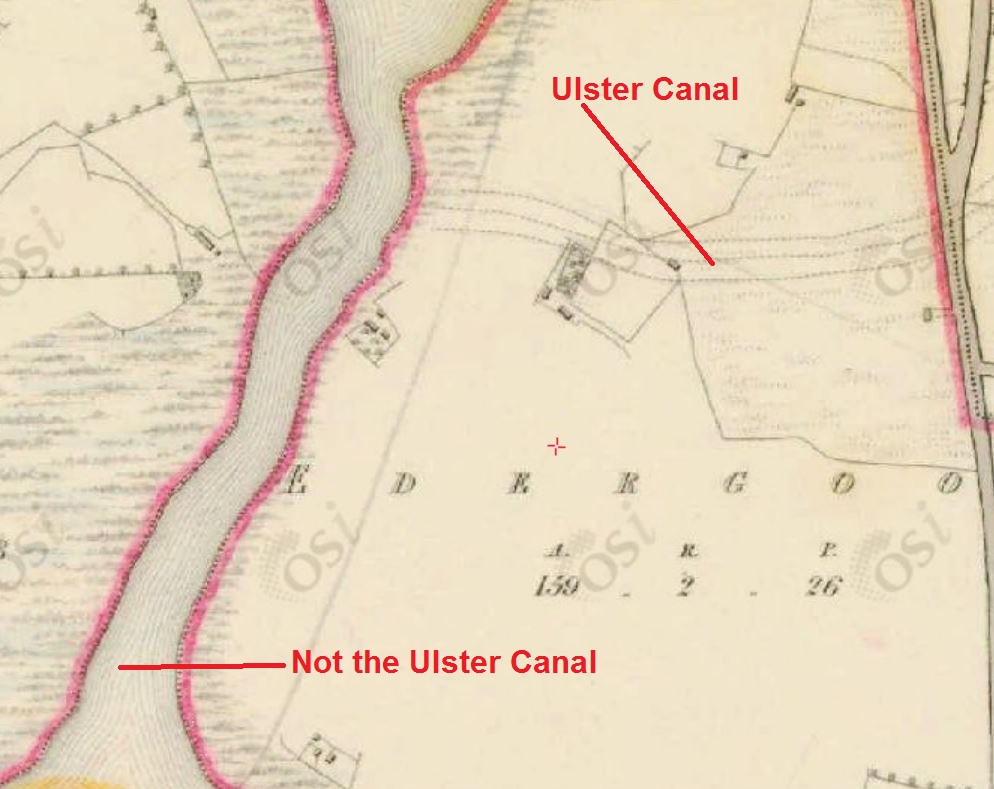
By the way, some folk get confused about the location of the Ulster Canal; this map may help:

Saunderson's Sheugh -v- the Ulster Canal (OSI ~1840)

Saunderson’s Sheugh -v- the Ulster Canal (OSI ~1840)

Anyway, for folk who are interested in weightier matters than ministers talking through portions of their anatomies that they can’t distinguish from their elbows, here is some speculation about opening bridges on the Ulster Canal.

That’s the Ulster Canal Ulster Canal, not the Saunderson’s Sheugh “Ulster Canal”, by the way.

My OSI logo and permit number for website


Mick the Coach

A familiar face in unfamiliar surroundings ….

Ballygalane on the Blackwater

Lismore Canal lock 28_resize

The Lismore Canal lock

The only lock on the Lismore Canal is at Ballygalane, on the River Blackwater. Here is a new page about the canal, with photos of some of its important features.

Waterside Belturbet

Here is a small amount of information about Belturbet and some of its industrial heritage. The photos were taken on a brief visit in July 2011.

Big it up for the Kingstown Blazers

Hats off to the Irish Sailing Association for its successful campaign to persuade owners of diesel-powered pleasure craft to pay the Mineral Oil Tax. The ISA reckoned that, if more folk paid up, the nasty foreigners might allow boaters to continue to use patriotic green diesel:

It may already be too late to save the present diesel supply system in Ireland, but the very least we can do is to strengthen the country’s case by paying the tax. If we don’t do that, we won’t have a leg to stand on.

There have been other press releases since then, and the ISA has said that

The issue for leisure sailors is not the price of diesel but its availability.

Which suggests that it’s only a series of misfortunes that has prevented 99.75% of owners from paying the tax they should have paid. Perhaps the dog ate their chequebooks.

But the ISA put its shoulder to the wheel, its nose to the grindstone and its money where its mouth was, calling on other people to pay up. And, by golly, they did. It is no doubt as a result of the ISA’s call that the number of folk paying Mineral Oil Tax in 2015 (for 2014) was …

30%

… up on the previous year’s figure.

Admittedly that just meant it went from 20 to 26, so the non-compliance rate is still around 99.75%, but let us not mock honest effort. If the number continues to increase at six a year, there will be full compliance by the year 3677, which will be good; I look forward to recording the event.

For the record:

Year Payers Litres Amount
2010 for 2009 38 n/a n/a
2011 for 2010 41 n/a n/a
2012 for 2011 22 141,503.29 €53,398.58
2013 for 2012 23 301,674 €113,841.45
2014 for 2013 20 279,842.4 €105,561.74
2015 for 2014 26 289,151 €108,934.80

The income generated by the tax is about 10% of the amount the ISA gets from the state every year.


Was the Brickey a navigation?

The Brickey is a small river that flows into Dungarvan Bay. Small boats used its lower, tidal reaches, but in the eighteenth century there was a proposal to link the Brickey to the Finisk, another small river that flows into the Blackwater south of Cappoquin.

Waterford County Museum, and others, believe that work began on that project in the mid nineteenth century and that a driveable track along the south bank of a stretch of the river was built as a towpath.

I have visited the river and looked online for further information; my conclusions (with maps and photographs) are here. However, I would welcome further information.

Grand Canal Greenway

Ewan Duffy reports on damage here.

A grand day out in Galway for small boats

Here, courtesy of Kyran O’Gorman, are his notes on navigating the Ballycuirke Canal from Lough Corrib to Ross Lake. Small boats only, and at your own risk.