The cost of boating …

in the Americas. Maybe such inspection and decontamination charges would help Waterways Ireland to enforce the guidelines in its bio-security advice document [.docx].
London Docklands

Big it up for the Museum of London Docklands, near Canary Wharf. You can go there on the DLR, always a bonus, which will counteract the queasiness you feel at proximity to a large number of bankers, accountants and lawyers.

Apart from any temporary exhibitions, the Museum offers a chronological account of the ports of London from Roman times to the present day; you start on the third floor and work downwards. The timeline anchors the narrative, but there is no attempt to pretend that there is a single uncontested history: conflicts over slavery, dock labour schemes and modern redevelopment are all presented, using a mixture of text, displays of artefacts large and small, models, paintings, audio and video. Easy to spend several hours there; the Docklands at War section was particularly interesting.

And if you have time afterwards, nip around to The Grapes for bangers and mash (£6.50) [or whatever you like] and a pint of Timothy Taylor’s Landlord, which (weather permitting) you may be able to consume on the balcony overlooking the Thames, with the shingle below on which the mudlarks worked, while you remember all those Conrad novels and sing “Sweet Thames flow softly” .

Fun for anoraks

Lots of info on the WI website:

I liked the bit on this page:

Enforcement

Boats in non-compliance with the bye-laws will enter an enforcement process. Enforcement is undertaken by Authorised Officers and will begin with a notification in the form of a sticker and if non-compliance continues may result in the ​craft being removed from the navigation at the owners cost.

I wonder about investing in a crane company.


Like the Mary Ellen Carter …

rise againJust a few weeks ago the depth was around 1.7m at Athlone weir, about 7″ above the navigational minimum. But today the depth is over 2.4m and, with staff gauge zero at 35.360m above Poolbeg datum, the water level is 37.760 m above Poolbeg datum.

DUKWs

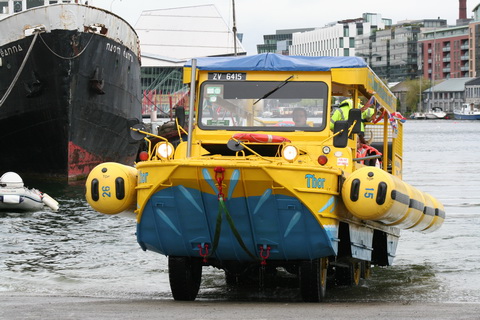
In June 2013 I reported on the sinking of a DUKW in Liverpool, the second of the year, and in September on the fire aboard a DUKW in London. Oddly enough, it seems that the two accidents had a common element: the foam added inside the hulls to improve buoyancy.

The UK’s Marine Accident Investigation Branch has found that the DUKWs in the Liverpool fleet had not been fitted with enough foam to provide 110% buoyancy, enough to keep the vessel afloat when flooded. MAIB’s tests on the Liverpool vessels

… raised serious questions about whether the operators of DUKWs could fit sufficient foam internally to comply with the current requirement for 110% buoyancy without compromising the safe operation and the practical day to day maintenance of these vehicles.

The “safe operation” part affected the London vessels. In July 2013, a DUKW had to be towed in after a drive shaft universal coupling failed when it overheated and ran dry of lubrication: engine bay temperatures were too high because of the volume of foam inserted. And a report commissioned by the London Fire Brigade into the September fire concluded that:

… the most likely cause of fire was the action of the rotating drive shaft (or other moving parts) on the oil contaminated surfaces of the buoyancy foam blocks.

MAIB has issued a safety bulletin [four-page PDF] with this conclusion:

The MAIB identified significant difficulties in fitting a DUKW with the volume of foam required to meet the buoyancy standards set out in MSN 1699 (M). Further, the nature of these old amphibious vessels, specifically their weight in relation to their size and the complexity of their propulsion arrangements, makes it difficult for operators to comply with the standards applicable to more conventional craft by solely using internal foam buoyancy. An alternative standard, ensuring that DUKWs have the necessary level of damage survivability, therefore needs to be established if they are to be operated safely.

It has recommended that the Maritime and Coastguard Agency should

… ensure that the means used by DUKW operators to achieve the required standard of buoyancy and stability for their vessels does not adversely impact on their safe operation. Furthermore, these vessels should not be permitted to operate until satisfactory levels of safety can be assured under all feasible operating conditions.

The Maritime and Coastguard Agency’s website doesn’t seem to be working, but there is a BBC report here quoting an MCA person as saying

We will not be permitting the vessels to operate until we are satisfied that the necessary safety measures have been achieved.

VikingSplash DUKW in Dublin

VikingSplash DUKW in Dublin

All of this may help to explain why the VikingSplash DUKWs operating in Dublin are fitted with additional external buoyancy.

Sailing up the Liffey (not)

While in Blighty I read a brief but entertaining piece in [HM] Independent newspaper [a piece that doesn’t seem to be available online] saying that the Sean O’Casey pedestrian bridge, which spans the Liffey in Dublin, cannot be opened because the remote control has been missing since 2010.

The story doesn’t seem to have had much coverage in Ireland, but The Journal seems to have originated it; it has been picked up by MSN and there is discussion at boards.ie, although I don’t know that many people will be inconvenienced by the inability to get tall vessels into a relatively short stretch of water.

Ardnacrusha

A press release just in from Waterways Ireland:

Waterways Ireland Change Advice on Travel into Limerick

Waterways Ireland is changing the advice on travel from Ardnascrusha into the Limerick Navigation due to a new service available from the ESB which provides real time information on the output from the turbines.

Boaters are advised not to travel on the Ardnacrusha to Limerick Navigation if the output from Ardnacrusha is above 20 Megawatts. The previous advice advised boaters not to travel if one turbine was operating; 1 turbine is equivalent to 20 megawatts.

The new service offers real time information on the megawatt output of Ardnacrusha by phone (tel 087-6477229) and is available 24hrs a day. Boaters are advised to contact the ESB phoneline for information on the output when making travel plans. In the event of a line failure in the real time information number, boaters can call the main Ardnacrusha number 087-9970131 for the megawatt information as well as any other information required for travel through Ardnacrusha.

This new information service is an improvement in safety for mariners who travel on the Ardnacrusha to Limerick Navigation.

Update 2018: that was in 2013. Much better information is now available here.

Northsouthery minus northsouthery

I noted here what the Minister for Arts, Heritage and the Gaeltacht had to say about Waterways Ireland’s budget — or at least that portion of it paid by the RoI government — for 2014. The minister listed WI’s “core activities and targets” and various other things it should be doing:

  • promoting increased use of the waterways resource for recreational purposes
  • developing and promoting the waterways
  • attracting increased numbers of overseas visitors
  • stimulating business and regeneration in these areas
  • increasing recreational access along the routes of waterways
  • keeping the waterways open for navigation during the main boating season.

Note that WI is not expected to promote, engage in or achieve anything in the realm of northsouthery. That’s slightly odd when it receives [the larger] part of the northsouthery budget of the minister’s department.

WI’s budget: the minister speaks

I wrote here about the implications of the RoI 2014 budget for Waterways Ireland. The minister, Jimmy Deenihan [FG, Kerry North/West Limerick], spoke about it in the Dáil on Wednesday 16 October 2013 [h/t KildareStreet.com]. At the end of his lengthy contribution he said:

I am committed to developing North-South co-operation within the broader arts, heritage and commemorative activities of the Department as well as through the funding of North-South bodies. A provision of €38.3 million will be made available to support the two North-South implementation bodies, An Foras Teanga, comprising Foras na Gaeilge and the Ulster-Scots Agency, and Waterways Ireland. The provision will enable Waterways Ireland to deliver on its core activities and targets, which include keeping the waterways open for navigation during the main boating season and promoting increased use of the waterways resource for recreational purposes. This expenditure should also assist in developing and promoting the waterways, attracting increased numbers of overseas visitors and stimulating business and regeneration in these areas. Capital funding of almost €4 million will be made available to Waterways Ireland to facilitate the ongoing maintenance and restoration of Ireland’s inland waterways, thereby increasing recreational access along the routes of waterways.

The Government has reaffirmed its commitment to continuing to make progress, to improving the economy, to exiting the bailout, and to helping to create jobs. The Department and the sectors it represents will make a significant contribution to this work over the course of 2014.

I pointed out last year that Waterways Ireland is part of northsouthery and that, at budget time, we don’t get a breakdown of the northsouthery budget between An Foras Teanga and Waterways Ireland. In 2011, WI got roughly 60%, but I don’t know what happened after that. Here’s what I thought was happening last year:

Current spending (WI)

2010 Estimates: €25 585 000
2011 Estimates: € 24 335 000
2012 Estimates: €22 929 600 (60% of €38 216 000)

Capital spending (WI)

2008 Estimates: €11 000 000
2009 Estimates: €10 300 000
2010 Estimates: €8 000 000
2011 Estimates: €6 000 000 (or €6 002 000)
2012 Estimates: €4 500 000 (or €4 502 000) (100%)

In his speech, above, the minister said that northsouthery is going to get €38.3 million and that Waterways Ireland is to get capital funding of €4 million. However, the €4 million is included in the €38.3 million. The expenditure report [PDF; see page 160] gives these details:

  • for 2013 northsouthery had €36 210 000 of current spending; for 2014 it will get €34 425 ooo
  • for 2013 northsouthery had €4 080 000 of capital spending (all, or almost all, of which was for Waterways Ireland}; for 2014 it will get €3 958 000
  • the overall budget for northsouthery is down 5%.

We can calculate that the capital budget is down about 3%; the much larger current budget is down 5%. If WI gets 60% of the total, its current expenditure contribution from RoI will be €20 655 000, down over €2 000 000 from the previous year and about €5 000 000 since 2010, and its total current expenditure (85% RoI, 15% NI) will be €24 300 000.

The other interesting part of the minister’s speech is what WI is expected to do:

  • promoting increased use of the waterways resource for recreational purposes
  • developing and promoting the waterways
  • attracting increased numbers of overseas visitors
  • stimulating business and regeneration in these areas
  • increasing recreational access along the routes of waterways.

That should keep them busy. But I omitted one activity:

  • keeping the waterways open for navigation during the main boating season.

Emphasis mine, but does this mean that winter boating (at least if it involves staff time, eg at locks) will become a thing of the past?


Maureen O’Sullivan and Effin Bridge

A knowledgeable written question [h/t KildareStreet.com] from Maureen O’Sullivan [Ind, Dublin Central] about the Effin Bridge over the Royal Canal at Newcomen Bridge:

To ask the Minister for Arts, Heritage and the Gaeltacht if he will identify the parties concerned with the operation of the lifting bridge which occupies the site of the original first lock on the Royal Canal Newcomen Bridge, Dublin 1; the factors that contribute to the status of the lifting bridge; if he will convene a meeting of interests concerned with the operation of the lifting bridge with a view to devising a management and operational system that is less hostile to the use of the waterway as currently it is an impediment and discouragement to navigation on the Royal Canal and an obstacle to navigation-communication between the Royal Canal and River Liffey and between Royal Canal and Grand Canal at their eastern reaches; and if he considers the lifting bridge could be re-engineered as a dropping bridge.

The minister, Jimmy Deenihan [FG, Kerry North/West Limerick], responded:

I can advise the Deputy that the parties concerned with the operation of the lifting bridge over the railway line close to Newcomen Bridge are Irish Rail and Waterways Ireland. The bridge carries the rail line from Connolly Station to the lower line link to the docks area. The bridge was procured and installed by Waterways Ireland’s predecessors. The bridge is operated by Irish Rail staff on a request basis at Waterways Ireland’s expense. The option of introducing a drop lock to replace the need of the lifting bridge has been considered but not deemed viable due to the cost estimate involved.

Note that the question was about a “dropping bridge” but the answer was about a “drop lock”.

The answer suggests that the number of lifts each year is a function of the number of requests made by Waterways Ireland; it would be interesting to know whether that it actually so. If it is, then WI’s budget [cut again] is probably the ultimate determinant; if Irish Rail has a say in the matter, its operational needs may influence the decisions.

I cannot think of any cost-effective solution. I am not convinced that the bridge in itself discourages navigation.