This day thou shouldst be with me

G K Chesterton thought that Paradise was somewhere reached by way of Kensal Green, but in fact it’s at the junction of the Shannon and Fergus estuaries. I have had a page about Paradise for some time; I have now added some black and white photos taken by Brigadier Frank Henn, whose family home it was, in 1936 and 1938.

This has come about through the kindness of Seán Matthews, who made the arrangements. Seán’s grandmother Hester Mahon married a Matthews; her sister Geraldine married a Henn and Frank is Geraldine’s son.

The black and white photographs show, better than my colour pics do, why the place was called Paradise. The copyright in those photos belongs to Brigadier Frank Henn; I am extremely grateful both to him and to Seán Matthews for making it possible for me to use them. They are spread about among the earlier material on this page.

You are changing/said death to the maiden …

… your wan face
To memory, to beauty.

Thus Kathleen Raine, but not the list of licensed marked fuel traders [.xls] along the Shannon.

No change though you lie under …

… the land you used to plough, in your ruddy great tractor running on cheap diesel. No change either in the number of licensed sellers of said diesel [PDF] along the Shannon.

Sinn Féin promotes a certain Sheugh

The Dáil discussed the Good Friday Agreement on Tuesday 14 and Wednesday 15 May 2013. On the Tuesday the minister, Jimmy Deenihan (FG, Kerry North/West Limerick), gave the standard line on the Clones Sheugh:

One of the projects it is currently progressing is the restoration and reopening of the Ulster Canal between Clones and Upper Lough Erne. Planning permission has been granted by Cavan County Council, Monaghan County Council, Clones Town Council and, more recently, the Northern Ireland Department of the Environment planning service. I have established an interagency group to explore funding options for advancing the Ulster Canal project, including existing funding streams and leveraging funding from other sources. The group comprises county managers from Monaghan and Cavan county councils, the director of leisure development and arts from Fermanagh District Council, representatives from the Northern Ireland Tourist Board, Fáilte Ireland, the Strategic Investment Board, Waterways Ireland and senior officials from the Department of Culture, Arts and Leisure and the Department of Arts, Heritage and the Gaeltacht. The next meeting of the interagency group will take place later this week. This interagency approach has been effective elsewhere and I suggest it could be used for similar projects in future.

Nobody else mentioned the Sheugh that day, but on the following day local man Caoimhghín Ó Caoláin (SF, Cavan-Monaghan) gave a rose-tinted account of the benefits of canal restoration:

The second outstanding issue I wish to raise is the Ulster Canal. Far-seeing individuals, not least in the local communities, saw the potential long ago of re-opening the Ulster Canal from Lough Erne in County Fermanagh, through Clones in County Monaghan and on to Lough Neagh. This was a flagship project identified in the Good Friday Agreement and confirmed in subsequent negotiations and agreements. Those far-seeing people saw the potential economic return for entire communities throughout this beautiful part of rural Ireland with the opening up of the Erne-Shannon waterway, linking Lough Erne with the River Shannon. They rightly concluded that similar benefits could be gained from re-opening the Ulster Canal, with the 13 km Erne to Clones section marked out as the first phase of the overall project.

In July 2007, nearly six years ago, the North-South Ministerial Council agreed to proceed with the Ulster Canal project. That was widely welcomed at the time, especially in the Border counties, where the peace dividend had been very slow to materialise. It was widely seen as vindication of the campaign of the local communities and the calls from elected representatives of all parties North and South, including my Sinn Féin colleagues and me, for this very positive project to be advanced. In the intervening period we have seen the economic collapse in this State and a parallel contraction in the North. Despite that, the Ulster Canal project was kept live. Nonetheless, it took until October 2011 for Waterways Ireland to lodge planning applications. Permission was granted last month for the northern section by Minister for the Environment, Alex Attwood, and earlier this month by Clones Town Council and Monaghan County Council for the section in this jurisdiction. The Minister, Deputy Deenihan, has advised that the earliest the contract could be awarded would be late 2014 with a completion date in spring 2017. I urge the Government to do all in its power to expedite this process. I also urge the Minister, Deputy Deenihan, and other colleagues to maximise the possible EU funding for the project from the PEACE IV programme. The Ulster Canal project is hugely important, not only symbolically, but will prove to be powerful in terms of economic development across this island. It is time to get the work on the ground under way.

Nobody else mentioned it.



A trip through the Butterley Tunnel

I have recently been sent links to explorations of the Butterley Tunnel on the Cromford Canal, whose Friends are here with a map here and the first of the explorations here. The second exploration [don’t try this at home, kids] is described rather more extensively in this PDF.

Coincidentally, I found that Joseph Tatlow paid a brief visit to the canal in about 1869:

After about eighteen months of office work I had a long and serious illness and was away from duty for nearly half a year. The latter part of the time I spent in the Erewash Valley, at the house of an uncle who lived near Pye Bridge. I was then under eighteen, growing fast, and when convalescing the country life and country air did me lasting good. Though a colliery district the valley is not devoid of rural beauty; to me it was pelasant and attractive and I wandered about at will.

One day I had a curious experience. In my walk I came across the Cromford Canal where it enters a tunnel that burrows beneath coal mines. At the entrance to the tunnel a canal barge lay. The bargees asked would I like to go through with them? “How long is it?” said I, and “how long will it take?” “Not long,” said bargee, “come on!” “Right!” said I.

The tunnel just fitted the barge, scarcely an inch to spare; the roof was so low that a man lying on his back on a plank placed athwart the vessel, with his feet against the roof, propelled the boat along. This was the only means of transit and our progress was slow and dreary. It was a journey of Cimmerian darkness; along a stream fit for Charon’s boat. About halfway a halt was made for dinner, but I had none. Although I was cold and hungry the bargees’ hospitality did not include a share of their bread and cheese but they gave me a drink of their beer.

The tunnel is two miles long, and was drippingly wet. Several hours passed before we emerged, not into sunshine but into the open, under a clouded sky and heavy rain which had succeeded a bright forenoon. I was nearly five miles from my uncle’s house, lightly clad, hungry and tired. To my friends ever since I have not failed to recommend the passage of the Butterley tunnel as a desirable pleasure excursion.

Joseph Tatlow Fifty Years of Railway Life in England, Scotland and Ireland The Railway Gazette, London 1920

A picnic on the Barrow in 1896

[…] I recall a little arbitration case in which I was engaged. It was during the summer, in July I think. The Grand Canal (not the canal which belongs to the Midland and is called the Royal) is a waterway which traverses 340 miles of country. Not that it is all canal proper, some of it being canalised river and loughs; but 154 miles are canal pure and simple, the undisputed property of the Grand Canal Company. On a part of the river Barrow which is canalised, an accident happened, and a trader’s barge was sunk and goods seriously damaged. Dispute arose as to liability, and I was called on to arbitrate. To view the scene of the disaster was a pleasant necessity, and the then manager of the company (Mr Kirkland) suggested making a sort of picnic of the occasion; so one morning we left the train at Carlow, from whence a good stout horse towed, at a steady trot, a comfortable boat for twenty miles or so to the locus of the accident. We were a party of four, not to mention the hamper. It was delightfully wooded scenery through which we passed, and a snug little spot where we lunched. After lunch and the arbitration proceedings had been dispatches, our pegasus towed us back.

Joseph Tatlow Fifty Years of Railway Life in England, Scotland and Ireland The Railway Gazette, London 1920

Rubbish

Dromaan

Dromaan

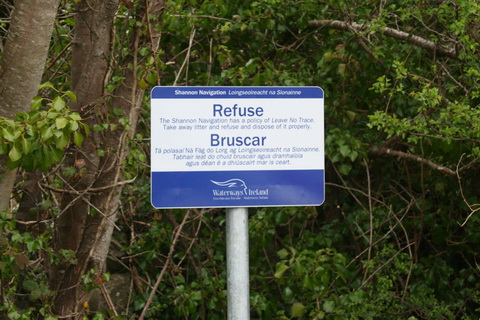
Refuse, it says: The Shannon Navigation has a policy of Leave No Trace. Take away litter and refuse and dispose of it properly.

Unfortunately Ryanair limits the amount of stuff a visiting tourist can carry home on an aeroplane.


Funding the Sheugh

The Sunday newspaper read by the better class of person tells us today [paywalled]:

Coalition frees up cash for construction

The government has signalled that it intends to spend more money next year on building projects in a bid to use spare cash, including savings from the promissory note deal, to stimulate the economy and promote job creation.

The Department of Public Expenditure has written to other government departments asking them to submit lists of capital projects in addition to what has already been planned.

The projects selected are likely to include housing, retro-fitting of housing stock, schools, local roads, primary care centres and other health facilities and it is hoped to boost job creation, especially in the decimated construction sector. It is likely that preference will be given to “shovel-ready” projects that can be progressed to the tender stage almost immediately.

I suppose it’s a change from piers and seed potatoes and other famine relief works. I wonder what the Department of Arts Heritage and the Gaeltacht will be digging out of its bottom drawer.

53 Percy Place, Dublin

53 Percy Place, Dublin

And I wonder whether 53 Percy Place, which was to be sold, and was expected to raise €1 600 000 for the Clones Sheugh, will still be in WI’s hands in a year or two.


Bell, book and candle …

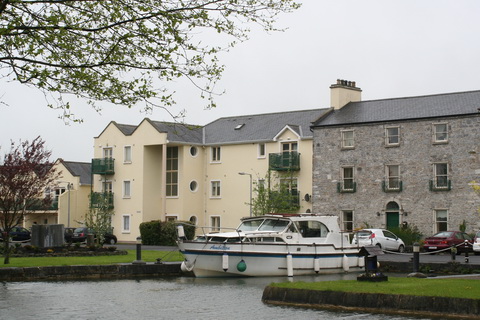
… shall not drive me back, but something has driven boats from the Bell Harbour in Monasterevan, which I can’t recall seeing so empty: just one cruiser and one WI workboat.

Monasterevan May 2013 03_resize

Cruiser at the Bell Harbour

Monasterevan May 2013 01_resize

WI workboat at the Bell Harbour

Actually, I’m not sure whether it is a WI workboat: I can’t see any logos or other ID on it.

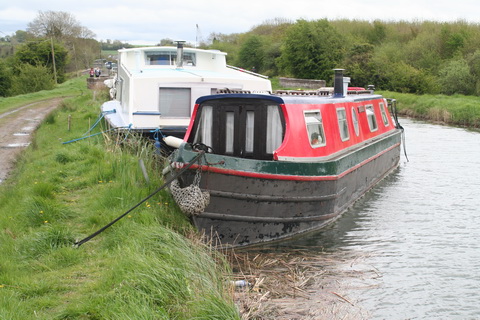
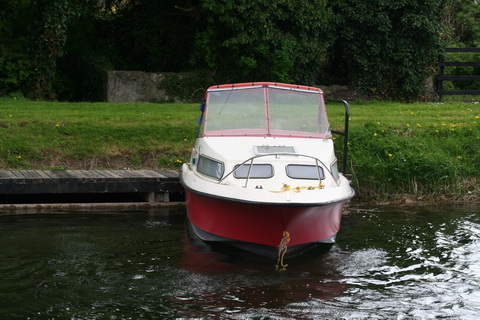
Swinging moorings

If you own either of these boats, you might like to check your mooring lines.

Barrow Otter between the aqueducts

Barrow Otter between the aqueducts

Small boat at Robertstown_resize

Small boat between the Robertstown slipway and Lowtown

Incidentally, the roadway between Robertstown and Lowtown is in dreadful condition.