Tag Archives: barge

Reading list

Waterways Ireland has been putting out more and more stuff on its website.

If you haven’t already seen them, you can get the full set of Product Development Studies, in PDF format, here.

Even more interesting, to this site, are the waterway heritage surveys. Those for all waterways other than the Shannon are available here. The Shannon study was done some years ago (I remember making some comments on it at the time) and will be uploaded “in due course”.

I was in a WI office yesterday and had a quick look at the Lower Bann survey, which was done by Fred Hamond (so we know it will be good), and I’m looking forward to learning more about the waterway I know least about. It is done thematically and has lots of illustrations: Fred is able to see and present the bigger picture, but a full database, with all the supporting information, is available on request.

Maureen O’Sullivan asks sensible questions …

I am happy to report that Maureen O’Sullivan TD [Ind, Dublin Central] asked some sensible written questions in the Dáil on 15 January 2014.

Under the rather odd heading “Waterways Ireland Remit“, she asked Jimmy Deenihan [FG, Kerry North/West Limerick; Minister for the City of Culture]

[…] if he will include work on land maps to determine what land abutting the canals is owned privately, by Waterways Ireland, the Railway Procurement Agency, Iarnrod Éireann, Dublin City Council, Office of Public Works or other; and if he will make a statement on the matter.

The minister replied:

I am informed that Waterways Ireland already has an ongoing programme to modernise historic canal ownership maps and register navigation property in its ownership.

She put another question to Jimmy Deenihan under the same heading; you can see the link between the two questions:

[…] having regard to the prospective re-opening of the Royal Canal towpath at Portland Place in Summer 2014 further to the refurbishment of the collapsed wall at Portland Place and having regard also to the Spencer Dock Greenway Project and the re-lining works to be carried out at the sixth level, if he will direct Waterways Ireland to commission a strategic environment assessment for a new canal-side walkway along the south side of the sixth level of the Royal Canal at Phibsborough from Shandon Gardens to the railway bridge at the seventh lock with a new pedestrian crossing (details supplied); and if he will make a statement on the matter.

The only problem with this is that even getting an environmental assessment done is likely to strain WI’s budget at the moment, so it’s not a good time to be suggesting new expenditure. However, it didn’t matter in this case, as Jimmy Deenihan explained:

I am informed by Waterways Ireland that it does not own the lands on the southside of the Royal Canal between Shandon Gardens and the 7th lock, at Liffey Junction and therefore will not be commissioning a Strategic Environment Assessment for a new canalside walkway.

She also asked Alan Kelly [Labour, Tipperary North] about that:

[…] noting that it is the intention of the National Transport Authority to pursue a cycling and walking greenway along the Royal Canal in Dublin city, if he will ask Iarnród Eireann, the Railway Procurement Agency and Dublin City Council to assess the viability of opening a new walkway along the Royal Canal, 6th level, from Shandon Gardens to the 7th lock with a new footbridge at the 7th lock railway crossing linking to the existing Greenway route; if, in particular, this option will be explored alongside any re-lining work that might be undertaken by Waterways Ireland along that level.

He said:

The development of walking and cycling facilities within the Greater Dublin Area is a matter for the National Transport Authority (NTA) in conjunction with the relevant local authority, which is Dublin City Council in this case.

The NTA provides funding to local authorities for a range of schemes to benefit pedestrians, including new walkways, under the Sustainable Transport Management Grants Programme. Accordingly, I have sent your request to the NTA and have asked them to reply to you directly in relation to the above matter.

I’m all in favour of getting money from other people to pay for waterways.

Finally, under the heading of Inland Waterways Development, she had another question for Jimmy Deenihan:

[…] if he will explore all possible options within current fiscal constraints to advance and develop the potential of the Royal and Grand canal lines that pass through Dublin city; if he will establish an inter-agency group on the Dublin City reaches of the Royal and Grand canals; if he will explore ways to advance their development, examining funding options, including existing funding streams and the leveraging of funding from other sources and the possibility of EU funding which may be available.

I might say at this stage that I don’t see why TDs are asking ministers about stuff that they could find out themselves by asking WI directly. It’s not as though they’re going to get a lot of favourable publicity by doing so: this isn’t the PAC grilling a hospital or charity board and the meeja aren’t really interested.

Anyway, Jimmy Deenihan replied:

As the Deputy may be aware, the Dublin City Canals Study [PDF] was launched on 20th July 2010. This was prepared by consultants on behalf of Waterways Ireland, Fáilte Ireland, Dublin Docklands Development Authority and Dublin City Council. The study examined the existing activities on the Royal and Grand Canals and identified an overall vision for the development of the City Canals within the M50. I am advised that following on from the study an Operations Liaison Group plus two sub-groups (one for the Royal Canal and one for the Grand Canal) were established and continue to meet to deliver the recommendations identified, within the current fiscal constraints.

I am informed that to complement the above study, Waterways Ireland engaged additional consultants to carry out a detailed study of Grand Canal Dock and Spencer Dock with the objective of producing a Master Plan, currently at draft stage, that realises their potential as a recreational amenity and a living, vibrant part of Dublin and its Docklands. Waterways Ireland will continue to work collaboratively to unlock the pivotal role of these two major docks and to attract funding to develop a maritime quarter within the city of Dublin.

I wasn’t very impressed by the Dublin City Canals Study, which didn’t seem to me to be rooted in actual conditions in Dublin. I will look forward to seeing the master plan for the two dock areas.

Anyway, that was a more sensible set of questions from Maureen O’Sullivan, and it kept her off the subject of Effin Bridge.

Grace’s Guide and the Brunswick Dockyard

William Watson, of the City of Dublin Steam Packet Company, held patents for a double canal boat, capable of being shortened to pass through locks, and for a form of composite construction for boats, with iron ribs and wooden planking. I found recently that at least one composite boat was built for the CoDSPCo at the Brunswick boatyard in Ringsend, Dublin.

The invaluable Grace’s Guide had no entry for the Brunswick boatyard/dockyard but, when I mentioned the matter, undertook some research and produced a page about it. Grace’s and I would welcome any more information about that yard; as the Guide says:

The precise location of the dockyard has yet to be identified.

Pat Sweeney’s Liffey Ships and Shipbuilding (Mercier 2010) just mentions Henry Teal [sic]; Irish Maritime History’s list is light on early nineteenth century construction.

I would welcome information about other yards that might have built vessels for the CoDSPCo.


Hospital barge

Richard Hare, writing in Practical Boat Owner February 2014, drew my attention to this ww1 poem by Wilfred Owen..

Composite construction on Irish inland waterways

I wrote here about Watson’s Double Canal Boat, saying inter alia that, in 1839, William Watson, manager of the inland department of the City of Dublin Steam Packet Company, patented:

an improvement in the construction of ships, and which improvement is also applicable to all kinds of sea-going vessels; and also certain improvements in the construction of boats and other vessels intended to be used on canals and inland navigations. [1]

I quoted the Mechanics’ Magazine of December 1839, which said that:

Three canal barges have already been built upon Mr Watson’s plan of construction, of 60 tons burthen each, and with eminent success.[2]

I said that the size suggested that these canal barges were for the CoDSPCo’s Irish inland operations, but that I had no information about where they were built.  I have now found information about one builder.

SHIP BUILDING

On Thursday, the 22nd instant, a fine new trade boat, built with iron ribs, according to the patent of William Watson, Esq., and belonging to the City of Dublin Steam company, also a new smack, 50 tons measurement, were launched from the Brunswick dock-yard, Ringsend Docks.[3]

I would be grateful for more information.


[1] “List of patents granted for Scotland from 18th March to 18th June 1839” in The Edinburgh New Philosophical Journal , exhibiting a view of the progressive discoveries and improvements in the sciences and the arts Vol XXVII No LIII — July 1839; “List of English patents granted between the 25th of May and the 25th of June, 1839” in The Mechanics’ Magazine No 829, Saturday, June 29, 1839

[2] The Mechanics’ Magazine Vol XXXII No 855 28 December 1839

[3] The Freeman’s Journal Saturday 24 July 1841. An almost identical note appeared in the Dublin Evening Mail of Monday 26 July 1841.

Slightly Foxed

WI says today, of its sale of surplus barges:

The ” Fox” workboat/barge currently located at Roosky has been withdrawn from the Sale .

Winter Quarters

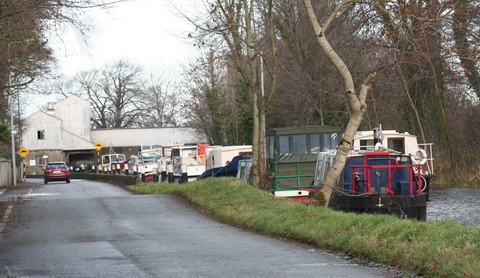
At Leinster Mills, Naas Branch, new year's eve 2013

At Leinster Mills, Naas Branch, new year’s eve 2013

WI lifting boats

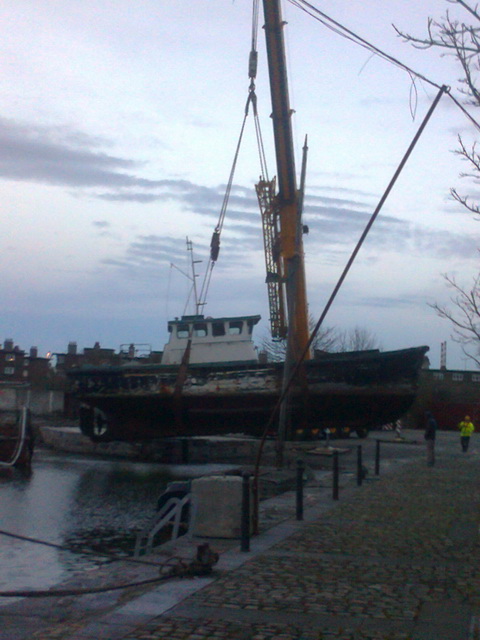
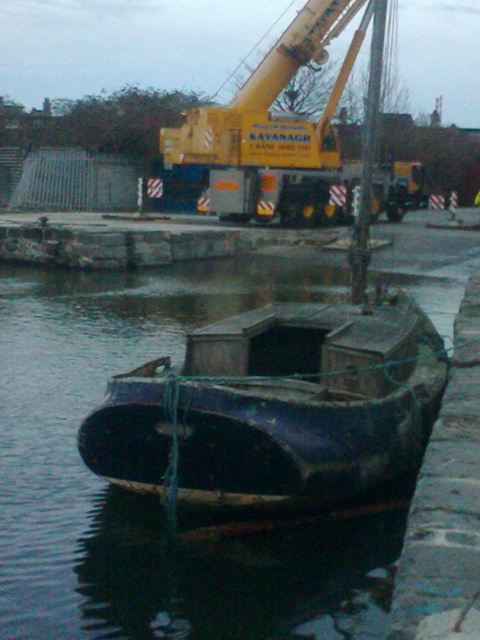
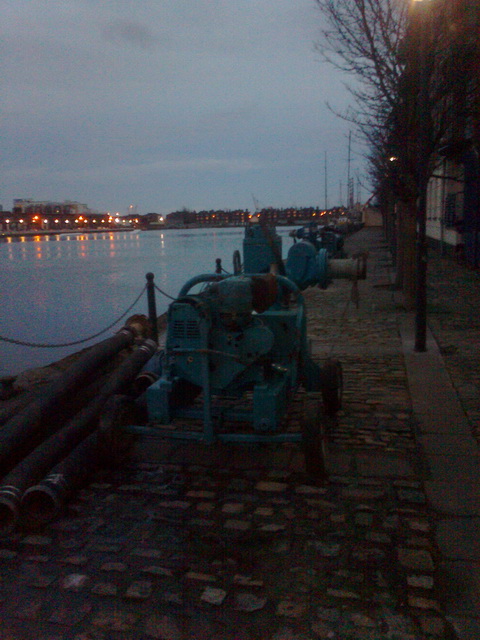
Waterways Ireland removed boats from Charlotte Quay in the Grand Canal Dock at Ringsend today.

being lifted_resize

Being lifted

getting ready_resize

Getting ready

pumps on quay_resize

Pumps on the quay

ready for the slings_resize

Ready for the slings

Thanks to Paul Quinn for the information and photos.

“Ireland has no inland waterways …” says Minister for Transport

Those very words came from Leo Varadkar [FG, Dublin West], Minister for Transport, Tourism and Sport, in a written answer to a Dáil question on 3 December 2013.

I have, of course, quoted him selectively and out of context. The full sentence was

Ireland has no inland waterways within the definition of the EU legislation as Ireland’s inland waterways are not navigable for commercial traffic and we do not have any interconnected inland commercial transport for the purposes, or on the scale, envisaged by EU proposals in this area.

The poor man was responding to yet another question from the Pest of the Royal Canal, Maureen O’Sullivan [Ind, Dublin Central], who was continuing her misguided campaign to get public money from anywhere at all to replace Effin Bridge, the lifting railway bridge at Newcomen Bridge over the Royal Canal in Dublin 1. I reported on her campaign here, here and here, with the last of those showing that current demand for passages is less than the (admittedly restricted) supply. That being so, I cannot see how any expenditure on replacing Effin Bridge could be justified, especially in the country’s current situation and with Waterways Ireland desperate for money. I would, of course, have no objection to any voluntary fund-raising campaign that Ms O’Sullivan might initiate.

Ms O’Sullivan questioned two ministers on 3 December. She asked Leo Varadkar:

…  if his attention has been drawn to Inland Waterway Transport Funding, the Funding Guide for Inland Waterway Transport in Europe published by the European Commission’s Directorate General for Energy and Transport in 2008; the reason the 19 countries’ inland waterways systems referenced in the publication does not include Ireland; if he will ensure that any future edition of the guide will contain a country profile for Ireland including information on major inland waterways and ports together with an overview on the national inland waterways transport funding policy, funding programmes and institutions; and if he will make a statement on the matter.

The saintly and erudite minister replied:

The Funding Guide that the Deputy refers to was published following the launch of the 2006 NAIADES Action Programme, a multi-annual programme on the promotion of inland waterways transport. The Commission has recently decided to update and renew this programme until 2020. Ireland does not have a country profile in the Funding Guide as, in general, Ireland is exempt from EU inland waterways rules and proposals since they relate to waterways of a greater size and carrying a greater capacity of goods than exist in Ireland. The European Union’s inland waterway network spans 20 Member States with about 37,000 kilometres of inland waterways. Every year, these transport around 500 million tons of cargo, in particular in the densely populated and congested areas of Germany, the Netherlands, France and Belgium.

Ireland has no inland waterways within the definition of the EU legislation as Ireland’s inland waterways are not navigable for commercial traffic and we do not have any interconnected inland commercial transport for the purposes, or on the scale, envisaged by EU proposals in this area.

My Department is responsible for licensing all commercial inland craft in Ireland. There are no commercial cargo craft on Ireland’s inland waterways, apart from some small workboats. There are a number of domestic passenger boats and ships operating locally as tourist excursion vessels.

Ireland keeps a watching brief on EU inland waterways matters, mainly to ensure that any proposals do not conflict with, or overlap, the existing maritime safety regimes.

I expect that Ms O’Sullivan will be back shortly to propose the setting up of a horse-drawn barge fleet on the Royal Canal, returning Ireland to the late eighteenth century, to which the Irish left (and republicans) seem so devoted.

Her other questions were to Jimmy Deenihan [FG, Kerry North/West Limerick], Minister for Arts, Heritage and the Gaeltacht. She asked:

… if he will identify the various State agencies whose operations bear upon the management of the Royal Canal and the steps they are taking, individually or collaboratively; if he will increase commercial-leisure use of the Royal Canal since the reopening of Spencer Dock to navigation in 2010; and if he will make a statement on the matter.

… if the European Regional Development Fund has been considered as a possible source of funding towards the costs, estimated at over €5 million, of overcoming obstacles to navigation, namely, the lifting bridge and the fixed Spencer Dock bridge on the sea level of the Royal Canal; and if he will make a statement on the matter.

The patient and polite minister said:

[…] Waterways Ireland is the navigation authority for the Royal Canal and is responsible for the management, maintenance and development of the Royal Canal, principally for recreational purposes. Waterways Ireland undertook the work to re-commission the Royal Canal prior to its reopening in 2010 and continues to develop the canal and its facilities, and promote its use for recreation.

I am advised that Waterways Ireland has not sought funding to redevelop the lifting bridge referred to by the Deputy and has no plans to seek such funding at this time. Ongoing operation of the bridge continues to be kept under review with Iarnród Éireann, while Dublin City Council remains responsible for the operation of the Spencer Dock Bridge at Sheriff Street.

And rightly so.

Note that the €5 million figure referred only to Effin Bridge; replacing Sheriff Street Bridge would be another kettle of fish.

Lowtown Canal Yard is for sale

Details here.

If I won the lottery I’d buy it myself. Sad to see Robert and Caroline Few selling, after many years of service to the canal; I wish them all the best in the future.