Tag Archives: Clare

Lough Derg in 1820

Troll along (h/t Co Kildare Online Electronic Historu Journal) to the National Archives new online section showing the papers of the Chief Secretary of Ireland. So far they’ve put up a catalogue for the first five years, 1818 to 1822 inclusive, with images of some pages, including 17 maps and drawings.

The second map shows the Ballyteigue Canal in Co Wexford, the third is John Killaly’s map of Lough Derg in 1820 and the fourth (which is as far as I’ve got in looking through them) shows Cappa Pier at Kilrush. They’re a bit small when seen online, but you can select (and save a copy of) a PDF version.

Big it up for the National Archives and for Professor Francis J Crowley, whose bequest made this possible.

Killaloe and Ballina

Nice to see they’re going to get a Discover Day.

Limerick bridge

Just as Killaloe is to have a new bridge, so too is Limerick. Or perhaps more than one …. This page (on a site whose ownership I do not know) has a map of proposed routes for the proposed Limerick Northern Distributor Road, which is to provide a northern bypass of Limerick. You can read about it on the websites of the promoters, Limerick County Council, Clare County Council and Limerick City Council. You can download stuff. And you will be pleased to hear that there are to be consultations (only not many of them).

This road is to be built in two phases, the first covering the area from west of the city to Parteen and the second from there to the old Dublin road (N7 as was, now demoted to the status of boreen). There are (or were) several options for each section, but the decision to cross the navigation at the Ardnacrusha tailrace, between the power station and the existing bridge, seems to be set in, er, concrete: that is, it seems, where the ESB wants it.
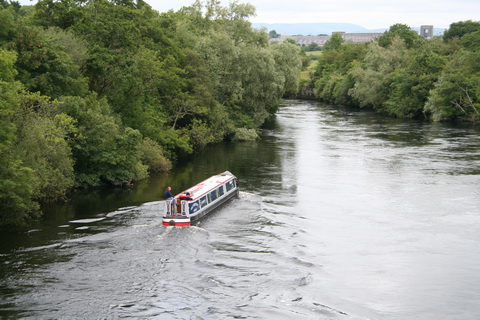
Ardnacrusha and the tailrace seen from the existing bridge at Parteen

The current consultation is about Phase 2, south-east from Parteen. There are several possible routes.

Two of them, B1 and B2, would cross the Shannon downstream of Plassey and the Black Bridge; they would not cross the Plassey–Errina Canal. It would be important to ensure that they did not further damage the towing-path and its artefacts on the Limerick side.
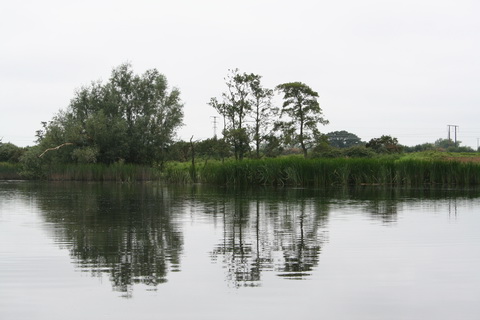
The west bank below Plassey

Four other routes — C1, D1, D2 and E1 — would cross the Plassey–Errina Canal between Gillogue and Wooden Bridge; they would cross the non-navigable Shannon upstream of Plassey, between there and a point just above the confluence of the Mulcair. C1 seems to run very close to Gillogue Lock, although that may be an effect of the scale of the route markings.
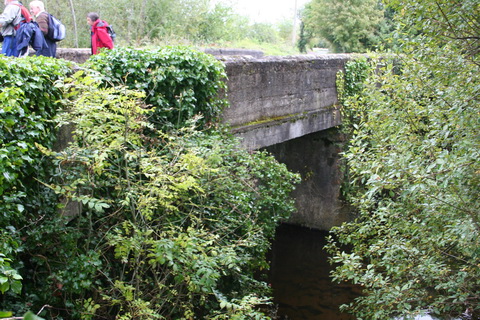
Woodenbridge (which isn't)

I am sure that the ESB will look after the interests of the existing navigation (through Ardnacrusha) and that Waterways Ireland will look after those of the former navigation (the river to Plassey and the canal thence to Errina). However, it might be worthwhile lobbing in a comment to TPTB, first to sttress the heritage value of the abandoned navigation and second to suggest that a new road near Plassey might improve rather than diminish access to that area.

One final thought: this new road seems likely to put the final nail in the coffin of the Limerick Tunnel under the Shannon estuary downstream of Limerick. I very much enjoy using the tunnel, but many folk are deterred by the charges and they drive through the city instead — or, worse, cross the Shannon at O’Briensbridge. As a result, revenue is less than expected, so the traffic guarantee mechanism means that the National Roads Authority has to compensate the tunnel operators.

So now that a new, free, presumably fast road is to link the east and west sides of the city, what will happen to the numbers of vehicles using the tunnel and to the taxpayers who are ultimately paying the compensation? They’ll pay more. The tunnel is on a national primary route, so it’s the NRA’s problem, whereas the new bypass is a regional or local route, which is in the hands of the local authorities.


=p-po-

Killaloe bridge

The Irish Times tells us that the proposed new bridge at Killaloe will be built. The preferred route would cross the canal at Moys, below the breach in the wall,  and, on the Tipperary side, feed into the existing roundabout at the junction of the R494 and R496.

The Preliminary Design Report for the project said:

There is an existing canal alongside the river on the west side, which served a navigational function up to the time of the construction of the Parteen Weir and the raising of the water level in the river. The canal is now inundated by the river as a result of the raising of the water level, and now merely forms a parallel channel alongside the river. A strip of land some 25m wide separates the river from the canal, which is approximately 10m to 12m wide at the bridge site. As the river is now fully navigable, the canal serves no navigational function except that recreational vessels wishing to access properties on the western shore can only do so by entering the canal through certain access points, and travelling along the canal to their desired destination on the shore.

It seems that Waterways Ireland (god bless ’em) insisted that the canal remain navigable:

[…] Waterways Ireland have now requested that passage along the canal be retained, and have advised that they intend to refurbish the canal as a recreational amenity.

A culvert is therefore to be built over the canal, but not a low-level culvert:

[…] Waterways Ireland require that the structure provide a minimum of an 8 metre wide waterway with a 4 metre wide towpath for vehicle and pedestrian access. They require the provision of a minimum headroom of 3.86 metres above normal water level, and a bed level not higher than the downstream cill of the canal lock at Killaloe/Ballina Bridge.

The section of canal will be dewatered during construction work.

These quotations are from Shannon Bridge Crossing Preliminary Design Report Rev F01 by RPS Consulting Engineers in October 2006. I am unable to find, on the Clare County Council website, any later documents that might assure me that the canal crossing provisions still apply. That’s not to say that they don’t; it may just be that the Council doesn’t think citizens need up-to-date information on the matter.


Annoying the neighbours

It would be unfair to condemn the proposed opening of a canal to Clones without also condemning the proposed reopening of the Park Canal in Limerick (and the Newry, when I get around to it). The link is to a top-level page; the first substantive page has a lead to the second, the second to the third and so on up to the fifth.

Fracking Leitrim

This morning, on the wireless, I heard two people opposing the use of fracking to find gas around Lough Allen in Co Leitrim. Neither of them was convincing. One started by objecting to big multinationals being given licences to investigate the resources available; it is not clear that there was any ban on small native companies or workers’ cooperatives (or soviets of workers, peasants and soldiers) applying for licences, and presumably they could use traditional Irish implements like sleans if they wanted to.

The general line of argument adopted by the objectors was that anything that could go wrong would go wrong, probably all at the same time, wiping out the whole of Irish agriculture (some of which is not in Leitrim) and, er, eco-tourism. There would, the objectors seemed to suggest, be no preventive or mitigating measures and no insurance and the full cost of every accident would be borne by the residents of the area.

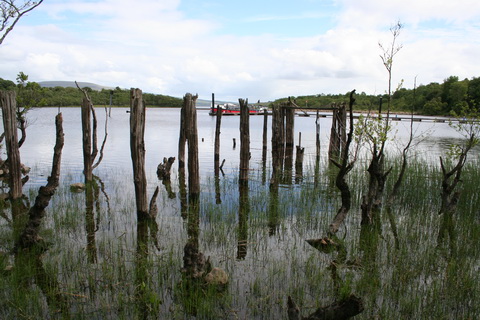
Remains of a pier at the brickworks, Spencer Harbour, Lough Allen


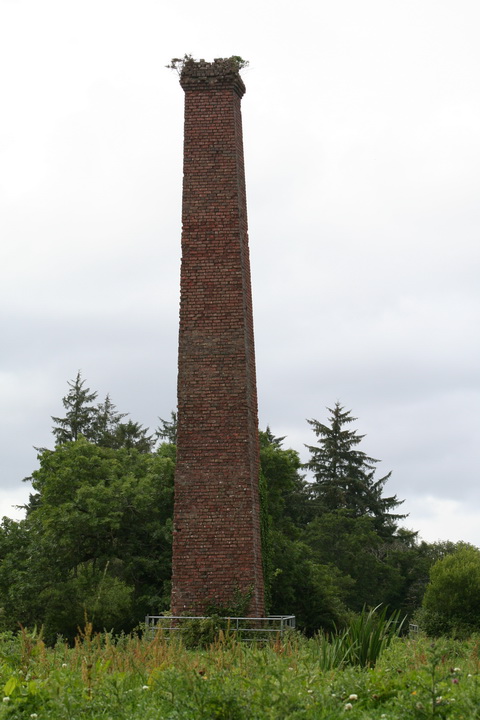
But the bit that really annoyed me was the depiction of the area as one of rural seclusion. Yet Lough Allen had canals, railways, coal mines, dams, iron works and brick works.

Spencer Harbour on Lough Allen


The very canal linking Lough Allen to the
rest of the Shannon Navigation owes its very existence to the desire
to carry coal from around Lough Allen to Dublin. And one of the most best tourism initiatives in the area, the Arigna Mining Experience, recognises that heritage.

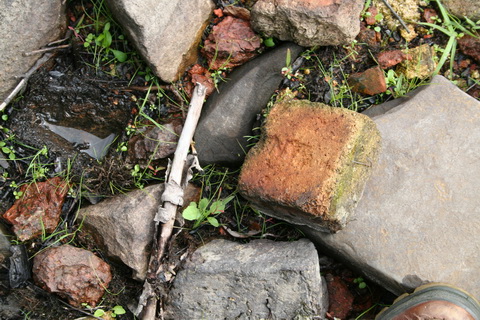
Part of a brick


Insist on proper assessment and management of risk by all means, but don’t exaggerate it — and don’t ignore Leitrim’s industrial heritage.


The Limerick Navigation

As a preliminary to increasing coverage of the old Limerick Navigation, I have improved the section’s top-level page. I added maps of the separate sections of the navigation and distances (in eighths of miles) from Prothero and Clark.


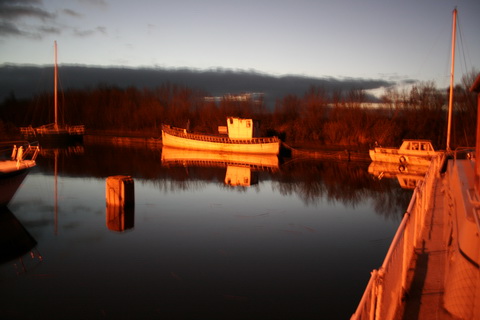
Dromaan at night

Dromaan at night (December 2011)

SS John Randolph

The SS John Randolph, described as “America’s first successful iron ship in commerce”, is commemorated by a historical marker in Savannah, Georgia, USA.

The John Randolph was one of the first six iron vessels built by Lairds of Birkenhead (later merged into Cammell Laird). The other five were built for use on the River Shannon.

Pat Lysaght to the rescue

The Limerick Leader has a story that updates my piece on Limerick dredging.