Tag Archives: Dublin

Draining Lough Derg

The ESB is currently letting more water down the old course of the Shannon, from Parteen Villa Weir through O’Briensbridge, Castleconnell and the Falls of Doonass. This channel gets the first 10 cubic metres per second from the Shannon; the next 400 go through Ardnacrusha and anything left over is sent down the old course.

The result is to help to reduce the water level on Lough Derg while raising it on the old course.

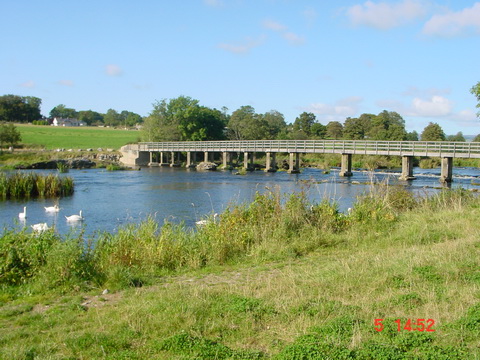
The footbridge in Castleconnell at normal summer level in 2002

The footbridge in Castleconnell at normal summer level in 2002

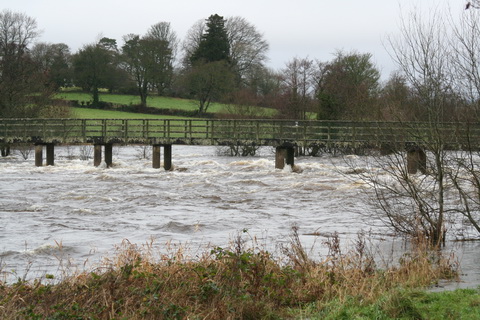
The footbridge on 1 January 2014

The footbridge on 1 January 2014

Before Ardnacrusha was built, the old channel took the entire flow of the Shannon, so it can take more than it has now.

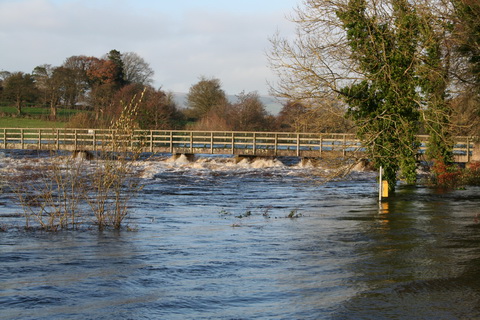
The footbridge in the floods of November 2009

The footbridge in the floods of November 2009

The level is still below that of 2009, when the land around the old channel flooded in several places. But much land is waterlogged: I saw yesterday that the upper reaches of the Nore, the Barrow and other rivers were in flood. And more rain is forecast.

Wouldn’t it be nice if some of that could be sent to Dublin instead? I see that some folk claim (on what looks like a website that hasn’t been updated for a while) that the evil Dublin folk want to extract 350 million litres of water from the Shannon every day; the original idea was to take it from Lough Ree but now it seems that Lough Derg is the preferred source.

Now 350 million litres sounds like a lot, but it’s 350 000 cubic metres per day, 14 583.3 per hour, 243.05 per minute, 4.05 per second, which is less than 1% of normal flow through the two channels draining Lough Derg. There’s a lot more at the moment, and the good citizens of Dublin are welcome to come down and fill their buckets. I suspect that Clare TD Michael McNamara has got things out of proportion.

Addendum: 350 million litres per day, over a lake whose area is 130 square kilometres, would lower the level of the lake (if my calculations are correct) by 2.69 millimetres. If no water entered the lake, the level would be down 983 mm after a year, ignoring evaporation and other abstractions and assuming that the Shannon and other tributaries no longer flowed in and that there was no rain.

Saving the nation part 97

Clip_resizeThat’s from the government’s Medium Term Economic Strategy 2010 [PDF]. Not a word about the Clones Sheugh, which would undoubtedly save the economies of both jurisdictions on this island, but perhaps it will qualify for one of the new models of infrastructure funding mentioned hither and yon in the document.

Maybe the Sunbeds Bill would be more interesting – or more important.

PS Folk who write “between both” should be flogged naked through the streets before being hanged in the marketplace.

WI lifting boats

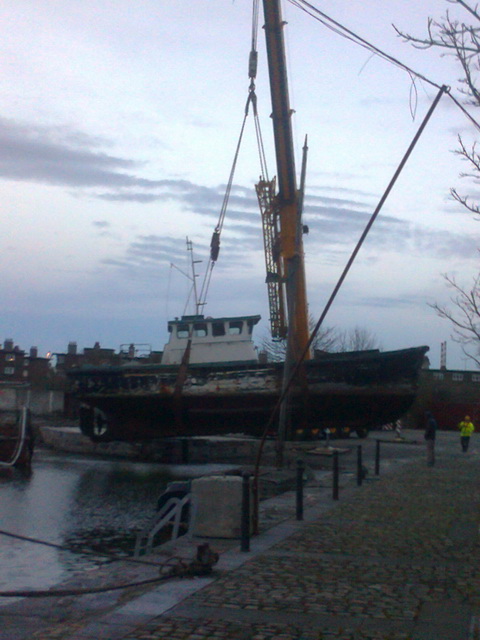
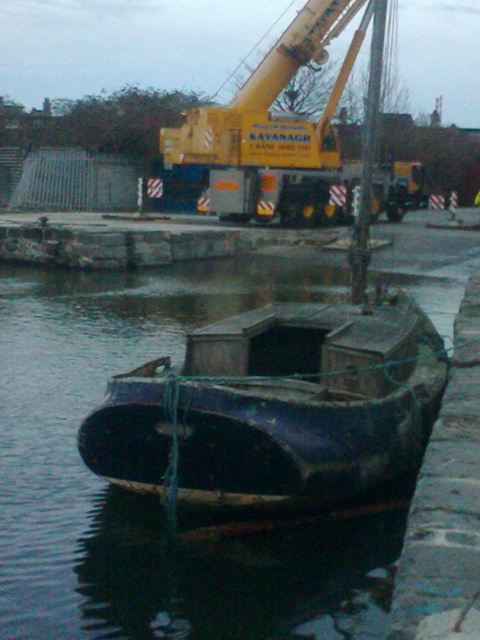
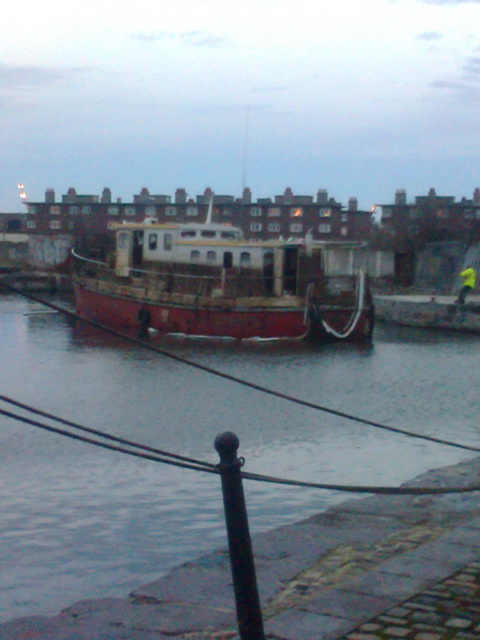
Waterways Ireland removed boats from Charlotte Quay in the Grand Canal Dock at Ringsend today.

being lifted_resize

Being lifted

getting ready_resize

Getting ready

pumps on quay_resize

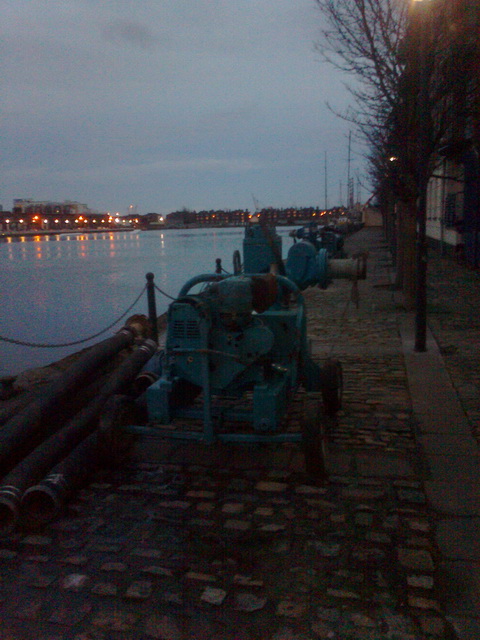
Pumps on the quay

ready for the slings_resize

Ready for the slings

Thanks to Paul Quinn for the information and photos.

“Ireland has no inland waterways …” says Minister for Transport

Those very words came from Leo Varadkar [FG, Dublin West], Minister for Transport, Tourism and Sport, in a written answer to a Dáil question on 3 December 2013.

I have, of course, quoted him selectively and out of context. The full sentence was

Ireland has no inland waterways within the definition of the EU legislation as Ireland’s inland waterways are not navigable for commercial traffic and we do not have any interconnected inland commercial transport for the purposes, or on the scale, envisaged by EU proposals in this area.

The poor man was responding to yet another question from the Pest of the Royal Canal, Maureen O’Sullivan [Ind, Dublin Central], who was continuing her misguided campaign to get public money from anywhere at all to replace Effin Bridge, the lifting railway bridge at Newcomen Bridge over the Royal Canal in Dublin 1. I reported on her campaign here, here and here, with the last of those showing that current demand for passages is less than the (admittedly restricted) supply. That being so, I cannot see how any expenditure on replacing Effin Bridge could be justified, especially in the country’s current situation and with Waterways Ireland desperate for money. I would, of course, have no objection to any voluntary fund-raising campaign that Ms O’Sullivan might initiate.

Ms O’Sullivan questioned two ministers on 3 December. She asked Leo Varadkar:

…  if his attention has been drawn to Inland Waterway Transport Funding, the Funding Guide for Inland Waterway Transport in Europe published by the European Commission’s Directorate General for Energy and Transport in 2008; the reason the 19 countries’ inland waterways systems referenced in the publication does not include Ireland; if he will ensure that any future edition of the guide will contain a country profile for Ireland including information on major inland waterways and ports together with an overview on the national inland waterways transport funding policy, funding programmes and institutions; and if he will make a statement on the matter.

The saintly and erudite minister replied:

The Funding Guide that the Deputy refers to was published following the launch of the 2006 NAIADES Action Programme, a multi-annual programme on the promotion of inland waterways transport. The Commission has recently decided to update and renew this programme until 2020. Ireland does not have a country profile in the Funding Guide as, in general, Ireland is exempt from EU inland waterways rules and proposals since they relate to waterways of a greater size and carrying a greater capacity of goods than exist in Ireland. The European Union’s inland waterway network spans 20 Member States with about 37,000 kilometres of inland waterways. Every year, these transport around 500 million tons of cargo, in particular in the densely populated and congested areas of Germany, the Netherlands, France and Belgium.

Ireland has no inland waterways within the definition of the EU legislation as Ireland’s inland waterways are not navigable for commercial traffic and we do not have any interconnected inland commercial transport for the purposes, or on the scale, envisaged by EU proposals in this area.

My Department is responsible for licensing all commercial inland craft in Ireland. There are no commercial cargo craft on Ireland’s inland waterways, apart from some small workboats. There are a number of domestic passenger boats and ships operating locally as tourist excursion vessels.

Ireland keeps a watching brief on EU inland waterways matters, mainly to ensure that any proposals do not conflict with, or overlap, the existing maritime safety regimes.

I expect that Ms O’Sullivan will be back shortly to propose the setting up of a horse-drawn barge fleet on the Royal Canal, returning Ireland to the late eighteenth century, to which the Irish left (and republicans) seem so devoted.

Her other questions were to Jimmy Deenihan [FG, Kerry North/West Limerick], Minister for Arts, Heritage and the Gaeltacht. She asked:

… if he will identify the various State agencies whose operations bear upon the management of the Royal Canal and the steps they are taking, individually or collaboratively; if he will increase commercial-leisure use of the Royal Canal since the reopening of Spencer Dock to navigation in 2010; and if he will make a statement on the matter.

… if the European Regional Development Fund has been considered as a possible source of funding towards the costs, estimated at over €5 million, of overcoming obstacles to navigation, namely, the lifting bridge and the fixed Spencer Dock bridge on the sea level of the Royal Canal; and if he will make a statement on the matter.

The patient and polite minister said:

[…] Waterways Ireland is the navigation authority for the Royal Canal and is responsible for the management, maintenance and development of the Royal Canal, principally for recreational purposes. Waterways Ireland undertook the work to re-commission the Royal Canal prior to its reopening in 2010 and continues to develop the canal and its facilities, and promote its use for recreation.

I am advised that Waterways Ireland has not sought funding to redevelop the lifting bridge referred to by the Deputy and has no plans to seek such funding at this time. Ongoing operation of the bridge continues to be kept under review with Iarnród Éireann, while Dublin City Council remains responsible for the operation of the Spencer Dock Bridge at Sheriff Street.

And rightly so.

Note that the €5 million figure referred only to Effin Bridge; replacing Sheriff Street Bridge would be another kettle of fish.

Lowtown Canal Yard is for sale

Details here.

If I won the lottery I’d buy it myself. Sad to see Robert and Caroline Few selling, after many years of service to the canal; I wish them all the best in the future.

Waterways budgets: cut by one third in six years

I wrote here and here about the RoI budgetary allocations to Waterways Ireland for 2014, here about the difficulty of establishing exactly what WI’s budget is and here about some questions I have put to the Department of Arts, Heritage and the Gaeltacht on the matter.

But, while a focus on the procedural woods is important, I may have been neglecting the implicational trees. I am recalled to a consideration of the details by two written Dáil questions asked by Gerry Adams [SF, Louth] on 19 November 2013, one of Brendan Howlin, Minister for Public Expenditure and Reform, and the other of Jimmy Deenihan, Minister for Arts, Heritage and the Gaeltacht. Reading the runes is reminiscent of Kremlinology, but it seems to be possible that Waterways Ireland will have to make significant cuts in its spending, cuts that will reduce the services it provides to waterways users.

The questions and the answers

This is what Gerry Adams asked Brendan Howlin:

To ask the Minister for Public Expenditure and Reform the total budget for each All Ireland Body established under the Good Friday Agreement for the years 2010 to date in 2013; and any proposed budget reductions to the these bodies currently being considered.

And this is what he asked Jimmy Deenihan:

To ask the Minister for Arts, Heritage and the Gaeltacht the total budget for each of Waterways Ireland, Fóras na Gaeilge and Ulster-Scots Agency for the years 2010 to date in 2013; and any proposed budget reductions to these bodies currently being considered.

Ignoring the details given for bodies other than Waterways Ireland, we learn that its allocations from its two “sponsor departments”, DCAL in NI and DAHG in RoI, were:

2010 €38.99 million
2011 €35.18 million
2012 €31.15 million

These figures appear to include capital and current expenditure.

For some reason,

The 2013 Budget allocation to the Body are subject to on-going discussion by the two Sponsor Departments.

But Jimmy Deenihan said

My Department’s REV provision for Waterways Ireland for 2013 is €25.463m, a 6% efficiency saving on 2012. My Department’s Estimates provision for 2014 is €24.183m, a 5% efficiency saving on 2013.

The extent of the cuts

I don’t know how to get from a REV provision, or indeed an Estimates provision, to WI’s total budget for 2013 or 2014. One possibility is that the figures include capital and current expenditure. In that case, the RoI contribution to WI’s 2013 budget would be €21.383 million current and €4.080 million capital [PDF; see p160]; adding the NI 15% contribution to current would bring that to about €25.156 million; the €4.080 million capital makes €29.236 million. Perhaps there might be a small amount extra for NI capital spending. By the same logic [and I repeat that I don’t know whether this is the way to do it], the 2014 Estimates provision gives €27.752 million plus NI’s capital spending. Without NI capital spending, the total is 71% of the 2010 figure, so WI will have had its total spending cut by 29% in four years.

Another crude calculation is that the 2012 figure of €31.15 million is 80% of the 2010 figure. Knock off Jimmy Deenihan’s 6% in 2013 and 5% in 2014; the 2014 total comes out again at 71% of the 2010 figure.

But that’s not all. Brendan Howlin said:

In common with other public sector bodies North and South, the North South Implementation Bodies are expected to deliver their objectives in a cost effective and efficient manner. In order to provide a framework for this, my Department and the Department of Finance and Personnel, have issued guidance to the North South Implementation Bodies requiring them to achieve a minimum of 4% efficiency savings per annum in 2014, 2015 and 2016.

So we have to cut another 4% in 2015 and 4% in 2016, by which stage the total will be just under 66% of the 2010 figure: a cut of one third in six years.

Coping

The brunt of the cuts has been borne by the capital budget; we have no figures for expected NI capital spending from 2013 onwards, but on the RoI figures capital spending by 2016 will have been cut by 70%. That seems to have been the general pattern in the Irish public service: cut capital spending first, cut staff costs last.

WI’s operating income is negligible: in 2011 it was €71,000 from licences, €120 from property and €193,000 from permits, lock charges etc, as well as a few other bits and pieces; it is almost entirely reliant on its sponsor departments. So if it is to cope with reduced departmental income, it must either devise new and significant earning opportunities quickly or make serious cuts to its services.

WI’s spending is categorised under five headings, one of which (currency gains or losses and interest) involves a tiny amount. The other four are depreciation, which can’t readily be cut, staff costs, “programme costs” and “other operating costs”.

The “other operating costs” are:

Travel
Recruitment costs
Training and conferences
Contracted in services
Compensation/provision for liability claims
Premises running costs including utilities
Health and safety
Communications
Other operating lease rental
Printing and stationery
Computer running costs
Rent
Audit fee
Marketing and promotions
Insurance and legal fees
Pension administrator costs
General expenditure.

The 2011 total was €5,026,000. None of the individual items looks as if it could provide huge savings, although I imagine each category is being shaved.

The programme costs are allocated to individual waterways; in 2011 (the latest available accounts) the total was €8,082,000, and 63% of those were incurred on the Grand, Royal and Barrow. The Royal’s programme costs were up in 2011, with the reopening, but the Grand’s were cut by 25% and the Barrow’s by 17%. You can’t keep cutting at that sort of rate every year, but I suspect that the Grand, Royal and Barrow will continue to be cut more than the Shannon, Erne and SEW (the Lower Bann cost is tiny).

WI’s main cost is staff: €21,903,000 in 2011, up very slightly on the previous year. I don’t know what cuts have been made in hours or rates (I have heard that there is an overtime ban) but I suspect we haven’t seen the last of them.

At this stage, I imagine that the easy cuts have been made; further cuts may require some combination of

  • reductions in services to users
  • major changes in work practices
  • cuts in staff costs.

There are interesting times ahead.

One small pointer

I noted that, when Jimmy Deenihan spoke in the Dáil on 16 October 2013, he said that WI’s “core activities and targets” included

… keeping the waterways open for navigation during the main boating season.

The last five words [emphasis mine] may be significant: Mr Deenihan may have been hinting that boating is no longer to be regarded as a year-round activity.

Questions, questions

I reproduce below the text of an email I have sent to the press office at the Department of Arts, Heritage and the Gaeltacht, which is responsible for waterways in RoI. Though you wouldn’t think it; DAHG’s home page has this list of activities on the left-hand side:

Arts
About Us
Culture
Heritage
20-Year Strategy for the Irish Language 2010–2030
Irish
Islands
An Ghaeltacht
Aran LIFE+ Posts
Ministers
Public Service Reform
National Famine Commemoration 2013
National Ploughing Championships
EU Presidency
Censorship of Publications
Press Releases
Publications
Speeches
Consultations
Links
Contact Details

Nothing about either waterways or northsouthery (which is the category into which waterways fall).

Anyway, here are the questions I asked.

1. On 19 November 2013, in a written answer to Gerry Adams, Jimmy Deenihan said:

My Department’s REV provision for Waterways Ireland for 2013 is €25.463m, a 6% efficiency saving on 2012. My Department’s Estimates provision for 2014 is €24.183m, a 5% efficiency saving on 2013.

I would be grateful if you could tell me what a REV provision is.

2. Your minister also said:

The 2013 and 2014 Budget allocations to the Bodies are subject to ongoing discussion by the two Sponsor Departments and will require, of course, formal approval by the NSMC.

I would be grateful if you could tell me (a) why Waterways Ireland’s budget had not been finalised when 88% of the year had passed and (b) how that affected budgetary management in the Body.

3. I would be grateful if you could tell me when Waterways Ireland’s report and accounts for 2012 will be published.

4. I would be grateful if you could tell me when Waterways Ireland’s plan for 2014 and subsequent years is to be published and what public consultation there has been on it.

5. On 16 October 2013 Jimmy Deenihan said in the Dáil that WI’s

core activities and targets

include

keeping the waterways open for navigation during the main boating season.

I would be grateful if you could tell me whether that formulation represents any forthcoming change in WI’s practices in keeping waterways open outside the main boating season.


Effin stats

I wrote here about Maureen O’Sullivan’s questioning of ministers about Effin Bridge, the lifting railway bridge below Newcomen Bridge on the Royal Canal in Dublin. It seems that she would like a drop-lock to replace the bridge, thus enabling boats to pass under the railway at any time without interfering with the operation of the trains. Which would be very nice, but that it would cost over €5 million and cause significant disruption to the railway during construction.

I was distressed by Ms O’Sullivan’s failure to make any sort of economic case for the drop-lock or for any other measure that might allow for free movement of boats on that section of the Royal Canal. I said:

As the expenditure on reopening the Royal Canal is a sunk cost, I am all in favour of making its use easier — provided that it can be demonstrated that (a) there is a demand for increased use, (b) such increased use will have benefits that outweigh the costs of any improvements and (c) no alternative investment offers better returns. As far as I can see, Ms O’Sullivan has demonstrated none of the three: indeed I see no evidence that she has even considered them.

Ms O’Sullivan’s position might be described as favouring an increase in the supply of possible passages along that section of the canal, but I thought it might be interesting to know what the demand for such passages was, so I asked Waterways Ireland how many boats had passed under Effin Bridge in 2013.

I was wrong about the number of days on which the bridge was lifted: nine lifts were available altogether. Six were on Tuesdays, two on Saturdays and one on a Sunday (to facilitate the Dublin boat rally):

Tuesday 16 April 2013:           0 boats
Tuesday 30 April 2013:         10 boats
Sunday 5 May 2013:            24 boats
Tuesday 21 May 2013:           0 boats
Saturday 1 June 2013:           8 boats
Tuesday 18 June 2013:           2 boats
Saturday 20 July 2013:          3 boats
Tuesday 13 August 2013:       7 boats
Tuesday 17 September 2013:  4 boats

So that’s 58 boats in a year.

I asked what the cost was: I was told that Irish Rail charges €1200 per weekday lift and €2000 per weekend lift. I presume that Waterways Ireland itself incurs other costs, perhaps overtime at weekends, but I don’t know what they are. The cost per boat for each lift was:

Tuesday 16 April 2013:           0 boats: lift cancelled as no boats wanted it
Tuesday 30 April 2013:         10 boats: €120.00 per boat
Sunday 5 May 2013:            24 boats: €83.33 per boat
Tuesday 21 May 2013:           0 boats: lift cancelled as no boats wanted it
Saturday 1 June 2013:           8 boats: €250.00 per boat
Tuesday 18 June 2013:           2 boats: €600.00 per boat
Saturday 20 July 2013:          3 boats: €666.67 per boat
Tuesday 13 August 2013:       7 boats: €171.43 per boat
Tuesday 17 September 2013:  4 boats: €300.00 per boat

The total charged to Waterways Ireland (not to the boaters) by Irish Rail was €10800.00.

Suppose that a drop-lock had been built for €5000000. Would it be worth investing that amount to save an annual expenditure of €10800? I suspect not, although I am open to correction by anyone capable of calculating NPVs or other relevant measures.

It seems to me, though, that the case for any capital expenditure is weak while demand for passages is lower than supply. Perhaps Royal Canal enthusiasts might work on attracting more boats to the Dublin end, whether from the Shannon end or from the Grand and Liffey.


Ticking all the boxes

Sometimes an idea comes along that is just so good, so right, so advantageous on all counts that it is simply irresistible. This idea comes from the Americas, from the US Coast Guard. Adapted to the Irish inland waterways, and specifically to the Shannon, it could:

  • help to promote industry in recession-hit rural areas
  • create direct employment
  • help to stimulate indirect employment
  • promote Irish energy independence by reducing reliance on imported hydrocarbons
  • counter pollution of water-courses
  • reduce the number of heavy trucks using remote rural roads
  • use environmentally-friendly water transport, by barge along the Shannon
  • honour and promote the industrial heritage of Co Leitrim and the transport heritage of the Shannon
  • help to defray the costs of maintaining the Shannon Navigation
  • solve Dublin’s water supply problem, at least for non-potable water.

How could anybody resist?

The US Coast Guard has proposed that wastewater from fracking [PDF] should be transported by barge, rather than by truck or railway train, from the fracking sites to remote storage or treatment facilities. So, when fracking begins around Lough Allen, the wastewater could be carried down the Shannon by barge and, if necessary, pumped to Dublin.

It sounds like a winner to me.

Bolshevism, boats and bridges

The balance bridge crossing the canal, near Newcomen-bridge, as designed and erected under the superintendence of Mr Bindon Stoney, engineer of the Dublin Port and Docks Board, has been completed, and adds considerably to the facilities for carrying on the traffic. This bridge has been erected in substitution of a lift-bridge, constructed in 1872, but to which an unfortunate accident occurred in February, 1878.

Ralph S Cusack, Chairman, in the report of the Directors of the Midland Great Western Railway, 19 February 1879, quoted in the Freeman’s Journal 27 February 1879

In mid-October I mentioned that Maureen O’Sullivan [Ind, Dublin Central] had asked the unfortunate Jimmy Deenihan [FG, Kerry North/West Limerick, and minister for waterways] about Effin Bridge, the lifting railway bridge below Newcomen Bridge on the Royal Canal in Dublin. The bridge is lifted, to allow boats through, on [IIRC] one Saturday each month in the summer, making five lifts a year. Waterways Ireland says on its website [click Bridges if necessary]

The Newcomen Lift Bridge in Spencer Dock is owned and operated by Irish Rail, and requires a rail possession to be lifted. It can only be lifted for boats at limited prearranged times organised with Waterways Ireland. For details of opening times and to arrange passage contact the Eastern Regional Office on 01 868 0148.

Maureen O’Sullivan wanted

… a meeting of interests concerned with the operation of the lifting bridge with a view to devising a management and operational system that is less hostile to the use of the waterway as currently it is an impediment and discouragement to navigation on the Royal Canal and an obstacle to navigation-communication between the Royal Canal and River Liffey and between Royal Canal and Grand Canal at their eastern reaches […].

Jimmy Deenihan said

The bridge is operated by Irish Rail staff on a request basis at Waterways Ireland’s expense.

However, he wasn’t giving any hostages to fortune by making rash promises or even by commenting on whether the bridge was an impediment to navigation. But Ms O’Sullivan was undeterred: she returned to the topic with two written questions on 5 November 2013 and a priority question, no less, on 7 November 2013 [for certain values of “priority”]. On 5 November she asked two questions of Jimmy Deenihan

To ask the Minister for Arts, Heritage and the Gaeltacht further to Parliamentary Question No. 59 of 16 October 2013, the extent of railway track that needs to be closed by Irish Rail in order for a vessel on the Royal Canal, Dublin, to be given access between the First and Sea Levels of the Royal Canal; if there has been an assessment of whether the extent of track closure could be reduced to facilitate greater ease of navigation on the Royal canal; and if he will make a statement on the matter.

To ask the Minister for Arts, Heritage and the Gaeltacht further to Parliamentary Question No. 59 of 16 October 2013, if the option of a introducing a drop lock to replace the need of the lifting bridge has been considered since the establishment of Waterways Ireland or if that assessment was made by Waterways Ireland’s predecessors; the level of use of the sea level assumed in relation to the assessment; if the impact of the Spencer Dock Greenway was taken into account and vice versa, was account taken of the impact on the Greenway were the sea level to be made accessible to navigation by replacing the lifting bridge; if the assessment includes analysis of whether the effective re-opening of the sea level of the Royal Canal to meaningful levels of year-round traffic would be consistent with the EU’s commitment to the ‘protection and preservation of cultural heritage, in view of the fact that Dublin’s waterway’s heritage is part of the cultural infrastructure of Europe, contributing to economic attractiveness, job opportunities and quality of life; and if he will make a statement on the matter.

The ever-patient Mr Deenihan replied:

I am advised that the option of constructing a drop lock to replace the need for the lifting bridge at the location in question has been considered by Waterways Ireland but it was not deemed viable due to the estimated costs involved, given that the minimum cost for a drop lock to replace the bridge would be of the order of €5m. Work to install a drop lock at this location would also involve considerable temporary works, the extent of which would be unknown until ground conditions were assessed in detail.

I am also advised that there have been no assessments or analyses undertaken by Waterways Ireland in respect of the level of use or impact on the Spencer Dock Greenway.

I can inform the Deputy that the length of railway track disconnected from the rest of the loop line from the station when the bridge is in the ‘up’ position is approximately 16 metres. However, as the control and operation of the railway line in the vicinity of the lifting bridge lies entirely with Irish Rail, only it can indicate the extent of the permanent rail line that needs to be closed when the bridge is opened.

He might also have pointed out that €5m is more than WI’s entire capital budget, which is under €4m for all southern waterways for 2014. And if he were an argumentative chap, he might have pointed out that there is no evidence of a demand for

… the effective re-opening of the sea level of the Royal Canal to meaningful levels of year-round traffic …

and no evidence that it would be of any economic benefit to anyone, least of all the residents of Dublin Central, even if boats were travelling that way every day of the week.

He might, if he were an impatient sort of chap, have pointed to the idiocy of the “cultural heritage” argument: with one or two minor exceptions, pleasure craft were not part of the “cultural heritage” of the Royal but, even if they were, such “heritage” wouldn’t be worth millions that might be spent instead on bringing soup to the deserving poor of Dublin Central.

Ms O’Sullivan was back with more on 7 November, this time trying to get Leo Varadkar [FG, Dublin West] to get the National Transport Authority to include Effin Bridge and the Sheriff Street non-lifting bridge (not a Scherzer) included in a National Transport Authority study of “the management and movement of people and goods to, from and within Dublin city centre”. Ms O’Sullivan’s rather confused and confusing case seemed to be that there was a greenway, and there were walking and cycling routes along the canal, so a road bridge (that works perfectly well for carrying a road) and a railway bridge (that works perfectly well for carrying a railway) should be included  in the study because the canal has navigational potential.

Or something. She even managed to bring water polo [does she mean canoe polo?] into the argument.

As far as I can see, walking, cycling, road travel and rail travel — and even water polo — are not in any way adversely affected by the current arrangements, while the canal is of negligible importance in the movement of people and goods. Boating on the canal is a leisure activity for a small number of people who are sufficiently well heeled to own pleasure-boats; I am rather surprised to find that their interests are a matter of such concern.

As the expenditure on reopening the Royal Canal is a sunk cost, I am all in favour of making its use easier — provided that it can be demonstrated that (a) there is a demand for increased use, (b) such increased use will have benefits that outweigh the costs of any improvements and (c) no alternative investment offers better returns. As far as I can see, Ms O’Sullivan has demonstrated none of the three: indeed I see no evidence that she has even considered them.

What’s depressing here is the absence of any indication of a rational approach to capital spending on waterways. They’re still cargo: a magical source of wealth, that will bring peace and prosperity as long as we all believe in fairies and avoid facts, thinking and analysis.

No wonder the country is in a state of chassis.

Update 15 November 2013: some information about demand for passage under Effin Bridge.