Tag Archives: Ireland

Early water transport

In a piece about the Augustinian Priory at Athassel, near Golden in Co Tipperary, I wrote

But the really extraordinary thing about Athassel, at least from the waterways viewpoint, is that Dundry stone was used for sculptural (but not for structural) work.

Now, that may mean as little to you as it did to me, until I looked it up and found that Dundry is in Somerset, on the Bristol Channel. The stone could have been taken from there to Waterford by sea and it must have been hauled up the Suir from there.

In the last century, the horse-drawn traffic up the Suir to Clonmel ceased, and Carrick-on-Suir became the effective head of the navigation. But Athassel is at least another twenty miles upstream from Clonmel, and cargoes were brought up there seven hundred or so years ago.

However, traffic in materials for religious establishments was not all one way, and I am indebted to John Ditchfield for the information that some of the oak used in the roof of Salisbury Cathedral was felled in Ireland, on or near the east coast, in the spring of 1222 and used by 1225. Timber from 75 trees has been identified and at least one shipment, by William of Dublin, is recorded in 1224.

Inside Salisbury Cathedral (courtesy of John Ditchfield 2015)

Inside Salisbury Cathedral (courtesy of John Ditchfield 2015)

A 2003 story in the Telegraph says

The wood was bought from “William of Dublin” and carted from Bristol or Southampton.

However, in the English Heritage [now Historic England] report from 2002 on The Tree-Ring Dating of the Roof Carpentry of the Eastern Chapels, North Nave Triforium, and North Porch, Salisbury Cathedral, Wiltshire [PDF], I found nothing about how the timber got from the English coast to Salisbury, which is some distance inland.

It may be, of course, that the Patent Rolls for AD 1224 say what English port was used and how the timber was transported from there to Salisbury. I do not, alas, have a copy of the Patent Rolls to hand and Messrs Google don’t seem to have been able to get hold of them for digitising.

But if the Patent Rolls don’t provide evidence to the contrary, my guess would be that the timber was carried up the Avon. And that might enable Rollalot to insert another date between the first and second in the history of Avon navigation on this page; Rollalot, like me, has read Douglas Caffyn on the right to navigate on rivers.

 

News from the Windsor and Eton Express

A memorial to the lord lieutenant from the gentry and landed proprietors of Sligo, Leitrim, Fermanagh, and Cavan, lies in Enniskillen for signatures. It prays that a canal may be formed which will connect Lough Earne [sic] with Lough Allen, and that again with Lough Gill, which is navigable to Sligo. This, with the canal already sanctioned between Lough Erne and Neagh, will open a communication across the kingdom, from Sligo to the ports of Newry and Belfast. In a commercial point of view, this undertaking is of the greatest importance to Ireland.

Windsor and Eton Express Saturday 28 May 1825

Interesting information about the Ulster Canal …

… as distinct from ministerial reelection photo opportunities.

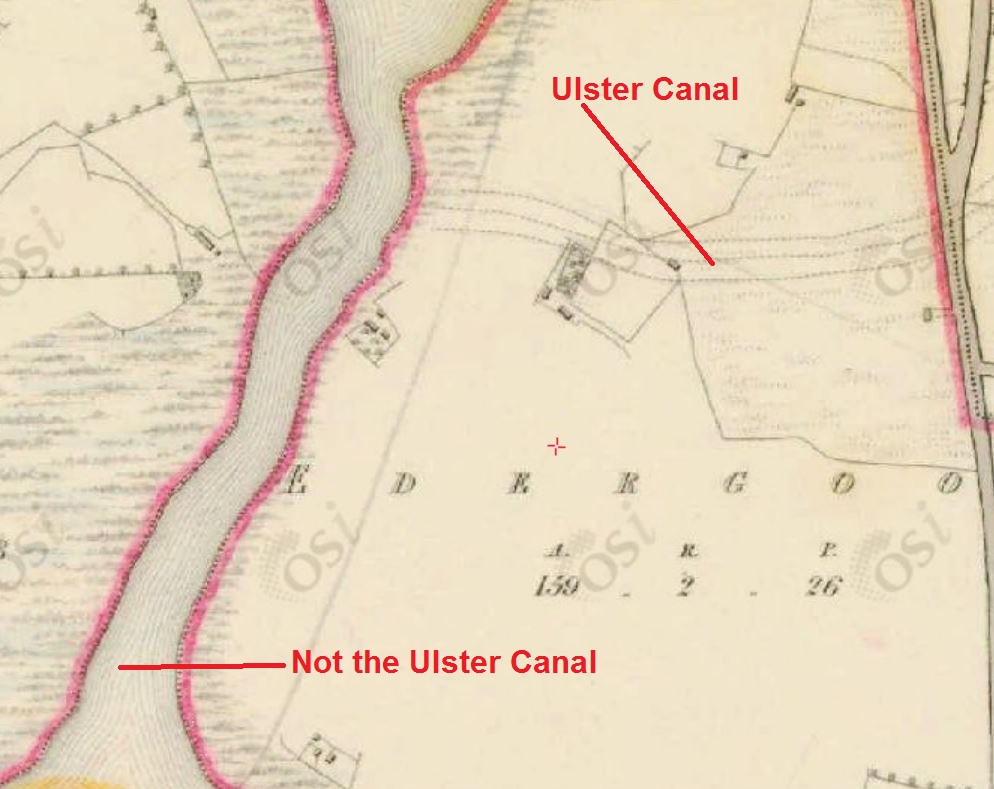
By the way, some folk get confused about the location of the Ulster Canal; this map may help:

Saunderson's Sheugh -v- the Ulster Canal (OSI ~1840)

Saunderson’s Sheugh -v- the Ulster Canal (OSI ~1840)

Anyway, for folk who are interested in weightier matters than ministers talking through portions of their anatomies that they can’t distinguish from their elbows, here is some speculation about opening bridges on the Ulster Canal.

That’s the Ulster Canal Ulster Canal, not the Saunderson’s Sheugh “Ulster Canal”, by the way.

My OSI logo and permit number for website


The industrial heritage of Mullingar …

in song.

Mick the Coach

A familiar face in unfamiliar surroundings ….

Ballygalane on the Blackwater

Lismore Canal lock 28_resize

The Lismore Canal lock

The only lock on the Lismore Canal is at Ballygalane, on the River Blackwater. Here is a new page about the canal, with photos of some of its important features.

Waterside Belturbet

Here is a small amount of information about Belturbet and some of its industrial heritage. The photos were taken on a brief visit in July 2011.

Big it up for the Kingstown Blazers

Hats off to the Irish Sailing Association for its successful campaign to persuade owners of diesel-powered pleasure craft to pay the Mineral Oil Tax. The ISA reckoned that, if more folk paid up, the nasty foreigners might allow boaters to continue to use patriotic green diesel:

It may already be too late to save the present diesel supply system in Ireland, but the very least we can do is to strengthen the country’s case by paying the tax. If we don’t do that, we won’t have a leg to stand on.

There have been other press releases since then, and the ISA has said that

The issue for leisure sailors is not the price of diesel but its availability.

Which suggests that it’s only a series of misfortunes that has prevented 99.75% of owners from paying the tax they should have paid. Perhaps the dog ate their chequebooks.

But the ISA put its shoulder to the wheel, its nose to the grindstone and its money where its mouth was, calling on other people to pay up. And, by golly, they did. It is no doubt as a result of the ISA’s call that the number of folk paying Mineral Oil Tax in 2015 (for 2014) was …

30%

… up on the previous year’s figure.

Admittedly that just meant it went from 20 to 26, so the non-compliance rate is still around 99.75%, but let us not mock honest effort. If the number continues to increase at six a year, there will be full compliance by the year 3677, which will be good; I look forward to recording the event.

For the record:

Year Payers Litres Amount
2010 for 2009 38 n/a n/a
2011 for 2010 41 n/a n/a
2012 for 2011 22 141,503.29 €53,398.58
2013 for 2012 23 301,674 €113,841.45
2014 for 2013 20 279,842.4 €105,561.74
2015 for 2014 26 289,151 €108,934.80

The income generated by the tax is about 10% of the amount the ISA gets from the state every year.


Was the Brickey a navigation?

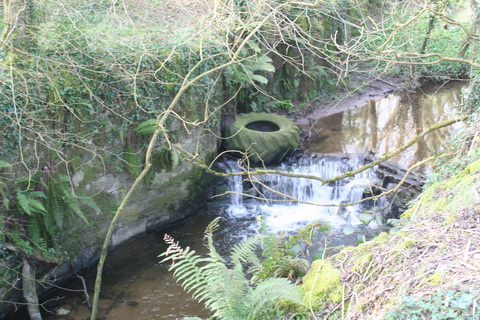
The Brickey is a small river that flows into Dungarvan Bay. Small boats used its lower, tidal reaches, but in the eighteenth century there was a proposal to link the Brickey to the Finisk, another small river that flows into the Blackwater south of Cappoquin.

Waterford County Museum, and others, believe that work began on that project in the mid nineteenth century and that a driveable track along the south bank of a stretch of the river was built as a towpath.

I have visited the river and looked online for further information; my conclusions (with maps and photographs) are here. However, I would welcome further information.

“Rural Ireland no longer exists”

Sensible comments here from a knowledgeable chap, who provides a link to this piece too.