Tag Archives: Kilrush

Mark Twain and the Cammoge drownings of 1849

Mark Twain wrote:

There is something fascinating about science. One gets such wholesale returns of conjecture out of such a trifling investment of fact.

I have indulged in just such conjecture about the design of the ferry boat in use at Cammoge in 1849, crossing the outlet from Poulnasherry Bay, west of Kilrush on the Shannon estuary. The news reports of the time give very little information about the design of the boat, and the reliability of that information is questionable, which makes my speculation even more dangerous. Nonetheless, I thought it might be useful to set out some thoughts on the subject in the hope that other folk, who know more about the background, the location or naval architecture than I do, might be able to help to clarify the design.

CWW bridge

Paul Quinn’s photos showed the new Marlborough Street Bridge being constructed across the Liffey. Last Saturday’s Irish Times reported that Dublin City Council would soon be advertising to seek suggestions for naming the bridge; it said that a body called Labour Youth [whose members may be socialists, I fear] wanted it named after one Rosie Hackett, who went on strike  many years ago. It did not report that there is another campaign to have the bridge named after E T S Walton, a physicist.

The north-eastern corner of the bridge features the site of the offices of the City of Dublin Steam Packet Company, whose crest still adorns the walls. I suggest that the bridge be named after the company’s founder, the remarkable Irish entrepreneur Charles Wye Williams: the father of the Shannon, the master of scheduled steam shipping, the founder of the CoDSPCo and a founder director of the Peninsular and Oriental Steam Navigation Company, godparent of the Irish livestock industry, innovator in marine safety, promoter of the turf industry, writer and experimenter on steam technology, tireless campaigner ….

Apart from his company’s crest on Eden Quay, and his name on a bridge he caused to be built in Limerick, there is no monument to this remarkable man. Name the bridge after him and move the plaque to it (and protect it adequately).


Around the world with Irish waterways

Yesterday was one of those days: I managed to track down sources for several pieces of information I’ve been hunting for some time, but in the process I came across a few interesting links, from Gordon of Khartoum to the War between the States.

The starting point was William Watson, manager of the Inland Department and later Chairman of the City of Dublin Steam Packet Company. He worked with Robert Mallet on the design of an innovative boat for use on Irish inland waterways. Robert Mallet married a Cordelia Watson in 1831. (I thought that might be a daughter of William of the CoDSPCo but it’s pretty clear from the excellent Mallett Family History site that that was not so.)

One of Mallet’s inventions was a large mortar designed for use in the Crimean War. And one of Mallet’s sons, John William Mallet, went to the USA and became professor of chemistry at the University of Alabama. He joined the Confederate forces, rising to the rank of lieutenant-colonel in the artillery and superintendent of the Confederate ordnance laboratories.

Meanwhile Watson’s son Charles Moore went east rather than west. Colonel Sir Charles Moore Watson KCMG, CB, MA, of the Royal Engineers, Watson Pasha, was a general in the Egyptian Army and Governor-General of the Red Sea Littoral. Watson’s base was at Suakin on the Red Sea. The Dubliner was succeeded in that post by a Kerryman, Horatio Herbert Kitchener, from Ballylongford near Saleen on the Shannon Estuary, on which the City of Dublin Steam Packet Company operated.

Watson was “Gordon’s principal friend in Egypt”:

It is certain that Watson was, above all others, the one man in Cairo whom Gordon cared about most, and that he was the last to see Gordon off when he started [for Khartoum].

Gordon died at Khartoum; the relief expedition, led by another Irishman, Sir Garnet Wolseley, arrived two days too late.

A younger brother of Sir Garnet, Frederick Wolseley, went to Australia. His Sheep Shearing Machine Company made a brief expedition into the manufacture of motor-cars, under one Herbert Austin, who later founded his own company. Austin and Wolseley both ended up in British Leyland Motor Corporation, which made diesel engines, some of which were marinised and used in boats on the Irish inland waterways … which brings us back to where we started.

Where is this?

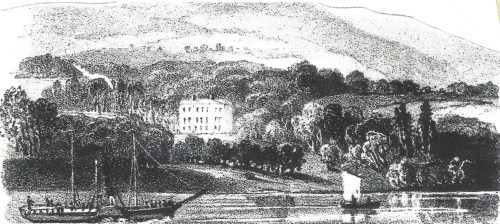
Paul Gauci's 1831 drawing of a Shannon steamer

Paul Gauci’s 1831 drawing of a Shannon steamer

This drawing of a steamer is from an 1831 book called Select Views of Lough Derg and the River Shannon by Paul Gauci. I haven’t seen the book myself, but this illustration is used in a couple of places, including Ruth Delany’s book The Shannon Navigation [The Lilliput Press Ltd, Dublin 2008]. Andrew Bowcock, in his article “Early iron ships on the River Shannon” in The Mariner’s Mirror Vol 92 No 3 August 2006, says of the steamer shown that

The funnel looks to be almost over the paddle shaft, which is artistic license.

But my question is not about the vessel but about the house in the background. If it is drawn without artistic licence, where is it?

It is a very large house, seven bays by three storeys, quite close to the water. Using the Historic 6″ Ordnance Survey map [~1840], I have followed the banks of the Shannon from Shannon Harbour down Lough Derg to Killaloe, then from Limerick down the estuary as far as Tarbert, across the estuary to Doonaha and back up on the Clare side to Limerick, then from Killaloe up the Clare and Galway shores back to Shannon Harbour. Anywhere I found a large house within what seemed the right distance of the shore, I looked it up in the Landed Estates Database and in the National Inventory of Architectural Heritage, with some supplementary googling.

I haven’t been able to find images of all the houses marked on the OSI map, but I found enough to show that houses of the size shown by Gauci were very rare. Within those few, I ruled out some (like Tervoe) because they didn’t seem to match Gauci’s drawing (although alterations could have accounted for that). I ended up with only one house that looked at all like Gauci’s, but the background may not match.

If you can identify the house, I would be glad if you could leave a Comment below.

Dick Gaughan and John Grantham …

… both had an interest in Erin-go-Bragh,

From Kilrush to Carlingford …

ferry interesting news.

SESIFP

Read about the draft Strategic Integrated Framework Plan (SIFP) for the Shannon Estuary here. You can comment on it up to 15 February 2013.

A gratifying display of loyalty

His Excellency the Lord Lieutenant took a trip on the Shannon Estuary in July 1856 on the City of Dublin Steam Packet Company’s vessel Erin-go-Bragh. He was greeted by demonstrations of loyalty from the populace, had dejeuner on board off Scattery Island and heard an address from the proprietary, clergymen, merchants, traders and inhabitants of Kilrush, read to him by Colonel Vandeleur. Here is the Freeman’s Journal‘s account of the trip.

Urination in Co Clare

In County Clare, urination has a long and distinguished history. Here is a piece about one early example: while it was not on inland waters, I hope that the involvement of the Head Pacificator, renowned for his efforts to promote the Shannon, as well as of two authors who provide useful information about the river, will excuse the inclusion.

Praise for Kilrush

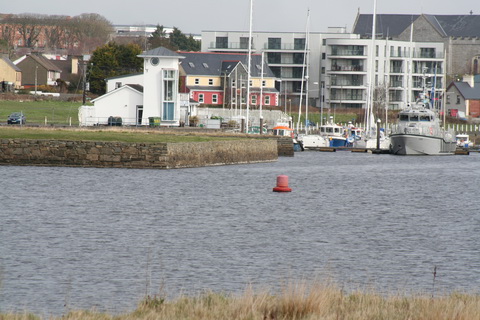
Kilrush across the creek

It was highly gratifying to witness the animation that prevailed in Kilrush — the neatness of the little shops, the flagged pathway, and the absence of accumulated dirt, so prominent and offensive a peculiarity of most small towns in Ireland. The people about Kilrush (whose population is 5000) are handsome, and appear considerably more intelligent than in many other places.

Jonathan Binns The Miseries and Beauties of Ireland Vol II Longman, Orme, Brown and Co, London 1837