Tag Archives: Limerick

From the hearts of cranes

Several ports on the Shannon Navigation have old cranes (or parts thereof), most of them nicely painted. Their age may not be apparent, but it is possible that they date back to the days of the Shannon Commissioners in the 1840s; at least one of them may be even older than that.

This page shows photographs of those cranes I know of, and discusses their possible ages. But there is much that remains unknown, and readers may be able to cast light on some of the mysteries.

The Lartigue: the Listowel & Ballybunion Railway

The Listowel & Ballybunion Railway operated between 1888 and 1924, using perhaps the most eccentric railway technology ever invented: the monorail developed by Charles Lartigue.

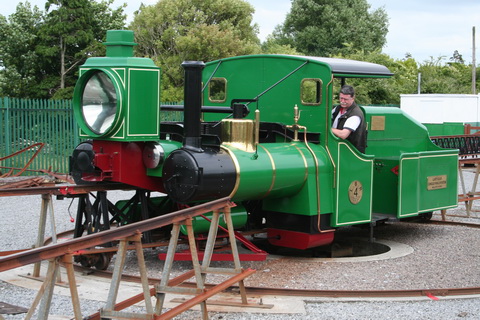
Very little original material was left after the railway closed, but a short section of railway has been recreated in the town of Listowel, Co Kerry, with a single locomotive (now diesel rather than steam) and two carriages. However, it shows the more exciting features of the original: the ingenious turntables and switches. There is also a small display of models, photographs and artefacts, and a showing of three short films, with some original newsreel footage of the railway in operation. The volunteer staff are knowledgeable and happy to chat and, all in all, it makes for a very entertaining few hours for anyone interested in transport or engineering.

Listowel is close to Ballybunion on the south side of the Shannon Estuary; anyone visiting the industrial heritage artefacts of the Lower Shannon Industrial Heritage Park could easily build in a visit to the Lartigue – and then take the ferry from Tarbert to Killimer and visit the West Clare Railway.

Read about the Lartigue here.

Anguilla anguilla: the ESB eel fishery

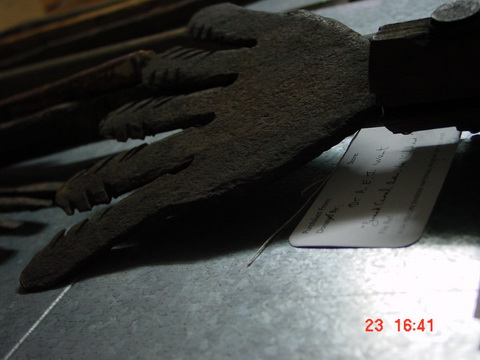
This photo shows an eel spear from the National Folklife Collection‘s overflow material, stored in the former “reformatory” at Daingean, on the Grand Canal in Co Offaly. There were many spears there, with different designs from different rivers. This one, to judge from the label underneath it, came from the extraordinarily prolific and observant Dr A E J Went.
If you look at pretty well any Irish river on the 1840s Ordnance Survey map (here’s the Shannon at Killaloe; switch to Historic 6″ if necessary), or indeed on the 1900s map (same URL but switch to Historic 25″), you’ll find evidence of eel weirs. Ireland’s shortest canal was built to allow the eel-boats of Anthony Mackey’s fleet to reach the trains at Banagher.

But the European eel is a “critically endangered species” and all eel fishing has been banned in Ireland. As far as I know, though, the Lough Neagh fishery, in Northern Ireland, continues.

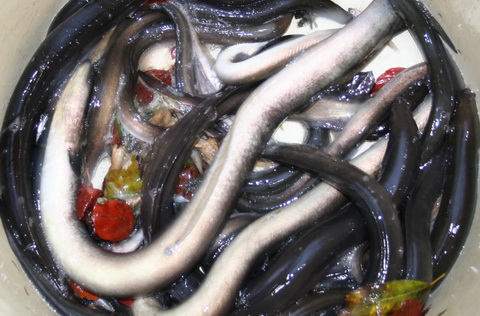
The Electricity Supply Board (ESB) is in charge of the eel fishery on the River Shannon. It has nets and a storage unit (packing station) at Killaloe and, until recently, it also had nets at Clonlara on the headrace supplying the power station at Ardnacrusha; the Clonlara nets have just been removed. This page is about the Clonlara and Killaloe operations, but includes a look at an eel survey conducted for the ESB in 2008, before eel fishing was banned in Ireland. The aim now is to make it easy for eels to reach the sea to reproduce, and that sometimes involves “trap and transport”: catching the eels and moving them past obstacles, whether on their way to the sea or, for the young glass eels, on their way upriver.
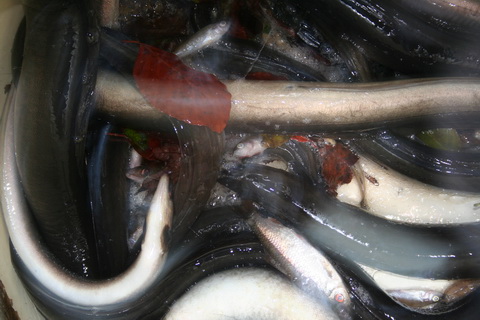
The photos on this page are a tribute to what was an important activity on the Shannon. I hope that the European eel stocks can recover.

Dry docks

I’m starting a new section on Irish inland waterways dry docks. The thing is, I have photos of very few of them, and even my list of docks is almost certainly incomplete. So this page has photos of a few of the docks, but I’m hoping readers will be able to help with lots more.

Knock knock …

Knock in Co Mayo is well known, having its own airport; Knock in Co Clare is less well known, though it has its own port. Here is a short account of its history, with some photographs, but more information would be welcome.

Additions

Material has been added today to the pages on

  • non-WI workboats
  • traditional boats and replicas
  • Waterways Ireland workboats
  • Irish waterway bogs.

See links to the right.

Saleen Pier

It’s a long way from Trinity College, Dublin to the pier at Saleen on Ballylongford Creek, on the south side of the Shannon Estuary. But the college owned large amounts of land in the area, including bogs, and turf was one of the cargoes exported from Ballylongford. There was a battery on Carrig Island at the mouth of the creek and a Coast Guard Station at Saleen Pier, which was built by the Commissioners for the Improvement of the Navigation of the Shannon. Read more about Saleen here.

Floods November 2009: kayaks at Curragour

One beneficial aspect of the floods is that there is lots of water for kayakists. Here are some pics taken at Curragour, on the Shannon in Limerick city, on 28 November 2009.

Sailing directions: Shannon Estuary and Loughs Derg (1838-9), Ree (1837) and Erne (1835-6)

Here are the Sailing Directions for the Shannon Estuary (completed before 1848) and for Lough Erne (1835-6), Lough Ree (1837) and Lough Derg (1838-9). They were compiled by Commander James Wolfe RN, who was one of those who drew up the relevant Admiralty Charts. Like the Charts, these Directions have not been updated, so boaters should not rely on them for navigation.

The Google Books Team have kindly permitted me to extract these from a larger document, which was one of those they had scanned and placed online, and to make them available (free, of course) to visitors to this site. Note that I have omitted part of the description of the smaller Lough Derg, which is not part of the connected waterways system.

Shannon & Erne sailing directions

The ESB lock at Ardnacrusha on the River Shannon

The Electricity Supply Board (ESB) operates the lock that takes boats through the hydroelectric power station at Ardnacrusha, on the lower reaches of the River Shannon. The lock is, in Irish waterways terminology, a double: a staircase pair, which counts as one lock, with a combined drop in the two chambers of about 100 feet. It’s not the deepest lock in Europe by any means (although it is by far the deepest in These Islands: five times the depth of Tuel Lane) but it is relatively small, a fact that enhances the impressions created by a passage through the lock. I’ve put up a page of photos and information about the lock here.