
Tag Archives: Lough Derg

Coill an Eo

Arklow Marine Services reports:

The “Coill an Eo” a 26 metre works barge, used in maintaining buoys and markers on the Shannon and owned by Waterways Ireland, has recently been docked in Rooskey, Co. Roscommon.

The first job the Yard had to do was carry out ultrasonic readings on the vessels hull, both internally and externally. A new main engine, tailshaft, propeller and bearings are to be fitted to the vessel and a complete electrical installation carried out.
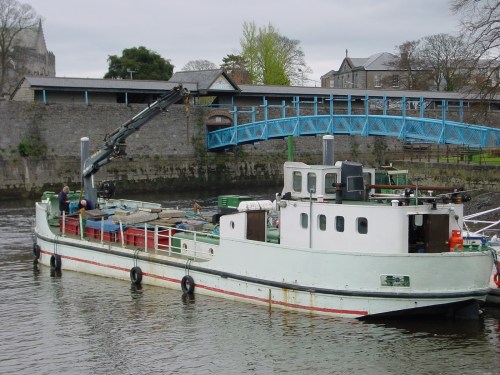
Coill an Eo in Limerick in 2003

More photos of WI vessels here.

Pat Sweeney, in Liffey Ships and Shipbuilding Mercier Press, Cork 2010, says that Coill an Eo, launched in 1969, was the last vessel built on the Alexandra Basin slipways. He describes her as “a small grab hopper dredger” and says that the £40,000 cost was shared by the Commissioners of Public Works (then responsible for the Shannon) and Bord Fáilte.

Kilgarvan Quay

On 3 October 1906 Mr Hugh Delaney of Borrisokane, Co Tipperary, gave evidence to the Royal Commission appointed to enquire into and to report on the canals and inland navigations of the United Kingdom. Tipperary (North Riding) County Council had asked him “to give evidence on behalf of the quay at Kilgarvan.”

His evidence became rather confused, as he and his interlocutors misunderstood each other. The source of the problem seems to have been his using the term “the canal” to refer both to the Grand Canal Company and to the canal itself. The main points of his evidence were these:

  • Kilgarvan Quay was “only of recent date: it was only opened in [October] 1891 and it has had an extraordinary effect on the traffic of the district and brought down the railway rates [from Cloughjordan] very considerably”
  • there had been no quay at Kilgarvan before that; there was deep water at the quay
  • the grand jury of the North Riding of Tipperary gave £230 towards the cost and the Grand Canal Company paid the rest, about £579
  • although it was only 104 miles from Kilgarvan Quay to James Street harbour, it took five or six days for barley to reach Dublin
  • he felt that the trip should be done in two days, using steam launches
  • he thought that transhipment at Shannon Harbour caused undue delay
  • people at Terryglass had built a quay and it made a port of call for the Grand Canal Company.

The present quay at Kilgarvan is not on the ~1840 OSI map (though there is a smaller quay near the bend in the road) but it is on the ~1900. I have a photo of the crane on my page about Shannon cranes; I’m no expert, but I wonder whether the crane might be older than the quay.

Bealkelly Woods

Bealkelly Woods, on the south side of Scarriff Bay near the mouth of the Scarriff River, will host another CELT Weekend in the Woods on 29 and 30 September 2012:

CELT Weekend in the Woods – 29th / 30th September – Bealkelly Oak Woods, Tuamgraney, Co.Clare.

Choose from 17 traditional and ecological skills introductory courses: Wood Carving, Longbow making, Felt-craft, Needle-felting, Basketry, Herb Lore, Sugan Chair making, Silversmithing, Natural Building, Coppersmithing, Blacksmithing, Bowl & Spoon making, Knife making, Musical Instrument making, Spinning / Weaving & Natural Dyeing, Dry-stone and Lime-mortar Walling, – and, for 8-14yrs, Adventure Bushcraft.

Cost 130 euro (concessions and group rates available). Free camping. Good lunch and refreshments available – also evening pizza from clay oven. Music and song round campfire Sat night. See website for more info.

More info on the CELT website.

Raising the dead

North Tipperary LEADER Partnership (lead), Clare Local Development Co. and Galway Rural Development Co. intends to contract an individual or company with relevant experience who will work in conjunction with the Lough Derg Marketing Strategy Group to identify tourism projects that would be eligible for funding under the Rural Development Programme. The aim, through animation and capacity building, is to assist the tourism sector in the three regions with the supports they require to develop Lough Derg as a key destination for water based activities combined with a range of very high quality walking, cycling, heritage and culture and food experience.

More info here; not sure whether you need to register to see it.

Bring back the Black

The Black Bridge at Plassey has been closed since the floods of November 2009. Its reopening seems to have a low priority; I suspect that is because the importance of the bridge in Ireland’s technological, economic, entrepreneurial and political history is not widely appreciated. Here is a page explaining some of the background and suggesting a context within which reopening might be justifiable.

Marl update

I have added more information, from Arthur Young in 1780, to my piece on dredging for marl on Lough Derg. Young provides a few more details on the process.

A very interesting photo …

here.

h/t PW

Plasticine

Why, when speaking of the branded product Plasticine, did [do?] Irish teachers insist on using the Irish word marla? Even that word was, according to Terry Dolan’s Dictionary of Hiberno-English [Gill & Macmillan, Dublin 2004; new ed forthcoming], derived from the English marl.

At least in the nineteenth century, marl was a valuable manure or fertiliser and, on Lough Derg, Mr Head of the Derry Estate introduced a system of dredging it from deep water. Read about it here.


Barges, cots and subaltern waterways studies

I am to speak at Jamestown, near Carrick-on-Shannon in Co Leitrim, on Saturday 4 August 2012. Jamestown is having its heritage festival, and large numbers of old (converted) barges will be there. I will be giving one of four talks; mine is entitled

Down with barges: why cots were the really important vessels on Irish inland waterways.

I will be citing His Late Majesty Henry VIII, Fid Def, in support of my contention.

Here is some of the background to my thinking. If you would like to hear more, do come along on the day: the talks are open to all.

Essential kit for barge-drivers

So there you are outside one of the more sheltered harbours (Dromaan, say), unable to see how much space there is inside and wondering whether, if you go in, you’ll find you have to reverse out again. How useful it would be to be able to see inside from some distance away. How useful it would be to have a small helicopter at your disposal, one that could send pics back to you.

Clearly such a gadget would be a must-have item, an essential piece of equipment for any conscientious barge-driver. Happily, it exists.