Tag Archives: Lough Neagh

They’re taking the [bodily fluid]

Of the cost of land to be acquired for a canal to Clones:

We understand that the costs of land acquisition are based on the purchase of 46 hectares of land (equivalent to approx. 114 acres), the majority of which is poor quality agricultural land for a total estimated cost of €6m. This is equivalent to an average price for acquisition of just over €52,500 per acre, although the total acquisition costs would also include legal costs associated with the process.

Nevertheless, an average price of €52,500 would appear to be very high compared with the average price at which agricultural land is currently sold in the area. If an average price of €25,000 per acre (including legal costs) was applied, then total land acquisition costs would be reduced to €2.85m. This is still a generous assumption. The average RoI price of agricultural land in 2014 was less than €10,000. [Irish Farmers’ Journal Agricultural Land Price Report 2013 January 2014]

That’s from Department of Arts, Heritage and the Gaeltacht Restoring the Ulster Canal from Lough Erne to Clones: Updated Business Case February 2015. Hats off to Fitzpatrick Associates for checking and for leaving the information in the final report. I have written to Waterways Ireland to ask for more information:

I would be grateful if you could let me have a list of

  • the names and addresses of the owners of the land you propose to buy to build a canal to Clones

  • map references or maps showing the location of that land

  • the size and nature of each plot of land you propose to acquire

  • the amount you propose to pay for each plot

  • the justification for each such amount.

Actually, I have the list of landowners in Co Monaghan, because it’s in the planning application. I can’t find the equivalent on the NI Planning Service’s website because I can’t work out how to search by applicant.

The stony grey soil of Monaghan must be worth more than one might think. Either that or this proposal is a steaming dunghill.

DAHG and the unicorns

In purely quantifiable monetary terms, it is clear from these estimates that the project has a very significant capital cost of circa €46m and that the quantified annual net economic benefits are at most €323.5k per annum. The latter thus covers the annual revenue costs of €308.8k per annum only. Applying any cost benefit analysis, whether payback period or net present cost, will result in a large negative for the project.

The justification of the project therefore relies largely on the unquantifiable benefits associated with the project and the disadvantaged area in which these will occur.

Department of Arts, Heritage and the Gaeltacht Restoring the Ulster Canal from Lough Erne to Clones: Updated Business Case February 2015

The project will give this border region, which has suffered greatly from economic deprivation, a much needed boost in terms of job creation and tourism. There is significant potential for growth in the waterways based tourism market and I have no doubt that the reopening of this section of the canal will help to attract significant numbers of visitors to the area.

Heather Humphreys quoted in Department of Arts, Heritage and the Gaeltacht press release Minister Humphreys secures Government approval to restore Ulster Canal from Upper Lough Erne to Castle Saunderson 24 February 2015

If “quantified annual net economic benefits are at most €323.5k per annum” for a sheugh running all the way to Clones, it is hard to see how a shorter sheugh to Castle Saunderson is going to result in “a much needed boost in terms of job creation and tourism”.

But that’s where the unicorns come in: it will all happen by magic.

Shagging the Shannon to shovel the sheugh

On 24 February 2015, the Irish Times published an article headed

First stage of Ulster Canal restoration due to begin in April
Some €2m will be spent on a section of the Shannon-Erne waterway

It ended with these sentences:

The €2 million will be drawn from the funds of Waterways Ireland, a north-south implementation body. It will carry out the dredging of a 2km section of the Erne river and the construction of a new navigation arch at Derrykerrib Bridge to accommodate boat traffic, with a target completion date of April 2016.

It may be that the Irish Times doesn’t know very much about waterways. If it did, it might have been aware that, on 18 December 2014, the North South Ministerial Council approved Waterways Ireland’s Business Plan 2015, which included this Action:

3.6 Progress the restoration of the Ulster Canal on an incremental basis. €1,000

So on 18 December 2014 the North South Ministerial Council — which for all practical waterways purposes consists of Heather Humphreys, the southern minister for waterways and other stuff, and Carál Ní Chuilín, her northern counterpart — approved the allocation of €1,000 to the Ulster Canal in Waterways Ireland’s 2015 plan. Yet, just over two months later, they expect Waterways Ireland to spend about €2 million on the blasted thing, about €1.5 million of it in 2015.

The southern government’s party of treasure-seekers seems to have disappeared entirely: at any rate it doesn’t seem to have found any money. And the two ministers’ departments have presided over successive years of cuts in Waterways Ireland’s current and capital budgets, cuts whose effect has been worsened by the woefully inadequate provision for an ever-increasing pensions bill. Waterways Ireland’s Corporate Plan 2014–2016 shows a cumulative increase of €984,000 in pension costs over the period of the plan, which wipes out a lot of savings in other areas.

I suppose that curiosity is a weakness in journalism. Were it not so, two questions might have struck the Irish Times:

  • how is Waterways Ireland to come up with €2 million out of an ever-decreasing budget?
  • why has Waterways Ireland’s Business Plan been so violently disrupted only two months after it was approved? The €2 million is half WI’s total capital budget spending in for the republic in 2015; it will be recalled that the republic, in a fit of more than usually nitwitted arrogance, undertook to pay for a canal to Clones, which is what the powers-that-be are pretending Saunderson’s Sheugh is.

I can answer the first question, at least for 2015, during which WI expects to spend €1,416,000:

  • €166,000 will come from Heather Humphreys’s department
  • €900,000 will (WI hopes) come from the sale of property assets
  • €150,000 will come from the postponement of an IT programme
  • €220,000 will come from the postponement of non-navigation works on the Shannon
  • €90,000 will come from postponing development of the Barrow Blueway.

I don’t know what property assets WI can sell to bring in the requsite amount. It seems that damage to everyday navigation has been avoided, but the Shannon and the Barrow are to suffer to pay for dredging a river that merely provides a small extension of the Erne navigation.

As for the second question, I suspect that Sinn Féin put a gun to someone’s head: “We’re fed up waiting for our sheugh. Start digging or the baby gets it.” The baby might have been Heather Humphreys’s Dáil seat or it might have been something more important. And the gun was, I suspect, a message accompanying the “business case” prepared by the northern department and sent to the southern. [I have asked both departments for copies and other information.]

Arthur Aughey, then lecturer in politics at the University of Ulster, wrote in Magill magazine in February 2001:

Puritanical republicans grieve at the thought that the hunger strikers [of 1981] died to achieve the Waterways Ireland Implementation Board.

I suspect that the less puritanical republicans, those who operate in the devolved institutions of Northern Ireland, are now demanding that the southern government deliver, through the “Waterways Ireland Implementation Board”, what nitwitted previous governments promised. It’s a pity that Sinn Féin and those previous governments couldn’t have come up with a more sensible list of waterways and other infrastructural projects.


Saunderson’s Sheugh and the border problem

Castle Saunderson and the border

Castle Saunderson and the border

Saunderson’s Sheugh, the latest manifestation of the proposed reconstruction of the Ulster Canal, would run along a border for much of its length. That’s the border between Ireland and Northern Ireland, but there is one important border it does not seem to cross [as far as I can see]: that between counties Cavan and Monaghan.

Has Cavan stolen the sheugh from its northern neighbour? I’m sure that folk in the Monaghan part of the Dáil constituency of Cavan-Monaghan won’t mind, but I wonder whether the Minister for Arts, Heritage and the Gaeltacht, who is a TD from the Monaghan end and is in charge of Sheughery, is concerned that her Monaghan colleague Caoimhghín Ó Caoláin [Sinn Féin] might turn the situation to his party’s advantage. On the other hand, from Sinn Féin’s viewpoint, the question might be whether any sheugh is better than none.

Of course, as soon as a coalition of Sinn Féin and the Éamon Ó Cuív wing of Fianna Fáil takes power, we’ll have the entire Ulster Canal built immediately. And there will be grants for growing flax, carrying corn to Dublin and draining the Shannon [which might mean that there are no southern boats to visit the Ulster Canal].

I should say, though, that Davy, in two reports out today, is not very worried about what Sinn Féin might do: Finfacts story here; Davy here; the two reports here and here [each of which should open as a PDF; if that doesn’t work, use the links on the Davy or the Finfacts page].

Map: OpenStreetMap; copyright explained here.

Ulster Canal restoration: a history

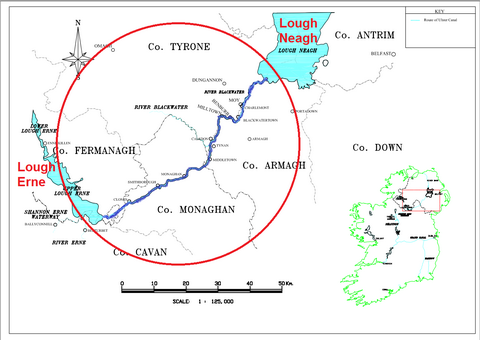
Ulster Canal 01 whole_resize

Studies 1994–2000

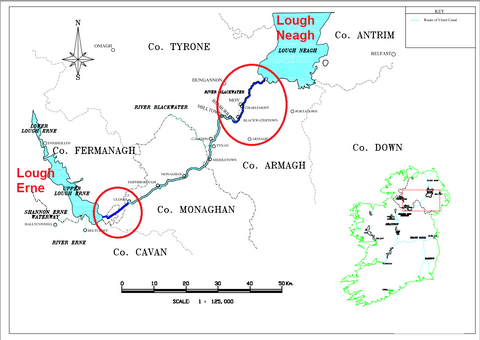
Ulster Canal 02 whole_resize

Socio-economic summary report and feasibility study 2006

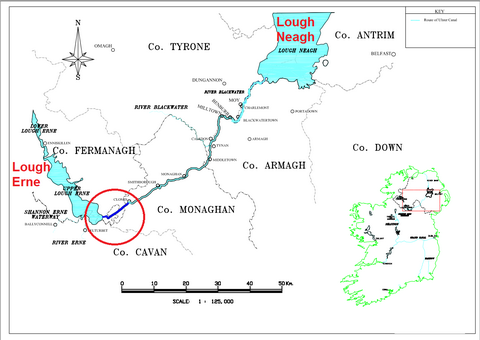
Ulster Canal 03 whole_resize

North/South Ministerial Council agreement 2007, with the Irish government to pay the full cost

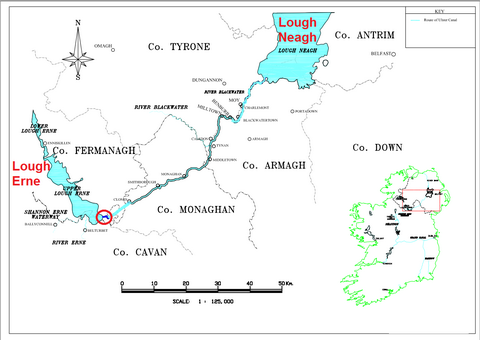
Ulster Canal 04 whole_resize

DCAL business case to DAHG 2015

Exhaustive coverage begins here but use the search facility for updates. More to come.

A quick bit of sheughery

Here, read this. I haven’t time to take it all in at the moment, but the minister’s “An updated business case was recently completed for my Department” is, as far as I know, misleading: that business case was completed by DCAL in Northern Ireland and sent to Dublin. Thus, as the SF TD Mr Ó Snodaigh probably knows, the “business case” (which is not a cost-benefit analysis) came from a Sinn Féin minister’s department.

It seems our designation of “Saunderson’s Sheugh” was spot on.

The contagious cargo cult

Readers will be saddened to learn that Ireland’s cargo cult, the delusion that canals bring prosperity, is spreading. It may even be that an increasing frequency of political references to Saunderson’s [né the Clones] Sheugh means that the devotees are about to engage in sympathetic magic by attempting to dig a sheugh.

The sheugh was mentioned in both legislative assemblies on the island on 20 January 2015. In Dublin, Gerry Adams [SF, Louth] said:

I remind the House that the peace process is the most important political project on this island at this time and it needs to be nurtured, protected and enhanced. It must be at the top of the Government’s agenda alongside other priorities.

I wonder how many priorities can dance on the head of an agenda ….

I welcome the financial commitments that have been made, including €25 million in annual funding for the A5 road project, which will assist people in Tír Chonaill, Derry, Fermanagh and Tyrone. I welcome additional funding for reconciliation under the European Union’s PEACE and INTERREG programmes and the Government’s renewed commitment to the Narrow Water bridge and Ulster Canal projects. These are important developments which need to be delivered.

If the Shinners are going to prioritise such nitwitted public spending projects, Goldman Sachs will never allow them into government [assuming that Goldman Sachs cares what happens in Ireland, which they might not, pace Peter Sutherland]. Nobody else mentioned the sheugh in that debate, but several Norn Iron politicos seem to have succumbed to the delusion. They had a debate on “Ulster Canal: Tourism Benefits“, which is like having a debate about the nature of unicorn excrement without first checking to see whether unicorns exist.

Note, in what follows, the complete absence of any quantification of benefits, with only a single mention of costs and with an unwavering belief that canals bring prosperity, even if they lack any interesting features (apart from the engine shed in Clones). There is no attempt at identifying why tourists would be attracted to the sheugh, no discussion of the mechanism by which public spending is translated into tourism revenue and then into local or national benefit.

Not that southern politicians are any better, of course.

Anyway, back to the NI Assembly. Sean Lynch [SF] “asked the Minister of Enterprise, Trade and Investment for her assessment of the potential tourism benefits of re-opening the Ulster canal”. Note that he didn’t say how much of the canal he wanted.

Arlene Foster [DUP] [for it was she] said

The waterways of Northern Ireland have the potential to become an integral part of the tourism experience in Northern Ireland. The proposed Ulster canal development could provide opportunities for canal boating as well as supporting infrastructure to support walking and cycling, all of which would benefit our visitors and the local area.

All of which is waffle. She provided no assessment.

Although the project is being led by DCAL, the Northern Ireland Tourist Board (NITB) continues to work with the Ulster canal inter-agency group through the Destination Fermanagh steering group and with the Clones Erne East Blackwater project to try to maximise the tourism benefit that this project could bring.

Nice to hear that the treasure-seekers, the “inter-agency group”, still exist. I wonder what they do.

So far, Arlene seems to be sticking to her script and hasn’t given much away: the sheugh could do this, that or the other, but there’s nothing concrete. But Mr Lynch asks a follow-up question:

I thank the Minister for her somewhat encouraging answer. Does she agree that, because the canal goes through Monaghan, Fermanagh, Cavan and Tyrone, both tourism boards on the island of Ireland should work closely together to ensure that it is a success?

If it were worth doing, why would the tourism boards have to “work closely together”? Would not hundreds of thousands of foreigners, from lands without canals, come flocking to the sheugh and to the irresistible attractions of Clones? What more could the tourism boards do to sell the thing? “Visit a short canal in the middle of nowhere leading to Clones”?

Mr Lynch may just have been trying to trap Ms Foster into agreeing to some tourism crossborderality. But she seems to have been doing a bit of crossborderality of her own:

The TD for Cavan-Monaghan, Heather Humphreys, has taken a particular interest in the matter, as you would imagine. It is in part of her constituency, as it is in part of ours; therefore, she is keen to move the project forward. When I last spoke to her, she again mentioned the need to push ahead on the Ulster canal.

Oh dear.

So, I think, generally, there is support for the project. I suppose that the big challenge for us all is funding. The Northern Ireland Tourist Board — or Tourism Northern Ireland, as we should now call it — will work with its counterparts to assist and make sure that all the tourism benefits are put into any business case that is put forward.

When ministers are asked questions by members of their own parties, I wonder whether the questions were arranged beforehand in order to allow the ministers to make certain points.

William Humphrey [DUP] said “The Minister is quite right that the primary responsibility lies with the Department of Culture, Arts and Leisure.” The minister knew that already. But then he asked two questions. The first was:

Is Fermanagh District Council taking a collaborative approach to the cross-border element?

That might be intended to sell the prospect of further local government crossborderality to DUP supporters. The minister answered:

As I understand it, Fermanagh District Council is part of the Clones Erne East partnership, which seems to be driving this initiative. Of course, the Erne East councillors will be part of that partnership.

Humphrey’s second question, which elicited an interesting answer, was:

Obviously, in the current economic climate, budgets are tight. Has the Department looked at the possibility of funding from the European Union, given that it is a cross-border venture?

Ms Foster said

I simply do not know is the answer, because DCAL leads on this issue. However, I do know, and I have been advised, that some €54 million would be needed to secure the project to get it completed within 21 to 24 months. It is a large sum of money. If there are options to look elsewhere for funding, we would of course be supportive of them being explored.

Now, what is that €54 million for? Irish ministers have been quoting a figure of €35 million for years, even after 2011 when I was given a revised estimate of €45 million [overview of the history here]. That was to get to Clones. Is Clones now to cost €54 million? Or is that to Castle Saunderson? Or to Lough Neagh? Probably not the last. Note that these cost increases have come even before anybody starts digging anything.

Why does Clones deserve €54 million? Its population seems to be slightly below 3000; why not give every man, woman and child €15,000 each to forget about the sheugh, thereby saving €9 million?

Back to the Assembly. Basil McCrea [UUP], who may be the most sensible MLA, suggested, as he has suggested before, that users of inland waterways pay “for example, through a boat tax” something towards the cost of the waterways “provided that the money is used specifically for enhancing inland waterways?” Ms Foster said that was not her business and added

I want to encourage more people to come and use the inland waterways. Of course, I want them to use Lough Neagh and Lough Erne in particular.

I wonder why she omitted the Lower Bann, the Shannon–Erne Waterway and the various derelict navigations — including Saunderson’s Sheugh.



From the [UK] Civil Service Quarterly

An interesting article [h/t celr] about the setting up of the Canal & River Trust, which runs (it says itself) 2000 miles of waterway in England and Wales. The article is not, perhaps, to be seen as an objective evaluation of the benefits of the UK’s Public Bodies Reform Programme, but the idea of transferring a large operation to the voluntary sector is an interesting one, as is the scope for volunteer donations and involvement (British Waterways, C&RT’s predecessor, had nothing like as high a proportion of lockkeepers as Waterways Ireland has).

I have occasionally been asked, by British folk, whether the possibility of transferring Waterways Ireland to the voluntary sector is being considered here. I have explained (a) that WI has nothing like as significant an independent (non-grant) income as BW had and (b) that any such transfer would require the rewriting of the Good Friday, St Andrew’s and (now) Stormont House Agreements. So we are stuck with the current arangements, which at present are leaving WI at the mercy of budget cuts, a disastrous pensions arrangement, disputes between its two governing departments and a nitwitted demand, from Sinn Féin and Fianna Fáil and perhaps from Fine Gael too, for a pointless canal reconstruction.


Saunderson’s Sheugh

The Minister for  Arts, Heritage and the Gaeltacht [who is also a Fine Gael TD for Cavan–Monaghan] spoke at the meeeting of the Joint Oireachtas Committee on Environment, Culture and the Gaeltacht on 25 November 2014. She said:

In addition to progressing North-South co-operation, my key priority is progressing the first stage of the Ulster Canal project from upper Lough Erne to Castle Saunderson, near Belturbet, County Cavan. I am working on this with the Government and other key partners, including the North-South Ministerial Council and Waterways Ireland. […]

It sounds, then, as if the minister intends to get work started on the Clones Sheugh, but only as far as Castle Saunderson, where there is a scouting establishment. The route from Quivvy Lough (location of the Quivvy Marina) is along the Finn River; the first 5.5 km of the route would be in the river and the last 8.5 km to Clones in a canal. The route to Castle Saunderson would, I imagine, require dredging and the removal of rocks as well as work on [or replacement of] Derrykerrib Bridge [I have not read all the details].

It would, of course, be faster to get there by road, but no doubt lots of people will travel from Foreign Parts for the excitement of seeing Castle Saunderson from the water and paying tribute to the memory of a stout Orangeman and founder of the Irish Unionist Alliance.

No mention of the treasure-hunting group who are to find the money, but there’s an election in the offing so money won’t be a problem. Until afterwards.

Quivvy to Castle Saunderson [OSI ~1840]

Quivvy to Castle Saunderson [OSI ~1840]

The minister also said:

Regarding the Ulster Canal, which stretches from upper Lough Erne to Castle Saunderson, we hope to get the project started on that section because that is the one part of the inland waterway system that has not been developed. If we get that done, the Ulster Canal will connect into Lough Neagh. That means we will have a complete network of waterways in Ireland, which is very important. It is also a cross-Border project, and there is a peace dividend in terms of that project. It is very important in terms of cross-Border relationships. It is one shovel-ready project that can be progressed.

The minister said that “a complete network of waterways in Ireland […] is very important”. She did not say why and I can think of no possible economic justification for the creation of such a “network”. Nor is it clear what the “peace dividend” is. But the phrase that evoked most terror is “shovel-ready project”, which I take to mean something that might buy votes in the next election.

The minister’s predecessor, Éamon Ó Cuív, a Fianna Fáil TD for Galway West, said:

I welcome the Minister’s continuation of the work on the Ulster canals. There was quite a bit of work done on that in my time and I was very anxious to see it progress on a step-by-step basis. I was going to bring it to Clones, I am not sure whether the place the Minister mentioned is further or nearer than that.

The minister interjected:

It is not as far as Clones. We will start it anyway and we will get it there.

And Mr Ó Cuív continued:

I take the view that even if she were to get it half a mile, we should just nibble away at it until we get it finished. It is of strategic national importance and if we could connect Coleraine, where I was the other day and where my poor car is getting mended, all the way down the coast through Lough Neagh down to Shannon and back up the canals, it would be a fantastic facility for the island. I will not be heard complaining in any way that it is in the Minister’s constituency – that just happens to be a happy coincidence in this case.

Actually, although both Quivvy Marina and Castle Saunderson are in the Free State, most of the River Finn route is in the United Kingdom of Great Britain and Northern Ireland.

It seems that I must cease to speak of the Clones Sheugh: it’s Saunderson’s Sheugh. I suppose that, if reaching Castle Saunderson were enough to shut up the Shinners, who seem to be madly keen on Sheughery for some reason that is hidden from me, that might be a bargain: it would certainly be better than going all the way to Clones.

My OSI logo and permit number for website


Three drowned on Lough Neagh

Most distressing accident on Lough Neagh — three young gentlemen drowned

It is with painful regret we have to announce a very afflicting calamity that occurred on Lough Neagh, on Friday, by which Mr Alexander Charters, son of our esteemed townsman, Mr John Charters, Mr Henry Nelson, son of Mr James Nelson, Ballinderry, and Mr Allen Bell, Glenavy-water-foot, have been consigned to an early grave.

They had that day gone on the lake on a pleasure excursion; and between three and four o’clock in the afternoon, when rounding Ram’s Island, the yacht in which they were capsized in a sudden and violent squall and sunk, when the three young men perished. Several persons on the shore witnessed the occurrence, but at the distance, and the wind blowing an unusually stiff gale from the north, no assistance could be afforded.

All the bodies have been recovered. Mr Alexander Charters, whose untimely death it is thus our melancholy duty to record, had been on a visit to his uncle, who resides near the shore of the lake.

The Dublin Monitor 3 May 1844, quoting the Northern Whig