Tag Archives: Royal Canal

Around the world with Irish waterways

Yesterday was one of those days: I managed to track down sources for several pieces of information I’ve been hunting for some time, but in the process I came across a few interesting links, from Gordon of Khartoum to the War between the States.

The starting point was William Watson, manager of the Inland Department and later Chairman of the City of Dublin Steam Packet Company. He worked with Robert Mallet on the design of an innovative boat for use on Irish inland waterways. Robert Mallet married a Cordelia Watson in 1831. (I thought that might be a daughter of William of the CoDSPCo but it’s pretty clear from the excellent Mallett Family History site that that was not so.)

One of Mallet’s inventions was a large mortar designed for use in the Crimean War. And one of Mallet’s sons, John William Mallet, went to the USA and became professor of chemistry at the University of Alabama. He joined the Confederate forces, rising to the rank of lieutenant-colonel in the artillery and superintendent of the Confederate ordnance laboratories.

Meanwhile Watson’s son Charles Moore went east rather than west. Colonel Sir Charles Moore Watson KCMG, CB, MA, of the Royal Engineers, Watson Pasha, was a general in the Egyptian Army and Governor-General of the Red Sea Littoral. Watson’s base was at Suakin on the Red Sea. The Dubliner was succeeded in that post by a Kerryman, Horatio Herbert Kitchener, from Ballylongford near Saleen on the Shannon Estuary, on which the City of Dublin Steam Packet Company operated.

Watson was “Gordon’s principal friend in Egypt”:

It is certain that Watson was, above all others, the one man in Cairo whom Gordon cared about most, and that he was the last to see Gordon off when he started [for Khartoum].

Gordon died at Khartoum; the relief expedition, led by another Irishman, Sir Garnet Wolseley, arrived two days too late.

A younger brother of Sir Garnet, Frederick Wolseley, went to Australia. His Sheep Shearing Machine Company made a brief expedition into the manufacture of motor-cars, under one Herbert Austin, who later founded his own company. Austin and Wolseley both ended up in British Leyland Motor Corporation, which made diesel engines, some of which were marinised and used in boats on the Irish inland waterways … which brings us back to where we started.

An early narrowboat on the Royal Canal?

This photo, which is used in Ruth Delany’s Ireland’s Royal Canal, shows the Royal Canal harbour in Mullingar, from the bridge. Note the very large amount of timber lying around (could some of it belong to Russells of Portarlington?). The wooden barge in the foreground has had its tiller unshipped, but what’s all that kit on deck and in the hold?

Then look at the vessel in front of it, which seems to be more the sort of beam we’d expect on an English narrowboat. It’s very hard to see any details, but could it be a steam tug?

Carrying on the Royal Canal

This is a point I’ve come across in passing. It’s not central to my main concerns so I won’t pursue it further for the moment, but I’m posting it here in case it helps anyone else researching the subject.

It will be recalled that, until the passing of the Canal Carriers Acts 1845 and 1847, most canal companies carried passengers but not freight on their own canals. After the passing of those acts, the Grand Canal Company set out to take over the bulk of the freight business on their own canal (and, in consequence, on the rivers connected thereto). But what of the Royal Canal, which had been taken over by the Midland Great Western Railway in 1845?

Ruth Delany, in Ireland’s Royal Canal 1789–2009 [with Ian Bath; The Lilliput Press, Dublin 2010], says on page 192:

In 1871, despite its failure to show a profit on the Grand Canal lease, the MGWR decided to try acting as carriers on the Royal, which had been permitted by legislation since 1845. Horse-drawn boats were used until 1875 when five steamers were purchased: Rambler, Rattler, Mermaid, Conqueror and Pioneer.

In a note, she says

For this period, 1849–1906, the principal source of information is found in the minutes of evidence to the Shuttleworth Commission, HC 1907 (Cd 3717), XXXIII, Part 1, 9.

Peter Clarke, in his The Royal Canal: the complete story (ELO Publications, Dublin 1992), says:

It is important to recall that at this time, the carriage of goods on the canal was undertaken by a number of boat owners who paid tolls to the railway company. The failure to have these tolls increased was what most probably prompted the railway company to establish themselves as carriers on the canal in 1870. […] Until 1876 an unknown number of railway owned horse drawn barges were used. In that year, the service was expanded when four new screw propelled boats were purchased at a cost of £5000.

His source is the Waterways Commission of 1923, Minutes of Evidence nineteenth day, p13.

Ernie Shepherd in The Midland Great Western Railway of Ireland: an illustrated history (Midland Publishing Ltd, Leicester 1994), says

The MGW decided to operare its own carrying trade in 1871 and this lasted until 1886. Horse drawn boats were used until 1875 when steamers were purchased.

On 15 August 1853 The Freeman’s Journal and Daily Commercial Advertiser of Dublin carried this notice in the Railways column.

Midland Great Western Railway (Ireland) Company — Royal Canal

Haulage of boats

The Directors will receive Proposals for the Haulage of their Trade Boats to and from Dublin and Longford and the River Shannon, from and after the 12th November next. Parties are at liberty to tender for a part or the whole of the work. Security will be required for the fulfilment of the Contract; and further particulars may be had on application at this Office.

Tenders to be sent in on or before 10th September next.

By order, Henry Beausire, Secretary.
Dublin Terminus, 10th August, 1853

This suggests that, in 1853, the MGWR had its own trade boats (lumber boats, freight-carrying barges) at work on the Royal Canal. It would be nice to know more. I have said before that we do not know anything like the full history of the Royal Canal.

Newcomen Bridge

Mick Farrell of the HBA has pointed out that, on the Historic 6″ Ordnance Survey map (~1840), the first lock on the Royal Canal is downstream of Newcomen Bridge whereas on the Historic 25″ (~1900) the lock is upstream of the bridge.

Industrial Heritage Ireland has created a page giving the history of the railway crossing at Newcomen Bridge. However, it would be nice to have some documentary evidence about the resiting of the lock — and about the headroom under the bridge before the lock was moved.

Waterways Ireland asset disposals

I was interested in Waterways Ireland’s programme for disposal of assets. I wrote asking for:

  • a list and details of the assets disposed of since 1 January 2010, including the amounts realised. I said that I was particularly interested in disposals of land and built assets (as opposed, say, to old machinery)
  • a list and details of the assets planned to be disposed of between the date of my enquiry and 31 December 2012
  • an account of the uses to which the funds realised have been, are being or will be put
  • a list of land and built assets being leased or rented out by Waterways Ireland.

I had mentioned some of these disposals here when the North/South Ministerial Council [NSMC] approved them, but I had no information on their value.

WI very kindly provided the information; it’s easier to deal with it in reverse order.

Land and built assets being leased or rented out

WI said:

Waterways Ireland currently leases a total of 233 properties, comprising (1) land, (2) buildings and (3) land and buildings. Of these properties, 121 are on the Grand Canal, 50 on the Royal Canal, 3 on the Barrow Navigation, 2 on the Lower Bann Navigation, 2 on the Shannon Erne Waterway and 55 on the Shannon Navigation. The compilation of the full list will take some time due to pressure of work coming up to the end of year. However, if there are specific areas, navigations or regions of particular interest, every effort will be made to provide the information as quickly as possible.

That’s quite a lot of leases, so I said that I was happy to wait.

The application of funds

WI said:

The funds raised are principally used for capital works in the relevant jurisdiction.

So if something is sold in NI, the money is used there. That is consonant with WI’s funding arrangements for capital projects (other than the Clones Sheugh). As far as I can see, all the property disposed of was in the republic.

Note that the disposals (rightly) do not go to supplement grant income for current expenditure.

Disposals 1 January 2010 to 31 December 2012

WI very kindly sent me an Excel file listing the disposals, only one of which fell into the category covered by my second question (planned to be disposed of between the date of my enquiry and 31 December 2012), so I’m dealing with both questions under one heading. WI said:

The 2010 & 2011 figures have been extracted from Waterways Ireland’s Audited Accounts and represent the Gross amount received i.e. before costs. The 2012 figures have not yet been audited.

The first point to be made is that the total value of property disposals over three years was only €529,557.19: a little over half a million euro in the context of capital expenditure for the three years of about €30,000,000: €21m in 2010 and €5m in 2011, according to WI’s annual accounts, and an amount slightly smaller than 2011’s budgeted for in 2012. So the asset disposals are not very important in WI’s overall capital spending.

disposals to public bodies

Several of the disposals were to other public bodies, allowing them (I imagine) to build bridges, lay pipes and so on. There may also (I imagine) have been disposals of small parcels of land that WI didn’t need but the other body could use. Here are the disposals that seem to fall into that category:

  • Long Lease of Property at Ballyconnell to Cavan County Council: €18,100.00
  • Long Lease of Property at Reilly’s Bridge, Dublin to Iarnrod Eireann: €23,000. This was, I think, what the NSMC called “granting of a 99 year lease to Córas Iompair Éireann for the proposed construction of a road bridge, crossing the Royal Canal at Ratoath Road, Dublin”
  • Long Lease of Property at Lesson Street, Dublin to Dublin City Council: €5,100.00. This may have been what allowed the Council to bury utility ducts under the towpath
  • Long Lease of Lands at Tullamore re: N52: €25,000.00
  • Grant of Easement at Ballygoran to Kildare County Council: €7,500. This may have been to allow Kildare County Council to run water pipes across the Royal Canal near Pike Bridge
  • Long Lease of Lands at Kilkenny re: N9/N10: €41,791.50
  • Long Lease of Lands at Fingal re: M50/N3: €48,582.62.

There was also a Grant of Right of Way at Ballyleague, Co. Roscommon (presumably at WI’s harbour on the west of the Shannon, opposite Lanesborough) for €5,000. No further information is provided but this looks like another pro forma grant of access, perhaps to the local authority. If you know more, please leave a Comment below.

Delwood

Delwood Park is in Castleknock, Dublin 15, and part of it backs on to the Royal Canal. Delwood Close is east of Delwood Park and runs towards the canal.

In 2010/11 WI sold “two parcels of land at Delwood Close, Castleknock” for €60,000 and in 2012 it sold “9 Plots to rear of Delwood Park, Castleknock” for €36,000. I don’t know who bought them so I don’t know whether the residents were extending their gardens or Iarnród Éireann wanted to build a new platform or provide a bridge over the canal from Delwood to the railway …. Local info welcome.

In the bogs

In 2010/11 WI sold property at Ferbane, Co Offaly, on the Grand Canal, for €100.00. In 2012 it sold three properties at Derrycooley, south of Pollagh, which is also on the Grand Canal, for €587.00, 750.00 and €750.00 respectively, and it expects to sell property at Pollagh for €6,750.00 before the end of 2012. That’s a total of less than €9,000.00. I don’t know what land this is, or why WI owns it, but at the prices I suspect it’s bog. Could it have been associated with Turraun?

The rest

The lowest price achieved was for “Long Lease of Property at Lough Ree”, which earned “No Premium”, which I take it means that there was no charge. I don’t know what property that was for; did WI support any charitable or similarly worthy endeavour on Lough Ree in 2012?

The highest price was €150,000.00 for “Sale of Freehold Interest of Property in Salins, Co. Kildare”. Again, I would welcome information on the property. In fact, that applies to all of these, so I won’t repeat it.

The second highest price was €87,500.00 for “Sale of Lots at Derrymullen, Robertstown, Co. Kildare”, which is where Lowtown is. And the final two were €19,046.07 for “Sale of Lands at Albert Lough [presumably that should be Lock], Drumsna” and €19,000 for “Sale of Freehold Interest in Properties at Dolphins Barn, Dublin”, which may have been land underlying the two harbours formerly to be found there.
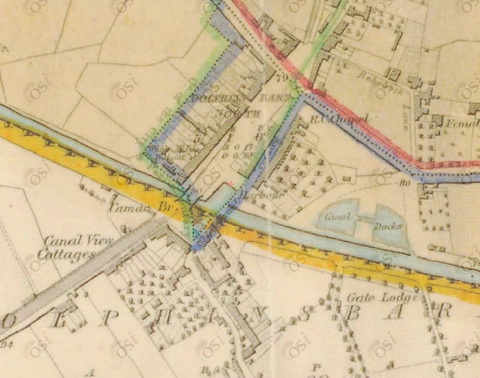
Dolphin's Barn

Dolphin’s Barn

My OSI logo and permit number for websiteWasn’t that fun?


An abandoned section of the Royal Canal

Here is a page about a plan to route the Royal Canal through Kinnegad.

WI extended mooring applications Batches 2 and 3

I reported on 28 November 2012 that Waterways Ireland had issued a press release about the second batch of locations to which extended mooring permits (EMPs) would apply. WI has a new notice about it today; the notice also outlines the third batch of locations, which will …

…  include locations in Kildare on the Barrow Navigation and Royal Canals at Monasterevin, Skirteen, Obstertown and Moyvalley. In addition Ballingowan Glebe and Ballyshane in Co Offaly on the Grand Canal are open for applications. In Westmeath, Coolnahay is also opening on the 17th December.

Southron sheughs

For reasons now lost in the mists of time, I forgot to draw the attention of Learned Readers to an exchange in the Dáil on 18 April 2012, which was reported on the invaluable KildareStreet website as well as on the Oireachtas site. Jack Wall, a Labour TD for Kildare South, asked this question:

Question 702: To ask the Minister for Arts, Heritage and the Gaeltacht the position regarding the canal system under Waterways Ireland; the plans the agency has for the development of the canals; the number of lock keepers in the system; if there are any vacancies; if so, when same will be filled and the mechanism that will be adopted to do so; if the agency has any plans to refurbish existing systems that are not in use at present; if the agency has any plans to increase the number of berthings on the canals and if so, in which areas; if the traffic on the canals has shown a percentage increase over each year for the past three years; and if he will make a statement on the matter. [18431/12]

Now, that’s a bit of a portmanteau question. I wonder whether Jack Wall was prompted to ask about lock keepers but not quite well enough briefed to ask follow-up questions. The minister, Jimmy Deenihan, gave a four-paragraph answer, and I’m going to break it up so that I can discuss each element individually.

Waffle

The minister’s first paragraph was background music:

Since its formation in 1999, Waterways Ireland has continued to upgrade the facilities on the canals through the capital allocations under the National Development Plans. The canals system has benefited extremely well during that time, particularly with the number of additional mooring and landing spaces that have been made available. The provision of further mooring space will be dependent on available finance and priorities over the coming years.

I’m going to move the third paragraph up and deal with it next.

Lockkeepers

The minister said:

I am informed by Waterways Ireland that there are 20 lock keepers employed at present on the Grand Canal and Barrow Navigation. A number of staff have retired recently and decisions on their replacement will be taken having regard to the business needs of the organisation. I understand that Waterways Ireland is not planning to recruit lock keepers at this time. Any posts filled will be either by internal transfer or external recruitment, depending on the particular circumstances.

Although the minister mentions the Royal Canal elsewhere in his answer, and the question certainly does not exclude the Royal, the minister doesn’t mention it in this paragraph. In fact, there are several things the minister doesn’t mention:

  • that there are no lockkeepers on the Royal
  • that agency staff have been employed
  • that, far from considering recruiting replacement lockkeepers, Waterways Ireland might be considering reducing their numbers, or at least assigning some of them to other duties, perhaps on the Royal.

Now, I’m not saying that any of those actualities or possibilities is necessarily a bad thing. In fact, given the virtual absence of lockkeepers on the Canal & River Trust’s English and Welsh canals, it’s hard to see why the Irish canals, with much lower traffic, need so many.

But my point here is that a TD, and especially a Labour Party TD (haven’t they something to do with supporting workers?), might be presumed to be interested in the aspects that the minister did not mention. The minister’s answer was true but incomplete.

For the 2011 election Fine Gael published a document called Reinventing Government, with section headings on “More Open and Transparent Policy-Making Processes” and “New Systems of Openness and Transparency”. Where are they?

Stop digging

Here is the minister’s second paragraph:

My Department’s 2012 capital allocation for Waterways Ireland is €4.5m. This will facilitate continued investment in the development and restoration of the inland waterways. The main thrust of the refurbishment of the waterways over the next few years will be focused on the re-opening of the Ulster Canal from Upper Lough Erne to Clones. However, Waterways Ireland is also undertaking feasibility studies on the Kilbeggan Branch of the Grand Canal and on the Longford Branch of the Royal Canal. These are due to be completed by the end of 2013.

AAAARRRGGGH!

They’re thinking of digging even more sheughs!

Look. I know that engineers love to have excuses (and money) to do engineering: all that kit, wellies and hard hats, muck-shifting and the satisfying feeling that you are bringing joy (and tourists) to a small town. But it’s a waste of time and money. And there is absolutely no point in doing feasibility studies: what you want are cost-benefit analyses. Pretty well every single canal ever built with public funding in Ireland has been a waste of money and there is no reason to believe that relining the canals to Longford and Kilbeggan will be any better. I mean, look at the Naas Branch: very scenic, but hardly anyone ever goes there other than in convoy.

What you want to do is to explain, politely, to the TDs of Longford and Kilbeggan that they can have canals only if they will agree to having all other public services (including the drinking-water supply) cut off. But of course both Kilbeggan and Longford already have ways of attracting tourists. Kilbeggan has a distillery while Longford has an absence of signposts, especially to Athlone, thus causing motorists to drive around in ever-decreasing circles until they imitate the oozlum bird.

I mean, the canal age is over; this is the age of the camper van.

Traffic

Here is the minister’s final paragraph.

I am informed that boat traffic numbers on the Grand Canal and Barrow Navigation have remained fairly constant over 2009 and 2010. In 2011 the numbers increased by 30% following the re-opening of the Royal Canal and the fact that access was available to the Tall Ships event in Waterford.

Now this is really interesting, for three reasons:

  • first, Waterways Ireland keeps telling me that it cannot produce any usage figures for the canals and the Barrow. So on what traffic numbers are the minister’s statements based?
  • second, note that the basis of comparison between the earlier years (2009 and 2010) and the later (2011) is not clear. The Royal was not officially open during the earlier years, although there was some traffic. Was it counted? And does the 2011 figure that shows the 30% increase include Royal figures (in which case it would be an invalid comparison) or not (in which case the few boats doing the complete triangular route caused a huge increase in traffic)?
  • third, note that the minister does not give any actual usage figures. Could it be that they are very small?

What the canals and the Barrow need is action to increase the amount of traffic, especially in summer (when few people travel because of weed and sometimes water shortages) and winter (when few travel because it’s miserable). Adding extensions only spreads the existing traffic more thinly over a larger number of destinations. When you get to the stage of having traffic jams at locks, you can begin to think about extra destinations. Until then, put the shovels away.

More mooring locations on the canals

From a WI presser received this afternoon:

The second set of locations offering the E.M.P include the Floating Moorings on the Grand Canal Dock beside the Waterways Ireland Visitor Centre on which a permit will be offered until March 2013. Additionally extended mooring locations will also be opened on the Grand Canal near Lock 34 in Co Offaly, Pike Bridge in Co Kildare and Abbeyshrule in Co Longford. The full details of the locations including the GPS co-ordinates, the Application Form and Guidance Notes will be available on www.waterwaysireland.org from the 3rd December.

Update 4 December 2012: the press release is now on the WI site.

Royal water (current status)

I have updated my page about Royal Canal feeders with some information provided by Nigel Russell of WI to the An Bord Pleanála oral hearing on the Royal water supply scheme.

Incidentally, the Department of Arts, Heritage and the Gaeltacht, WI’s parent department in RoI, was among the (few) objectors to the proposed abstraction of water from Lough Ennell, although it was in favour of ceasing to abstract water from Lough Owel [Inspector’s report pp11–12]. Indeed it seemed to have some reservations about the reopening of the Royal Canal, not on economic grounds but because “some important nature consideration issues need to be fully addressed”.