Tag Archives: Shannon-Erne Waterway

Waterways budgets: cut by one third in six years

I wrote here and here about the RoI budgetary allocations to Waterways Ireland for 2014, here about the difficulty of establishing exactly what WI’s budget is and here about some questions I have put to the Department of Arts, Heritage and the Gaeltacht on the matter.

But, while a focus on the procedural woods is important, I may have been neglecting the implicational trees. I am recalled to a consideration of the details by two written Dáil questions asked by Gerry Adams [SF, Louth] on 19 November 2013, one of Brendan Howlin, Minister for Public Expenditure and Reform, and the other of Jimmy Deenihan, Minister for Arts, Heritage and the Gaeltacht. Reading the runes is reminiscent of Kremlinology, but it seems to be possible that Waterways Ireland will have to make significant cuts in its spending, cuts that will reduce the services it provides to waterways users.

The questions and the answers

This is what Gerry Adams asked Brendan Howlin:

To ask the Minister for Public Expenditure and Reform the total budget for each All Ireland Body established under the Good Friday Agreement for the years 2010 to date in 2013; and any proposed budget reductions to the these bodies currently being considered.

And this is what he asked Jimmy Deenihan:

To ask the Minister for Arts, Heritage and the Gaeltacht the total budget for each of Waterways Ireland, Fóras na Gaeilge and Ulster-Scots Agency for the years 2010 to date in 2013; and any proposed budget reductions to these bodies currently being considered.

Ignoring the details given for bodies other than Waterways Ireland, we learn that its allocations from its two “sponsor departments”, DCAL in NI and DAHG in RoI, were:

2010 €38.99 million
2011 €35.18 million
2012 €31.15 million

These figures appear to include capital and current expenditure.

For some reason,

The 2013 Budget allocation to the Body are subject to on-going discussion by the two Sponsor Departments.

But Jimmy Deenihan said

My Department’s REV provision for Waterways Ireland for 2013 is €25.463m, a 6% efficiency saving on 2012. My Department’s Estimates provision for 2014 is €24.183m, a 5% efficiency saving on 2013.

The extent of the cuts

I don’t know how to get from a REV provision, or indeed an Estimates provision, to WI’s total budget for 2013 or 2014. One possibility is that the figures include capital and current expenditure. In that case, the RoI contribution to WI’s 2013 budget would be €21.383 million current and €4.080 million capital [PDF; see p160]; adding the NI 15% contribution to current would bring that to about €25.156 million; the €4.080 million capital makes €29.236 million. Perhaps there might be a small amount extra for NI capital spending. By the same logic [and I repeat that I don’t know whether this is the way to do it], the 2014 Estimates provision gives €27.752 million plus NI’s capital spending. Without NI capital spending, the total is 71% of the 2010 figure, so WI will have had its total spending cut by 29% in four years.

Another crude calculation is that the 2012 figure of €31.15 million is 80% of the 2010 figure. Knock off Jimmy Deenihan’s 6% in 2013 and 5% in 2014; the 2014 total comes out again at 71% of the 2010 figure.

But that’s not all. Brendan Howlin said:

In common with other public sector bodies North and South, the North South Implementation Bodies are expected to deliver their objectives in a cost effective and efficient manner. In order to provide a framework for this, my Department and the Department of Finance and Personnel, have issued guidance to the North South Implementation Bodies requiring them to achieve a minimum of 4% efficiency savings per annum in 2014, 2015 and 2016.

So we have to cut another 4% in 2015 and 4% in 2016, by which stage the total will be just under 66% of the 2010 figure: a cut of one third in six years.

Coping

The brunt of the cuts has been borne by the capital budget; we have no figures for expected NI capital spending from 2013 onwards, but on the RoI figures capital spending by 2016 will have been cut by 70%. That seems to have been the general pattern in the Irish public service: cut capital spending first, cut staff costs last.

WI’s operating income is negligible: in 2011 it was €71,000 from licences, €120 from property and €193,000 from permits, lock charges etc, as well as a few other bits and pieces; it is almost entirely reliant on its sponsor departments. So if it is to cope with reduced departmental income, it must either devise new and significant earning opportunities quickly or make serious cuts to its services.

WI’s spending is categorised under five headings, one of which (currency gains or losses and interest) involves a tiny amount. The other four are depreciation, which can’t readily be cut, staff costs, “programme costs” and “other operating costs”.

The “other operating costs” are:

Travel
Recruitment costs
Training and conferences
Contracted in services
Compensation/provision for liability claims
Premises running costs including utilities
Health and safety
Communications
Other operating lease rental
Printing and stationery
Computer running costs
Rent
Audit fee
Marketing and promotions
Insurance and legal fees
Pension administrator costs
General expenditure.

The 2011 total was €5,026,000. None of the individual items looks as if it could provide huge savings, although I imagine each category is being shaved.

The programme costs are allocated to individual waterways; in 2011 (the latest available accounts) the total was €8,082,000, and 63% of those were incurred on the Grand, Royal and Barrow. The Royal’s programme costs were up in 2011, with the reopening, but the Grand’s were cut by 25% and the Barrow’s by 17%. You can’t keep cutting at that sort of rate every year, but I suspect that the Grand, Royal and Barrow will continue to be cut more than the Shannon, Erne and SEW (the Lower Bann cost is tiny).

WI’s main cost is staff: €21,903,000 in 2011, up very slightly on the previous year. I don’t know what cuts have been made in hours or rates (I have heard that there is an overtime ban) but I suspect we haven’t seen the last of them.

At this stage, I imagine that the easy cuts have been made; further cuts may require some combination of

  • reductions in services to users
  • major changes in work practices
  • cuts in staff costs.

There are interesting times ahead.

One small pointer

I noted that, when Jimmy Deenihan spoke in the Dáil on 16 October 2013, he said that WI’s “core activities and targets” included

… keeping the waterways open for navigation during the main boating season.

The last five words [emphasis mine] may be significant: Mr Deenihan may have been hinting that boating is no longer to be regarded as a year-round activity.
Setback for Sheugh

The likelihood that limitless wealth will result from the construction of the Clones Sheugh was reduced recently with the closure of the cruiser-hire base closest to the Ulster Canal: the Emerald Star (Le Boat) operation at Belturbet.

Perhaps, though, it reflects a wider decline in the hire business rather than disappointment at the delay in the canal’s reconstruction.

Shannon traffic figures to September 2013

The current (November 2013) issue of the British magazine Waterways World (available online only to subscribers) has an interview with Dawn Livingstone, new CEO of Waterways Ireland. There was a question about visitor numbers:

How are boating visitor numbers holding up in the recession?

The type of boating is changing — more sports boats for example, and numbers, after an initial decline, have held steady in the cruiser hire and private boat fleets. But more customers are investing in active recreation — canoeing, sailing, rowing, and these clubs and holiday types are growing rapidly.

My sense of the types of boating is the same, but I do not know of any source of reliable data. I think it would be useful if Waterways Ireland were (somehow) to collect and then to publish data on these activities and their economic costs and benefits.

But I was amused by the statement that …

[…] numbers, after an initial decline, have held steady in the cruiser hire and private boat fleets.

I’m not sure what useful data there are for the Lower Bann, Shannon–Erne Waterway, Grand, Royal and Barrow, though perhaps enhanced enforcement of the regulations will improve the data for the last three of those waterways. For the Shannon and Erne, the numbers in the fleets are, I presume, derived from the numbers of registered vessels, but there is no annual re-registration and I am not clear how many boats that are removed from the navigation are removed from the registers.

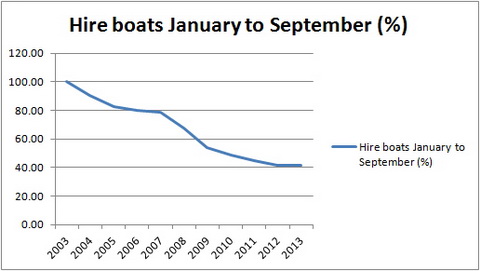
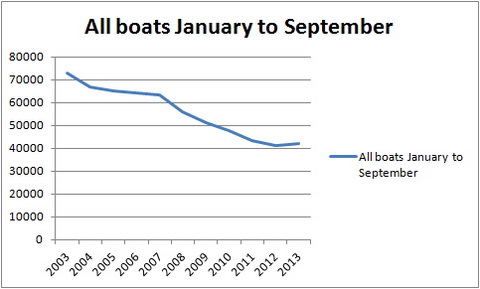
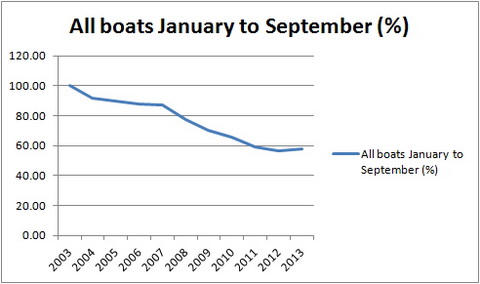
The other, indirect, measure, which applies only to the Shannon, is of passages through locks and moveable bridges. And, for hire boats, the “initial decline” has been 60% since 2003. If the numbers are now holding steady, it is at a very much lower level than ten years ago.

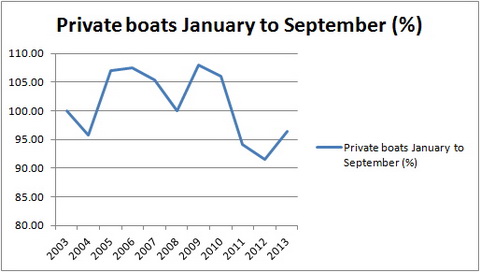
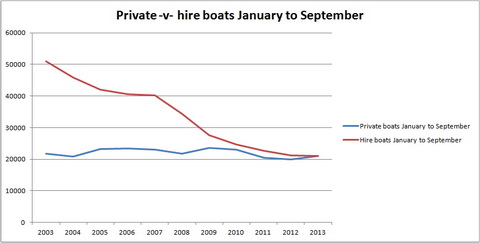
I was able to report in August that the better weather in July seemed to have led to an increase in the number of passages by private boats [the usual caveats apply]. Furthermore, for the first time that I knew of, the number of passages by private boats in the first seven months of the year exceeded the number of passages by hire boats in the same period.

I now have the figures for two more months, August and September, kindly supplied by Waterways Ireland, who are not to blame for my delay in getting the information up here.

All boats JanSept nos_resize

Look! An increase!

All boats JanSept percent_resize

Total passages are now almost back up to 60% of the levels of ten years ago

Hire boats JanSept percent_resize

Hire boat numbers are down by only a tiny amount

Private boats JanSept percent_resize

Private boat numbers are up

Private -v- hire JanSept nos_resize

Hire boat numbers are slightly above private boat numbers

Private boat numbers are ahead of hire in the three main summer holiday months of June, July and August and, although the numbers are tiny, in the winter months as well; hirers are ahead in spring and autumn.


Fun for anoraks

Lots of info on the WI website:

I liked the bit on this page:

Enforcement

Boats in non-compliance with the bye-laws will enter an enforcement process. Enforcement is undertaken by Authorised Officers and will begin with a notification in the form of a sticker and if non-compliance continues may result in the ​craft being removed from the navigation at the owners cost.

I wonder about investing in a crane company.


WI’s budget: the minister speaks

I wrote here about the implications of the RoI 2014 budget for Waterways Ireland. The minister, Jimmy Deenihan [FG, Kerry North/West Limerick], spoke about it in the Dáil on Wednesday 16 October 2013 [h/t KildareStreet.com]. At the end of his lengthy contribution he said:

I am committed to developing North-South co-operation within the broader arts, heritage and commemorative activities of the Department as well as through the funding of North-South bodies. A provision of €38.3 million will be made available to support the two North-South implementation bodies, An Foras Teanga, comprising Foras na Gaeilge and the Ulster-Scots Agency, and Waterways Ireland. The provision will enable Waterways Ireland to deliver on its core activities and targets, which include keeping the waterways open for navigation during the main boating season and promoting increased use of the waterways resource for recreational purposes. This expenditure should also assist in developing and promoting the waterways, attracting increased numbers of overseas visitors and stimulating business and regeneration in these areas. Capital funding of almost €4 million will be made available to Waterways Ireland to facilitate the ongoing maintenance and restoration of Ireland’s inland waterways, thereby increasing recreational access along the routes of waterways.

The Government has reaffirmed its commitment to continuing to make progress, to improving the economy, to exiting the bailout, and to helping to create jobs. The Department and the sectors it represents will make a significant contribution to this work over the course of 2014.

I pointed out last year that Waterways Ireland is part of northsouthery and that, at budget time, we don’t get a breakdown of the northsouthery budget between An Foras Teanga and Waterways Ireland. In 2011, WI got roughly 60%, but I don’t know what happened after that. Here’s what I thought was happening last year:

Current spending (WI)

2010 Estimates: €25 585 000
2011 Estimates: € 24 335 000
2012 Estimates: €22 929 600 (60% of €38 216 000)

Capital spending (WI)

2008 Estimates: €11 000 000
2009 Estimates: €10 300 000
2010 Estimates: €8 000 000
2011 Estimates: €6 000 000 (or €6 002 000)
2012 Estimates: €4 500 000 (or €4 502 000) (100%)

In his speech, above, the minister said that northsouthery is going to get €38.3 million and that Waterways Ireland is to get capital funding of €4 million. However, the €4 million is included in the €38.3 million. The expenditure report [PDF; see page 160] gives these details:

  • for 2013 northsouthery had €36 210 000 of current spending; for 2014 it will get €34 425 ooo
  • for 2013 northsouthery had €4 080 000 of capital spending (all, or almost all, of which was for Waterways Ireland}; for 2014 it will get €3 958 000
  • the overall budget for northsouthery is down 5%.

We can calculate that the capital budget is down about 3%; the much larger current budget is down 5%. If WI gets 60% of the total, its current expenditure contribution from RoI will be €20 655 000, down over €2 000 000 from the previous year and about €5 000 000 since 2010, and its total current expenditure (85% RoI, 15% NI) will be €24 300 000.

The other interesting part of the minister’s speech is what WI is expected to do:

  • promoting increased use of the waterways resource for recreational purposes
  • developing and promoting the waterways
  • attracting increased numbers of overseas visitors
  • stimulating business and regeneration in these areas
  • increasing recreational access along the routes of waterways.

That should keep them busy. But I omitted one activity:

  • keeping the waterways open for navigation during the main boating season.

Emphasis mine, but does this mean that winter boating (at least if it involves staff time, eg at locks) will become a thing of the past?


No worst, there is none.

Pitched past pitch of grief,
More pangs will, schooled at forepangs, wilder wring.
Comforter, where, where is your comforting?

And no more licensed marked fuel traders [.xls] on the Shannon either.

FF -v- SF on C18 economic development

More from the splendid KildareStreet.com, this time an actual Dáil debate, with real people speaking, on 30 May 2013. The debate was initiated by Micheál Martin [head honcho in FF, Cork South Central], who asked the minister …

… his plans for capital investment in Waterways Ireland in the coming year; and if he will make a statement on the matter.

There are three odd aspects to that question.

The first is that Micheál Martin should already know that the capital expenditure allocation for WI within RoI for 2013 is €4 071 000: I can understand that he wouldn’t have wanted to plough through the vast wodges of budgetary bumpf, but I’m sure he would have read the highlights on this site.

The second oddity is that Micheál Martin must have known that the minister would not himself have any plans for capital expenditure: they would be WI’s plans.

The third oddity is that FF didn’t seem to have any particular reason for asking this question: the rest of the debate (see below) seems rather desultory. Could it be that it’s trying to reclaim the waterways limelight from the Shinners, who’ve been keeping an eye on WI dredging as well as on thon sheugh?

To be honest, it all seems a bit pointless: waterways may be interesting to me, and presumably to readers of this site, but they’re hardly of great national importance. A serious debate, by informed participants, might be useful, but (with all due respect to the contributors) there was little sign of that here.

Jimmy Deenihan did actually give some interesting, albeit minor, details about WI’s plans for this year. I omit the first two paras and the last, which are boring boilerplate bumpf that will be familiar to regular readers.

Jimmy Deenihan [FG, Kerry North/West Limerick]: While the Waterways Ireland 2013 business plan and budget is the subject of ongoing discussions with the co-sponsoring Department of Culture, Arts and Leisure in Northern Ireland and will require formal approval by the North-South Ministerial Council, I have provided an indicative funding allocation of €4.071 million to Waterways Ireland for capital projects in this jurisdiction in the coming year. This will facilitate capital works by Waterways Ireland in developing, restoring and improving infrastructure for water based and activity recreation and tourism, consolidating facilitates and improving access to the waterways across the navigations.

I am advised that the Waterways Ireland draft 2013 business plan has a development schedule providing for 1354 m of additional moorings across the navigations. Works planned within this jurisdiction include a range of major projects such as upgrading Bagenalstown Lock on the Barrow; provision of a slipway and stabilisation of the dock walls at Grand Canal Dock, dredging the Grand Canal; development of houseboat facilities at Lowtown and Sallins; lifting the bridge at Tullamore depot; bridge upgrades, works on weirs and locks on the Shannon; and commencement of work on the Belturbet Service Block on the Shannon Erne and purchase of plant and machinery.

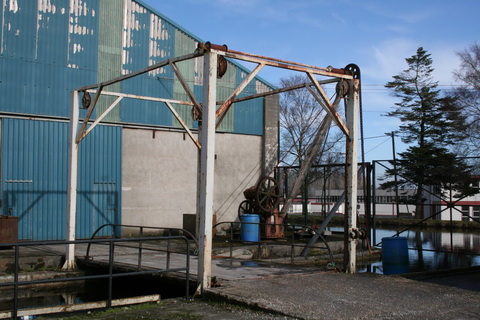
I said that I would welcome information about what “lifting the bridge at Tullamore depot” means. The answer was provided in the Comments below; here is a photo of the bridge in question.

The (currently non-lifting) lifting bridge at Tullamore

The (currently non-lifting) lifting bridge at Tullamore


Most of the rest is unsurprising.

The FF follow-up came from Seán Ó Fearghaíl [FF, Kildare South], who said:

I welcome the many positive developments to which the Minister referred but one of our concerns is that since 2011 the funding available for Waterways Ireland has been cut from €35 million to approximately €32 million.

Studies over the years have shown that waterways tourism is one of the activities that is most likely to generate return visits. As a regular user of places like the Shannon Navigation, one never ceases to be amazed at the number of non-nationals one meets on that waterway who have been coming back to Ireland year in, year out. I wonder to what extent the funding the Minister has available to him should be augmented by the Department of Transport, Tourism and Sport. These waterways are of immense value to the local populations privileged to live in the catchment area of each amenity, along with their huge tourism importance. What sort of interaction does the Minister have with tourism bodies north of the Border and the Department of Transport, Tourism and Sport? Is anything planned for the waterways under the auspices of The Gathering?

What has happened in Kildare this week? We had Bernard Durkan [FG, Kildare North] the other day and Clare Daly [Socialist Party, Dublin North, but originally from Newbridge, Co Kildare] a moment ago; now we have a new chap from Kildare South.

Anyway, it can’t have come as any surprise to Mr Ó Fearghaíl that WI’s budget has been cut: so has everybody else’s, and the budgets were announced last December. I note that he didn’t ask how the Clones Sheugh was to be funded, never mind the Cavan Sheugh to Lough Oughter. But his question is the sort that a journalist might ask: vague, unfocused, couched in generalities, lacking in evidence of research into the subject. I would like to know more about his “Studies over the years”, with particular reference to the balance between and the allocation of the costs and benefits of investment in waterways; generating return visits is not in itself terribly useful (I really do not want Great Aunt Maud here again).

Not that the minister offered many hard facts in his reply:

I have seen for myself the provision of moorings at Killaloe and Ballina. Those have made a major difference to both towns in different counties on either side of the Shannon. The result of that investment is obvious and local people would accept that.

As regards involvement from Fáilte Ireland, Waterways Ireland is augmenting Fáilte Ireland’s promotion of the waterways. Waterways Ireland is providing funding on an annual basis for the promotion of tourism on its waterways. It is a North-South body, which is also very important, because Tourism Ireland promotes the entire island and the waterways network of more than 1,000 navigable kilometres can really be pushed on an all-island basis and we are doing that. I have tried to minimise the reduction in funding for Waterways Ireland because of its North-South significance and its potential and considerable work has been done. We have improved facilities for tourists so we are now ready to proactively promote this great facility.

Any, like, figures? Statistics? References to analyses? How much of WI’s budget is being diverted to the tourism bods and what is the benefit?

Next (and last) up was Peadar Tóibín [SF, Meath West], with “now for something completely different“:

A number of groups are actively trying to create a green way along the Boyne from the estuary to its source. The Boyne is littered with internationally recognised heritage monuments and would be a fantastic tourist attraction that would bring people into the region. People who holiday in the region visit Trim Castle and Newgrange on coach trips and as ar result Meath does not get the full value of their tourism. The Boyne Canal runs from Navan to Drogheda. It is not covered by the Waterways Ireland network. Would the Minister agree that such a canal should be brought within the ambit of Waterways Ireland, along with other canals, and would he consider the funds that might be available to help with the development of such a green way along the River Boyne?

The minister’s reply is interesting:

We have no plans to extend the present 1,000 kilometres of navigable waterways. The focus of our investment in capital development will be from Clones to Lough Erne to the value of €35 million.

What? No Cavan Sheugh? No Kilbeggan, Longford or Mountmellick Branch?

Oh, and note that the figure of €35 million is being quoted for the Clones Sheugh, although the last estimate I had form WI was higher than that.

The minister continued:

As regards the green way, I do not have direct responsibility but any way I can help through Waterways Ireland, I will do so. As a keen cyclist and walker, I am all for encouraging green ways wherever possible. If the Deputy has a proposal I can forward to Waterways Ireland for discussion, I will gladly take it.

Well, well. A Monaghan greenway is being developed; why not a Clones greenway too, instead of an expensive canal?

Thon Cavan Sheugh

Thanks to Kildare Street for this, which came up in Dáil written answers on Wednesday 22 May 2013.

Brendan Smith [FF, Cavan-Monaghan]: To ask the Minister for Arts, Heritage and the Gaeltacht the position regarding the feasibility study that has been underway for some time in relation to the proposed extension of the Erne Navigation from Belturbet to Killykeen and Killeshandra; when this study will be completed; and if he will make a statement on the matter. [24538/13]

Jimmy Deenihan [FG Kerry North/West Limerick]: I am informed by Waterways Ireland that the current position is that work is continuing on the collection of data relating to this project and Waterways Ireland is currently preparing draft options for the project. At that point consultants will then assess the environmental implications of the options. It is expected that the feasibility study will be completed as planned by the end of 2013.

That’s Lough Oughter they’re talking about. If thon Monaghan boys are getting a sheugh, Cavan boys need one too. And, of course, consultants are having a hard time so they could benefit by earning a few bob. The net benefit to the economy will be pretty well nil (any spending will simply be displaced from elsewhere).

I think that Killykeen is a forest park; it is not clear how the local economy would benefit from the arrival of a few boats. If the folk of the area want a unique water-based attraction that might bring foreign tourists, they would be better advised to have the lake made an engine-free zone, open only to boats rowed, paddled or sailed, and with safe places to camp on the banks.

You can read here about how to get a boat from Belturbet to Lough Oughter.

Sinn Féin’s sheughs

I have remarked before that Sinn Féin seems to be devoted to the leading-edge communications technology of the eighteenth century, the canal. I have no idea why it takes such an interest in the subject, but further evidence of its devotion has emerged in the last week.

The Fermanagh Herald reported, on 5 May 2013, that Michelle Gildernew MP [whose Sinn Féin page seems to have disappeared] listed the Clones Sheugh amongst the jobs on which European taxpayers should spend money. She did so at a meeting with Colette Fitzgerald, head of the European Commission’s Belfast office; Ms Fitzgerald made polite noises but did not promise any money.

But Sinn Féin does not confine itself to Clones. Carál Ní Chuilín MLA, whose Sinn Féin web page is live but well out of date, is (as Minister of Culture, Arts and Leisure) the NI minister responsible for Waterways Ireland. We learn from the Londonderry Sentinel that she wanted Waterways Ireland to be landed with responsibility for the Strabane Sheugh.

Happily, the North South Ministerial Council shot that down, but the minister wants to see whether the unfortunate Strategic Investment Board can find any loot for the canal. It might be better if they were asked to find a use for it first: even if it were restored, it would be unlikely ever to see more than a few small boats in a year. It might provide a walking route, for which (pace the Clones dudes) neither locks nor water would be needed, but the Londonderry Sentinel leaves me unclear whether the towpath is usable. It says:

A year ago the Sentinel reported the ‘tow path’ section of the Strabane Canal was to open for the first time in 50 years in June 2012.

It doesn’t say that the towpath did reopen, which seems odd; a Belfast Telegraph article of June 2012 says that it was reopened temporarily but WalkNI says that it is being restored. So is it open or not? I’d like to know, because I favour walking routes along unrestored canals, as does the learned IndustrialHeritageIreland, which also notes encouraging interest from Monaghan County Council.

The drums, Carruthers

I pointed out recently that some newspapers seemed to have reproduced, unquestioningly, what may have been press releases about the Clones Sheugh. On 25 April the Irish Independent, and other media, had a story, attributed to the Press Association, beginning:

Part of the cross-border Ulster Canal which has not been used for 80 years is to reopen, it has been revealed.

That followed the granting of planning permission, in Northern Ireland, for those portions of the proposed canal to Clones that lie with HM Realm. A couple of weeks earlier, Sinn Féin had been calling for taxpayers’ money to be spent on the project. And Brian Cassells was quoted in the Belfast Telegraph on 27 April 2013 in praise of walking in the country. I wondered whether there was a coordinated campaign to put pressure on the Irish government to come up with the loot for the Clones Sheugh: whether the jungle drums were being orchestrated.

Paying the piper

But none of those stories made it clear that the Irish taxpayers, who had been volunteered to pay for those sheugh, could not afford it. Then, last week, we had several stories making that very point — but without any reference to the stories of the previous week:

The Indo gives the cost of the Clones Sheugh as €35m and the BelTel as £29.6m; it is not clear whether they are repeating an outdated estimate or whether Waterways Ireland’s engineers have provided a new estimate.

Please put a penny

Both stories repeated the current Irish government’s current rather confusing story about where the money was to come from:

  • sale of Waterways Ireland assets (which Irish ministers are not empowered to sell)
  • annual budgetary allocations to Waterways Ireland
  • income from commercialisation of Waterways Ireland assets, which (as I interpret it) is not the same as revenue from the sale of assets.

But it is the journalism that concerns me again here. Newspapers have printed a story saying that there is no money for the Clones Sheugh but they have ignored their own stories, of only a week earlier, saying that the project was going ahead.

Given that, I find it difficult to believe that the newspapers (and the Press Association) have anyone taking an active interest in the Clones Sheugh: researching, investigating and reporting. I suspect — and I accept, of course, that I may be entirely wrong — that on both occasions the journos were simply presented with press releases, probably pre-digested.

Calling the tune

I think it would be interesting to know who has been issuing these various press releases and why they have been doing do. So I’d like journos to tell us the context and the background: that would be more interesting to read, and more worthy of the journos’ efforts, than the reproduction of the releases’ contents.

I don’t know who sent out the first set of releases, saying that the Ulster Canal was to go ahead, but I suspect that the second set was a damage-control effort by the current Irish minister. I suspect that he wanted to dampen down unrealistic expectations without actually the Clones enthusiasts to get stuffed (whether for the short or for the long term). What happened in between the two sets of releases was that a member of the minister’s own party, Heather Humphreys [FG Cavan-Monaghan], asked a Useful Question in the Dáil. That was no doubt entirely coincidental, and not in any way prompted by the minister or by the FG managers, but it allowed the minister to get his story out.

South of the border

The occasion was a Topical Issue Debate on Cross-Border Projects on 1 May 2013. Ms Humphreys was able to associate herself with the views of the local supporters of the project (who are not paying for it), to say how important it was and to claim that getting planning permission was a significant step forward. Which it might be, but it doesn’t help the project to get past the financing obstacle, although she did say that the government was hoping to nick some Euroloot (from PEACE IV; here’s some stuff about PEACE III) for the project.

The minister responded with a history of the proposed rebuilding; then he said [I’ve added extra paragraph breaks]:

The planning applications for this project are now likely to be determined in May 2013. The compulsory purchase order, CPO, land maps are well progressed. It is estimated that the CPO process will take approximately 12 months and, depending on the funding in place, the CPO process may proceed incrementally.

A decision on the construction of the project and on whether to have a single large contract or a number of smaller contracts will also have to be made.

As the project is above the EU procurement threshold the tender process will be required to comply with the EU procurement process and will take approximately six months to complete. Taking that into consideration the earliest the contract could be awarded would be late 2014 with a contract period of 24 months giving a completion date of spring 2017. If the project is to proceed in a more piecemeal fashion the completion date could be some years later, depending on the number and timing of individual contracts. Funding for the project very much depends on the availability of funding from the Exchequer. Deputy Humphreys referred to the possibility of funding from a European source. The Taoiseach referred to a similar possibility.

I established an inter-agency group comprising county managers from Monaghan and Cavan, the director of leisure, development and arts from Fermanagh, representatives from the Northern Ireland Tourist Board, Fáilte Ireland, the Strategic Investment Board, Waterways Ireland and senior officials from the Department of Culture, Arts and Leisure, Northern Ireland and the Department of Arts, Heritage and the Gaeltacht. The inaugural meeting was held on 20 September 2012 and the next meeting will take place shortly. Its challenge is to find alternative sources of funding. I again thank the Deputy for raising the matter. With the planning permission process completed, the next stage is to acquire the land and we will proceed with that immediately.

I feel sorry for the poor folk from the NI Strategic Investment Board, who barely mention the Ulster Canal in their Investment Strategy for Northern Ireland 2011–2021: building a better future [PDF], and who take care to mention the Unionist Lagan Navigation along with the Republican Ulster Canal. They must be wondering how their involvement is expected to help the southern government to meet its commitment to pay for the Clones Sheugh.

Along the banks

Anyway, back to the Dáil. Heather Humphreys, who may not have seen many canals, responded, saying (inter alia):

The canal is an iconic, achievable project that is worthy of support.

Naturally, I disagree about the “worthy of support” bit, but even “iconic” is nonsense. The Ulster Canal was a relatively minor, small, uninteresting waterway carrying insignificant cargoes, and there is little to attract the tourist. The Royal Canal is much more “iconic”, and even that pales by comparison with some canals elsewhere.

The minister finished by saying:

Potential funding from the €150 million PEACE IV programme is very important. If we could source funding from it that would give a greater possibility of the project progressing in the near future. I hope that having completed the CPOs we can make a start on the project in 2015 or 2016. As Deputy Humphreys indicated, it is an iconic project and it would give a major boost to that part of the country which has suffered considerably from rural depopulation. The farming community is under a lot of pressure as well.

Certainly, this project would be seen to be a major asset to the local community and local economy.

It seems that the rural seclusion of the area between Lough Erne and Clones will not be broken by the sounds of JCBs just yet.