Tag Archives: steamer

The Limerick Navigation: lock sizes

Here is a table showing the sizes of the locks on the (now abandoned) Limerick Navigation.
Sailing in the Lowtown high

WI & L&MK at Lowtown, with pics and map, here.

Mark Twain and the Shannon

From Life on the Mississippi 1883:

Mississippi steamboating was born about 1812; at the end of thirty years, it had grown to mighty proportions; and in less than thirty more, it was dead! A strangely short life for so majestic a creature. Of course it is not absolutely dead, neither is a crippled octogenarian who could once jump twenty-two feet on level ground; but as contrasted with what it was in its prime vigor, Mississippi steamboating may be called dead.

Shannon steamboating began (on the non-tidal river) in the late 1820s and was dead, if not absolutely dead, by the 1850s.

Twain’s book is a great read. Here is an extract from the Project Gutenberg ebook. The narrator is a young apprentice to the experienced steamer pilot, Mr Bixby. There are eight or ten other experienced pilots on board for the trip, inspecting the “upper river” between St Louis and Cairo at a time of low water levels.

Mr Bixby at the wheel

We went booming along, taking a good many chances, for we were anxious to ‘get out of the river’ (as getting out to Cairo was called) before night should overtake us. But Mr Bixby’s partner, the other pilot, presently grounded the boat, and we lost so much time in getting her off that it was plain that darkness would overtake us a good long way above the mouth.

This was a great misfortune, especially to certain of our visiting pilots, whose boats would have to wait for their return, no matter how long that might be. It sobered the pilot-house talk a good deal. Coming up-stream, pilots did not mind low water or any kind of darkness; nothing stopped them but fog. But down-stream work was different; a boat was too nearly helpless, with a stiff current pushing behind her; so it was not customary to run down-stream at night in low water.

There seemed to be one small hope, however: if we could get through the intricate and dangerous Hat Island crossing before night, we could venture the rest, for we would have plainer sailing and better water. But it would be insanity to attempt Hat Island at night. So there was a deal of looking at watches all the rest of the day, and a constant ciphering upon the speed we were making; Hat Island was the eternal subject; sometimes hope was high and sometimes we were delayed in a bad crossing, and down it went again.

For hours all hands lay under the burden of this suppressed excitement; it was even communicated to me, and I got to feeling so solicitous about Hat Island, and under such an awful pressure of responsibility, that I wished I might have five minutes on shore to draw a good, full, relieving breath, and start over again. We were standing no regular watches. Each of our pilots ran such portions of the river as he had run when coming up-stream, because of his greater familiarity with it; but both remained in the pilot house constantly.

An hour before sunset, Mr Bixby took the wheel and Mr. W— stepped aside. For the next thirty minutes every man held his watch in his hand and was restless, silent, and uneasy. At last somebody said, with a doomful sigh — ‘Well, yonder’s Hat Island — and we can’t make it.’

All the watches closed with a snap, everybody sighed and muttered something about its being ‘too bad, too bad — ah, if we could only have got here half an hour sooner!’ and the place was thick with the atmosphere of disappointment. Some started to go out, but loitered, hearing no bell-tap to land. The sun dipped behind the horizon, the boat went on. Inquiring looks passed from one guest to another; and one who had his hand on the door-knob and had turned it, waited, then presently took away his hand and let the knob turn back again.

We bore steadily down the bend. More looks were exchanged, and nods of surprised admiration — but no words. Insensibly the men drew together behind Mr Bixby, as the sky darkened and one or two dim stars came out. The dead silence and sense of waiting became oppressive. Mr Bixby pulled the cord, and two deep, mellow notes from the big bell floated off on the night. Then a pause, and one more note was struck. The watchman’s voice followed, from the hurricane deck — ‘Labboard lead, there! Stabboard lead!’

The cries of the leadsmen began to rise out of the distance, and were gruffly repeated by the word-passers on the hurricane deck. ‘M-a-r-k three!… M-a-r-k three!… Quarter-less three!… Half twain!… Quarter twain!… M-a-r-k twain!… Quarter-less—’

Mr Bixby pulled two bell-ropes, and was answered by faint jinglings far below in the engine room, and our speed slackened. The steam began to whistle through the gauge-cocks. The cries of the leadsmen went on — and it is a weird sound, always, in the night. Every pilot in the lot was watching now, with fixed eyes, and talking under his breath. Nobody was calm and easy but Mr Bixby. He would put his wheel down and stand on a spoke, and as the steamer swung into her (to me) utterly invisible marks — for we seemed to be in the midst of a wide and gloomy sea — he would meet and fasten her there. Out of the murmur of half-audible talk, one caught a coherent sentence now and then — such as — ‘There; she’s over the first reef all right!’

After a pause, another subdued voice — ‘Her stern’s coming down just exactly right, by George!’

‘Now she’s in the marks; over she goes!’

Somebody else muttered — ‘Oh, it was done beautiful — beautiful!’

Now the engines were stopped altogether, and we drifted with the current. Not that I could see the boat drift, for I could not, the stars being all gone by this time. This drifting was the dismalest work; it held one’s heart still. Presently I discovered a blacker gloom than that which surrounded us. It was the head of the island. We were closing right down upon it. We entered its deeper shadow, and so imminent seemed the peril that I was likely to suffocate; and I had the strongest impulse to do something, anything, to save the vessel. But still Mr Bixby stood by his wheel, silent, intent as a cat, and all the pilots stood shoulder to shoulder at his back.

‘She’ll not make it!’ somebody whispered.

The water grew shoaler and shoaler, by the leadsman’s cries, till it was down to — ‘Eight-and-a-half!…. E-i-g-h-t feet!…. E-i-g-h-t feet!…. Seven-and —’

Mr Bixby said warningly through his speaking tube to the engineer — ‘Stand by, now!’

‘Aye-aye, sir!’

‘Seven-and-a-half! Seven feet! Six-and —’

We touched bottom! Instantly Mr Bixby set a lot of bells ringing, shouted through the tube, ‘NOW, let her have it — every ounce you’ve got!’ then to his partner, ‘Put her hard down! snatch her! snatch her!’ The boat rasped and ground her way through the sand, hung upon the apex of disaster a single tremendous instant, and then over she went! And such a shout as went up at Mr Bixby’s back never loosened the roof of a pilot-house before!

There was no more trouble after that. Mr Bixby was a hero that night; and it was some little time, too, before his exploit ceased to be talked about by river men.

Fully to realize the marvelous precision required in laying the great steamer in her marks in that murky waste of water, one should know that not only must she pick her intricate way through snags and blind reefs, and then shave the head of the island so closely as to brush the overhanging foliage with her stern, but at one place she must pass almost within arm’s reach of a sunken and invisible wreck that would snatch the hull timbers from under her if she should strike it, and destroy a quarter of a million dollars’ worth of steam-boat and cargo in five minutes, and maybe a hundred and fifty human lives into the bargain.

The last remark I heard that night was a compliment to Mr Bixby, uttered in soliloquy and with unction by one of our guests. He said — ‘By the Shadow of Death, but he’s a lightning pilot!’


CWW bridge

Paul Quinn’s photos showed the new Marlborough Street Bridge being constructed across the Liffey. Last Saturday’s Irish Times reported that Dublin City Council would soon be advertising to seek suggestions for naming the bridge; it said that a body called Labour Youth [whose members may be socialists, I fear] wanted it named after one Rosie Hackett, who went on strike  many years ago. It did not report that there is another campaign to have the bridge named after E T S Walton, a physicist.

The north-eastern corner of the bridge features the site of the offices of the City of Dublin Steam Packet Company, whose crest still adorns the walls. I suggest that the bridge be named after the company’s founder, the remarkable Irish entrepreneur Charles Wye Williams: the father of the Shannon, the master of scheduled steam shipping, the founder of the CoDSPCo and a founder director of the Peninsular and Oriental Steam Navigation Company, godparent of the Irish livestock industry, innovator in marine safety, promoter of the turf industry, writer and experimenter on steam technology, tireless campaigner ….

Apart from his company’s crest on Eden Quay, and his name on a bridge he caused to be built in Limerick, there is no monument to this remarkable man. Name the bridge after him and move the plaque to it (and protect it adequately).


Dargan, O’Regan, steam and the Newry Canal

I wrote here about Simon O’Regan’s passenger-carrying screw steamer tried on the Grand Canal in Dublin in 1850. I am grateful to John Ditchfield for pointing me to an article about what happened next: steam trials on the Newry Canal in 1850, but this time with a lumber (freight) boat.

I would welcome more information about Simon O’Regan or about the use of steam power on the Newry Canal.

Simon O’Regan -v- John Inshaw

Did Simon O’Regan attempt to preempt John Inshaw? Here is a page about O’Regan’s single-screw passenger steamer, demonstrated at Portobello on the Grand Canal in Dublin in 1850.

The fear of Baal’s Bridge

In May 1895 the fear induced by the prospect of a passage under Baal’s Bridge, on the Abbey River in Limerick, as revealed in the commercial court in London before Mr Justice Mathew and reported by the Freeman’s Journal of 20 May 1895.

Arthur George Mumford of Colchester, Essex, was described as an agent, but was actually a marine engineer and manufacturer of steam engines. He owned a 25-ton steam yacht called Gipsy, which he decided to sell through Messrs Cox & King, the well-known yachting agents (their 1913 catalogue is here).

The buyer was Ambrose Hall, the man responsible for the statue of Patrick Sarsfield. A former mayor of Limerick, he was an alderman and a “house and land commission agent”; his address was given as Mignon House, Limerick, which I have not so far found.

Hall bought the boat for £500; it was to be delivered to him at Limerick. The original plan was to sail it around the coast of Ireland and up the Shannon estuary, but bad weather in late 1894 caused Cox & King to suggest taking it to Dublin and then down the Grand Canal and the Shannon to Limerick. Hall agreed; the boat left Dublin in January 1895. It reached Killaloe on 19 January and Limerick “a day or two afterwards”, where it was moored in the canal harbour.

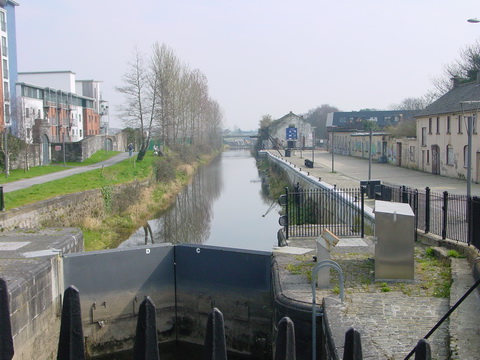
25 Grand Canal Harbour Limerick March 2007 01_resize

Canal harbour, Limerick in March 2007

Hall refused to accept the boat in the canal, saying that it should have been delivered to Limerick dock, a short distance downstream. Mumford and Cox & King sued him and the National Bank.

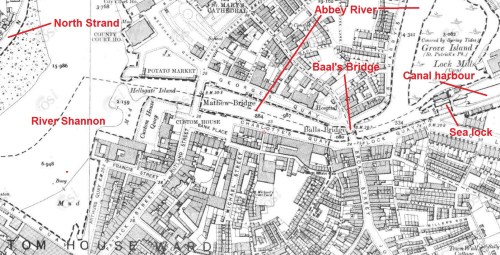
Hall and Baal

Ordnance Survey ~1900

Hall, an alderman and a former mayor, who had lived at North Strand, presumably knew the river and its difficulties.

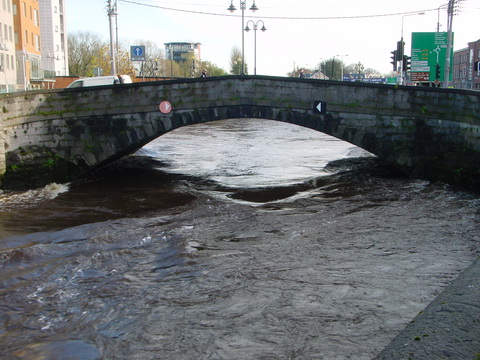
Baal's Bridge 20091128 1_resize

Baal’s Bridge looking upstream towards the canal harbour in the floods of 2009

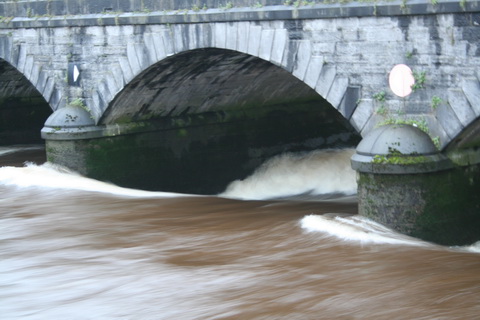
Navigation arch at Mathew Bridge 20091122_resize

The navigation arch at Mathew Bridge looking downstream in the floods of 2009

It was contended by the defendant that to get the vessel from the canal into the estuary of the Shannon there was a considerable risk involved. The passage was only a few hundred yards, but it was stated it could only be effected at certain states of the tide when it would be possible to get through Ballsbridge.

The judge sensibly suggested that it should be possible to insure the boat for the journey; the plaintiffs agreed to deliver it; Hall agreed to accept delivery and to pay £15 for the cost of the caretaker who had been looking after the boat since 23 January; the case was settled.

Clearly Ambrose Hall didn’t know Pat Lysaght.

My OSI logo and permit number for website

The 120′ Irish steam-powered narrow boat

Read about it here.

Canal Boat No 279

There is a mystery about Canal Boat No 279, which sank in the entrance to Spencer Dock, on the Royal Canal, in December 1873. Actually, there are several mysteries, and readers’ comments, information and suggestions would be welcome. Read the story here.

Canal boat sunk on the Liffey

In a comment here I wondered what a canal boat was doing as far up the Liffey as Grattan Bridge in 1873. Here is a report from the Freeman’s Journal of 10 March 1875 that may provide a possible explanation.

THE LATE WRECK IN THE RIVER LIFFEY:— The porter-laden canal boat which was swamped on Monday by being borne by the flood in the river against the southern abutments, at the western side of Grattan-bridge, still remains in the place where she sank. Though she came with great force against the structure, she did not inflict the slightest injury upon it. Measures will be at once taken for floating the sunken vessel, which does not in any way interfere with the river traffic, as the centre arches are quite clear. All the porter which was on board the canal boat when she went down has been secured.

Remember that Guinness built its wharf on the Liffey in 1873 but did not start building its own fleet of barges for the Liffey until 1877. It did, however, have “a few small tugs” that were used to draw laden boats.

Guinness had easy access to the Grand Canal Harbour at James’s Street, so it seems unlikely to me that Grand Canal boats would risk the Liffey passage to supply pubs along the Grand, the Barrow and the lower Shannon. It therefore seems more likely that the boats were either Royal Canal boats or were being used to supply ships in the port.