
People whom I’ve told where I was going today are barred from this quiz ….
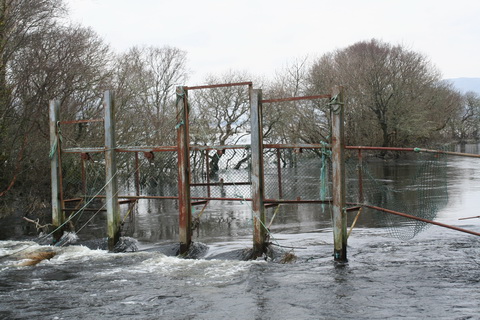
Upstream end
Of which Irish canal is this the upstream end? (The structure is a now-disused eel weir.)
People whom I’ve told where I was going today are barred from this quiz ….
Upstream end
Of which Irish canal is this the upstream end? (The structure is a now-disused eel weir.)
Ewan Duffy of IndustrialHeritageIreland and I have both, in recent times, uncovered new information about the history of the Royal Canal after it was taken over by the Midland Great Western Railway in 1845: a period that, because (I think) of the absence of company archives, is not well covered in published histories of the Royal. Ewan today said that he will be posting new material about the stretch from Lock 1 to Lock 5 on 30 March 2013, so watch that space.
Posted in Ashore, Built heritage, Charles Wye Williams, Economic activities, Engineering and construction, Extant waterways, Industrial heritage, Ireland, Non-waterway, Operations, Rail, Restoration and rebuilding, Steamers, waterways, Waterways management
Tagged boats, bridge, canal, Dublin, Ewan Duffy, industrial heritage ireland, Ireland, lock, MGWR, railway, Royal Canal
L & M Keating at work here.
Posted in Built heritage, Economic activities, Engineering and construction, Extant waterways, Industrial heritage, Ireland, Irish inland waterways vessels, Irish waterways general, Operations, People, Restoration and rebuilding, Sources, waterways, Waterways management
Tagged boats, canal, Dublin, Grand Canal, Ireland, L & M Keating, Operations, quay, vessels, water level, waterways, Waterways Ireland, workboat
The River Greese is a tributary of the River Barrow, joining it below Maganey Lock. The photo is taken from the road on the west bank of the Barrow.
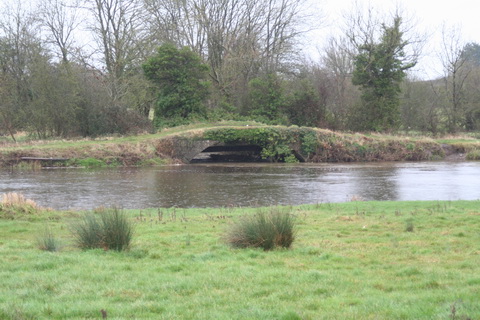
The Greese joins the Barrow: the trackway passes over it on a bridge
You can locate it on the OSI map by zooming out from here; the extract below shows the confluence.
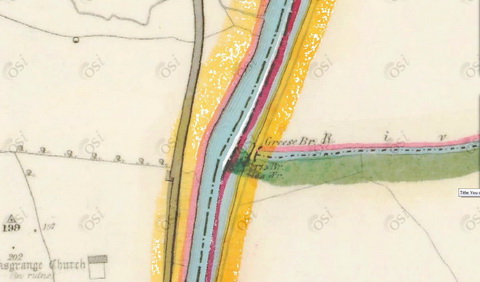
The confluence

Posted in Ashore, Built heritage, Drainage, Economic activities, Engineering and construction, Extant waterways, Industrial heritage, Ireland, Natural heritage, Operations, Scenery, waterways, Weather
Tagged Barrow, bridge, Carlow, floods, flow, Grand Canal, Greese, Ireland, Laois, Maganey, Operations, Shrule, waterways
Quite the most remarkable story I’ve come across about the Royal Canal and the Midland Great Western Railway ….
An Affecting Charge
The following case lately came for trial before Mr Henn QC, the new Recorder of Galway:— George Hamilton, who for twenty-five years had been in the employment of the Midland Great Western Railway Company as station-master, was indicted for stealing from a hamper some goods, the property of Sir Arthur Guinness, which were addressed to Cong, in the county Mayo. For some time a course of pilfering had been carried on, and the directors, in order to find out who were the guilty parties, employed two Dublin detectives, named Stookman and Healy, who arrived in Galway on Aug 31st, and, concealing themselves in the goods-store in empty barrels, remained on the watch all night. About one o’clock next morning they heard a noise, and observed the prisoner entering the place. Having satisfied himself that he was unseen, he took out his penknife and proceeded deliberately to cut the cords of the hamper and extract some of its contents. The detectives waited until he had taken out a bottle of vinegar, a bottle of pickles, and some cheeses, and then tied up the hamper again. They then issued from their hiding-place and seized him. He begged them for God’s sake to have mercy on his wife and family, and to leave the matter between himself and the manager, but they refused to do so, and, having called the police, gave him into custody. About twenty witnesses were examined for the prosecution, and among them the clerk of the goods store, who swore that it had been locked and the key left with the prisoner.
Mr M’Laughlin QC appealed to the sympathies of the jury, and, pointing out some alleged discrepancies in the evidence, pressed them, if they had a doubt that the prisoner took the articles with a guilty intent, to give him the benefit of it.
The Recorder, in his charge, showed that the discrepancies only proved the truth of the charge, and expressed the deep pain he felt at seeing in such a position a man who had held a respectable position, with a salary of £300 a year, and had young ladies whom he saw in court dependent upon him. He finally burst into tears.
The jury retired, and after three hours’ deliberation returned into court and stated that there was no chance of an agreement. His worship sent them back to their room, and, after being absent for another hour, they brought in a verdict of not guilty, which the Recorder stated he could not endorse, but characterised as monstrous.
The Leeds Times 12 October 1878
The Recorder, Mr Henn, was the father of T R Henn and later lived in Paradise. Sir Arthur Guinness, a stout fellow, was a descendant of this chap and had a small holiday house at Cong on Lough Corrib, where his family had many boats.
Posted in Ashore, Built heritage, Economic activities, Engineering and construction, Industrial heritage, Ireland, Irish inland waterways vessels, Operations, People, Politics, Rail, Scenery, shannon estuary, Sources, Water sports activities, waterways
Tagged boats, cheese, Clare, Corrib, detectives, estuary, Fergus, Guinness, Henn, Ireland, Midland Great Western Railway, Operations, pickles, vinegar, waterways
His late Most Excellent Majesty Henry the Eighth, by the Grace of God, King of England and France, Defender of the Faith, Lord of Ireland and of the Church of England and also of Ireland in Earth Supreme Head, has many claims to fame, but the greatest is undoubtedly his Act for the Weares upon the Barrow, and other Waters in the County of Killkenny of 1537, which begins thus:
Prayen the commons of this present Parliament assembled, That where at all times necessarie boates, scowts, wherries, clarans, cottes, and other vessels, loden and bestowed with goods, merchandizes, and other stuffe, have beene used to passe and repasse thorough and in the King’s most excellent Majesty’s rivers and waters of the Barrow, the Noyre, the Suyr, and the Rie, within this land, which Rie is in the county of Kilkenny, to and from the King’s citie of Waterford, and the townes of Kilkenny, Rosse, and Clomel [sic], to and from diverse borrowe and corporate townes, and other places, being sitiated in the counties of Kyldare, Catherlagh, Wexford, Kilkenny, Waterford, and Tipperary, through which great commoditie and profit hath growen and might grow to the said citie, townes, noroughes, and other places, and to all and every the King’s true subjects adjoyning to the same waters and rivers: […]
We resume a couple of pages later:
[…] and that the said owners, their servants, marryners, boatmen, and other rulers and conveyers, and all other persons coming in ayd and help of them and every of them, at all such times as the said mariners, boatemen, and other rulers and conveyers shall thinke the same necessarie and needfull, shall have and occupie at every of their wills and pleasures, the space and breadth of seven foote or more, as need require, of plain ground, upon every part of the land, of every side of every the said rivers and waters, next adjoyning to the said rivers and waters, and that to bee where they must needs draw the said boats and other vessels afore named, with strength of horses or men, by land […].
So His late Most Excellent Majesty provided that those drawing boats, using manpower or horsepower, could use a space seven foot wide on either side of the river. From the 1750s onwards, work was done on building a towing-path along the Suir between Carrick and Clonmel; work seems to have been finished before 1789 and the towing-path continued in use until the early years of the twentieth century.
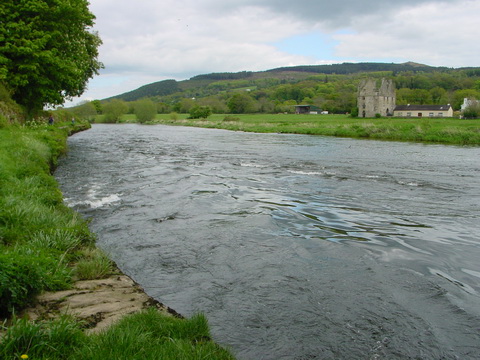
Kincor Castle below Sir Thomas’s Bridge at Ferryhouse
Much, but not all, of the towing-path is accessible, and maintainted by South Tipperary County Council; as well as providing a walking route, it allows anglers, boaters and other leisure users to get to the river. However, some sections are impassable, so that it is not possible to walk the whole length of this extremely scenic route between Clonmel and Carrick.
South Tipperary County Council is now considering declaring public roads on the towing-path and thus taking it in charge.

South Tipperary County Council’s newspaper ad about declaring public roads on the Suir towing-path
The Council’s documents are here. I think that this is a good idea and I have written to the Council (and to local newspapers) to declare my support.
Posted in Ashore, Built heritage, Economic activities, Engineering and construction, Extant waterways, Forgotten navigations, Industrial heritage, Ireland, Operations, People, Politics, Restoration and rebuilding, Sources, Suir, Tourism, Water sports activities, waterways, Waterways management
Tagged access, angling, Barrow, boats, bridge, Carrick-on-Suir, Clonmel, Deerpark, Ferryhouse, floods, flow, Ireland, King Henry VIII, Operations, public road, Suir, take in charge, Tipperary, towing-path, towpath, vessels, walking, water level

 Irish waterways history