Category Archives: Engineering and construction

A Bourne mystery

Here is an ad, from 1785, offering to let flour-mills at Portlaw, Co Waterford, and a bake-house in John Street, Waterford, to a “tenant possessed of abilities”.

The ad is interesting in several respects. First, although the location of the flour-mills is not clear, they may have preceded the iron-works, the famous Malcolmson cotton-mill and the later tannery on the site; they certainly seem to have used the water power of the Clodiagh.

Second, the ad suggests that flour could be carried from the mills by three rivers to Waterford: the Clodiagh, the Suir and St John’s Pill, which is another navigation featured on this site.

Third, the ad invites applications to be sent to either John Thomas Medlycott in Dublin or John Edwards Bourne in Mayfield, Waterford. The Post-Chaise Companion [4th ed] says

Within half a mile of Portlaw, on the L is Glen-house the seat of Mr Bourne.

At Portlaw are the extensive mills built by Edward May Esq, and about a quarter of mile beyond Portlaw on the L is a large house built by the same gentleman.

About a mile from Portlaw, on the R situated on the banks of the Suir, is Mayfield, the noble and delightful seat, with very extensive and beautiful demesnes and plantations, of William Watson Esq and on the L is Coolfin, the seat of the Rev Thomas Monck.

That puts a Mr Bourne in Portlaw, though in Glenhouse rather than Mayfield. The Glenhouse address is confirmed by Matthew Sleater in 1806.

But what interests me is whether the John Edwards Bourne mentioned in the ad is related to John Edwards Bourne of Dunkerrin, Co Offaly, formerly of Nenagh, Co Tipperary, who died in 1799 or so. The Offaly Bourne seems to have had four brothers and three sisters.

I would be glad to hear from anyone who knows anything about the Portlaw Bourne (or indeed any of the other Bournes). If you can help, please leave a Comment below.



God bless England, now we pray

Finally, as to the want of cleanliness of which you complain — although I do not pretend to say that the Irish peasantry are as fond of order as the English, yet here also we can discover how much is owing to want of education and early training. If you visit the union workhouses, the prisons, the lunatic asylums, and other public institutions in Ireland, you will perceive that, under proper instruction and discipline, Irish men and women can be cleanly, and can keep rooms and houses as orderly and neat as any other people. The fact is, that the Celtic race appear to stand in need of training and discipline, for the acquirement of those habits which seem to come naturally to the Saxon; but with such training, and the stimulus of suitable encouragement, or even of a kind word, the Irish may be made all that their English neighbours can desire.

Edward Newenham Hoare The English Settler’s Guide through Irish Difficulties; or, a hand-book for Ireland, with reference to present and future prospects Hodges and Smith, Dublin; John W Parker, London 1850


Dublin to Limerick or Kilkenny

FRANCIS JENKINSON,
At the DROGHEDA’s ARMS, Monasterevan,
PROPRIETOR of the LIMERICK and KILKENNY
STAGE COACHES

Most respectfully informs his friends and the public, that he has removed from the Old Town of Monasterevan, to a spacious and elegant house adjoining the Canal, which he has fitted up in a stile superior to any on the road:— His coach-houses, stabling, &c are on a very extensive scale; he has gone to a great expence in fitting up stall stables, which he flatters himself will give general satisfaction; — returns his sincere thanks for the numerous favours received since his commencement in business.

His Larder is constantly well assorted, and his wines are of the first quality.

NB said Jenkinson informs the public, that his Stage from Kilkenny sets off precisely at half after four in the morning, arrives in time for the three o’clock packet which leaves Monasterevan, and on passengers coming from Dublin will arrive in Ballyroan, so as to be in Kilkenny early next day. Said coach passes through Castle Durrow coming and going.

Stage passengers for Limerick or Kilkenny not charged with beds.

Seats taken in Dublin at Mr John Goffen’s, No 7, Bolton-street, and in Kilkenny at Mr Francis Reynold’s, Wheat Sheaf.

Dublin Evening Post 17 June 1790


I would be glad to hear from anyone who can tell me where Mr Jenkinson’s Drogheda’s Arms was. Please leave a Comment below.

St John’s Pill (River) in Waterford

Brian Simpson writes from Waterford:

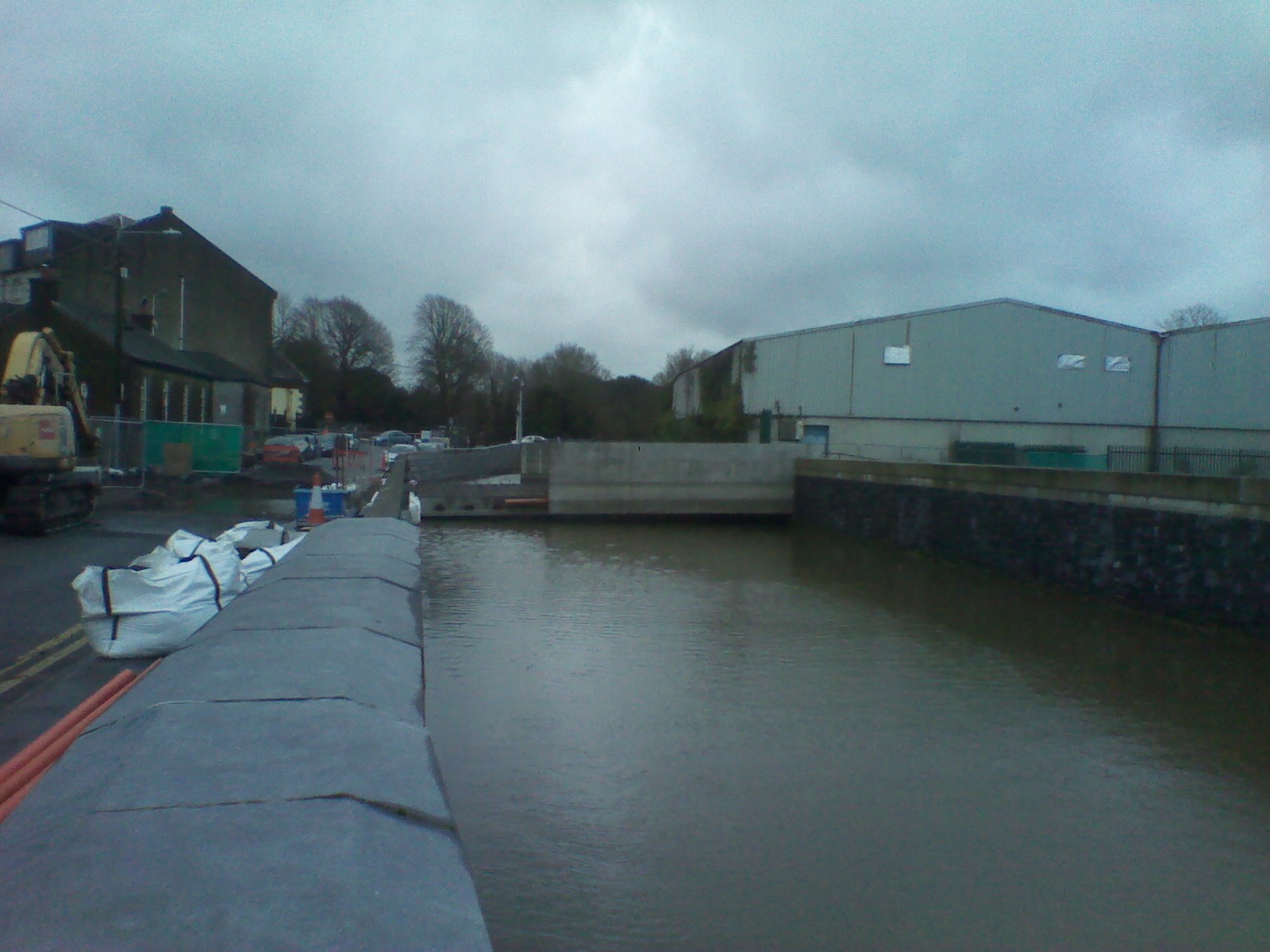
There’s a new bridge being built on the Waterside in Waterford City and sadly it looks like it is going to be a death blow for the Friends of St John’s River and Waterford Small Boat Owners Association’s attempts to restore navigation along this waterway.

The new bridge at high tide (Brian Simpson)

Please find attached the Facebook link for comments and attached photo of bridge at high tide.

Half our canal was taken by a humpback bridge, Wyse Bridge, being replaced at Poleberry in 1980; this effectively stopped any chance of barges navigating the other part of the waterway, which was being done up to the 1950s.

I do hope that boats will still be able to use the Pill.

Update: a link to a video.

Lough Allen to Limerick 1786

The hopes of a gentleman of Limerick ….

Down the Nore from Castletown

Seventeenth-century transport on the Nore from Castletown to Ross and Waterford.

The Slieve Anierin Canal

Carthach O’Maonaigh very kindly drew my attention to an item in The Schools’ Collection, “a collection of folklore compiled by schoolchildren in Ireland in the 1930s” made available on Dúchas.ie. The item in question, which has been scanned and transcribed, is what Patrick McLoughlin, aged 59, told Mary Josephine reynolds of Cormongan, Co Leitrim; it can be seen here but Dr Críostóir Mac Cárthaigh, Interim Director of the National Folklore Collection at UCD, has very kindly given me permission to reproduce the text here.

Slieve Anierin Canal and Cornashamsoge Furnace

About the year 1650, there was a furnace for smelting Iron ore in the townland of Cornashamsogue, situated on the east side of Lough Allen. The ore had to be conveyed to the furnace for a distance of about 3 miles.

For this purpose a canal was made. The canal ran by the foot of the mountain. Several rivers flow westward from the mountain into Lough Allen. The largest of these is the Stoney river, a river that becomes a roaring torrent in times of heavy rain, often overflowing its banks, and causing great destruction, to lands, crops and houses.

At the time mentioned above, about the year 1650, the water of the Stoney river was diverted into the canal. The canal then was fed principally by this river, and in a lesser degree by the other smaller rivers that ran in the same direction. All the rivers ran at right angles to the canal.

The water also supplied the power that worked the furnace. The site of the furnace can still be pointed out, and the field in which it is situated has got the name of the Furnace Meadow. This furnace was in operation about the same time as, and may have some connection with the furnace, or furnaces, at Drumshanbo, which would be about 3 miles away.

Iron ore was conveyed to the Drumshanbo furnaces by boat, on Lough Allen. The sources of supply, were, the Slieven an Iern, Ballinaglera, Arigna mountains, all situated around Lough Allen. It is thought that the town of Drumshanbo had its origin in these industries. As to the Slieve an Iern canal, there are but very meagre traces of it at the present time.

A canal built in 1650 would be a very early canal and I would be grateful for any information anyone can provide about it; please leave a Comment below if you can help. I can’t see any trace of either canal or furnace on the OSI 6″ and 25″ maps but I may not be looking for the right shapes.


Transport books

Here is a site with links to many old books, mostly late nineteenth and early twentieth century, on several forms of transport[ation]. Not all the links are to free online copies, but it’s a useful list nonetheless.

A train on the canal

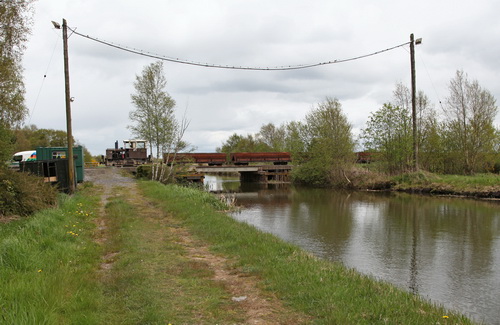
Thanks to Ted McAvoy (via Andrew Waldron) for this photo.

LM 238 crossing the Grand Canal (Ted McAvoy)

It shows a Bord na Mona ballast train crossing the Grand Canal just here. It’s on the BnM’s Derrygreenagh System and, if you follow the line northwards on the map, you’ll get to Derrygreenagh on the R400. I am told that the train was going to Ballybeg Bridge Quarry but I haven’t managed to locate that.


Maps

Many thanks to the learned Eoin C Bairéad for the information that the good people at logainm.ie have scanned many old maps, and other documents, and made them available here, free of charge. They include maps of counties bordering the Shannon, Murdoch Mackenzie’s 1775 chart of the Shannon Estuary (with some soundings) and Mackenzie’s Views of the West Coast of Ireland.

Note: some of the files are very large.