Category Archives: Engineering and construction

Before Ardnacrusha

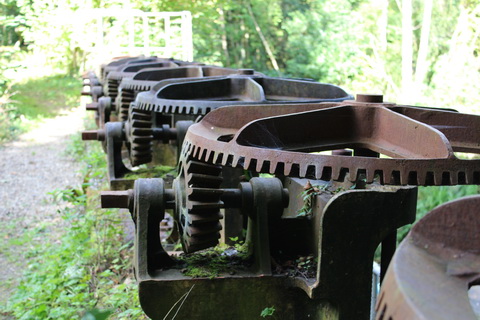
Waterworks sluices 06_resize


The power of the Shannon, falling 100 feet in 15 miles from Killaloe to Limerick, is nowadays tapped by the hydroelectric power station at Ardnacrusha. But in earlier times it did not go entirely unused. I have already written about the bleach mill at Doonass; here is a page about the other bleach mill, at Clareville, and about the water works in the same area. These works are on a stretch of the Shannon navigable only by cots (then) and kayaks and canoes (now).


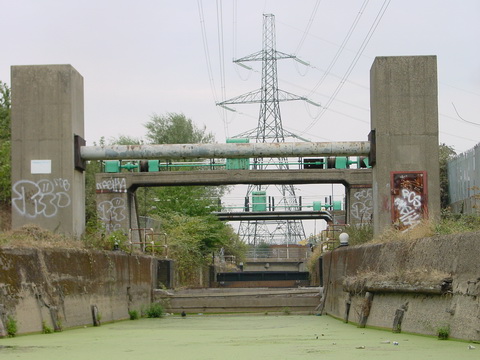
Carpenters Road Lock in London

Carpenters Road Lock in 2003

Carpenters Road Lock in 2003

Here is a page about an art (craft?) project happening at Carpenters Road Lock on the Bow Back Rivers in London: the lock has changed quite a bit since I took the photo (above) in 2003.

I should warn you that the link is to a very long web page, but the section headings stay on top so you can move around. However, if you allow Javascript, you’ll find that two places on the page show those very annoying sequences of photographs that change automatically.

What I thought was most interesting was the set of events organised at the lock. Canals of Dublin organises canal walks in, er, Dublin, but what about Waterways Ireland having lockkeepers doing talks and demonstrations?

Here are some links to sites with more information about the Bow Back Rivers in London:

London Canals and associated blog

An extensive Wikipedia article with schematic diagram

A political view from Mick Hartley

London’s Lost Rivers on pre-Olympic scenery (black background makes the text hard to read but the photos are good)

The most informative page I found: a superb piece of work. Well done Richard Thomas, to whose Steamers Historical site I have a permanent link.

h/t celr

Canal gets government go-ahead

In Egypt.


Urgent message for Athlone folk

If you’re anywhere near Athlone, hie thee to the Lough Ree Yacht Club at 8.00pm on Wednesday 22 October 2014 for the Old Athlone Society meeting. It features Paul Clements, who has just written a biography of Richard Hayward, author (amongst many other roles) of (amongst many other books) Where the River Shannon Flows, a book that should be in every Irish waterways person’s library.

The evening includes a showing of the film of the same name, which (though short) is highly evocative. WW2 was declared as the filming team reached Portumna. There is some very good footage of the Foynes flying-boats.

h/t gjb

The Slaney cot: photos

I wrote here about a Slaney cot, built by Larry Duggan, which we had spotted on its way to Wales. The owner has very kindly sent some more photos of the cot’s construction, of Larry Duggan and of the cot on the Usk; I have put them on a separate page here.

Longford

Longford is a town about five miles from Clondra, the junction of the Royal Canal with the River Shannon near Tarmonbarry.

Some of the local cargo-cultists seem to believe that, if the Longford branch of the Royal Canal is restored, fleets of vessels (probably from Limerick) will bring untold prosperity to the town. And the unfortunates of Waterways Ireland have been told to produce a feasibility study on the matter. According to the minister for waterways, the study will be available on the Waterways Ireland at the end of October.

Irrespective of whether the restoration is feasible, the question is whether it would be sensible. I see two possibilities:

(a) some of the thousands of vessels already using the Royal Canal will be attracted to Longford, where the attractions of the night-life will entice them to spend more money than they would otherwise have spent in, say, Clondra. If they don’t spend more than they would otherwise have spent, the spending is simply displaced from one place (eg Clondra) to another (Longford). If that is so, it might be worth the while of the publicans of Longford to pay for the restoration, because they will benefit from it, but there is no benefit to the taxpayer in paying for it because the spending is simply moved from one place to another

(b) the attractions of Longford are so great that thousands of visitors who would not otherwise have visited the Royal Canal will now do so. Again, the displacement argument applies, so these thousands of visitors must come from overseas, attracted by the reputation of Longford for metropolitan sophistication. Or something. Now, if that reputation were enough to attract overseas tourists, they would already be visiting Longford in their droves. Are they?

I am sure that Longford has many attractions apart from the alternator repair shop.

 

The Scotch Quay crane

Here is a page about the crane on Scotch Quay, on St John’s Pill in Waterrford. I would welcome information on the age of the crane, on who made it and on how it works.

Heritage outside the box

I was not entirely complimentary about Waterways Ireland’s online survey on the contribution of boating to the economy. However, its latest online survey seemed to me to be better designed.

It’s part of a consultation seeking opinions about a Heritage & Biodiversity Plan. I was afraid that the survey might limit the scope of responses to a small number of prepackaged options, but in fact I found it easy to make suggestions that might be outside the range of those expected. The response boxes expand as required, although I didn’t test the upper limits.

I encourage readers to complete it.

St John’s Pill: an update

I have found a little more information about the involvement of George Lane Fox with the upper reaches of St John’s Pill; I have written about it here.

Heather Humphreys on waterways

From the Financial Resolutions speeches:

I am committed to developing North-South co-operation within the broader arts, heritage and commemorative activities of my Department as well as through the funding of North-South bodies. A provision of more than €38 million is made available to support the two North-South implementation bodies — An Foras Teanga and Waterways Ireland. These budgets will be subject to the approval of the North South Ministerial Council in due course. The provision will enable Waterways Ireland to keep the waterways open for navigation during the main boating season and promote increased use for recreational purposes while developing and promoting our waterways to attract increased numbers of overseas visitors.

Nothing new there, I think, but note the repetition of a point I highlighted last year:

The provision will enable Waterways Ireland to keep the waterways open for navigation during the main boating season […].