Category Archives: Engineering and construction

Shannon passage times 1838

Estuary

Kilrush to Limerick 4 hours

Tarbert to Limerick 3 hours

Clare[castle] to Limerick 3.5 hours

Limerick Navigation

Limerick to Killaloe:

  • iron passenger boat 2.5 hours
  • timber passenger boat 3.5 hours
  • trade boat 6 hours.

Shannon

Killaloe to Portumna:

  • passenger steamer 6 hours
  • steamer towing lumber boats 8 hours.

Portumna to Shannon Harbour:

  • 6 hours.

Shannon Harbour to Athlone:

  • 8 hours.

Source: Railway Commissioners second report Appendix B No 6.

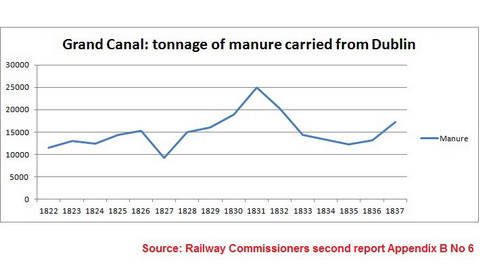
Keeping Dublin tidy

Fertilising the countryside

Fertilising the countryside

Erie warning: stuck with a sheugh

New York is a place in the Americas. There is a town of that name and there is also a state, whose economic development in the nineteenth century was assisted by the development of a canal, about which you can learn more on this excellent site. There is a trail along the canal that can be walked or cycled.

The canal is run by the New York State Canal Corporation, which is a subsidiary of the New York State Thruway Authority [a thruway is, it seems, a sort of road]. The canal loses money (naturally). The Thruway Authority sought to increase tolls; the State Controller said it should save money and improve management instead. Inter alia, it should

Commission an independent analysis of the Canal System to examine ways to streamline operations, seek new funding streams, and develop a realistically attainable vision for its future role in the upstate economy.

In his full report [Assessment of the Thruway Authority’s  Finances and Proposed Toll Increase [PDF] Office of the New York State Controller August 2012], the Controller said that

[…] the New York State Constitution forbids the Legislature to sell, abandon or otherwise dispose of the canals […]

but that

[…] choices regarding operational control and financial support for the Canal System are policy matters to be determined by the Governor and the Legislature.

His summary said that

Additional factors in the Thruway Authority‟s current weakened condition include the Authority‟s responsibility for financing and operating the State‟s Canal System as a result of legislation enacted two decades ago. The Canal System has consumed more than $1.1 billion of Thruway resources in the ensuing period. Contrary to the original legislative intent, responsibility for supporting the canals has diminished the Authority‟s ability to pursue its core mission. Moving the Canal System into the Thruway Authority was intended, in part, to stimulate tourism and economic development along the historic
canal corridors. This goal, too, has been elusive; boating activity on the canal has  declined substantially under Thruway control.

Later in the report he said

Second, the Authority‟s financial resources and organizational expertise, along with the then-newly created Canal Recreationway Commission, would position the underused Canal System to improve its facilities and marketing such that new users would be attracted from around the country, and even around the world.

Neither of these hoped-for outcomes has occurred. The Thruway Authority has invested more than $1.1 billion in the Canal System, and this drain of toll resources has also contributed to the deterioration of the Authority’s financial condition over the past decade. Meanwhile, despite major investments and new amenities, pleasure-craft activity on the Canal System in recent years is down by nearly one-third since the period immediately before the Thruway Authority assumed control.

The local media seem to take a somewhat more informed interest in their sheugh than do those in these parts:

Ireland and the United Kingdon could avoid finding themselves in these difficulties by refusing to recreate any more sheughs.

 

A wet winter?

Today’s Irish Times reports on yesterday’s launch of a report called Ireland’s climate: the road ahead [92.9 Mb 103 page PDF here]. The report predicts:

  • Daytime summer temperatures to rise by up to 2°C
  • Lowest winter night-time temperatures to rise by 2-3°C
  • Milder winters to reduce cold-related mortality rates
  • Wetter winters and drier summers
  • Increase in frequency of heavy precipitation event.

Chapter 10 “Climate change and catchment hydrology” covers river flows.

Met Éireann’s report on summer 2013 [2 page PDF] is available here; rainfall was down [on the 1981–2010 average] at all stations except Valentia; temperature was up everywhere and so was sunshine. So perhaps we’ll have a wet winter to look forward to.

Who saved Clonmacnoise?

It seems possible that, at some stage in the late eighteenth century, there was a plan that would probably have destroyed Clonmacnoise.

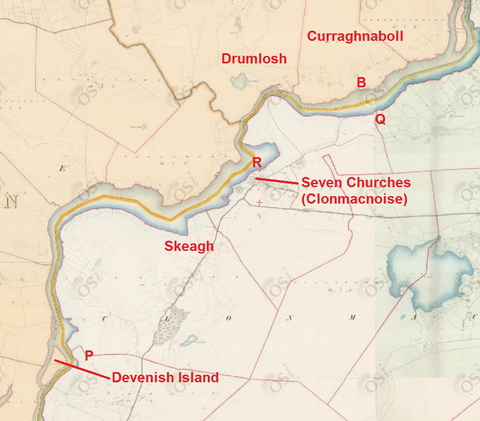
There exists A Map of the River Shannon from Athlone to Killaloe, Surveyed by John Killaly 1795, which contains much of interest. I do not have permission to reproduce it here, but here is the section around Clonmacnoise from the ~1840 OSI 6″ map.

Clonmacnoise OSI ~1840

Clonmacnoise OSI ~1840

I have marked on the map some of the placenames used by Killaly.

The legend reads:

[…]

B. Ford least water 4F 6J [which I take to mean 4′ 6″]

[…]

From Q to P the proposed Canal is ¾ Mile shorter than the River.

From Q to R [the proposed Canal] is ¾ Mile shorter than the River.

It seems therefore that, in 1795, someone was considering shortening the Shannon by digging one of two possible canals to cut off peninsulas along the east bank. Given the narrowness of the stretch between the esker and the river, I suspect it would have been impossible to dig either of them without destroying Clonmacnoise.

I would like to know more about the proposal and about why it was abandoned.

Incidentally, some folk prefer the spelling Clonmacnois but the Placenames Database of Ireland uses Clonmacnoise.

My OSI logo and permit number for website

Chambers, pots

Folk knowledgeable about canal engineering and artefacts might be able to contribute to a current discussion, over at the Helpful Engineer’s website, of the Four Pots overflow and the side chambers at Lock 16 (Digby Bridge) on the Grand Canal.

Water levels

Waterways Ireland is warning of low water levels on Lough Ree. You can see here how the level at Athlone Weir has changed over the past 35 days.

Landing pills

They had two of them on the Slaney.

Naas

An account of the official opening of the Naas Branch (County of Kildare Canal) in 1788.

The Helpful Engineer

The Helpful Engineer’s always-interesting blog today discusses an overflow mechanism on the Grand Canal.