Category Archives: Extant waterways

Sailing in the Lowtown high

WI & L&MK at Lowtown, with pics and map, here.
Mark Twain and the Shannon

From Life on the Mississippi 1883:

Mississippi steamboating was born about 1812; at the end of thirty years, it had grown to mighty proportions; and in less than thirty more, it was dead! A strangely short life for so majestic a creature. Of course it is not absolutely dead, neither is a crippled octogenarian who could once jump twenty-two feet on level ground; but as contrasted with what it was in its prime vigor, Mississippi steamboating may be called dead.

Shannon steamboating began (on the non-tidal river) in the late 1820s and was dead, if not absolutely dead, by the 1850s.

Twain’s book is a great read. Here is an extract from the Project Gutenberg ebook. The narrator is a young apprentice to the experienced steamer pilot, Mr Bixby. There are eight or ten other experienced pilots on board for the trip, inspecting the “upper river” between St Louis and Cairo at a time of low water levels.

Mr Bixby at the wheel

We went booming along, taking a good many chances, for we were anxious to ‘get out of the river’ (as getting out to Cairo was called) before night should overtake us. But Mr Bixby’s partner, the other pilot, presently grounded the boat, and we lost so much time in getting her off that it was plain that darkness would overtake us a good long way above the mouth.

This was a great misfortune, especially to certain of our visiting pilots, whose boats would have to wait for their return, no matter how long that might be. It sobered the pilot-house talk a good deal. Coming up-stream, pilots did not mind low water or any kind of darkness; nothing stopped them but fog. But down-stream work was different; a boat was too nearly helpless, with a stiff current pushing behind her; so it was not customary to run down-stream at night in low water.

There seemed to be one small hope, however: if we could get through the intricate and dangerous Hat Island crossing before night, we could venture the rest, for we would have plainer sailing and better water. But it would be insanity to attempt Hat Island at night. So there was a deal of looking at watches all the rest of the day, and a constant ciphering upon the speed we were making; Hat Island was the eternal subject; sometimes hope was high and sometimes we were delayed in a bad crossing, and down it went again.

For hours all hands lay under the burden of this suppressed excitement; it was even communicated to me, and I got to feeling so solicitous about Hat Island, and under such an awful pressure of responsibility, that I wished I might have five minutes on shore to draw a good, full, relieving breath, and start over again. We were standing no regular watches. Each of our pilots ran such portions of the river as he had run when coming up-stream, because of his greater familiarity with it; but both remained in the pilot house constantly.

An hour before sunset, Mr Bixby took the wheel and Mr. W— stepped aside. For the next thirty minutes every man held his watch in his hand and was restless, silent, and uneasy. At last somebody said, with a doomful sigh — ‘Well, yonder’s Hat Island — and we can’t make it.’

All the watches closed with a snap, everybody sighed and muttered something about its being ‘too bad, too bad — ah, if we could only have got here half an hour sooner!’ and the place was thick with the atmosphere of disappointment. Some started to go out, but loitered, hearing no bell-tap to land. The sun dipped behind the horizon, the boat went on. Inquiring looks passed from one guest to another; and one who had his hand on the door-knob and had turned it, waited, then presently took away his hand and let the knob turn back again.

We bore steadily down the bend. More looks were exchanged, and nods of surprised admiration — but no words. Insensibly the men drew together behind Mr Bixby, as the sky darkened and one or two dim stars came out. The dead silence and sense of waiting became oppressive. Mr Bixby pulled the cord, and two deep, mellow notes from the big bell floated off on the night. Then a pause, and one more note was struck. The watchman’s voice followed, from the hurricane deck — ‘Labboard lead, there! Stabboard lead!’

The cries of the leadsmen began to rise out of the distance, and were gruffly repeated by the word-passers on the hurricane deck. ‘M-a-r-k three!… M-a-r-k three!… Quarter-less three!… Half twain!… Quarter twain!… M-a-r-k twain!… Quarter-less—’

Mr Bixby pulled two bell-ropes, and was answered by faint jinglings far below in the engine room, and our speed slackened. The steam began to whistle through the gauge-cocks. The cries of the leadsmen went on — and it is a weird sound, always, in the night. Every pilot in the lot was watching now, with fixed eyes, and talking under his breath. Nobody was calm and easy but Mr Bixby. He would put his wheel down and stand on a spoke, and as the steamer swung into her (to me) utterly invisible marks — for we seemed to be in the midst of a wide and gloomy sea — he would meet and fasten her there. Out of the murmur of half-audible talk, one caught a coherent sentence now and then — such as — ‘There; she’s over the first reef all right!’

After a pause, another subdued voice — ‘Her stern’s coming down just exactly right, by George!’

‘Now she’s in the marks; over she goes!’

Somebody else muttered — ‘Oh, it was done beautiful — beautiful!’

Now the engines were stopped altogether, and we drifted with the current. Not that I could see the boat drift, for I could not, the stars being all gone by this time. This drifting was the dismalest work; it held one’s heart still. Presently I discovered a blacker gloom than that which surrounded us. It was the head of the island. We were closing right down upon it. We entered its deeper shadow, and so imminent seemed the peril that I was likely to suffocate; and I had the strongest impulse to do something, anything, to save the vessel. But still Mr Bixby stood by his wheel, silent, intent as a cat, and all the pilots stood shoulder to shoulder at his back.

‘She’ll not make it!’ somebody whispered.

The water grew shoaler and shoaler, by the leadsman’s cries, till it was down to — ‘Eight-and-a-half!…. E-i-g-h-t feet!…. E-i-g-h-t feet!…. Seven-and —’

Mr Bixby said warningly through his speaking tube to the engineer — ‘Stand by, now!’

‘Aye-aye, sir!’

‘Seven-and-a-half! Seven feet! Six-and —’

We touched bottom! Instantly Mr Bixby set a lot of bells ringing, shouted through the tube, ‘NOW, let her have it — every ounce you’ve got!’ then to his partner, ‘Put her hard down! snatch her! snatch her!’ The boat rasped and ground her way through the sand, hung upon the apex of disaster a single tremendous instant, and then over she went! And such a shout as went up at Mr Bixby’s back never loosened the roof of a pilot-house before!

There was no more trouble after that. Mr Bixby was a hero that night; and it was some little time, too, before his exploit ceased to be talked about by river men.

Fully to realize the marvelous precision required in laying the great steamer in her marks in that murky waste of water, one should know that not only must she pick her intricate way through snags and blind reefs, and then shave the head of the island so closely as to brush the overhanging foliage with her stern, but at one place she must pass almost within arm’s reach of a sunken and invisible wreck that would snatch the hull timbers from under her if she should strike it, and destroy a quarter of a million dollars’ worth of steam-boat and cargo in five minutes, and maybe a hundred and fifty human lives into the bargain.

The last remark I heard that night was a compliment to Mr Bixby, uttered in soliloquy and with unction by one of our guests. He said — ‘By the Shadow of Death, but he’s a lightning pilot!’


Mark Twain and the Cammoge drownings of 1849

Mark Twain wrote:

There is something fascinating about science. One gets such wholesale returns of conjecture out of such a trifling investment of fact.

I have indulged in just such conjecture about the design of the ferry boat in use at Cammoge in 1849, crossing the outlet from Poulnasherry Bay, west of Kilrush on the Shannon estuary. The news reports of the time give very little information about the design of the boat, and the reliability of that information is questionable, which makes my speculation even more dangerous. Nonetheless, I thought it might be useful to set out some thoughts on the subject in the hope that other folk, who know more about the background, the location or naval architecture than I do, might be able to help to clarify the design.

Myths and legends of the Shannon

I feel it necessary to point out that Thomas Rhodes (1789–1868), engineer to the Shannon Commissioners, whose name is on a plaque on Athlone bridge, was not a brother of Cecil Rhodes. Thomas was born near Bradford, the son of a carpenter called James Rhodes; Cecil was born in Bishop’s Stortford, the son of a clergyperson.

The last round-up

A press release from Waterways Ireland says:

Since November 2012 Waterways Ireland has offered Boaters on the Grand Canal, Barrow Navigation and Royal Canal a new Extended Mooring Permit which enables the boat to remain in a single location for more than five days. Extended Mooring Locations have been offered at two week intervals until the 4th March when the final 2013 locations will open. In total, 68 Extended Mooring Locations will have been offered across urban and rural locations on the three waterways. Each location has multiple moorings available; more than ample space for every boat currently on the system should all wish to apply. More locations are being prepared should demand increase.

Applications for the last set of locations begin on March 4th 2013. On the Barrow extended mooring locations will open at Moneybeg, Co Carlow and Lowtown, Co Kildare and on the Grand Canal at Derrymullen, Ticknevin and Allenwood Middle also in Co Kildare.

There follows the usual material about enforcement, which can be read here.

On wires and worked with steam*

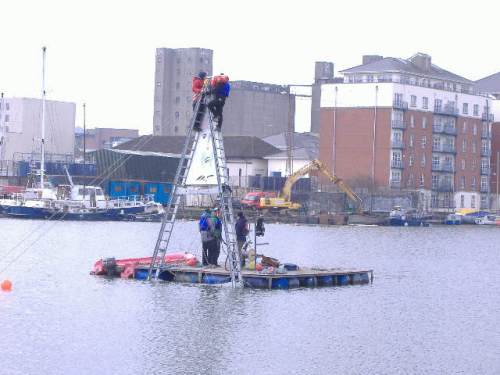
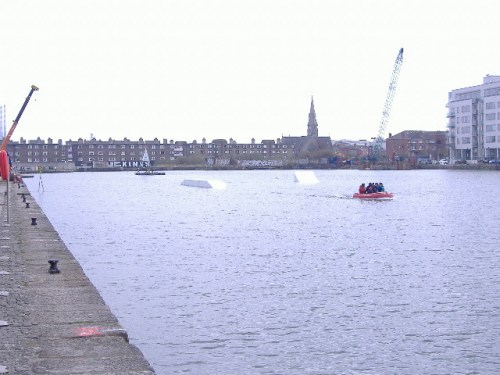
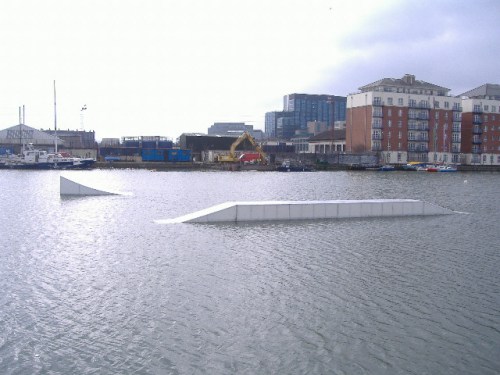
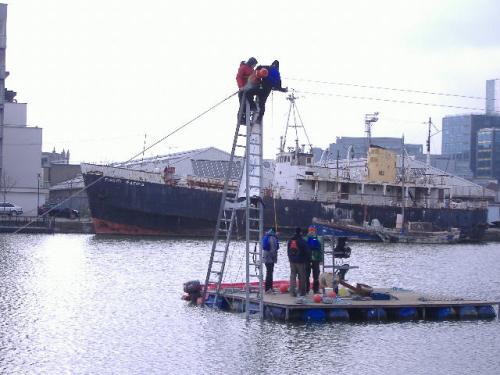
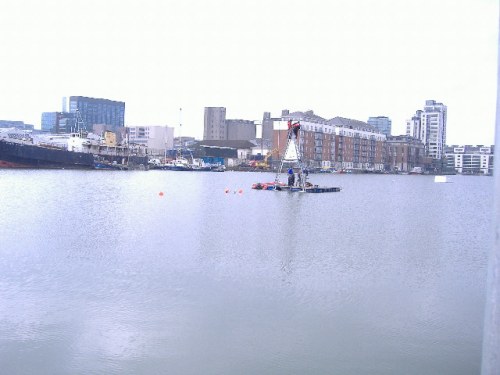
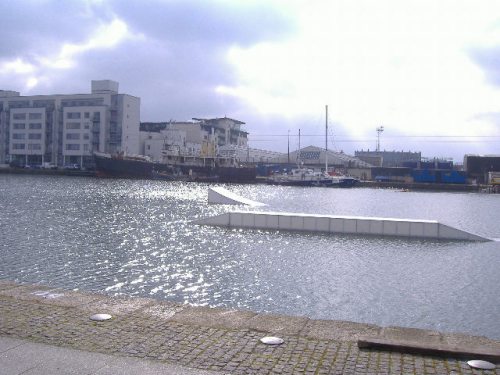
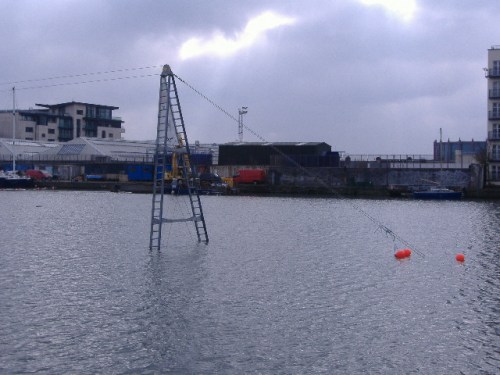
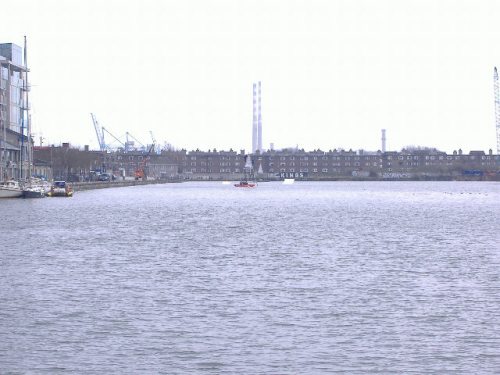
Thanks again to Paul Quinn for another set of photographs, this time of the newly-installed wakeboarding system thingie in Grand Canal Dock, Dublin, which is to be opened on 9 March 2013.

Wakeboarding, as I understand it, involves dressing up in brightly coloured plastics, standing on a plank and being towed around behind a boat. I don’t myself see the appeal, being more the sedentary sort, but chacun a son gout, as the French don’t say, apparently, although why they’re supposed to know anything about it I don’t … but I digress. The wakeboarding system thingie seems to allow wakeboarding without a boat; it might also require less sea room.

A system was installed temporarily last year; there is information about it here. I don’t know whether that is the same system as has now been installed. You can read the environmental report here [PDF]. Waterways Ireland tells me that

Waterways Ireland has entered into a three year commercial operating licence agreement with Colin Harris T/A Wakedock Ltd., to place and operate a mobile wakeboarding system in Grand Canal Dock.

There seems to be an association between Wakedock and the Surfdock business in the Naomh Éanna, although Wakedock also has its own website.

I asked Waterways Ireland how much it was earning from this; it refused to tell me:

Waterways Ireland do not release license fees charged to individual commercial licence holders as this would be detrimental to our business interest in future license fee valuations.

DSCF0958

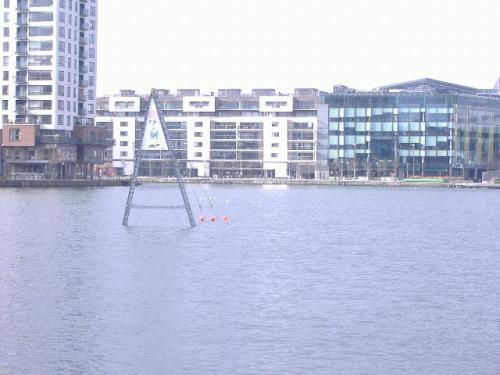
A tower tower

from grand canal theatre.

Looking from Grand Canal Theatre: note the white ramps

from hanover quay.

Seen from Hanover Quay

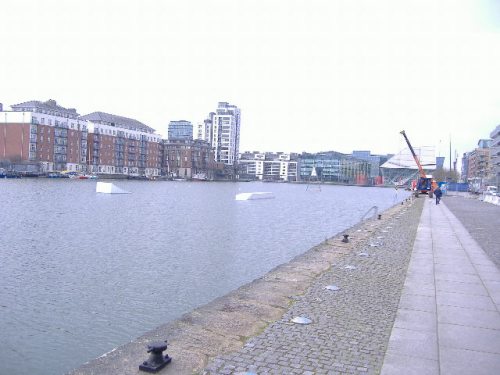
looking east towards ringsend

The ramps (looking east towards Ringsend)

looking south from hanover quay at ramps.

A close-up from Hanover Quay

looking south from hanover quay.approx.25 meters

The Naomh Éanna in the background

looking south from sea locks.aprox 50 meters

About 50m from the sea locks

looking west to gallery quay.

Looking west to Gallery Quay

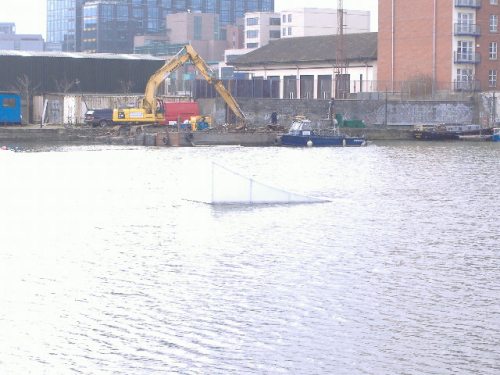
ramp with dredger at charlotte quay.

Ramp in the foreground; excavator at Charlotte Quay in the background

ramps and far  line support

Ramps and western line support

ramps and new position of naomh eanna.

Naomh Éanne in its new position

Waterways Ireland tells me that:

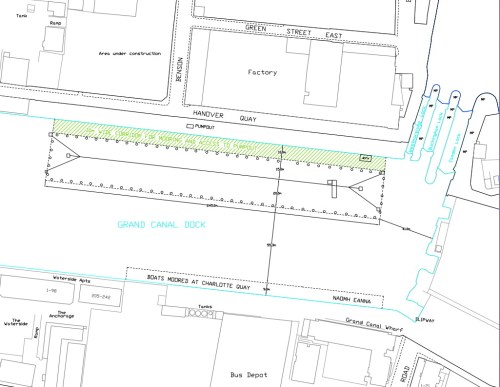
When agreeing the location, consideration was given to maintaining access to the pump-out on Hanover Quay and also access to vessels wishing to enter via the lock gates. No detrimental impact on navigation for other users is anticipated.

WI kindly provided this map.

GCD wakeboarding map

GCD wakeboarding map

Semper aliquid novi Africam adferre, as my old grandmother used to say.


* see The Third Policeman

CWW bridge

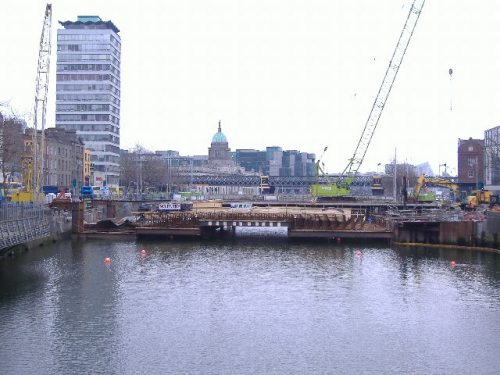
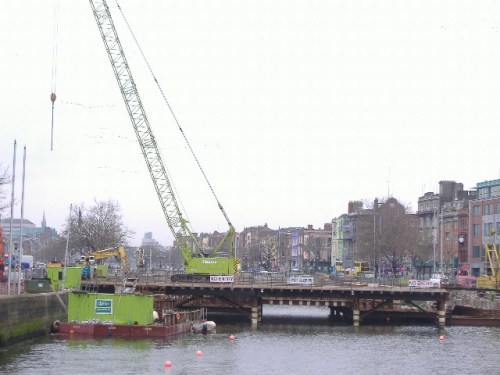
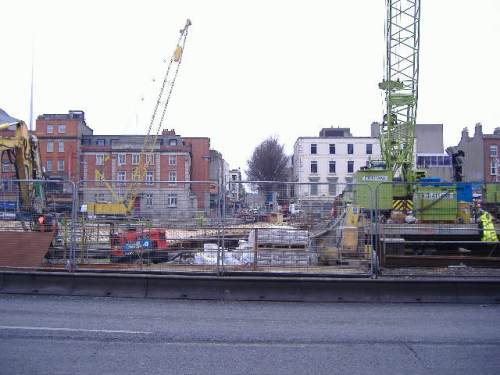
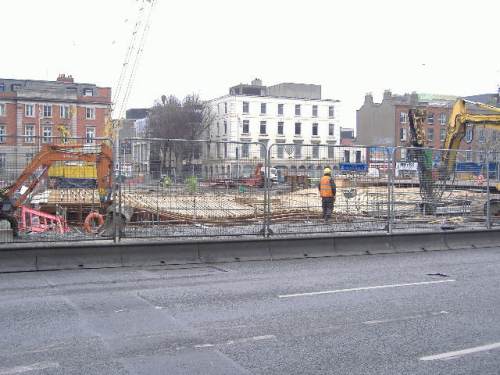
Paul Quinn’s photos showed the new Marlborough Street Bridge being constructed across the Liffey. Last Saturday’s Irish Times reported that Dublin City Council would soon be advertising to seek suggestions for naming the bridge; it said that a body called Labour Youth [whose members may be socialists, I fear] wanted it named after one Rosie Hackett, who went on strike  many years ago. It did not report that there is another campaign to have the bridge named after E T S Walton, a physicist.

The north-eastern corner of the bridge features the site of the offices of the City of Dublin Steam Packet Company, whose crest still adorns the walls. I suggest that the bridge be named after the company’s founder, the remarkable Irish entrepreneur Charles Wye Williams: the father of the Shannon, the master of scheduled steam shipping, the founder of the CoDSPCo and a founder director of the Peninsular and Oriental Steam Navigation Company, godparent of the Irish livestock industry, innovator in marine safety, promoter of the turf industry, writer and experimenter on steam technology, tireless campaigner ….

Apart from his company’s crest on Eden Quay, and his name on a bridge he caused to be built in Limerick, there is no monument to this remarkable man. Name the bridge after him and move the plaque to it (and protect it adequately).


No new thing …

… has arisen: Friday’s list of holders of marked fuel traders’ licences did not, as far as I could see, include any new Shannon-based suppliers. Oh well; there should be more news tomorrow.

News from the Suir

Some chap from Limerick has been quoted in the Nationalist (Clonmel) as supporting South Tipperary County Council’s proposed taking in charge of the towing-path between Carrick-on-Suir and Clonmel.

And Carrick-on-Suir River Rescue needs help raising funds to buy a premises.

Crossing the Liffey

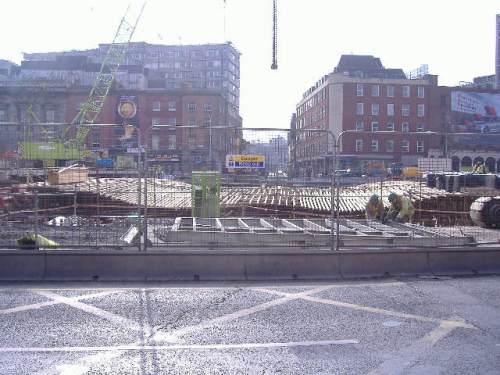
Thanks to Paul Quinn for pics of the construction of the new LUAS bridge across the River Liffey in Dublin.

DSCF0945

The Powers That Be

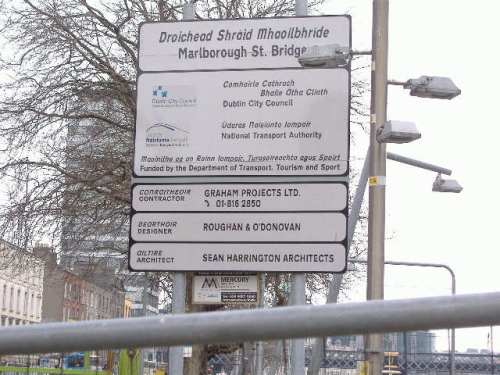
Dublin City Council tells us that “Construction on the bridge is due to commence in Autumn 2011”, which is nice to know, although an update would be nicer. Its PDF has a diagram of the bridge. If you can find anything about the bridge on the website of the National Transport Authority (which is paying for it), do please let me know. Incidentally, I hadn’t realised that the NTA’s reach had extended to passengers on ships, including those on inland waterways.

graham projects

The contractors

DSCF0939

Drilling contractor

The contractor is Graham Projects Ltd; Quinn Piling were working there a few weeks ago, but seem to have finished their end of things by now; I can’t find a website for Hilliard & Hilltwister Ltd of Listowel, Co Kerry.

from o'connell brg.

Looking east from O’Connell Bridge

from butt bridge looking west

Looking west from Butt Bridge

looking north

Looking north from Burgh Quay

looking north from burgh quay

Looking north to the City of Dublin Steam Packet Company offices

looking south from eden quay

Looking south from Eden Quay