Category Archives: Foreign parts

DCAL

What is the top priority of the Northern Ireland Department of Culture, Arts and Leisure?

Is it to promote culture?

No.

To promote the arts?

No.

To promote leisure?

No.

It is

… to promote social and economic equality and tackle poverty and social exclusion.

Ne sutor ultra crepidam?


Opera

On a barge.

The captain and the perjurer

Mary Meehan’s was a dramatic story.

In April 1847 she had gone to the house of William Dwyer at Cuphaunhane [Cappanahanagh?]. She heard voices inside and stopped to listen. The door opened and William Dwyer ran out. She went in and saw William’s wife Mary dragging the seemingly lifeless body of Ellen Dwyer, William’s sister, into the room. Mary Dwyer then ran off and Mary Meehan raised Ellen’s head; she saw blood on the left side of the head.

She went home and told her husband about it; he told her to say nothing. About two hours later she was in the haggard and saw William and Mary Dwyer digging at the brink of the ditch. She gave a deposition to Edward J Bell RM on 8 October 1849, adding on 16 December 1849 that, if Bell were to dig in the field near the Dwyers’ house, or in the nearby quarry, he would find the remains of a human body.

Bell, with Mr Head and the Castleconnell police, dug more than forty times in the field in question, but with no success. They then drained four feet of water from the quarry and found a skull and some human bones in the mud. Constable Swan delivered them to Dr Thomas Travers Riordan at Castleconnell.

Dr Riordan thought that the skull was more likely to be that of an old woman than that of a fifteen-year-old girl. The bones had been in water or earth for much more than two years and belonged to a tall muscular person: the skull and the bones were almost certainly from two different people. The church at Abington was close to the quarry.

On 14 March 1840 Mary Meehan was indicted …

… for that she with felonious intent to injure William Dwyer …

… did swear to an untrue story. She was described as …

… a woman of about forty years of age, […] dressed in a blue cloth cloak, clean white cap, and white woollen shawl, as the wife of a farmer in comfortable circumstances. Her appearance was not unprepossessing, but there was a peculiarly sinister expression about the eyes.

Mr Bell had taken depositions from William and Mary Dwyer; they contravened Mary Meehan’s statements but she stuck to her story. No witnesses supported her.

William Dwyer said that he had sent his sister to England [en route to America?] that April: his wife had accompanied her to Killaloe and seen her aboard one of the [City of] Dublin Steam Packet Company’s boats. He had not heard from her since then.

Mary Dwyer said that she and her sister-in-law had slept at the house of Mary’s father Michael Healy, in Killaloe, the night before Ellen’s departure. The following morning they went to the house of Nancy Preston, who accompanied them to the steamer to help Ellen get a cheaper fare. Michael Healy confirmed that evidence, as did Nancy Preston. Mary Dwyer said that she was on board with her sister-in-law until the boat left.

The final witness was the steamer’s captain, Captain Winder. He said he remembered the circumstances perfectly and had charged Ellen only 4s 3d for the passage to Dublin.

His Lordship charged, expatiating on the enormity of the prisoner’s offence, and the revolting exhibition of the remains of the skull and bones of a human being on the table, and adding that from the evidence they could hardly hesitate in finding a verdict of guilty.

The Jury returned a verdict of Guilty accordingly.

The Limerick Reporter and Tipperary Vindicator 15 March 1850

David St John Thomas

I was sorry to learn that David St John Thomas had died. He was the David in the David & Charles [Charles was Charles Hadfield] publishing company, which published Ruth Delany’s The Grand Canal of Ireland, V T H & D R Delany’s The Canals of the South of Ireland, Patrick Flanagan’s The Ballinamore and Ballyconnell Canal, D B McNeill’s  Irish Passenger Steamship Services (two volumes: north and south), P J G Ransom’s Holiday Cruising in Ireland: a guide to Irish inland waterways and W A McCutcheon’s The Canals of the North of Ireland.

That lot laid the foundations for the study of the history of Irish waterways, but Irish waterways were just one small part of a massive list.

There are obituaries online including one in The Scotsman and another in the The Daily Telegraph.

DCAL and water recreation

Noting that the NI Department of Culture, Arts and Leisure [DCAL] has a Water Recreation Development Programme, I emailed the department to find out more:

I would be grateful if you could let me have a copy of your 2013-14 Inland Waterways Water Recreation Development Programme and of any subsequent equivalent programmes, policies or documents. I have been unable to find anything on your website.

I am grateful for the reply, which read:

[…] we wish to advise you that we do not have a formal Water Recreation Development Programme document. How the Water Recreation Development Programme is operated is that we apply each year for capital funding. If successful, we then go out to local authorities seeking to work in partnership with them and other public bodies to co or match fund appropriate and inclusive capital projects. Such projects should provide water related access: for example riverside paths, canoe steps or other similar facilities on public owned land which is free for the public to access and use.

The process we follow is when we receive details of the projects from local authorities we complete an assessment of the project taking into account the following criteria

  1. Does the project provide water access
  2. Are there funding or delivery partners
  3. How the project links to the community
  4. How will the project be maintained in the future
  5. Does it enhance or improve disability access
  6. How does it promote social inclusion.

If DCAL is content that these criteria are met we would then consider funding for the project.

During the 13/14 year we had a capital fund and we were able to support six projects; however due to budget constraints we do not have a capital fund this year 14/15.

The Water Recreation Development Programme appears to be distinct from the Water Recreation Programme covered here and to apply to waterways other than those managed by Waterways Ireland.

This site has what purports to be the department’s business plan for 2013–4. I expected to find it here on the DCAL site but that page seems not to have been updated for some years. If anyone can point me to a link on the DCAL site, I would be grateful for guidance.

I cannot, therefore, be certain that the purported plan is actually DCAL’s plan, but I quote it anyway.

DCAL Inland Waterways

In partnership with local authorities and the voluntary and community sector, DCAL continued to manage canal towpaths in 2012-13. In addition, under the Inland Waterways Water Recreation Development Programme, in conjunction with local councils the Department grant aided 6 projects which included a canoe slalom, interpretative signage and the installation of an outdoor exercise ‘Trim Trail’. These facilities are free for everyone to use and it is a stipulation of the Programme that projects address social exclusion. The Water Recreation Programme is continuing in 2013-14. Funding was also made available to the Lough Neagh Partnership to engage with local rural communities around the lough to explore how they could develop the cultural and leisure tourist potential of the Lough.

In 2013-14, key challenges include work towards registration of assets on the Lagan Canal and investigations into the provision of a safe system of navigation markers for Lough Neagh. DCAL will also be considering the outcomes of a study into the potential for re-opening the former Lagan Navigation.

DCAL’s target for y/e 31 March 2014 was:

By 31 March 2014, to fund at least 5 water recreation projects which provide accessible opportunities for all and target those experiencing poverty and social exclusion.

Its “opening allocations” for 2013–4 were:

  • Inland Fisheries and Waterways: current £5.87m, capital £0.17m
  • North/South Body – Waterways Ireland: current £5.42m, capital £0.25m.


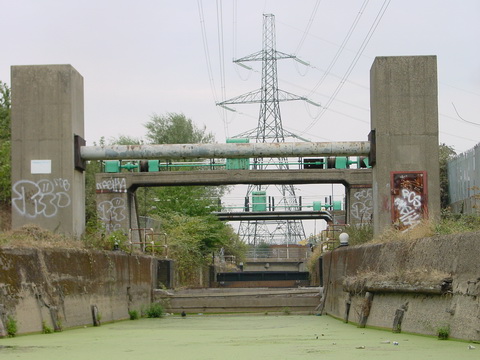
Carpenters Road Lock in London

Carpenters Road Lock in 2003

Carpenters Road Lock in 2003

Here is a page about an art (craft?) project happening at Carpenters Road Lock on the Bow Back Rivers in London: the lock has changed quite a bit since I took the photo (above) in 2003.

I should warn you that the link is to a very long web page, but the section headings stay on top so you can move around. However, if you allow Javascript, you’ll find that two places on the page show those very annoying sequences of photographs that change automatically.

What I thought was most interesting was the set of events organised at the lock. Canals of Dublin organises canal walks in, er, Dublin, but what about Waterways Ireland having lockkeepers doing talks and demonstrations?

Here are some links to sites with more information about the Bow Back Rivers in London:

London Canals and associated blog

An extensive Wikipedia article with schematic diagram

A political view from Mick Hartley

London’s Lost Rivers on pre-Olympic scenery (black background makes the text hard to read but the photos are good)

The most informative page I found: a superb piece of work. Well done Richard Thomas, to whose Steamers Historical site I have a permanent link.

h/t celr

Canal gets government go-ahead

In Egypt.


The Slaney cot: photos

I wrote here about a Slaney cot, built by Larry Duggan, which we had spotted on its way to Wales. The owner has very kindly sent some more photos of the cot’s construction, of Larry Duggan and of the cot on the Usk; I have put them on a separate page here.

Heritage outside the box

I was not entirely complimentary about Waterways Ireland’s online survey on the contribution of boating to the economy. However, its latest online survey seemed to me to be better designed.

It’s part of a consultation seeking opinions about a Heritage & Biodiversity Plan. I was afraid that the survey might limit the scope of responses to a small number of prepackaged options, but in fact I found it easy to make suggestions that might be outside the range of those expected. The response boxes expand as required, although I didn’t test the upper limits.

I encourage readers to complete it.

Heather Humphreys on waterways

From the Financial Resolutions speeches:

I am committed to developing North-South co-operation within the broader arts, heritage and commemorative activities of my Department as well as through the funding of North-South bodies. A provision of more than €38 million is made available to support the two North-South implementation bodies — An Foras Teanga and Waterways Ireland. These budgets will be subject to the approval of the North South Ministerial Council in due course. The provision will enable Waterways Ireland to keep the waterways open for navigation during the main boating season and promote increased use for recreational purposes while developing and promoting our waterways to attract increased numbers of overseas visitors.

Nothing new there, I think, but note the repetition of a point I highlighted last year:

The provision will enable Waterways Ireland to keep the waterways open for navigation during the main boating season […].