Category Archives: Foreign parts

The men in powdered hair

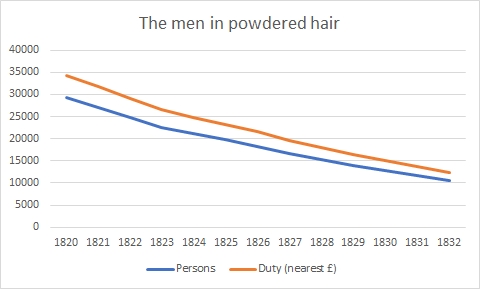
An Account of the Number of Persons charged to the Duty on wearing Hair Powder, and the Amount of Duty


The graph shows the sad decline in the number of persons [men and women, despite my heading] wearing (or at least paying duty, at £1 3s 6d, on) hair powder between 1820 and 1832. It is from “Returns furnished by the Comptroller of Accounts in the Tax Office, expressly for this Work”, the work being Tables of the Revenue, Population, Commerce, &c of The United Kingdom and its dependencies Part III from 1820 to 1833, both inclusive. Compiled from official returns; presented to both Houses of Parliament by Command of His Majesty HMSO, London 1834, compiled by G R Porter, Board of Trade, Whitehall, in July 1834.

The duty was imposed under the Duty on Hair Powder Act 1795; the act was not repealed until 1869, by which time hardly anyone was paying it. Here is a very entertaining account of the whole business.

The inland waterways connection here is via the schooner Nancy, which took part in the Anglo-American war of 1812 on the Great Lakes between Canada and the United States of America. Stan Rogers included a song about the Nancy on his album From Fresh Water and you can hear him singing it here.

The song’s narrator did not like men in powdered hair.

 

A non-lunatic …

… writes about Brexit.

I do not know why the Irish government agreed to kick the can down the road, thereby losing its influence over the discussions.

Big Knock

During the past month business at the Larne Shipbuilding Works has been exceedingly brisk, and the carrying out of new orders is still proceeding apace. […] There was launched on the 19th inst one steel motor barge, 70 X 16 X 7 feet, and fitted with 40 BHP Bolinder engines, to consume crude oil. The barge was built to the order of Messrs E Dowley & Sons, Ltd, of Carrick-on-Suir.

[…] The motor engines are installed by Bright’s Patent Pulley Co, Portadown.

Larne Times and Weekly Telegraph
22 February 1913

I don’t have the dimensions of the Big Knocknagow, but 70 X 16 is larger than the Little Knocknagow, so I suspect that this shows that the Big Knock was built in Larne and launched in 1913.

No doubt information about the origins of the Little Knock will turn up at some stage.

Anglo-Irish livestock trade: balls to Brexit

Kevin O’Rourke here.

Ulster Canal increased emigration

The Ulster Canal (recently renamed the Clones Sheugh but now known as Saunderson’s Sheugh) seems to have led to an increase in emigration. Working on its construction reclaimed many from “those habits of reckless indifference and that passion for ardent spirits which are so fatal to the happiness of the working classes in Ireland”:

With the power of saving out of their wages, the habit [of saving] has arisen. The whiskey-shop has been abandoned, and several among those who were first employed, have laid by sufficient money to enable them to emigrate to the United States and to Canada, where they have constituted themselves proprietors, and have before them the certainty of future comfort and independence.

G R Porter The Progress of the Nation in its various social and economical relations, from the beginning of the nineteenth century to the present time Sections III and IV Interchange, and Revenue and Expenditure: Charles Knight and Co, London 1838

Those who suggested more recently that restoration would provide employment in local pubs and eateries obviously hadn’t learned from experience. I presume that, to this day, the inhabitants of Monaghan and Fermanagh still won’t touch a drop of whiskey.


A summons from the sea

Older readers may, at some stage, have been forced encouraged to read some part of In Memoriam A H H, an extraordinarily long poem [make sandwiches (preferably anchovy) and a flask of coffee before you start reading it] written by Alfred Tennyson about the early death of his friend Arthur Henry Hallam. The poem was finished sixteen years after Hallam’s death in 1833.

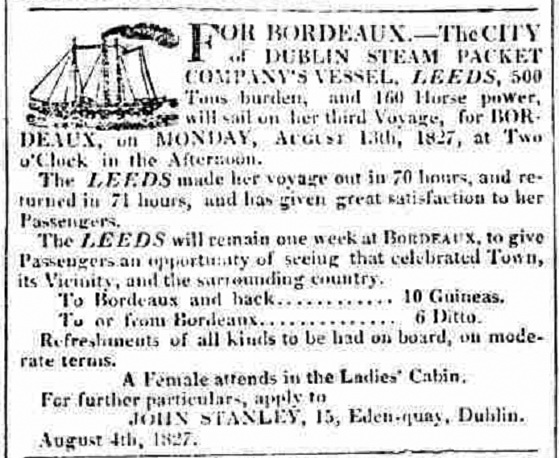
In 1830 Tennyson and Hallam visited France and returned from Bordeaux by steamer. The steamer was the SS Leeds, owned by the City of Dublin Steam Packet Company, which had been operating on the route from Belfast to Dublin and Bordeaux, in the summer months, since 1827. Passengers from England were given free transport from Liverpool to Dublin [Saunders’s News-Letter 11 June 1827 via the British Newspaper Archive].

CoDSPCo ad from the Dublin Evening Mail of 8 August 1827. Image © The British Library Board. All rights reserved.


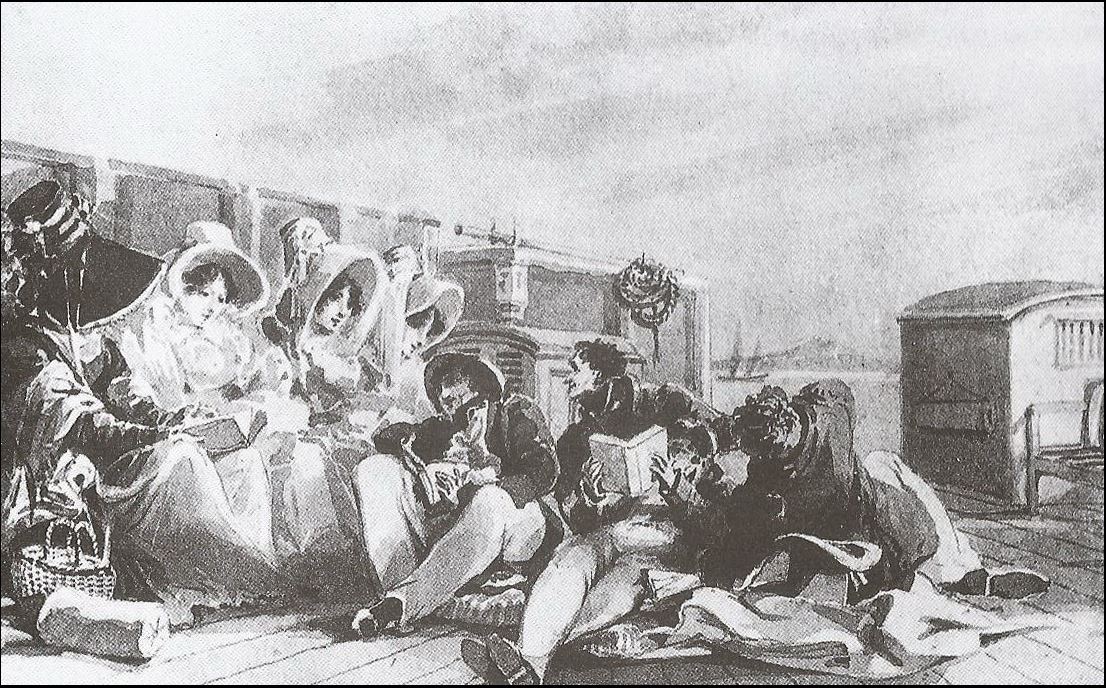
On their homeward journey, Tennyson and Hallam met the Tipperary-born landowner John Harden and his family. Harden lived in the English Lake District; he and his wife were “talented amateur artists”. The shipboard meeting is described in this extract from Leonee Ormond’s Alfred Tennyson: a literary life [Macmillan Press, Basingstoke 1993]. Harden sketched the group on deck`; here it is.

Tennyson, Hallam and the Harden family on board SS Leeds 1830

I cannot remember where I got that image. I presume that Harden’s copyright is long expired but it may be that a publisher or someone owns rights to the image. If I am in breach of copyright, leave a message below and I’ll remove the image.


Inland waterways: interesting problems

Crossing a river in Russia

Shipping news

But Britain is now but a modest-size ship on the global ocean. Having voted to leave the European Union, it is unmoored, heading to nowhere, while on deck, fire has broken out and the captain — poor Theresa May — is lashed to the mast, without the authority to decide whether to turn to port or to starboard, let alone do what one imagines she knows would be best, which is to turn around and head back to shore.

Steven Erlanger in the New York Times 4 November 2017

Lough Neagh during World War Two

Ernie Cromie of the Ulster Aviation Society will talk about Lough Neagh during World War Two on Monday 13 November 2017 at 8.00pm, at the Gate Inn, Gawleys Gate, Aghalee, Northern Ireland BT67 0DJ. Admission is free; the event is sponsored by the River Bann and Lough Neagh Association.


Boris the Shinner

I have suspected for some time that Britain’s Brexiteers are actually Sinn Féiners.

After 1916 the Irish Shinners decided to leave a larger economic and political entity and to do so without any business plan or any realistic idea of how their proposed state would make a living.

After 2016 the British Shinners decided to leave a larger economic and political entity and to do so without any business plan or any realistic idea of how their proposed state would make a living.

One lot of Irish Shinners, led by the lunatic Éamon de Valera, wanted a hard Irexit and started shooting the soft Irexiteers who, happily, managed to keep control; it is to be hoped that matters don’t go that far in Britain.

It may be objected that the evidence for this contention, that Brexiteers are Shinners, is a little light, but I have now found confirmation: Boris Johnson is an enthusiast for insane canal construction projects.

The mark of the Shinner is upon him.