Category Archives: Forgotten navigations

Value for money

Regular readers will be aware that I think the proposed canal to Clones is a bad investment. I thought it might be useful to look for information about other Irish canal restorations to see what they cost and what the return on investment has been. I understand that there was a study of the Shannon–Erne Waterway, but I can’t find a copy on tinterweb (if anyone has one to lend, please get in touch).

I therefore asked Waterways Ireland about the restoration of the Royal Canal:

I would be grateful if you could tell me the cost of the restoration of the Royal Canal, the annual cost of running it and the revenue it generates.

The reply (for which I am, as always, grateful) said:

Restoration of the Royal Canal commenced in 1987.

€37m Capital Expenditure on the restoration project funded through (1) Operational Programme for Tourism 1994-1999 (2) National Development Programme 2000 – 2007 and (3) National Development Plan 2007-2013.

The Maintenance Cost for 2012 is €2.46m.

The revenue generated by the canal in 2011 is not available.

I didn’t really expect that there would be a meaningful figure for revenue. A full assessment of the benefits would cover far more than the (probably minimal) direct revenue; I think such an assessment should be done, but that’s not what really got my attention.

According to Waterways Ireland, the Main Line of the Royal is 146 km long and has 46 locks and many bridges, some of them newly built as part of the restoration. Harbours have been improved, slipways have been provided and service blocks have been built. And all of this was done for €37 million (I don’t know whether that’s in constant prices and, if so, at which year’s rates: I’ve asked a supplementary question).

A canal to Clones would be 13 km long and, according to WI’s final restoration plan [PDF], would have one double lock (staircase pair). Some dredging would be needed on the River Finn and a new canal 0.6 km long would have to be provided; the work at the Finn end would cost €8.5 million altogether. On the line as a whole, work would be required on up to 17 bridges, some major and some minor or private bridges. And there would be a cost for land acquisition, although the Updated Economic Appraisal put that at a mere £1,268,280, a very small portion of the total cost. And then there would be the pumps and pipes to take water from the Erne, pump it to Clones and let it flow back down; it is not clear whether WI would have to pay for the water. And the total cost of this lot would be €38m + VAT, which I am told is about €45 million altogether.

Now, even allowing for the facts that there had been some voluntary and FÁS scheme work on the Royal, that no land had to be acquired and that parts of the canal were in water, I still find it difficult to see how a 13 km canal with one double lock can cost more than a 146 km canal with 46 locks. I have asked WI for a comment, but perhaps readers — especially if any of them are engineers or accountants — would be able to help to explain the mystery. Maybe it’s something simple like a mistake in the figures or maybe I’m missing something about the nature of restorations …. Enlightenment welcome.


Sailing merchant vessels

Niall O’Brien, author of the history of the Blackwater and Bride, has set up a Facebook page about sailing merchant vessels of Ireland and Britain. Many of these used the Irish estuaries — including the Shannon, Blackwater, Barrow and Suir — and thus overlapped with inland navigation.

Killaloe bridge

More on the new bridge here with the full public notice here [PDF]. Interesting to see how many of the names of landowners are known to me.

I see on page 6 of the notice that the ESB owns two rivers, which are occupied by the ESB, Waterways Ireland, the Inland Waterways Association of Ireland and other unknown persons. There is a canal, whose owners are unknown, which is occupied by WI, IWAI and the persons unknown, as is an island. I do hope that the council will return the canal, rivers and island when they’ve built the bridge.

A note for a councillor

Councillor Pat Treanor is a Sinn Féin member of Monaghan County Council. According to the Clones Regeneration Partnership’s website,

Cllr Treanor referred to the recent economic appraisals carried out by Fitzpatrick Associates on behalf of the Government and made reference to the large job creation and physical regeneration that would flow from the [Clones] canal proposal.

As far as I know, the most recent Fitzpatrick study was published in 2007. It said (Ch 10):

In terms of formal quantified economic appraisal, all restoration options involve significant net costs over benefits.

In other words, the Clones canal is a waste of money.

Clones folk might like to have a large wodge of public money spent in their area; Waterways Ireland might like to be able to keep engineers in employment. But neither of those wishes should weigh with those charged with the care of the state’s finances. If proposals like this are seriously considered by Irish government departments, then the sooner Angela Merkel appoints an official to run the place, the better.

Perhaps, though, a household tax in Monaghan could be used to pay for this, er, investment?


Unrealistic expectations

1818

It has not been shown that sobriety increased in Co Leitrim after the canal to Lough Allen was built.

1845

The waterway, completed in 1859, closed in the 1860s. It is not clear that any Killaloe slates ever reached Ulster by the waterway.

2007

The Clones canal today, a united Ireland tomorrow?


Show me the money

The Clones dudes have got Jimmy Deenihan to say that the canal to Clones is a great idea.

They haven’t got him to fund it. Or to say where money is to be found (perhaps the Monaghan gold mines?)

Is it kind to keep these chaps hanging on in this way? I blame the department. I begin to suspect that its northsouthery section fears that it will never gain fame and fortune from Tha Boord o Ulster-Scotch (whatever about its companion, Foras na Gaeilge) and is reluctant to kill off its chance of getting its photo in the papers at the ceremonial turning of a sod. Brendan Howlin might usefully direct his department‘s attention to the matter.

Lough Derg in 1820

Troll along (h/t Co Kildare Online Electronic Historu Journal) to the National Archives new online section showing the papers of the Chief Secretary of Ireland. So far they’ve put up a catalogue for the first five years, 1818 to 1822 inclusive, with images of some pages, including 17 maps and drawings.

The second map shows the Ballyteigue Canal in Co Wexford, the third is John Killaly’s map of Lough Derg in 1820 and the fourth (which is as far as I’ve got in looking through them) shows Cappa Pier at Kilrush. They’re a bit small when seen online, but you can select (and save a copy of) a PDF version.

Big it up for the National Archives and for Professor Francis J Crowley, whose bequest made this possible.

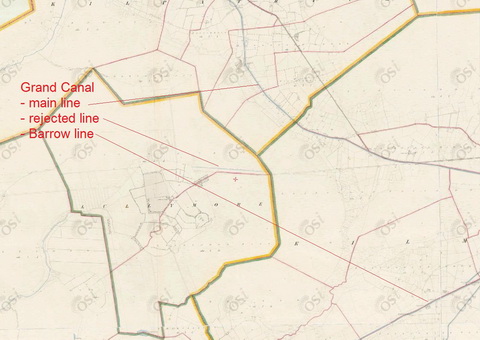
Despised and rejected of men

A free pint of stout (at a location of my choosing) …

… to the first person to identify the location of that rather sad stretch of canal.

Yes, of course I know where it is: I cut and pasted it from the OSI map.


After Liam’s successful identification, here’s the location:

Information about this rejected line would be welcome.

Killaloe and Ballina

Nice to see they’re going to get a Discover Day.

The Ballycuirke Canal and Lough Corrib

Thanks to Padhraic Conneally, who left a Comment that started the hunt, and to Zara Brady (IWAI Corrib), who visited the site to ask about something else entirely, and finally to Trevor Northage of AnglingCharts.com, who provided the name and other information, we now have two extra Galway waterways to add to the list. They’re both covered, with maps, on this page, although only the larger, the Ballycuirke Canal, gets its name in the heading.

I would welcome more information about both canals. It seems that the Ballycuirke was built for drainage but also used for transport; I would be glad to know more about such transport.