Category Archives: Historical matters

Costs on the Royal and the Grand 1843 and 1844

The second half-yearly meeting of the Grand Canal Company in 1844 seems to have been an extended affair. It was adjourned to allow the directors to amend their report on “the state of the company’s works” and, when it reassembled on Saturday 23 November, there was an unusually large attendance and a fractious debate, with several criticisms of the accounts and their “ambiguity and unintelligible nature”. The inconclusive meeting was eventually adjourned until 14 December, to allow proprietors [shareholders] to examine the accounts.

Amongst the critics of the directors was Mr H Bruce, who was unhappy with several aspects of the management of the company, one of them the extravagance of the directors. He said

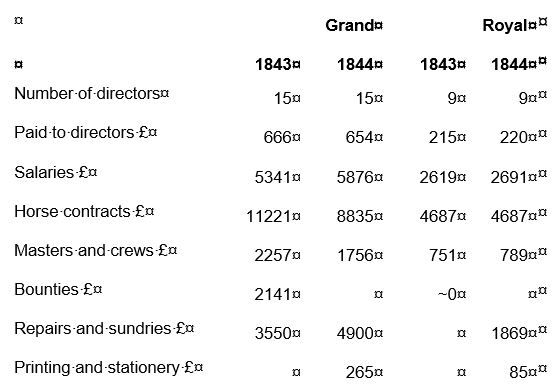
He had taken the trouble of comparing the Grand Canal with the Royal Canal Company for two consecutive years, and he would give the meeting the result of that comparison.

Here are the elements of that comparison in tabular format.

Those with a keen interest in the Royal Canal Company will no doubt have been surprised to find its management being complimented for anything, but the comparison is interesting even if, as Sir John Kingston James pointed out, the Royal Canal Company had fewer [passenger-carrying] boats “and consequently they had to pay less for horse power”: it would have been fairer to compare the costs per mile.

On repairs, Mr Bruce said that

Every one knew that the Royal Canal was a much more perishable canal than the Grand Canal, for instead of being excavated, a great part of it was built. No canal was more liable to the danger of an outbreak on the country, and of being bored through, than the Royal Canal, consequently it required more money to keep it in repair than the Grand Canal […]. Yet, what was the amount charged for repairing the Royal Canal in 1844, though in that year a serious breach took place in it? — why, only £1869.

Note that salaries cost considerably more than did the boat crews and that horse contracts, for hauling the boats, were about four times the cost of masters and crew on the Grand and aboout six times that cost on the Royal.

Dublin Evening Post 26 November 1844

Spencer Harbour

Excellent article about the Lough Allen Clay Company on the Dromahair Heritage website, though the schoolboy speculation on the naming of the harbour is not, I think, to be relied upon: the fifth Earl Spencer, twice Lord Lieutenant of Ireland, is I think the source of the name.

h/t COM for the link

Jamestown and the Longford

Jamestown [Co Leitrim] Heritage Festival starts on Friday 25 May and runs until Sunday 3 June 2018. The programme is here.

Apart from the presence of numerous barges and other vessels, the festival will feature these events of historical interest:

  • Saturday 26 May: talk by Alf Monaghan on Doon to Diesel, a review of the importance of Drumsna and Jamestown in Transport History
  • Sunday 27 May: talk on the sinking of the Royal Canal passage-boat Longford [in which fifteen people died] in 1845
  • Monday 28 May: bus trip to Arigna Mining Experience
  • Tuesday 29 May: talk by Alf Monaghan on Monastic Ireland — a gift from the Nile and display by Carrick-on-Shannon Historical Society
  • Wednesday 30 May: walking tour of Jamestown led by historian Mary Butler
  • Saturday 2 June: talk by Donal Boland on The Shannon’s hidden locations and gems and, in the afternoon, “traditional method demonstrations”.


Kilbeggan

Grand Canal Passage Boats

The Court of Directors will receive Proposals for drawing Two Small Light Passage Boats daily on the stages between

Ballycommon and Kilbeggan

for the terms, and at the Rates of Travelling which, with all other particulars, will be fully explained on reference to A Bagot Esq, Inspector of Passage Boats, Portobello.

Sealed Proposals, according to forms to be furnished by the Inspector, to be delivered at the Secretary’s Office, on or before the 30th instant.

By Order, John M’Mullen, Sec, Grand Canal House, William-street,
9th January 1841

Dublin Evening Post 12 January 1841

Railway archaeology

Ewan Duffy’s chapter “Royal Canal bridges in Dublin”, in The Royal under the Railway: Ireland’s Royal Canal 1830–1899 [Railway & Canal Historical Society, Derby 2014], drew attention to the hitherto neglected effects of the Midland Great Western Railway’s ownership on the physical structures along the Royal Canal in Dublin.

Ewan’s latest venture is a Railway Archaeology of Ireland, which he is publishing online, at the rate of one chapter per week. The introduction and Chapter 1 are now available. The focus is on “railway-related architectural and engineering structures”, not on trains or rolling stock.

It is possible to sign up to an RSS feed and thus get notified automatically when new chapters appear.


Canal oats

The Freeman’s Journal of 25 July 1832 included a report on the Dublin markets of the previous day. The report from the Dublin Corn Exchange said

We had a moderate supply in market, and prices may be quoted same as last.

The grains traded included wheat (prime red and prime white), grinding barley, malting barley, bere, new oats, new bere, oatmeal, M’Cann’s and First Flour, as well as

Prime Feeding Oats, 14 st [stone] to the brl [barrel], 11s 6d to 12s 0d

Canal ditto, 9s 6d to 9s 9d

Usage

The term “canal oats” is used in a report from New York in the Sydney Morning Herald in 1843 and another in  The Economist in 1847; the Central New-York Farmer has it in 1844 and Walt Whitman used the term in 1846. More from that side of the Atlantic anon.

The earliest occurrence I have found in the British Newspaper Archive is in the Dublin Evening Post of 11 March 1819:

Dublin Corn Exchange, March 10. — Our Market was but poorly supplied this day, particularly with Farmers’ Grains, owing to their being so much occupied at field work. — Canal Oats were more abundant than the demand warranted, and they were heavy sale from 16s to 17s 6d; prime, and for feeding, could not be got under 20s to 21s, and seed from 22s to 30s. — Wheat and Barley steady. — Malt, Flour and Oatmeal without variation, and in but indifferent demand.

There are other Irish instances in 1824, 1825 and 1826; in all cases the price of canal oats is below that of feeding oats.

The only British examples from this period, in Gore’s Liverpool General Advertiser on 23 February 1826 and in the Glasgow Herald on 21 April 1826, are from reports on the Dublin market.

I have not checked every occurrence, but my impression is that, to the end of 1840 (I looked no further), the term “canal oats” was used frequently in Irish newspapers from all parts of the island. However, the term was used only about the Dublin and Belfast corn markets; canals served both conurbations. British newspapers used the term only in reports from the Irish markets.

Meaning

I have found no definition of the term. Here, though, are some comments on possible connotations.

First, I presume that “canal oats” were oats that travelled [part of the way] to market by canal. It is likely that most oats came by road, probably on Scotch carts; that would have required packaging, no doubt in barrels of one kind or another. Some oats did arrive by non-canal boats: on 17 December 1838 the Dublin Mercantile Advertiser, and Weekly Price Current said

Limerick, Dec 15. — […] Oats since Wednesday in good supply by land carriage, prices declined ¼d to ½d per stone, to-day 11¾d is the highest down to 11d; by boat, 10d to 11d; barley, 12d to 15d. The depression of the London market on Wednesday accounts for the fall here.

Second, “canal oats” seems to have referred to oats of an inferior quality, or at least to oats that commanded lower prices. The Belfast Commercial Chronicle of 23 March 1839 referred to canal oats as “generally arriving out of condition”, proving difficult to sell and “going to warehouse for want of buyers”. The Pilot of 11 December 1839 referred to canal oats as “soft”; it is not clear whether that applies to their market or to their physical condition. On 16 February 1839 the Belfast Commercial Chronicle referred to canal oats as “unkilndried”: did that apply only to that batch or to all canal oats?

Third, the Limerick market report, above, suggests that lower prices may have applied to all oats arriving by water rather than by land. It is possible that the prices reflected something about the nature of the transport method rather than the inherent quality of the oats; alternatively, it is possible that water transport (which, where it was available, was probably cheaper than land transport) was chosen for the oats that would sell for less.

The first possibility has, I think, two sub-possibilities: that oats travelling by water might have been more at risk of damage or that their packaging might have been inferior: specifically, that they might have been a bulk cargo, poured loose into the hold, rather than packed in barrels. The Belfast Commercial Chronicle of 16 February 1839 might be taken to suggest that: “cargoes”, not barrels, were being sold, and by the ton rather than any lesser quantity:

Oats maintain their value, and cargoes have been sold from £8 5s [presumably per ton] to £8 7s 6d for unkilndried Canal Oats.

However, that is the only such example that my quick survey found.

Fourth, it is possible that canal oats were not used for human or equine consumption. The Dublin Morning Register of 3 November 1838 reported that

The supply of oats from the neighbouring farmers was short, and brought at the opening 13s to 13s 6d per barrel. Canal oats, of which rather a good quantity appeared, was taken off at 12s 6d to 13s per 196lbs. The distillers, anxious to get into stock, gave these prices freely. The advance is fully 1s 6d a barrel since Friday.

Again, that is an isolated example; it may be that the distillers did not always use oats.

Fifth, a case heard in the New York Court of Appeals in 1851, and reported in Henry R Selden Reports of Cases argued and determined in the Court of Appeals of the State of New York; with notes, references, and an index Vol I Little & Company, Albany 1853, concerned a contract for the sale of canal oats. The appeal was against the verdict in a case in which Messrs Vail and Adams sued Mr Rice

[…] in the court of common pleas of the city of New York for the breach of a contract dated New York April 28th 1847 for the sale of “a lot of canal oats, say about four thousand bushels, more or less, at forty seven cents per bushel, deliverable in all the month of May next, from boats at or near the foot of Broad street in this city, cash on delivery”.

The ultimate decision turned on other issues, but the relevant part is that Vail and Adams had called a witness who was in the grain trade and who said

[…] that oats sent by the canal vary about five per cent when they arrive from what they were when shipped. They generally overrun or fall short about five per cent. This is always expressed by the words ‘more or less’. We always make our contracts in that way and we mean by ‘more or less’ to provide for an excess or a diminution not over or under five per cent. We use the word ‘about’ to express the same thing. It is generally customary among us that the purchaser takes whatever it is, and gets the benefit or suffers the loss, not exceeding five per cent. On his cross examination the witness stated ‘The custom is a general custom. I have never known any particular instance. All the grain dealers do. SS & Co have such a custom. I can’t mention a particular instance. I can’t give any other instance. I have sold grain to M & D this way.’

If Irish usage was the same as American, this might strengthen the suggestion that canal oats were a bulk cargo, not measured before shipment, and thus with some uncertainty about the exact amount being shipped, bought or sold. That uncertainty might account for a lower price.

Envoi

None of that amounts to conclusive evidence, and I would be glad to hear from anyone [please leave a Comment below] who knows more than I do about canal oats.


Peril at Parker’s Point

Great storm on Lough Derg

40 tons of porter lost

All over the course of the Shannon the snowstorm was of the utmost severity. The Grand Canal Company had practically to suspend traffic, and steamers arriving at Portumna from Killaloe and Limerick report the roughest weather yet experienced on Lough Derg.

The steamer Dublin, bound from Shannon Harbour to Limerick with three barges in tow, loaded with 40 tons each of porter for Messrs A Guinness and Co’s stores, Limerick, was almost wrecked on Wednesday, but for the promptitude and presence of mind of the steamer’s crew.

She was nearing Parker’s Point, on the Clare [sic] side of the lake, when the storm was raging fiercest, and this being one of the most unsheltered spots in the course of the Shannon, heavy waves came rolling over the tug and barges and tossed them about. The strain broke the ropes which kept them in tow, and two boats with their crews broke away and went adrift, and were at the mercy of the waves.

The captain of the steamer Dublin (Patrick Moran), seeing the perilous position of the boats and crews, steered with the one boat which he had then in tow to the Tipperary side, and anchored her there in shelter, and again set out to the rescue of the two drifting barges, and after a severe struggle succeeded in getting to their rescue just as they were drifting on to the rocks at the point mentioned.

There were twenty tons each of porter stowed on the decks, and this was promptly secured by covers and lashed by ropes to rings, but notwithstanding this the barrels of porter, from the tossing about of the boats, broke through the covers and lash lines, and were lost on Lough Derg. The steamer’s master again got the barges in tow, and succeeded in bringing them on to Killaloe.


The Irish Times 31 December 1906

The Limerick steam ferry

Wanton outrage

The steam ferry barge, the property of Messrs J R Russell and Sons, which plies across the Shannon from Russell’s-quay to Lansdowne spinning mills, and which was got up for the convenience and conveyance of the factory operatives in the employ of the firm, was boarded during last night (Sunday) as she lay at the north side of the river, by some person or persons unknown, and maliciously injured to a considerable extent. She was not only scuttled, but the machinery was broken and some of the gear removed and taken away, so that the barge has become temporarily disabled. Portions of the machinery are said to have been found in the river, where they were thrown by the miscreants. This is the second attempt that has been made to damage this ferry since she was put on the river.

Cork Examiner 27 April 1869

State of trade on the River Suir [1842]

People who read this will hardly believe that such a state of things, as it details, can exist in any portion of the British dominions; and yet, in the year 1842, undoubtedly in Ireland, and in Ireland only, can we find such facts — positive facts.

It is still more surprising to find that this extraordinary state of things should exist on a river on which a very considerable export and import trade passes — and yet so it is.

A fair challenge to the Chambers of Commerce of Clonmel and Waterford is now given. Let them deny the following data, if they can, seriatim, honestly and plainly:—

  1. That the boat trade between Clonmel and Waterford is in the hands of so few persons that it is, in truth and fact, a monopoly to all intents and purposes.
  2. That those corn factors, who export their produce by these boats, are allowed to import coal, iron, timber, groceries, or other goods, at a lower rate of freight than merchants or shopkeepers, who only import those articles, and do not export.
  3. That combination exists amongst the boatmen to such an extent, that they are, in point of fact and truth, the masters of the river, and have in reality succeeded in their “strikes”.
  4. That only a certain fixed number of boats are allowed to ply on the river, and that when a new boat is built, part of an old boat must be worked up into the new one.
  5. That although great improvements have been effected at Carrick in deepening the river, and thus bringing up vessels to the new quay there, the boatmen of Clonmel and Carrick will not navigate any boats from Clonmel which are to ship their cargoes at Carrick, but they insist and do take such boats on to Waterford.
  6. That when the bill for the Limerick and Waterford railway passed, and £100000 was granted in aid — which railway was to pass through Carrick, Clonmel, Caher, and Tipperary — not one merchant in Clonmel took a share.
  7. That the exports of Waterford amount to above two millions annually, a considerable proportion of which is the produce of the vally [sic] of the Suir, and descends that river.
  8. That the state of the river Suir, as a navigation, between Clonmel and Carrick, is the worst in Ireland; that the import trade in these boats is dragged up the river by horses; that great delays take place, to such an extent, that the import trade suffers most considerably, to the detriment of every person in the community.
  9. That the expenses of the towing path &c fall upon the county at large.

Can it then be matter of surprise that, under such circumstances, Ireland is so much behind hand as she is?

Dublin Evening Mail 28 March 1842

What shall we do with the drunken sailor?

Liverpool Police. Saturday, Feb 17 [1827]

William Brown, the Sailor:
— a romance in real life

On Saturday last, as the Commerce steam packet, belonging to the City of Dublin Company, was starting from George’s Pier Head, Batchelor, the police constable on duty, called out to the commander of the vessel to hold on for a few minutes, and instantly went on board with two of his assistants, and after a few minutes’ search they returned on shore with one of the passengers in custody, who was dressed in sailor’s clothes, and passed by the name of Wm Brown.

The case of this person’s apprehension was a report which had been communicated to the Constable that a female in a disguise, the description of which corresponded with this person’s attire, had taken a passage for Dublin by the Commerce, which awakened in his mind, not unnaturally, a suspicion that it was some woman who had either escaped from prison, or had been engaged in some robbery, and was flying to evade detection, whom it was therefore his duty to detain for examination before a Magistrate. The dress had been so minutely described, that it was impossible to mistake the person, notwithstanding the addition of a still deeper disguise of intoxication, in which the party was found at the time of making the capture.

When safely lodged in Bridewell and about to undergo a personal examination by Mrs Clayton, the wife of the keeper, finding detection inevitable, the prisoner confessed the fact of her sex and disguise.

In the evening, when perfectly sobered, she stated her name to be Selina Augusta Hamilton. Inquiries which had been made in the interim led to the discovery of the house in which she had been lodging by the Old Dock, and one of the constables was engaged, in the course of the evening, in conversation with the landlady for the purpose of tracing her history, when a respectably dressed man entered the room, to whom the landlady pointed and said “here’s the very gentleman as can tell you all about her”. The gentleman in question proved to be the master of the brig Laura, of New York, lying in Prince’s Dock, whose name we have been told is Duffey.

From the account given by this person, who, we believe, was the cause of her detention, as well as from her own statement, the following particulars of this extraordinary being have been collected.

Her father is said to be a merchant in London, and owner, wholly or in part, of several vessels, one of which was stated to be now lying in George’s Dock. He was said, as we understood it, to have a counting-house at Topham’s (query Topping’s?) Wharf, and a dwelling-house at Shadwell. From his house, it appears that she absconded about three years ago, to follow a young man with whom she had fallen in love. He was the mate of a vessel in the North American trade; and hearing that he had sailed for St John’s, New Brunswick, she came down to Liverpool, and took her passage in a  vessel bound to that place. This part of her story is confirmed by several persons in this town, who recollect having seen her at that period, when they describe her to have been a young lady of fashionable appearance, elegantly dressed, and ladylike in her deportment.

On her arrival at St John’s, she found that the vessel to which her lover belonged had gone to Quebec; thither she therefore followed him, and there she learned that he had been drowned in the passage up the river St Lawrence.

Her determination was immediately taken to become a sailor for his sake, and, doffing her woman’s gear, of which she found means to dispose, and submitting the luxuriant tresses of her flaxen hair to the sheers, in the attire befitting a youth of the station which she assumed, she engaged herself as cook and steward to the master of a vessel bound for London, with whom she remained upwards of twelve months. While the vessel lay in the Thames, she met her father one day in the street, and touched her hat to him as she passed, but so completely was she altered as to defy recognition. In that vessel she served upwards of twelve months, and would still have continued in her, but that the Master, suspecting her secret, at length succeeded in extorting from her an acknowledgement of the truth, and afterwards wished her to remain with him, upon terms to which she would not submit.

Her assumption of the habits of a sailor, it seems, has by no means been limited to the “jacket and trowsers blue”, but the grog and the “backee”, and “the pretty girls to boot”, have all contributed their share towards the completion of the matamorphosis [sic]. Of the grog there was abundant evidence in her condition at the time of her being apprehended; of the tobacco, a token appeared in a well-filled box in her jacket pocket; and for the girls, she has unquestionably been humming them with a few adventures a la Paddingtoni. To one young woman she performed the honours of a regular courtship, underwent the threefold publication of the banns of marriage, and was only prevented from undergoing the ceremony itself, by a timely discovery of the parish officers, that the bride elect was in a condition very shortly to become a mother, when the creature was upon the point of declaring our heroine to be the father of her expected offspring; and then, says the latter, “you know I could not go any further”, and therefore the connection ended.

Since her arrival in Liverpool she has bamboozled more than one of the frail portion of its female inhabitants by affecting a serious attachment; and one night partaking too deeply of the potations to which she invited one of the beauties of Bridge-street, whom she had treated “to the play”, she was robbed by her of the greater part of her earnings by her last voyage.

The discovery of her sex on that occasion secured impunity to the plunderer, who afterwards buzzed it about; and to escape from the disagreeable consequences which the adventure had entailed upon her, she determined to go to Ireland in hopes of being able there to embark in one of the first vessels for British America, that being the trade to which she has attached herself in memory of her lover, William Brown, whose name she had assumed. She has stated since she has been in custody that she will have a fortune of £4000 at her own disposal when she comes of age — she is now not quite nineteen — and that she intends to lay it out in the purchase and equipment of a vessel, of which she expects by that time to have qualified herself to take the command.

She is in person of the ordinary stature of women, but rather stoutly made, and inclining to embonpoint; of fair complexion, with light hair and grey eyes, round face, features by no means handsome, though not unpleasing for a boy.

Yesterday, she was brought up for examination at the Town-hall, before Mr Alderman Peter Bourne, to whom a brief outline of her history had been sketched, the Mr Duffey, of the brig Laura, before named, appearing to state the grounds of her detention, in which, we must say, that for some reason or other, he cut as foolish a figure as any man could desire to do.

Before the lady made her appearance, Mr Duffey stated to the Magistrate that he had become acquainted with the prisoner from seeing her several times in her walk, near her father’s residence, but that he had no acquaintance with her father, whom, however, he knew to be a man of considerable property, as described above.

The prisoner, on being questioned by the Magistrate, said she knew that gentleman (Mr Duffey) very well, having often seen him at her father’s house.

The Magistrate then asked Mr Duffey if he had any thing to say against her; to which he replied, that he wished her to be given into his charge, that he might restore her to her father.

A look of something like surprise was the only comment of the girl upon this application; and the answer was, that he had no authority to give her into his charge. He, however, advised the girl to give up her present mode of life and return to her father.

She said she had made her own choice of her present mode of life, and she did not know why any one should wish to make her leave it. The Magistrate said he had no authority to prevent her from following her inclination, nor to detain her. She was therefore discharged.

Southern Reporter and Cork Commercial Courier 22 February 1827