Category Archives: Industrial heritage

Lough Derg 27 December 2013

Water level

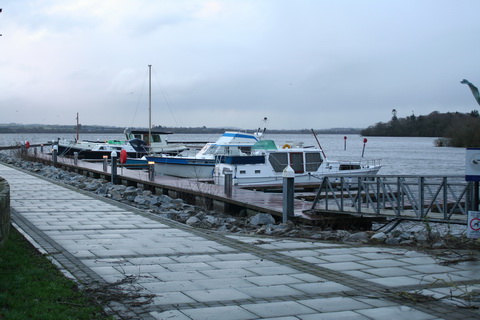
Dromineer 20131227 01_resize

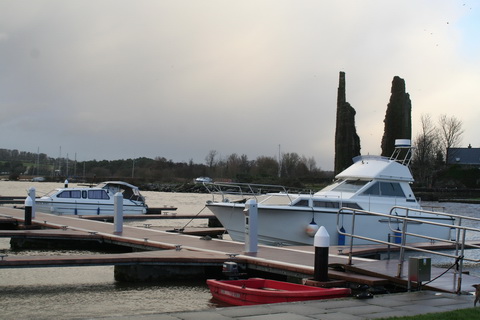
The ramp to the pontoons in Dromineer is now sloping upwards

The water level at Banagher has risen about one metre in the past 35 days.

Wind

Dromineer 20131227 02_resize

Dromineer people need to drink more wine

Dromineer 20131227 04_resize

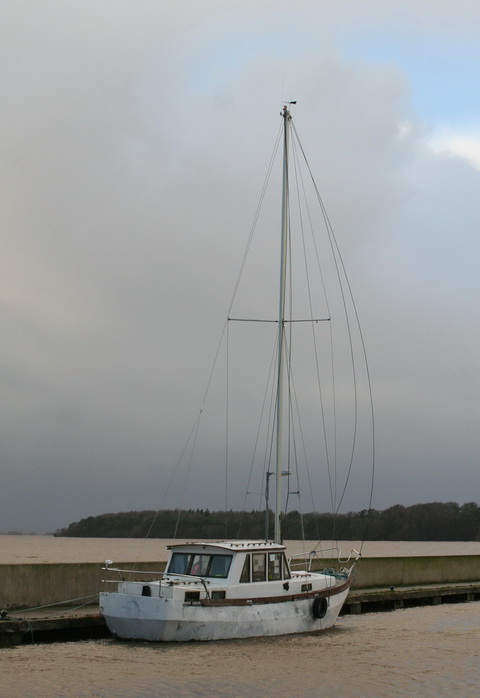
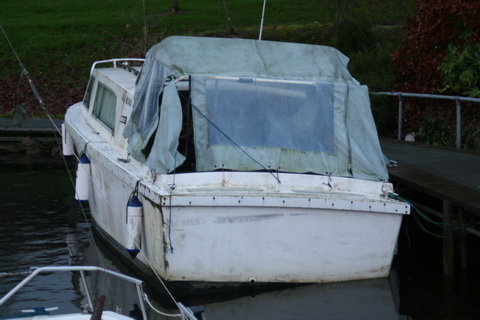
The ghost ship is back

Towers

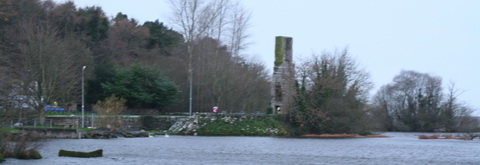
Dromineer 20131227 05_resize

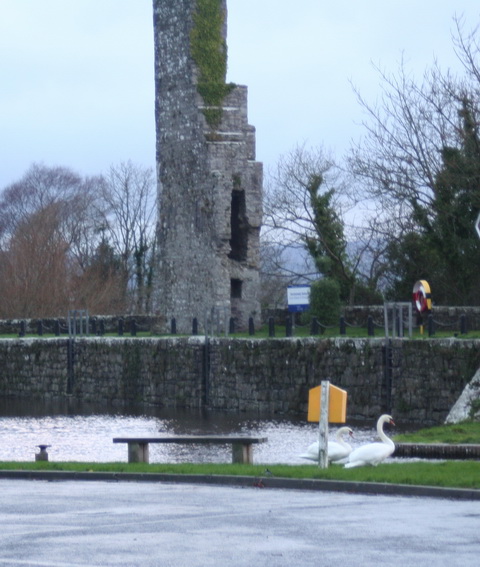
Dromineer sans ivy

Garrykennedy 20131227 02_resize

Garrykennedy

Garrykennedy 20131227 11_resize

Garrykennedy from a distance

Shelter

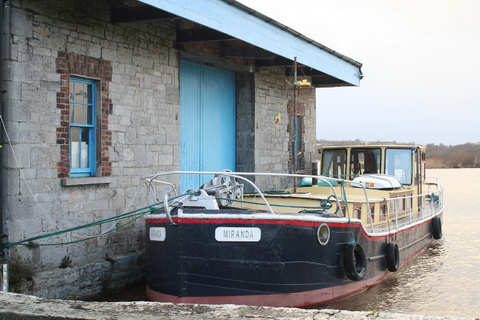
Dromineer 20131227 03_resize

Miranda in Dromineer

Garrykennedy 20131227 04_resize

Garrykennedy 1

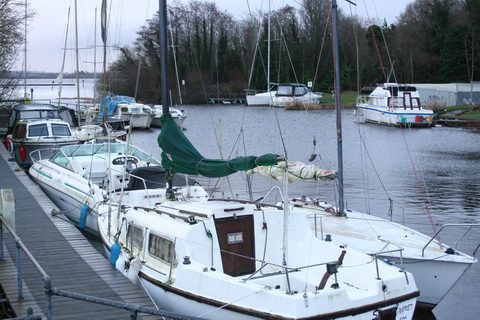
Garrykennedy 20131227 05_resize

Fewer boats in WI berths this year, I think

Garrykennedy 20131227 03_resize

Garrykennedy 2


Money from the bog

To a small extent reclamation is now going on in Ireland; Mr M’Nab, of Castle Connell, county Limerick, has reclaimed 80 acres of the worst red bog, devoid of vegetation and 20 feet deep. It was drained, then coated with the subsoil, and the land which was not worth 2s 6d per acre is now worth 30s per acre.

Thus Robert Montgomery Martin in his Ireland before and after the Union with Great Britain third edition with additions; J D Nichols and Son, London; James McGlashen, Dublin 1848.

I have written here about Mr Macnab (that was how the spelling settled down) and his talent for extracting money from the bog at Portcrusha, which is between Castleconnell and Montpelier, Co Limerick. It seems that his achievements are still remembered — and emulated.

Incidentally, in the same work, published in 1848, Mr Martin refers to the

… large practical mind, great experience,  and Christian philosophy …

of Sir Charles Trevelyan.

“Ireland has no inland waterways …” says Minister for Transport

Those very words came from Leo Varadkar [FG, Dublin West], Minister for Transport, Tourism and Sport, in a written answer to a Dáil question on 3 December 2013.

I have, of course, quoted him selectively and out of context. The full sentence was

Ireland has no inland waterways within the definition of the EU legislation as Ireland’s inland waterways are not navigable for commercial traffic and we do not have any interconnected inland commercial transport for the purposes, or on the scale, envisaged by EU proposals in this area.

The poor man was responding to yet another question from the Pest of the Royal Canal, Maureen O’Sullivan [Ind, Dublin Central], who was continuing her misguided campaign to get public money from anywhere at all to replace Effin Bridge, the lifting railway bridge at Newcomen Bridge over the Royal Canal in Dublin 1. I reported on her campaign here, here and here, with the last of those showing that current demand for passages is less than the (admittedly restricted) supply. That being so, I cannot see how any expenditure on replacing Effin Bridge could be justified, especially in the country’s current situation and with Waterways Ireland desperate for money. I would, of course, have no objection to any voluntary fund-raising campaign that Ms O’Sullivan might initiate.

Ms O’Sullivan questioned two ministers on 3 December. She asked Leo Varadkar:

…  if his attention has been drawn to Inland Waterway Transport Funding, the Funding Guide for Inland Waterway Transport in Europe published by the European Commission’s Directorate General for Energy and Transport in 2008; the reason the 19 countries’ inland waterways systems referenced in the publication does not include Ireland; if he will ensure that any future edition of the guide will contain a country profile for Ireland including information on major inland waterways and ports together with an overview on the national inland waterways transport funding policy, funding programmes and institutions; and if he will make a statement on the matter.

The saintly and erudite minister replied:

The Funding Guide that the Deputy refers to was published following the launch of the 2006 NAIADES Action Programme, a multi-annual programme on the promotion of inland waterways transport. The Commission has recently decided to update and renew this programme until 2020. Ireland does not have a country profile in the Funding Guide as, in general, Ireland is exempt from EU inland waterways rules and proposals since they relate to waterways of a greater size and carrying a greater capacity of goods than exist in Ireland. The European Union’s inland waterway network spans 20 Member States with about 37,000 kilometres of inland waterways. Every year, these transport around 500 million tons of cargo, in particular in the densely populated and congested areas of Germany, the Netherlands, France and Belgium.

Ireland has no inland waterways within the definition of the EU legislation as Ireland’s inland waterways are not navigable for commercial traffic and we do not have any interconnected inland commercial transport for the purposes, or on the scale, envisaged by EU proposals in this area.

My Department is responsible for licensing all commercial inland craft in Ireland. There are no commercial cargo craft on Ireland’s inland waterways, apart from some small workboats. There are a number of domestic passenger boats and ships operating locally as tourist excursion vessels.

Ireland keeps a watching brief on EU inland waterways matters, mainly to ensure that any proposals do not conflict with, or overlap, the existing maritime safety regimes.

I expect that Ms O’Sullivan will be back shortly to propose the setting up of a horse-drawn barge fleet on the Royal Canal, returning Ireland to the late eighteenth century, to which the Irish left (and republicans) seem so devoted.

Her other questions were to Jimmy Deenihan [FG, Kerry North/West Limerick], Minister for Arts, Heritage and the Gaeltacht. She asked:

… if he will identify the various State agencies whose operations bear upon the management of the Royal Canal and the steps they are taking, individually or collaboratively; if he will increase commercial-leisure use of the Royal Canal since the reopening of Spencer Dock to navigation in 2010; and if he will make a statement on the matter.

… if the European Regional Development Fund has been considered as a possible source of funding towards the costs, estimated at over €5 million, of overcoming obstacles to navigation, namely, the lifting bridge and the fixed Spencer Dock bridge on the sea level of the Royal Canal; and if he will make a statement on the matter.

The patient and polite minister said:

[…] Waterways Ireland is the navigation authority for the Royal Canal and is responsible for the management, maintenance and development of the Royal Canal, principally for recreational purposes. Waterways Ireland undertook the work to re-commission the Royal Canal prior to its reopening in 2010 and continues to develop the canal and its facilities, and promote its use for recreation.

I am advised that Waterways Ireland has not sought funding to redevelop the lifting bridge referred to by the Deputy and has no plans to seek such funding at this time. Ongoing operation of the bridge continues to be kept under review with Iarnród Éireann, while Dublin City Council remains responsible for the operation of the Spencer Dock Bridge at Sheriff Street.

And rightly so.

Note that the €5 million figure referred only to Effin Bridge; replacing Sheriff Street Bridge would be another kettle of fish.

Our Glorious Leader …

is to address, on Sunday night, anyone who watches television but doesn’t have a choice of television channels. There will be a medium term economic strategy too, promising a new and better future for all our people. But as Finfacts says:

… past experience coupled with signals so far, suggest that [the strategy] will be a promotional brochure for an international audience with some questionable claims and omissions. The expected plunge in services exports by as much as €50bn during the time horizon is not likely to be acknowledged.

There is an urgent need for a credible growth strategy that has an unvarnished assessment of the challenges with an honest analysis of strengths, weaknesses, opportunities and threats, using data that is free of the outsize impact of the foreign-owned exporting sector.

I wonder whether the strategy will include any sheughs.

Lowtown Canal Yard is for sale

Details here.

If I won the lottery I’d buy it myself. Sad to see Robert and Caroline Few selling, after many years of service to the canal; I wish them all the best in the future.

Sheughery

I wonder why Sinn Féin asks questions when it does. This one [h/t KildareStreet.com] seems to have been asked at a time that the minister might have welcomed.

Sandra McLellan [SF, Cork East]:

To ask the Minister for Arts, Heritage and the Gaeltacht the position regarding the Ulster Canal restoration project; the steps that must be taken to complete the project; the indicative timeline for the completion of the project; and if he will make a statement on the matter.

Jimmy Deenihan [FG, Kerry North/West Limerick] [the third para is the interesting one]:

As the Deputy will be aware, in July 2007 the North/South Ministerial Council (NSMC) agreed to proceed with the restoration of the section of the Ulster Canal between Clones and Upper Lough Erne. The then Government agreed to cover the full capital costs of the project, which were estimated at that time to be of the order of €35m.

It was always the intention that the Ulster Canal project would be funded from the Waterways Ireland annual allocations, as agreed through the annual estimates processes in this jurisdiction, as well as the deliberations of NSMC in relation to annual budgets. It was a key consideration throughout the process that the Ulster Canal project would be supported by a significant level of projected income from the commercialisation of certain Waterways Ireland assets. However, the economic downturn has had a negative impact on those plans.

I am continuing to explore all possible options to advance this project within the current fiscal constraints. In this regard, I established an Inter-Agency Group on the Ulster Canal to explore ways to advance the project and to examine possible funding options for it, including existing funding streams and the leveraging of funding from other sources. The Inter-Agency Group last met on 9th October and will meet again next week, on 9th December.

In the meantime, the Ulster Canal project is progressing on an incremental basis. Planning approvals have now been received for the project in both jurisdictions. Compulsory Purchase Order land maps are in preparation and consideration is being given to how the construction work and other technical aspects of the project will be structured once the necessary lands have been secured. The timeline for completion of the project will be determined when these preparatory steps have been completed.

I welcome these developments, which, I am sure the Deputy will agree, are a significant milestone for the project.

Hmm. The inter-agency group first met on 20 September 2012 and its second meeting was to take place in May 2013 or thereabouts. Now it’s going much faster, with meetings on 9 October and today, 9 December. Does this suggest that the group has found a pot of gold? Is there any link to the cancellation of SEUPB funding for the Narrow Water project?

And what has been going on in (and around) the North/South Ministerial Council? At its June 2013 meeting the Council approved or noted:

  • the business plan for 2012 (which had ended six months earlier)
  • the budget for 2012
  • the annual report for 2012
  • the draft accounts for 2012.

That suggests to me that there was either a major disagreement between the northern and southern ministers or a serious problem that rendered ministers unable to approve the WI budget and business plan until 18 months after the documents were required. Could it be that the northern minister, Carál Ní Chuilín [SF], like other NI politicians, had been looking for something from the waterways sector that hasn’t been delivered so far?

Note also that Jimmy Deenihan said

[…] consideration is being given to how the construction work and other technical aspects of the project will be structured once the necessary lands have been secured.

I understand that the design and construction of the Clones Sheugh was to be put out to tender but I wonder whether keeping the work in house might help WI to meet its increasing wage costs with a declining budget.


Waterways Ireland’s purpose in life

Waterways Ireland is currently (I presume) implementing its Corporate Plan 2011–2013 [PDF], which still has a month to run. That plan set out, inter alia, a mission:

Our mission is to provide a high quality recreational environment centred on the inland waterways in our care, for the benefit of our customers.

It also had core values, which is nice, and a vision:

Our long term vision is to create an interrelated waterways network which will provide accessible recreational benefits and opportunities for all.

We wish to create facilities and services which will attract and impress visitors from home and aboard, supporting and encouraging the tourism and recreational industries in Northern Ireland and Ireland and promoting sustainable economic growth across the island of Ireland. We seek to protect and enhance the natural environment in and along our waterways for the enjoyment of future generations.

For the period of this plan we intend to focus on the consolidation, improvement and promotion of existing waterways in order to maximise their use. We will progress toward our long term vision by focusing development on the Ulster Canal.

And it had strategic objectives:

To deliver the benefits and opportunities the waterways can provide across a range of areas, Waterways Ireland has identified 6 strategic objectives which will drive the delivery of our Mission and Vision and the objectives set out in this Corporate Plan. These Strategic Objectives are to:

1. Manage and maintain a reliable and high quality waterways network.
2. Develop and restore the waterways network.
3. Enhance the existing waterways network to widen its appeal to users.
4. Promote increased use of our waterways resource principally for recreational purposes.
5. Assess, manage and develop the assets of Waterways Ireland.
6. Develop an organisation of excellence.

Reading that lot, it seems to me that the focus was inward rather than outward, perhaps more in line with traditional engineering-led waterways management than with the new and exciting marketing-led organisation of the future.

The mission is de haut en bas, with waterways coming before customers, and the first sentence of the vision continues the theme. The second sentence does mention economic affairs, but “supporting and encouraging the tourism and recreational industries” suggests that tourism and recreation are something that other people do, not something that WI does: it does not seem to see itself as part of the “tourism and recreational industries”.

The intro to the strategic objectives is pure management gobbledegook, but the really revealing bit is the list of objectives. The last two are inward-looking, but note the ordering of the first four and what the balance of elements says about the corporate focus: WI is going to

  • manage and maintain the waterways network
  • develop and restore the waterways network
  • enhance the waterways network
  • and after that promote increased use.

This is what used to be called a sales model: design and build your widgets first; then go and flog them to the punters. There is an alternative approach: start by finding out what the potential punters might want and then design and build your widgets to meet their needs. In reality, of course, you do something in between, because you’re not starting with a blank slate: your factory can make one particular kind of widget, not all possible kinds. And, similarly, WI’s main asset is a collection of waterways, not of (say) amusement parks or bookshops.

But a marketing focus could help an organisation to think about how its widgets are to be used. The result doesn’t have to be as crude as adding the word “solutions” to everything; it can be used to shape how the organisation presents its widgets and to whom it presents them. And, in my view, WI needs to do that because, according to the only reliable (and admittedly inadequate) measure we have, the Shannon traffic figures, waterways usage has been declining for at least ten years. [I know that there are other waterways, and many other types of activities thereon, but I don’t know of any published statistics about the extent of usage.] WI needs to reimagine the waterways.

When Jimmy Deenihan spoke in the Dáil on 16 October 2013, he said:

The [budgetary] provision will enable Waterways Ireland to deliver on its core activities and targets, which include keeping the waterways open for navigation during the main boating season and promoting increased use of the waterways resource for recreational purposes. This expenditure should also assist in developing and promoting the waterways, attracting increased numbers of overseas visitors and stimulating business and regeneration in these areas. Capital funding of almost €4 million will be made available to Waterways Ireland to facilitate the ongoing maintenance and restoration of Ireland’s inland waterways, thereby increasing recreational access along the routes of waterways.

My attention was attracted by the phrase about keeping waterways open “during the main boating season”, which suggests a new, restrictive policy. However, the rest of the list is pretty much in line with the existing objectives. I hope that something more radical will come out of the corporate planning process in which WI tells me it is currently engaged.

By the way, note that there was no mention of either heritage, which was the excuse for nicking the waterways from the OPW, or northsouthery.

Setback for Sheugh

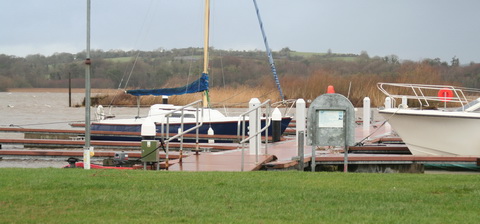
The likelihood that limitless wealth will result from the construction of the Clones Sheugh was reduced recently with the closure of the cruiser-hire base closest to the Ulster Canal: the Emerald Star (Le Boat) operation at Belturbet.

Perhaps, though, it reflects a wider decline in the hire business rather than disappointment at the delay in the canal’s reconstruction.

Effin stats

I wrote here about Maureen O’Sullivan’s questioning of ministers about Effin Bridge, the lifting railway bridge below Newcomen Bridge on the Royal Canal in Dublin. It seems that she would like a drop-lock to replace the bridge, thus enabling boats to pass under the railway at any time without interfering with the operation of the trains. Which would be very nice, but that it would cost over €5 million and cause significant disruption to the railway during construction.

I was distressed by Ms O’Sullivan’s failure to make any sort of economic case for the drop-lock or for any other measure that might allow for free movement of boats on that section of the Royal Canal. I said:

As the expenditure on reopening the Royal Canal is a sunk cost, I am all in favour of making its use easier — provided that it can be demonstrated that (a) there is a demand for increased use, (b) such increased use will have benefits that outweigh the costs of any improvements and (c) no alternative investment offers better returns. As far as I can see, Ms O’Sullivan has demonstrated none of the three: indeed I see no evidence that she has even considered them.

Ms O’Sullivan’s position might be described as favouring an increase in the supply of possible passages along that section of the canal, but I thought it might be interesting to know what the demand for such passages was, so I asked Waterways Ireland how many boats had passed under Effin Bridge in 2013.

I was wrong about the number of days on which the bridge was lifted: nine lifts were available altogether. Six were on Tuesdays, two on Saturdays and one on a Sunday (to facilitate the Dublin boat rally):

Tuesday 16 April 2013:           0 boats
Tuesday 30 April 2013:         10 boats
Sunday 5 May 2013:            24 boats
Tuesday 21 May 2013:           0 boats
Saturday 1 June 2013:           8 boats
Tuesday 18 June 2013:           2 boats
Saturday 20 July 2013:          3 boats
Tuesday 13 August 2013:       7 boats
Tuesday 17 September 2013:  4 boats

So that’s 58 boats in a year.

I asked what the cost was: I was told that Irish Rail charges €1200 per weekday lift and €2000 per weekend lift. I presume that Waterways Ireland itself incurs other costs, perhaps overtime at weekends, but I don’t know what they are. The cost per boat for each lift was:

Tuesday 16 April 2013:           0 boats: lift cancelled as no boats wanted it
Tuesday 30 April 2013:         10 boats: €120.00 per boat
Sunday 5 May 2013:            24 boats: €83.33 per boat
Tuesday 21 May 2013:           0 boats: lift cancelled as no boats wanted it
Saturday 1 June 2013:           8 boats: €250.00 per boat
Tuesday 18 June 2013:           2 boats: €600.00 per boat
Saturday 20 July 2013:          3 boats: €666.67 per boat
Tuesday 13 August 2013:       7 boats: €171.43 per boat
Tuesday 17 September 2013:  4 boats: €300.00 per boat

The total charged to Waterways Ireland (not to the boaters) by Irish Rail was €10800.00.

Suppose that a drop-lock had been built for €5000000. Would it be worth investing that amount to save an annual expenditure of €10800? I suspect not, although I am open to correction by anyone capable of calculating NPVs or other relevant measures.

It seems to me, though, that the case for any capital expenditure is weak while demand for passages is lower than supply. Perhaps Royal Canal enthusiasts might work on attracting more boats to the Dublin end, whether from the Shannon end or from the Grand and Liffey.


SEUPBer

SEUPB, the Special European Union Programmes Body, has withdrawn its offer of funding for the Narrowwater bridge about which I wrote here and here.

Perhaps the scheme’s proponents might now consider a Newry Southern Relief Road instead. It might not be iconic, but it would be considerably more useful.

And I really don’t think it needs an opening span to cater for a couple of yachts going up the Newry Ship Canal.

It seems that the SEUPB wants to reallocate the money to a project that could be completed by December 2015. A cross-border sheugh, maybe?