Category Archives: Industrial heritage

Divided by oceans, linked by a canal

Last Monday the erudite and sapient Póló wrote about a photo he took in Armagh on a school trip in the 1950s. He put a copy of the photo on a web page in 2004 and, eight years later, he got an email from the person who now lives in a house that was shown in the photo. Póló was able to supply a better copy, pleasing his correspondent, and (as Póló said)

[…] he learned something new and I got a better dating on my trip and photos.

But it was his next paragraph that rang a bell with me:

I am always telling people, particularly those who are following up their family history, that they should have a presence, however minimal, on the web. That way people can find you and you never know what they might be bringing to the table.

Just before reading that, I’d had a message from a correspondent in Australia. He had seen my page about the old Athlone canal and reckoned that he was probably related to a previous, British, visitor to the page; I put them in touch and it seems that they are cousins. You can read the correspondence on my Athlone canal page. So a reference to an abandoned canal on an obscure Irish website has helped two folk to get in touch — and I, and other visitors to the site, have learned a bit more about the canal.

But there is more to learn. Does anyone know anything about Canal Lodge? The AthloneLive forum has disappeared, so I can’t ask there, and I have no other information to hand. I am making enquiries, but if anyone has any information about the building I would be glad to receive it and I’ll make sure it’s passed on.


A London pub and the history of the Shannon

Piloti’s “Nooks and Corners” column in the latest issue of Private Eye [No 1325] reports [brief extract available to non-subscribers here] that a London pub is threatened with demolition. On the Google satellite view with photos, press the button to the bottom right of the building to see a pic headed “Derelict pub”.

Piloti says that the pub was built in the 1840s [Diamond Geezer says 1839] and at that time the Marquis (or Marquess) was Henry Petty-Fitzmaurice, 3rd Marquess of Lansdowne, KG, PC, FRS. The family’s main base was in Britain but they owned large estates in Ireland, notably in Counties Limerick and Kerry; certain roads in Dublin are also named after the family.

The late Marquis has two claims on the attention of Irish waterways enthusiasts. First, the best-known of the early River Shannon steamers, the Lady Lansdowne, was named after his wife. Second, he was Lord President of the Council [the current holder of the post is Nick Clegg] when the government of Her Late Majesty Queen Victoria decided, in 1839, to spend about half a million pounds improving the Shannon Navigation.


Blunderbuses on the Shannon

Saturday 10 May 1845

[…] On our way to Rooskey this Morning we visited Cloneen [Clooneen] & Cox shoal and they were going on very well with about 60 Men

I ordered them to double that Number to my astonishment I found 4 Policemen Barricked in one of our houses and a new Barrick erecting for 30 or 40 more Men this was being done in consequence of three villains placing themselves on the opposite bank of the River and deliberately firing four rounds of Ball from Blunderbuses some of which went into the office and from the marks made by one Ball must have been only a few inches from striking Joe Lambs head — afterwards the villains retired to the Bogs — the object of this outrage was revenge on the Men for not striking for 1/6 [8p] Pd day — the average being about 1/2 [6p] — which is considered at present ample

From David Brooke ed The diary of William Mackenzie, the first international railway contractor Thomas Telford Publishing, London 2000

What the blurb doesn’t say is that Mackenzie was the contractor for works on four areas of the Shannon, working for the Shannon Commissioners in the 1840s. He was responsible for Killaloe, Meelick, Banagher and Rooskey and also held a dredging contract.

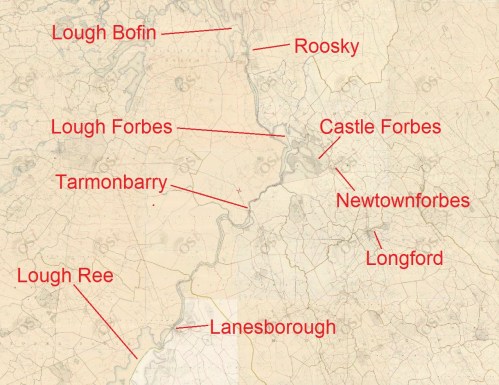
Lanesborough to Rooskey showing Lough Forbes

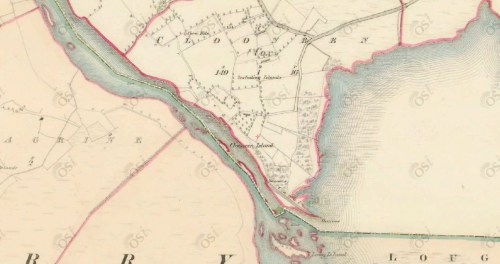
Clooneen (Cox) is the area at the upstream end of Lough Forbes; other Clooneens lie to the north on the east side of the river. Joe Lamb was the ganger.

Clooneen (Cox)

Political parties

Regular readers will know that I sent and FOI request to the Department of Community, Equality and Gaeltacht Affairs [now the Department of Arts, Heritage and the Gaeltacht] looking for files on the Clones Sheugh (aka the Ulster Canal). One of the grounds on which I was refused access was that certain files related to “the costing, assessment or consideration or any proposal of a political party carried out for or on behalf of that party”.

While my appeal against that refusal continues on its course, I thought I might as well ask the political parties directly for the information that might be in those files — in the process, of course, establishing which of them had Clones Sheugh proposals in mind.

Party time

As far as I can see, the parties that contested, or were eligible to contest, the 2011 general election were:

Christian Solidarity Party
Fianna Fáil
Fine Gael
Fís Nua
Green Party
Labour
People before Profit
Sinn Féin
Socialist Party
South Kerry Independent
Workers and Unemployed Action Group [WUAG]
Workers’ Party.

Accordingly, I decided to email them all, enquiring whether they had asked the [then] Department of Community, Equality and Gaeltacht Affairs for information “relating to the costing, assessment or consideration of the restoration of some or all of the abandoned Ulster Canal”. I added that, if they had done so, I would be grateful for a copy of the query they put to the department and of the response they received. I told them that I was sending my query to all political parties that contested the 2011 general election (or at least to all those for which I could find an email address).

That was not quite true: I omitted the South Kerry Independent Alliance, on the grounds that its interest in the Clones Sheugh was likely to be limited (I am of course open to correction on this). Furthermore, I was unable to find any website or email address for WUAG so I did not send my request to them.

Fianna Fáil logic

All of the other parties had websites and email addresses — except one: Fianna Fáil. Now, strictly speaking it falls outside the range of parties in which I might have been interested: not just for the obvious reasons but because it was in government at the time and would automatically have had full access to the civil service costings (such as they were). But I was interested to note that Fianna Fáil did not provide an email address on its website: interested enough to ring it and ask for an email address for its press office. The polite receptionist asked someone and told me that the address to be used was pressoffice@fiannafail.ie.

So I sent my query to that address. And I got back an autoresponse saying

This email is not monitored. For urgent queries you can contact the FF Press Office on 087 955 5600.

Well I never. What was the point of that?

Labour gains

Anyway, the results so far put Labour in the lead: I got an almost immediate informal response from Dermot Lacey, saying that he didn’t think Labour had contacted the department; I also got a more formal response next day, from Mags Murphy, Director of Councillor Services and Training, saying:

Labour did not include a specific commitment to the development of the Ulster Canal in our manifesto in the 2011 Election.

However, Labour is keen that all practical possibilities for cooperation, reconciliation and mutual benefit, including maximising tourism potential from a development of the Ulster Canal would be considered seriously as part of our deep commitment to the Good Friday agreement.

To this end, the Labour members of the Implementation of the Good Friday Agreement committee visited the Ulster Canal, Enniskillen and Clones with their cross-party colleagues for a range of meetings on 27 September 2012 with Waterways Ireland officials, local councillors and community groups.

Oh dear. Still, brownie points for responding.

What is the Implementation of the Good Friday Agreement committee?

Where are the others?

I am still awaiting responses from the other political parties.

Declaration of non-interest

I did not vote for any of those parties.

 

Ardnacrusha

Killaloe Coast Guard report here.

Nimmo’s non-existent bridge

Here is an account of the building of the old bridge across the Blackwater at Youghal.

Another description of the Dublin City Bason

From the Rev G Hansbrow’s 1835 publication An Improved Topographical and Historical Hibernian Gazetteer; describing the various boroughs, baronies, buildings, cities, counties, colleries, castles, churches, curiosities, fisheries, glens, harbours, lakes, mines, mountains, provinces, parishes, rivers, spas, seats, towers, towns, villages, waterfalls, &c &c &c, scientifically arranged, with an appendix of ancient names. To which is added, an introduction to the ancient and modern history of Ireland Richard Moore Tims; William Curry, Jun and Co; John Robertson and Co, Dublin; King and Co, Cork; Marks, Waterford; Simms and Mairs, Belfast; Campbell, Derry; M’Kerin, Limerick; Wheelock, Wexford; Collins, Drogheda; Dunlap, Coleraine; Purcel, Tralee; Kyte, Cashel; Blackham, Newry; Bole, Castlebar; Devir, Westport; and other booksellers:

The City Bason is the pleasantest, most elegant and sequestered place of relaxation the citizens can boast of; the reservoir, which in part supplies the city with water, is mounded and terraced all round, and planted with quickset hedges, limes and elms, having beautiful green walks between, in a situation which commands a most satisfactory prospect of a vast extent of fine country to the south. The entrance is elegant, by a lofty iron gate, and the water that supplies it, is conveyed from the neighbouring mountains.


Da new kidz in da hood

A couple of canally sites I hadn’t come across:

  • da corpo’s canal (h/t IndustrialHeritageIreland)
  • Dublin canal walks. I don’t know who is behind this site, which looks like a work in the early stages of progress, but I’m all in favour of folks’ walking along Dublin canals; my own effort at encouragement is here.

Industrial Heritage Ireland, by the way, has been watching the Clones Canal campaign. This suggests that the campaign is being cranked up, although I don’t know what the poor buggers from the NI Strategic Investment Board are doing in the group: pouring money into holes in the ground is not (pace Keynes) usually seen as an investment.

It is reported, nonetheless, that IWAI folk are confident that public money will be wasted on the ghastly project, thus subsidising their hobby. And it seems that a gang of Irish parliamentarians, following the tradition established in Grattan’s Parliament, are keen to distribute pork: there is nothing in the press release to suggest that any of the poor dears have any interest in assessing the costs and benefits of the Clones Canal proposal. In the unlikely event that any of them is interested, the pages starting here might be useful. And interested parliamentarians might like to check on any cost-benefit analyses done (or revised) since it was found that the canal would cost €45m, not €35m.


Coill an Eo

Arklow Marine Services reports:

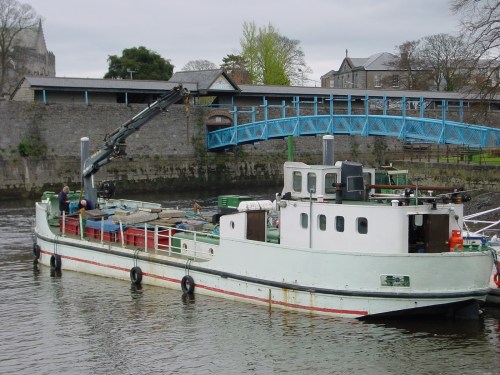
The “Coill an Eo” a 26 metre works barge, used in maintaining buoys and markers on the Shannon and owned by Waterways Ireland, has recently been docked in Rooskey, Co. Roscommon.

The first job the Yard had to do was carry out ultrasonic readings on the vessels hull, both internally and externally. A new main engine, tailshaft, propeller and bearings are to be fitted to the vessel and a complete electrical installation carried out.

Coill an Eo in Limerick in 2003

More photos of WI vessels here.

Pat Sweeney, in Liffey Ships and Shipbuilding Mercier Press, Cork 2010, says that Coill an Eo, launched in 1969, was the last vessel built on the Alexandra Basin slipways. He describes her as “a small grab hopper dredger” and says that the £40,000 cost was shared by the Commissioners of Public Works (then responsible for the Shannon) and Bord Fáilte.

How to collide

Cases, however, occasionally arise in river navigation, wherein it is not possible to avoid collision, either with vessels, barges, or boats; as, for instance, in the pool, near the Tower, &c, owing to the very crowded condition in which such places are generally found; being surrounded on every side by one or the other. In such a dilemma the only alternative is to stop the [paddle-]wheels, and let the vessels close together as easy as possible, taking care to guard the sides and paddle boxes with fenders, and using every endeavour to boom each other off; after which, let the Steamer drift with the tide, but watch an opening among the vessels for escape, and, so soon as it offers, set her on at rather better than half speed, in order to insure a command of her.

It is somehow consoling to know that even Commanders RN have been known to collide ….

The quotation is from Commander Robert Otway RN An Elementary Treatise on Steam, more particularly as applicable to the purposes of navigation, with a familiar description of the engine; Shewing the manner of its management in giving the Rotatory Motion; how started, eased, and stopped; the Nature and Properties of Steam, on both High and Low-pressure principles; its introduction into, and discharge from, the Cylinders, illustrated; as, also, how to ascertain the quantum of Actual Pressure at which the Engine is working; and the manner of Condensing Steam explained; together with a General Account of the operations of the Engine-Room; shewing the Accidents to which Steam Boilers are liable, and means of prevention; and, further, the Economy of Coals, how to be effected, &c, &c G Poore, Plymouth 1837.

This is a very readable book, available here as a free Google PDF, giving an interesting insight into the problems of the early naval steamers — and of their engineers.