
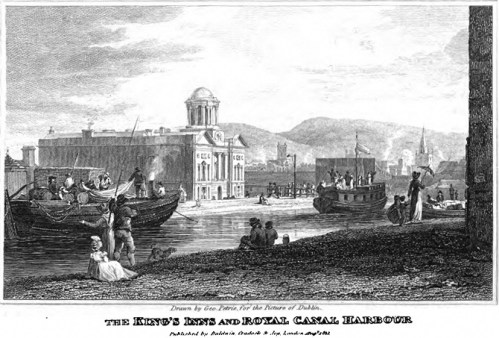
The Broadstone Harbour with King’s Inns in the background, early 1820s
This is a drawing by George Petrie, made for J. J. McGregor’s New Picture of Dublin of 1821. The details of the vessels are interesting. More on the Broadstone here.
The Broadstone Harbour with King’s Inns in the background, early 1820s
This is a drawing by George Petrie, made for J. J. McGregor’s New Picture of Dublin of 1821. The details of the vessels are interesting. More on the Broadstone here.
Posted in Ashore, Built heritage, Economic activities, Engineering and construction, Extant waterways, Forgotten navigations, Industrial heritage, Ireland, Irish inland waterways vessels, Operations, The cattle trade, waterways
Tagged boats, Broadstone, canal, Dublin, harbour, Ireland, King's Inns, passage boat, Petrie, Royal Canal, trade boat, vessels, workboat
There is quite a modern branch of trade risen up in Ireland — I mean the exportation of Dublin porter. I am not a proprietor in the brewery, and, in praising the beverage, which I consider most excellent, I cannot be considered to be actuated by interested motives. But, it is a curious fact, that, a few years ago, Ireland was an importing country of porter, while, at the present moment, a very considerable export trade is growing up in Dublin.
In this point, and, perhaps, in this point only, I fully expect the learned member for Dublin [Daniel O’Connell MP] to concur with me. I only venture to entreat hon. Members opposite, who wish to give some activity to the trade of their country, to encourage the fermentation of the vat, rather than the fermentation of politics. By so doing, they may greatly improve our trade and our internal condition; and, if they will but take my advice, I, for one, shall be ready, most heartily, to drink their healths in their own porter.
Thomas Spring Rice, MP for Cambridge (and previously for Limerick), Joint Secretary of the Treasury, in a House of Commons debate on the repeal of the Act of Union on 23 April 1834. On this site, you’ll find more on Daniel O’Connell here and on Uncle Arthur here.
The Abbey Theatre has announced that it has bought Nos 15–17 Eden Quay, Dublin 1. No 15 was the address of the main offices of the City of Dublin Steam Packet Company.
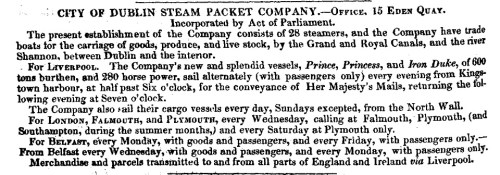
From the Dublin Almanac of 1845
The company crest is said to be still on the wall. Abbey Street Old seems to run between the two premises; no doubt there will be some means of avoiding any problem.
I wish the Abbey Theatre well in its extension, but I hope it will find some way of honouring the memory of the City of Dublin Steam Packet Company and of the underrecognised Charles Wye Williams.
Posted in Ashore, Built heritage, Charles Wye Williams, Economic activities, Engineering and construction, Industrial heritage, Ireland, Irish waterways general, Operations, People, Restoration and rebuilding, Shannon, shannon estuary, Sources, Steamers, The cattle trade, Tourism, waterways
Tagged Abbey Theatre, Charles Wye Williams, City of Dublin Steam Packet Company, Dublin, Eden Quay, estuary, Fergus, Grand Canal, Ireland, Irish Sea, Shannon, steam, steamer, waterways, workboat
… which is seeking a commercial partner to help it to digitise its collections. O si sic omnes.
Posted in Ashore, Economic activities, Industrial heritage, Non-waterway, Operations, Sources
Tagged digitise, Dublin, Ireland, National Library, NLI
In his A Tour in Ireland with Meditations and Reflections [S Highley, London 1844], James Johnson MD describes a flyboat trip on the Grand Canal from Dublin. He says:
At Newbury, a station near Edenderry, I debarked, and spent two or three days at the hospitable mansion of Newbury Hall, with my excellent friend Mr Wolstenholme and family, where I also met my amiable friend, Mrs Evans, of Portrane.
I have been trying to find Newbury. So far, the most likely candidate seems to be Newberry Hall, in Carbury, Co Kildare; the spelling Newberry is given on the ~1840 [Historic 6″] OSI map whereas the ~1900 [Historic 25″] map gives Newbury.
The Hall is indeed fairly close to Edenderry, but if Johnson got off the boat in Edenderry I’d have expected him to refer to it as Edenderry harbour. Looking at the OSI map (link above), the only other sensible point of debarkation would (I think) have been at Ticknevin Bridge, from which there was a road towards Newbury, but I have no evidence that it was Newbury station.
I would welcome enlightenment.
Posted in Ashore, Built heritage, Economic activities, Engineering and construction, Extant waterways, Industrial heritage, Ireland, Irish inland waterways vessels, Operations, People, Sources, waterways, Waterways management
Tagged boats, bridge, canal, Carberry, Carbury, Dublin, Edenderry, fly-boat, Grand Canal, Ireland, James Johnson, Newberry, Newbuty, Operations, Ticknevin, vessels, Waterways Ireland
In County Clare, urination has a long and distinguished history. Here is a piece about one early example: while it was not on inland waters, I hope that the involvement of the Head Pacificator, renowned for his efforts to promote the Shannon, as well as of two authors who provide useful information about the river, will excuse the inclusion.
Posted in Charles Wye Williams, Economic activities, Engineering and construction, Extant waterways, Industrial heritage, Ireland, Non-waterway, Operations, People, Politics, Scenery, waterways, Weather
Tagged boats, Charles Deane, Clare, estuary, Intrinsic, Ireland, iron, Jonathan Binns, Kilkee, Kilrush, Liverpool, Mary John Knott, New Orleans, Thoma Steele, wreck
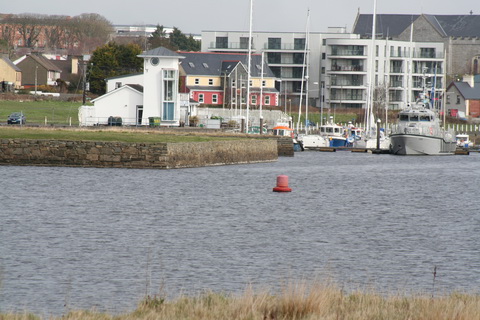
Kilrush across the creek
It was highly gratifying to witness the animation that prevailed in Kilrush — the neatness of the little shops, the flagged pathway, and the absence of accumulated dirt, so prominent and offensive a peculiarity of most small towns in Ireland. The people about Kilrush (whose population is 5000) are handsome, and appear considerably more intelligent than in many other places.
Jonathan Binns The Miseries and Beauties of Ireland Vol II Longman, Orme, Brown and Co, London 1837
Posted in Ashore, Built heritage, Charles Wye Williams, Economic activities, Engineering and construction, Extant waterways, Forgotten navigations, Industrial heritage, Ireland, People, Politics, Scenery, Shannon, shannon estuary, Sources, Steamers, The cattle trade, The fishing trade, The turf trade, Tourism, waterways
Tagged 1837, Clare, estuary, Ireland, Jonathan Binns, Kilrush, Shannon

 Irish waterways history