
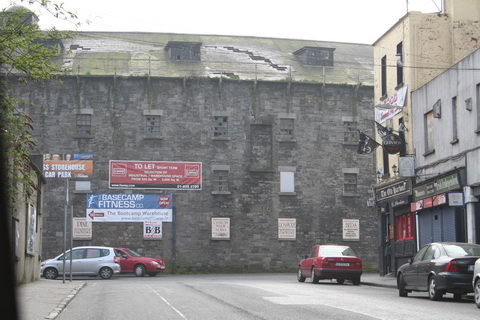
The curved building in March 2011 …
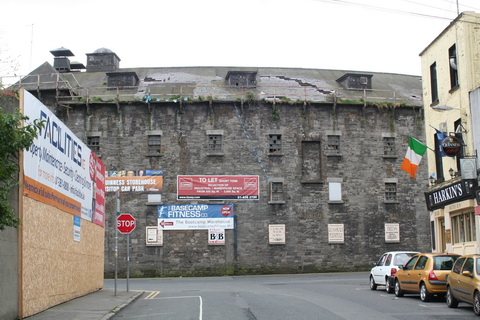
… and in May 2012
No sign of any improvement or of anything done to protect the building.
The curved building in March 2011 …
… and in May 2012
No sign of any improvement or of anything done to protect the building.
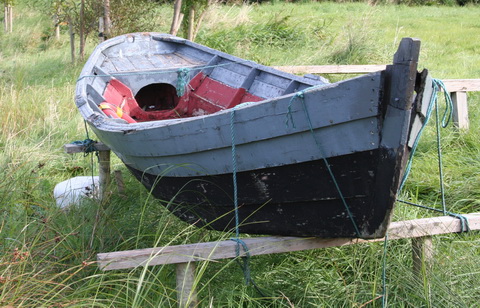
Bunratty Gandalow 2008
Gandalows (there are several spellings) are boats of the upper reaches of the Shannon Estuary. They come in several shapes and sizes and have been covered in several books. There is an opportunity to see some of them on the water, in Limerick, on Saturday 19 May 2012, when the ILEN School & Network for Wooden Boat Building has organised a day of talks and races. Full details here.
Posted in Built heritage, Engineering and construction, Extant waterways, Industrial heritage, Ireland, Irish inland waterways vessels, Operations, Restoration and rebuilding, Shannon, shannon estuary, Water sports activities, waterways
Tagged a k ilen, boats, gandalow, gandelow, Ireland, Limerick, Shannon
On 9 May 2012 the Irish Times carried a large ad offering for sale a “landmark site situated in a prestigious location on the North Circular Road/O’Callaghan’s Strand” in Limerick. The site is being sold by DTZ Sherry Fitzgerald but I can’t find it listed on their website; nor can I find, on the Irish Times website, the article “Toffee factory to test sticky Limerick market” that, coincidentally, appeared on the page after the ad.
However, the Limerick Post has a brief history of the site, which is shown on the OSI map of ~1900.

The Condensed Milk Manufactory ~1900
The waterways interest is actually in the dockyard, with its dock and slip, on the river just south of the manufactory. The yard also appears on the ~1840 map.
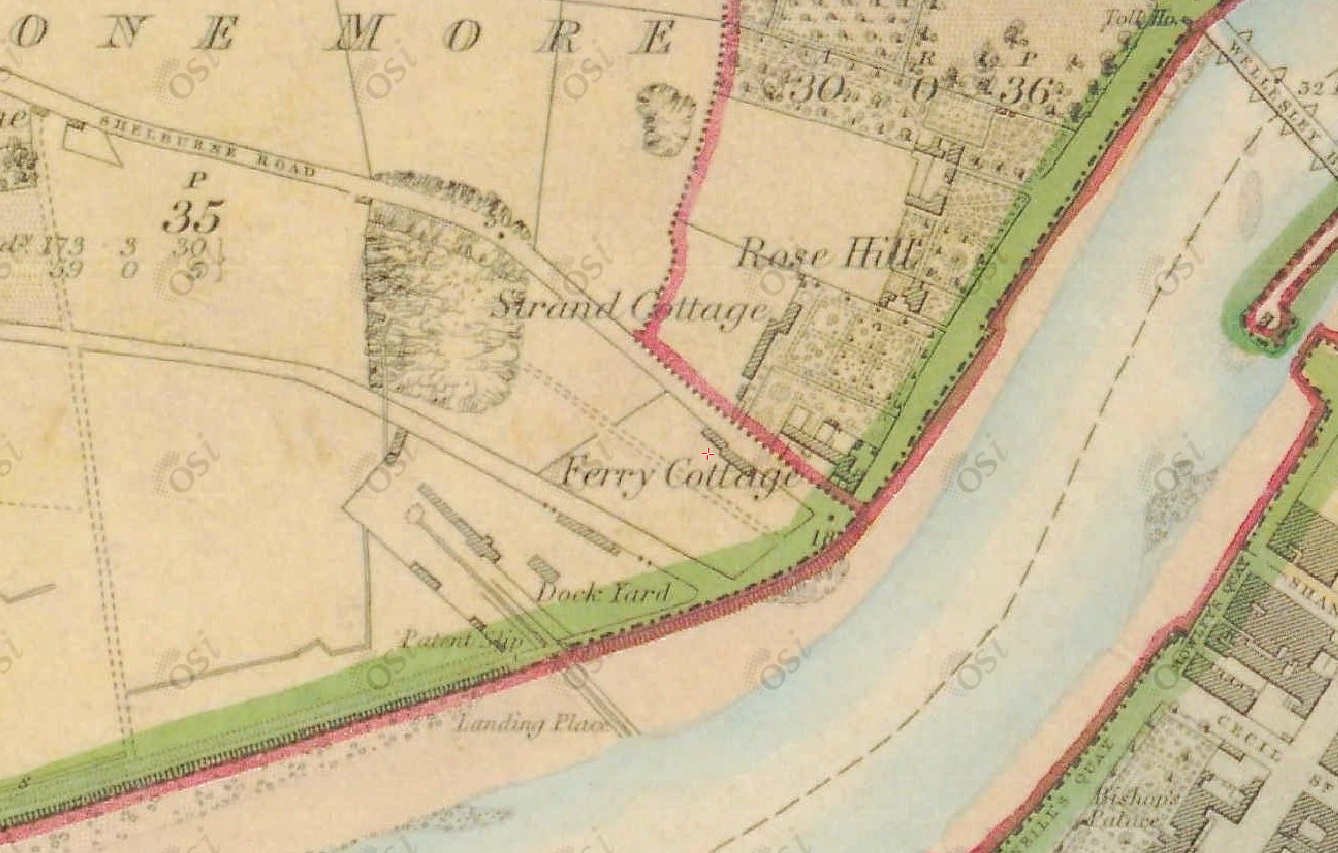
The dockyard ~1840
You can see the site on this Google photo …
… but the dockyard is gone.

Posted in Ashore, Built heritage, Economic activities, Engineering and construction, Extant waterways, Industrial heritage, Ireland, Non-waterway, Shannon, Sources, waterways
Tagged chimney, Cleeves, condensed milk, Dawn, Glanbia, Golden Vale, granite, Ireland, Kerry Group, Lansdowne, Limerick, North Circular, O'Callaghan's Strand, Shannon, toffee
The Heritage Council is now down wid da kidz in da hood, having acquired a facetweet page. Does this suggest that facetweeting is now becoming socially aceeptable? And it even has a YouTube thingie, where you can watch exciting videos of ministers making speeches.
Actually, the Heritage Council is becoming very with it, as the young folk say nowadays, aligning itself with the new reality that, unless it can show an economic payoff, its interests will be a low priority with the government.
You don’t need a weatherman to know which way the wind blows, comme on dit, or at least comme Mr Dylan dit.
Her Late Majesty Victoria, by the grace of god of the United Kingdom of Great Britain and Ireland Queen, had at least two locks named after her on this island: one at Meelick on the Shannon and the other at Upper Fathom on the Newry Ship Canal. This page gives a brief account of the canal’s history; it has links at the bottom to six pages (made up almost entirely of photographs) on aspects of the lock and its operation. Several of those aspects are not clear to me and I would welcome enlightenment about both the former manual operations and the current hydraulic operations.
Posted in Ashore, Built heritage, Economic activities, Engineering and construction, Extant waterways, Foreign parts, Industrial heritage, Ireland, Natural heritage, Operations, People, Restoration and rebuilding, Scenery, Sources, Waterways management
Tagged Albert, basin, Carlingford, Ireland, lock, Newry, Northern Ireland, ship canal, upper fathom, Victoria
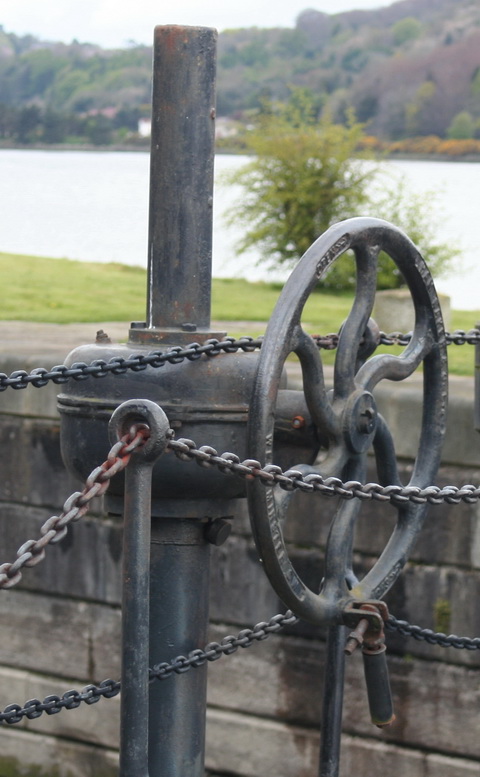
Where is it?
Here is an account of the background to, and the main features of, the proposed supply of water from Lough Ennell to the summit level of the Royal Canal. It does not discuss the amounts of water involved; I intend to cover that on a separate page.
Posted in Ashore, Built heritage, Drainage, Economic activities, Engineering and construction, Extant waterways, Industrial heritage, Ireland, Natural heritage, Operations, Politics, Restoration and rebuilding, Scenery, Sources, Tourism, waterways, Waterways management, Weather
Tagged abstraction, An Bord Pleanála, anglers, boats, canal, Dublin, floods, flow, Ireland, Lilliput, lock, Lough Ennell, Lough Owel, mills, Operations, Royal Canal, Shannon, summit level, trout, water level, water supply, waterways, Waterways Ireland, weir
I mentioned the other day that extensive searches of tinterweb had failed to find any data on the heights of overhead power lines above the Shannon and that I had been forced to resort to the telephone.
I am pleased to report that the ESB expert duly rang me back today, and further pleased to report that he had himself measured the height of every cable over the Shannon. Oh joy, oh happiness, I thought. But not for long.
The ESB, it seems, does not reveal the actual height of power lines above the water. This, if I understood the reasoning correctly, is because the water level varies and a boat-owner might not understand that, hit a line with a mast and then sue the ESB [where “ESB” means “electricity transmission or distribution operation”]. I have been told that a boat-owner in coastal water did just that (presumably between the mainland and an island) and that the lawyers have advised ESB to take no further risk; I would welcome information about the incident.
So, if you want to find the height of a power line, you’ll need to polish up your trigonometry (and then relate the height to Ordinary Summer Level). But the ESB does supply the information to one organisation that makes charts: the United Kingdom Hydrographic Office. That’s OK for coastal charts, but the UKHO (to the best of my knowledge) has not surveyed the inland Shannon since 1839, and I don’t think its inland charts have been updated since then. It is possible, of course, that the UKHO supplies the data to other (electronic or paper) chart-makers; I have emailed them to ask.
The quest continues again. More info when I get it.
Posted in Ashore, Built heritage, Economic activities, Engineering and construction, Extant waterways, Industrial heritage, Ireland, Irish inland waterways vessels, Operations, Politics, Shannon, shannon estuary, Sources, waterways, Waterways management
Tagged boats, clearance, ESB, height, Ireland, Lough Derg, Operations, OSL, overhead power line, Shannon, transmission, vessels, water level, waterways

 Irish waterways history