
… and move to London to make the grade.
Your productivity will be improved
And you’ll be happy that you’ve moved.
h/t Tyler Cowen
… and move to London to make the grade.
Your productivity will be improved
And you’ll be happy that you’ve moved.
h/t Tyler Cowen
A short piece about the canal at Ross on one of the lakes of Killarney. I have little information about its origins and current use and would welcome more.
Posted in Built heritage, Canals, Engineering and construction, Extant waterways, Historical matters, Industrial heritage, Ireland, Operations, Scenery
Tagged canal, Isaac Weld, Killarney, lake, Ross
I have mentioned Isaac Weld before., in the context of his sailing the Lakes of Killarney in a boat made of brown paper. He was also one of the first people, at least in Europe, to take a long sea voyage in one of the newfangled steamboats as a passenger rather than a crew member. Even better, he left an account of his journey.
One George Dodd was taking a steamer, originally called the Argyle, from the Clyde (where steamers came from) to the Thames, after which he renamed the boat. This was in 1815, only three years after Henry Bell‘s Comet began the first commercially successful steamboat service in Europe. [The first such service in America was inaugurated in 1807 by Robert Fulton, who was mentioned here the other day.]
Dodd took the steamer into Dublin en route to London and Isaac Weld, greatly interested, decided to travel on board for the rest of the trip. Weld’s wife, née Alexandra Hope, decided to accompany him; she may have been the first woman, at least in Europe, to take a long sea trip on a steam boat.
Here is a version of Weld’s account of his trip, as published in the Belfast Commercial Chronicle on 24 April 1816. It may have been translated from English to French and back again.
Posted in Engineering and construction, Foreign parts, Historical matters, Ireland, Passenger traffic, Sea
Tagged Alexandra Hope, Argyle, Dublin, George Dodd, Isaac Weld, London, steam, Thames
We are happy in being informed, that the young man (son of the Rev T Cooper, of Leeds street, Liverpool) who was suspected of having been drowned whilst bathing at Liverpool, and for whose body a reward was last week offered, was picked up alive by one of the Dublin Packets outward bound, having been carried away by the rapidity of the current, and after a voyage to Ireland, was on Saturday last restored to his disconsolate friends, having thus been most providentially rescued from a watery and untimely grave.
Lancaster Gazette 25 May 1816

Posted in Foreign parts, Ireland, Sea, Water sports activities
By the arrival of the Packet we received yesterday, at the early hour of three o’clock, pm, the London Mail of Tuesday. Had we stated a few years ago the probability of such an occurrence, we should have been reckoned wild and visionary enthusiasts.
But now the period has arrived, when, by the astonishing improvement of the roads from London to Holyhead, and the establishment of those noble vessels, the Post Office Steam Packets [inaccurate article here], the public may almost invariably calculate on the arrival in Dublin of the London Mail, within 44 hours after it is despatched from the British Capital. It is needless to point out the great advantage which the mercantile world must derive from the expeditious conveyance of the English Mail, and the consequent postponement of the departure of the Mail for London, from 10 o’clock pm to eight o’clock am.
While we bestow our warmest panegyric on the Post Masters General, for the strenuous exertions they have made to effectuate this desirable object, we must also pronounce, that Sir Henry Parnell amply merits the grateful thanks of every Irishman, for his unceasing and successful efforts to facilitate the communication, improve, and shorten the distance between the capital of the Sister Kingdom.
Considerable anxiety was evinced yesterday to witness the arrival of the Government Steam Packet; a number of the first characters, among whom were several Ladies, were on the Pier at Howth about one o’clock, at which hour the Meteor, commanded by Captain Davis, and also the Talbot [private sector] Steam vessel, were in view — both ploughed the ocean in grand style, the Meteor being first at the Quay by a quarter of an hour, and the Mail was landed from her at 10 minutes past two, 42 hours only having elapsed from its leaving London. The Lightning, which is to arrive to-day, is a larger vessel, being 80 horse power — the Meteor is only 60.
Saunders’s News-Letter 1 June 1821
Posted in Economic activities, Engineering and construction, Historical matters, Ireland, Operations, Passenger traffic, People, Roads, Sea, Steamers
Tagged corruption, Holyhead, howth, Ivanhoe, Lightning, Meteor, Post Office, Steam Packet, Talbot
B Hyland and Sons return their most grateful Thanks to their Friends and the Public, for the very flattering Encouragement they have received since their commencement in Business, above 20 years, and hope, that by their constant care and attention to merit a continuance thereof. They now take the opportunity of acquainting the Friends of their Trade, that all goods committed to their care, will be forwarded as usual, with the utmost expedition. Three of their Boats leave Dublin every week, for the conveyance of all kinds of Building Materials; Wines, Spirits, Porter, Tea, Sugar, Cotton Goods, and all kinds of Merchandize &c, at tge following reduced Prices, viz:
Dublin to Rathangan 8s 10d per Ton
Do. to Monastereven 10s 6d do.
Do. to Vicarstown 12s 4d do.
Do. to Athy 14s 2d do,
They beg leave to state to their Friends and the Public that they have got each of their Boats Hatched (so that it is impossible for Goods to meet with the slightest injury) and each Hatch is properly iron barred, with cross bars of Iron, in the most secure manner, and the moment the Goods are put into each Boat, the Hatches are put on, and locked down with brass-warded Locks of the best description, and then sealed. Each of their Agents at the above-named Stages have counter keys to open the Boats to get out the necessary Goods that is for each place. They have also provided excellent Stores at each of the above Harbours, for the general accommodation of all those who are pleased to favour them with the carriage of their Goods.
They return their best thanks to the Grand Canal Company, for their having so kindly reduced their Tolls, by which means they are thus enabled to carry Goods at the above Rates, and also to carry all kinds of Goods, Flour, Meal, Malt, Corn, &c at the under-mentioned rate of Freight to Dublin, where three of their regular fast-sailing Boats arrive each week from the country.
Athy to Dublin 12s 6d per Ton
Vicarstown to do. 11s 6d do.
Monastereven to do. 10s 6d do.
Rathangan to do. 8s 10d do.
Exclusive of the above arrangement they have also commenced plying another Boat drawn by two Horses, which Boat leaves Monastereven every Friday evening at Four o’Clock, and arrives in Dublin on the Saturday night following; this same Boat leaves Dublin every Tuesday morning at Five o’Clock, and arrives in Monastereven on the Wednesday evening following.
They hereby give notice, that any Grain or Corn that may come by their Boats, in bulk, to Dublin, will not be entitled to the above reduction of Freight; but if the Owners of such Grain or Corn, put it into Sacks, they will then be only charged at the above-mentioned Rates (so regulated and ordered by the Grand Canal Company).
They have also established Drays with Covers for the accommodation of their Customers in Dublin, and also in the Country, for the purpose of delivering all kinds of Goods that may be conveyed by their Boats to their respective Owners.
Samples are taken from all Wines and Spirits sent to their care, the instant they are laid down off the cars, in the presence of the Carrier, in small Vial Bottles, sealed, one of which is sent to the Owners, the other retained as a proof; and they are in all cases accountable.
Their Boat Agents are Mr Henry Farrell, at Rathangan; Mr John Coyle, at Monastereven; Mr Thomas Doyle, at Vicarstown; and Mr Michael Commins, at Athy; each of whom are purchasers of Grain, and will give the full value for Wheat, Bere, Barley, Oats and Rapeseed.
Wanted, 800 new Hemp Sacks of the best Irish Manufacture; each Sack must weigh 7 lb exactly standing beam.
They have always a large supply of the best KILKENNY COALS, on reasonable Terms.
Dublin Evening Post 12 September 1816
Posted in Ashore, Canals, Economic activities, Extant waterways, Historical matters, Ireland, Irish inland waterways vessels, Irish waterways general, Operations, The grain trade, waterways, Waterways management
Tagged Athy, Barrow Line, boat, canal, coals, Dublin, grain, Grand Canal, Monasterevan, Rathangan, tolls, Vicarstown
I have today sent this email to both Waterways Ireland and Clare County Council.
This email is being sent to Waterways Ireland (Scarriff office) and Clare County Council.
Let us suppose that, during the summer season (15 May to 15 September), I set off on my boat, with my dogs, from somewhere at the northern end of Lough Derg; I moor in Mountshannon at 11.15am.
Under Clare County Council’s beach bye-laws (number 16), I may not take my dogs ashore until 6.00pm: they will be confined to Waterways Ireland’s piers and pontoons. The entire area of the car park, the access from the piers to the roads, is off limits to dogs between 11.00am and 6.00pm.
Perhaps you might, for the convenience of visiting dog-owners, designate a corridor through which dogs (on leads) might be taken to land. After all, the area in question is not actually a beach: it is a car park.
Let us suppose that you are on a boat, with your dog, and perhaps some humans, and that you decide to visit Mountshannon, Co Clare, in the summer.
Here is a map of Mountshannon. I have stolen it from Clare County Council’s Beach Bye-Laws document, which you can download here [PDF].
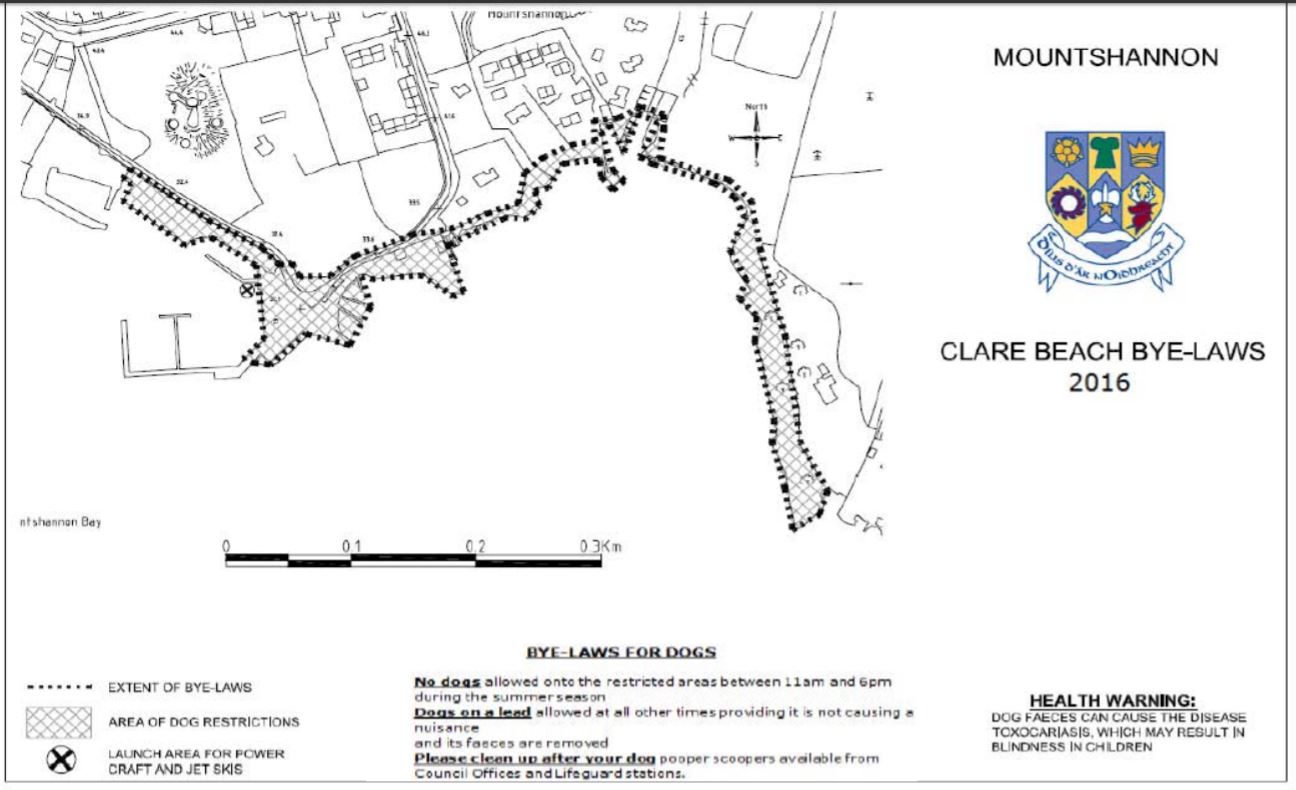
Mountshannon, Co Clare
Bye-Law 16 applies to this “beach”:
16) Between the hours of 11am and 6pm during the Summer Season, it shall be prohibited to bring any dog onto any part of the beach except the exempted areas delineated on the schedule of maps attached hereto. Before 11am and after 6pm, a dog may be brought onto the non-exempted areas of the beach on the conditions that:
- the dog is on a leash;
- it is not causing annoyance, danger or nuisance to any person using the beach or worrying, chasing, injuring or disturbing any animals, birds or other creatures on the beach; and
- its faeces is removed and deposited in a suitable receptacle.
There are some exceptions: guide dogs and those employed by the constabulary and the excise-persons.
The area from which dogs are excluded is shown by the hatching on the map. It covers the only exit from the piers to the shore. Thus it is not permissible to take little Fido to the land between 11.00 and 18.00 in the summer.
Little Fido had better be good at crossing his legs.
Posted in Ashore, Extant waterways, Ireland, Irish inland waterways vessels, Non-waterway, Operations, Shannon, Tourism, Waterways management
Tagged beach, bye-laws, Co Clare, dog prison, Mountshannon
At the Police-office on this day, 64 boys, inmates of Mountkennett workhouse, were brought up for effecting an entrance into the stores of the Dublin Steam Packet Company, which are underneath the workhouse, and converting to their own use 432 bottles of porter [6¾ bottles each], the property of Mr Hurley.
Tralee Chronicle 3 August 1850 citing Limerick Chronicle 31 July 1850

 Irish waterways history