Category Archives: Irish inland waterways vessels

Grand Canal Passage Boat Horses

Proposals in writing will be received by the Court of Directors, at No 105, Grafton street, for drawing six Passage-boats, for three, four, or five years, between the city of Dublin and Monasterevan. The Contractors to be paid monthly.

Proposals to be delivered in two ways, either for the present five stages, from Dublin to Hazle-hatch, Sallins, Robertstown, Rathangan, and Monasterevan; or for four stages, viz Hazle-hatch, Digby-bridge, Elanaree, and Monasterevan. Persons proposing may send proposals either for the whole line, or any one or more of the before-mentioned stages.

Any alteration that shall hereafter be made, by increasing or decreasing the number of Passage Boats, to be mutually allowed for in proportion to the contract.

The boys to be kept in proper apparel, and the contractors to find track lines.

Stables will be found by the Company on the new stages — if they should be adopted.

Proposals will be received until the 1st day of August next, and the contracts to commence on the 1st of October ensuing.

Security in the sum of £500 must be given for the due performance of the contracts.

Signed by order,
W Browne Sec

Dublin Evening Post 17 June 1790

St John’s Pill (River) in Waterford

Brian Simpson writes from Waterford:

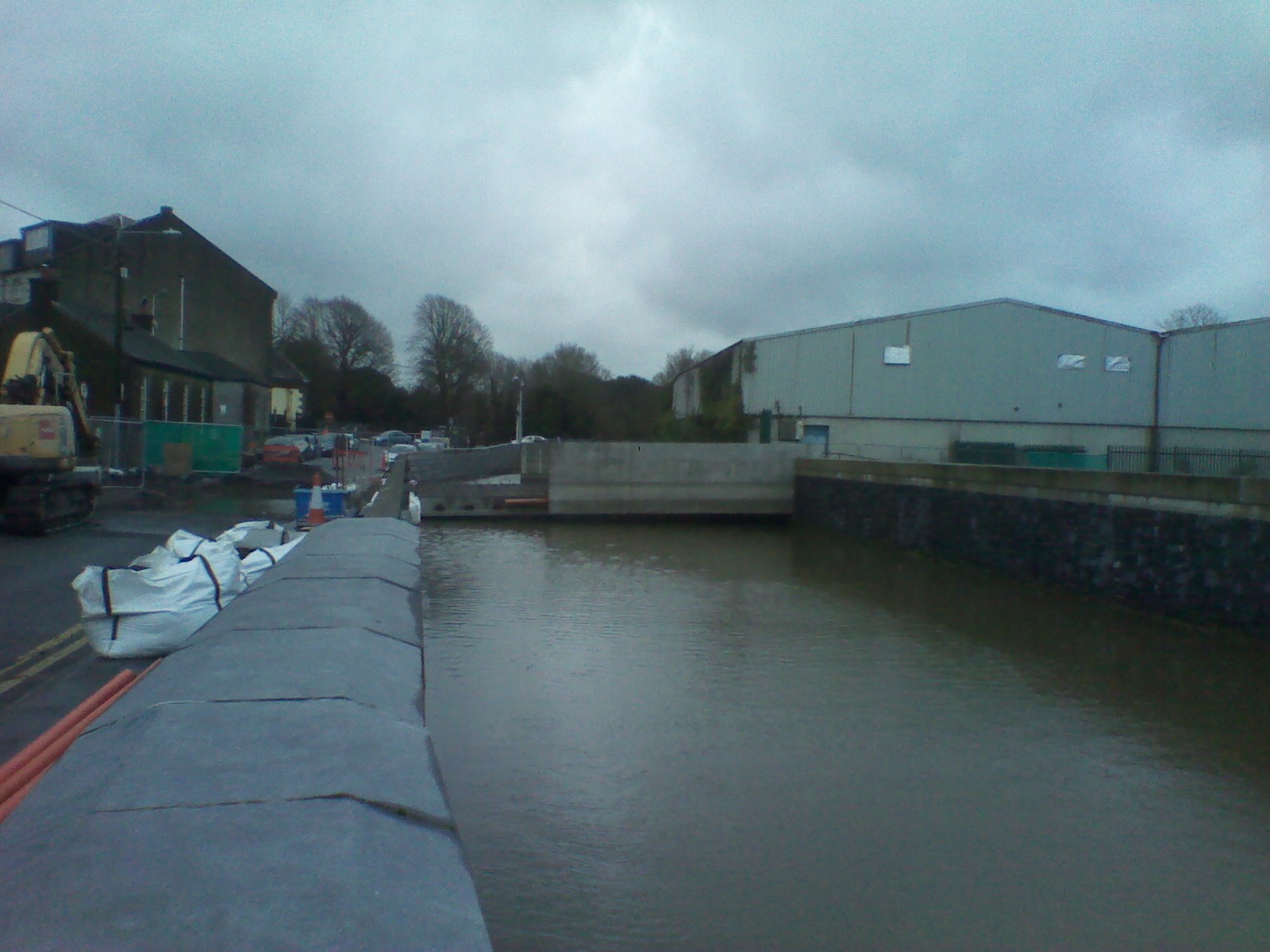
There’s a new bridge being built on the Waterside in Waterford City and sadly it looks like it is going to be a death blow for the Friends of St John’s River and Waterford Small Boat Owners Association’s attempts to restore navigation along this waterway.

The new bridge at high tide (Brian Simpson)

Please find attached the Facebook link for comments and attached photo of bridge at high tide.

Half our canal was taken by a humpback bridge, Wyse Bridge, being replaced at Poleberry in 1980; this effectively stopped any chance of barges navigating the other part of the waterway, which was being done up to the 1950s.

I do hope that boats will still be able to use the Pill.

Update: a link to a video.

Lough Allen to Limerick 1786

The hopes of a gentleman of Limerick ….

Down the Nore from Castletown

Seventeenth-century transport on the Nore from Castletown to Ross and Waterford.

Building Ardnacrusha

I had a page with photos of the construction of Ardnacrusha in 1930; I have expanded that page to include

  • photos taken in the 1920s by Eyre Chatterton and kindly supplied by Tony and Blair Chatterton
  • links to the ESB Archive’s reports made by Siemens during construction; h/t Carthach O’Maonaigh for drawing them to my attention.


The Earl of Granard

The Earl of Granard has, within the last ten days, placed a neat little steam-boat for pleasure on the Shannon. She is upwards of fifty tons burden, and is, we believe, the first steam-boat for pleasure ever placed on the Upper Shannon.

Longford Journal 8 October 1859 from the
British Newspaper Archive

From the BNA

Bang

The inhabitants of this city [Dublin] were greatly alarmed yesterday evening, between the hours of four and five, by a most violent concussion of the air, which broke several panes of glass, cracked others, and shook houses to the foundation in an unusual manner, accompanied by a very loud explosion. In the country parts adjacent to the city, the fears of the people led them to imagine that there had been a shock of an earthquake — but the cause proves to have been the explosion of two boats, that were coming down the Grand Canal, freighted with gunpowder from Counsellor Caldbeck’s powder-mills at Clondalklin.

Many lives it was reported were lost; but we can assure the public, from the best authority, that no more than two men were killed, and five or six slightly wounded. The loss from the gunpowder is not estimated to be very great.

It is not as yet ascertained through what manner the fire was suffered to communicate to the powder. It was said that it was from one of the hands having dropped some blazing tobacco from a pipe which he was smoking, but for that there appears no foundation.

Dublin Evening Post 24 April 1787

Another waterways mystery

According to Ruth Delany [Ruth Delany and Ian Bath Ireland’s Royal Canal 1789–2009 The Lilliput Press, Dublin 2010], the Royal Canal’s fast passenger-carrying fly-boats had neither toilets nor cooking facilities; the slower night-boats were better equipped.

So how did the fly-boat passengers relieve themselves?

Given that the boats travelled at six Irish miles per hour (about 12 km/h), any passenger who disembarked for the purpose would have found it difficult to catch up again. Yet standing on the notoriously unstable boats might have been difficult for the gentlemen, while the problems facing the ladies are not to be contemplated.

I don’t think that the india-rubber urinal had been invented by then. So what did they do?


Limerick 1850

For extent and population it is now the fourth town in Ireland. The shipping at the quays was not numerous. There are but two small steamers which ply from the port, and both are employed only in the summer, one being laid up during winter, as the other is found sufficient for the trade. These steamers ply down the river to Kilrush, calling off the ports on each side on their way. […]

Dung, in any quantity, may be got in Limerick, for 1s per load of 20 to 30 cwt.

James Caird, Farmer, Baldoon The Plantation Scheme; or, the West of Ireland as a field for investment William Blackwood and Sons, Edinburgh and London 1850

Tories on the Barrow and the Shannon

I read here that Olivia O’Leary, who chairs a Save the Barrow Line committee, says that the Barrow Line (trackway or towing-path)

[…] is a natural amenity and should be maintained as it is.

It isn’t. It is an entirely artificial creation, built to enable the use of horses to tow boats. Any geraniums, beetles, butterflies or tweetie-birds using it are interlopers, squatters and trespassers and should be paying rent; at the very least they should take second place to humans.

The Grand Canal Company often complained about the poor quality of the Barrow trackway: the surface was not up to the job. If it is to cater for more users, it may well need to be improved. That is an engineering decision on which I am not competent to pronounce but, as the Barrow is pretty well a dead loss for long-distance cruising by larger boats, it needs to be redesigned for walkers, cyclists and canoeists.

But at least the Barrow NIMBYs are prepared to accept more boats. Dr William O’Connor of the Old River Shannon Research Group writes about the Shannon here, complaining about the small number of “garish canoes” that occasionally travel downstream from Castleconnell to Clareville. Dr O’Connor asks

[…] why has it become a free-for-all for canoeists?

The answer is that there is a right to navigate, as I pointed out here (with an addendum here): I have had no response from the ESB so, while being open to correction, I maintain my position. Anglers may believe that their interests are paramount on that stretch of the Shannon: I disagree. Of course I would be all in favour of discussions between anglers, kayakers, dog-walkers and other users (even environmentalists), but such discussions cannot be based on a presumption that one group has all the rights, or that one activity is of supreme importance, and that the rest are secondary.

For some reason, canoes operated by commercial providers are particularly to be condemned, although it is not clear how salmon and lampreys can distinguish between public-sector, private-sector and voluntary-sector canoes — or whether they would be bothered anyway: Dr William O’Connor says

It is noted that there has been little scientific research on the ecological impact of canoeing.

In other words, there is no reason to believe that there is any basis for the concerns expressed by Dr O’Connor or by various anglers.

More broadly, though, the common factor on the Shannon and the Barrow is that existing users of public facilities are resisting new or expanded uses and seeking to protect their privileges. Irish Toryism is alive and well.

Addendum: this is probably the solution to the salmon problem.