
From the Waterways Ireland Signage Design Manual (October 2012) [PDF]:
Posted in Economic activities, Ireland, Irish waterways general, Operations, Waterways management
Tagged deity, diety, Ireland, signage, Waterways Ireland
Here is an article, perhaps by Philip Dixon Hardy himself, from his Dublin Penny Journal of 1835. It is about the Bog of Allen, and the turfcutters living thereon, seen from the Grand Canal in 1835.
He visited a turfcutter’s hovel in the bog while stopped at a double lock about twenty miles from Dublin. What lock could that have been?
Note that Kildare is not among the counties mentioned in the article.
Posted in Ashore, Drainage, Economic activities, Engineering and construction, Extant waterways, Industrial heritage, Ireland, Irish inland waterways vessels, Irish waterways general, Natural heritage, Non-waterway, Operations, People, Scenery, Sources, The turf trade, Tourism, waterways
Tagged boats, bog, Bog of Allen, canal, Dublin, Dublin Penny Journal, Galway. Roscommon, gorse, Grand Canal, hovel, Ireland, King's County, landlord, landshark, lock, Longford, Meath, Operations, Philip Dixon Hardy, Queen's County, reclamation, Royal Canal, Shannon, Tipperary, Tullamore, turf, vessels, Westmeath, Wicklow
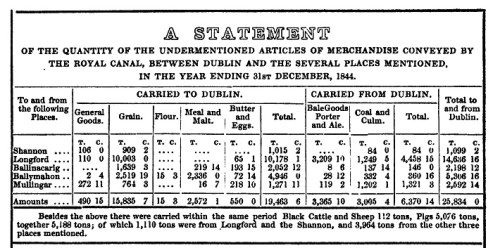
Royal Canal traffic in 1844 (Salt)
That table is extracted from Samuel Salt’s Statistics and Calculations essentially necessary to persons connected with railways or canals; containing a variety of information not to be found elsewhere 2nd ed Effingham Wilson and Bradshaw & Blacklock, London 1846, available from Messrs Google here.
The interesting point is how little of the Royal’s traffic travelled the whole way from the Shannon to Dublin or vice versa: only about 5% of the Dublin-bound traffic and less than 3% of the traffic westward.
Another point of interest is that traffic to Dublin was three times the traffic from Dublin.
Amongst the livestock, pigs were the dominant animals: they lost too much condition if they were walked long distances, which was the only alternative to canal transport before the railways came. Even there, I suspect that much of the tonnage described as “from Longford and the Shannon” was actually from west of the river, in Counties Mayo and Roscommon.
Posted in Charles Wye Williams, Economic activities, Extant waterways, Industrial heritage, Ireland, Irish inland waterways vessels, Irish waterways general, Operations, People, Rail, Restoration and rebuilding, Shannon, Sources, The cattle trade, waterways
Tagged boats, cattle, Dublin, Ireland, Longford, Operations, pigs, Royal Canal, Samuel Salt, Shannon, sheep, Tarmonbarry
Killaloe Coast Guard report here.
Posted in Built heritage, Economic activities, Engineering and construction, Extant waterways, Industrial heritage, Ireland, Irish waterways general, Non-waterway, Operations, Shannon, waterways
Tagged Ardnacrusha, canal, Clare, clonlara, Coast Guard, ESB, Ireland, Killaloe, Limerick, Lough Derg, Operations, Shannon, waterways, workboat
From the Rev G Hansbrow’s 1835 publication An Improved Topographical and Historical Hibernian Gazetteer; describing the various boroughs, baronies, buildings, cities, counties, colleries, castles, churches, curiosities, fisheries, glens, harbours, lakes, mines, mountains, provinces, parishes, rivers, spas, seats, towers, towns, villages, waterfalls, &c &c &c, scientifically arranged, with an appendix of ancient names. To which is added, an introduction to the ancient and modern history of Ireland Richard Moore Tims; William Curry, Jun and Co; John Robertson and Co, Dublin; King and Co, Cork; Marks, Waterford; Simms and Mairs, Belfast; Campbell, Derry; M’Kerin, Limerick; Wheelock, Wexford; Collins, Drogheda; Dunlap, Coleraine; Purcel, Tralee; Kyte, Cashel; Blackham, Newry; Bole, Castlebar; Devir, Westport; and other booksellers:
The City Bason is the pleasantest, most elegant and sequestered place of relaxation the citizens can boast of; the reservoir, which in part supplies the city with water, is mounded and terraced all round, and planted with quickset hedges, limes and elms, having beautiful green walks between, in a situation which commands a most satisfactory prospect of a vast extent of fine country to the south. The entrance is elegant, by a lofty iron gate, and the water that supplies it, is conveyed from the neighbouring mountains.
The Abbey Theatre has announced that it has bought Nos 15–17 Eden Quay, Dublin 1. No 15 was the address of the main offices of the City of Dublin Steam Packet Company.
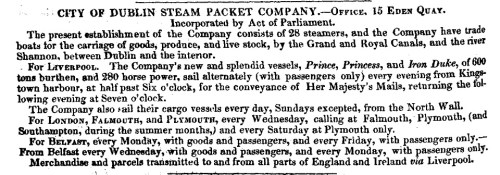
From the Dublin Almanac of 1845
The company crest is said to be still on the wall. Abbey Street Old seems to run between the two premises; no doubt there will be some means of avoiding any problem.
I wish the Abbey Theatre well in its extension, but I hope it will find some way of honouring the memory of the City of Dublin Steam Packet Company and of the underrecognised Charles Wye Williams.
Posted in Ashore, Built heritage, Charles Wye Williams, Economic activities, Engineering and construction, Industrial heritage, Ireland, Irish waterways general, Operations, People, Restoration and rebuilding, Shannon, shannon estuary, Sources, Steamers, The cattle trade, Tourism, waterways
Tagged Abbey Theatre, Charles Wye Williams, City of Dublin Steam Packet Company, Dublin, Eden Quay, estuary, Fergus, Grand Canal, Ireland, Irish Sea, Shannon, steam, steamer, waterways, workboat

 Irish waterways history