Category Archives: Irish waterways general

British power

The Sunday Business Post [paywall] reports that a British energy firm called SSE plc [formerly Scottish and Southern Energy plc], which already owns Airtricity, intends to buy Endesa Ireland. SSE’s press release is here.

Endesa owns the power stations at Tarbert, on the Shannon Estuary, and Great Island, at the junction of the Barrow and Suir estuaries; both are covered on this website. Endesa also owns a power station at Rhode, near the Grand Canal, and one in Co Mayo. It seems that SSE will also acquire options on sites at Lanesborough and Shannonbridge.

Lagan Navigation: Ballyskeagh High Bridge

A brief account here, with some photographs and some thoughts on the design of the locks of the Lagan Navigation.

Issalon kwahi *

Watery news from the Guardian.

That is, of course, the Nenagh Guardian, not that other provincial stalwart the Manchester Guardian.

Four items in the issue of 2 June 2012 caught my eye.

First, the members of the Nenagh Canoe Club have been cleaning up … the Nenagh River, a laudable endeavour.

Second, a community project in Ballina (Killaloe’s oppo) “will see a new jetty with a thirty-year lease built on the site of the old Lakeside Marina”. The paper says that …

[…] Jim Watkins, Eoin Little and Cllr Phyll Bugler of “The Friends of the Lake” have now initiated a project, which will be funded by Leader.

I have no idea what it’s for; I would welcome more information about the project and about the Friends of the Lake, whereof I know nothing.

Third, the Lough Derg Marketing Strategy Group (which god preserve), which is coordinated by the  Mid West Regional Authority (who knew?), is holding meetings about signposts. What would be really nice, though, would be if the MWRA took down the pic in its header showing adults and children in an open boat without lifejackets.

Finally, there’s a story about a proposed “fountain auditorium” planned for Birdhill [which was on the old N7, between Nenagh and Limerick, being chiefly famous for winning Tidy Towns competitions and being home to Matt the Threshers pub and eatery]. The “fountain auditorium” was, for reasons that are not entirely clear, to be a temporary operation, running until the end of 2016. It was to be located in a warehouse on the Shannonside Business Park (which is some miles from the Shannon).

The fountain auditorium was to have a pool 20m X 8m and “fountains capable of pumping water 9m into the air through more than 150 rotating nozzles”. The article says that

The proposed development is to serve as a tourist attraction centring on a fountain auditorium, in which audiences would be treated to pre-recorded shows marrying features of water, sound and synchronised lighting. The shows would have a “welcome to Lough Derg” theme, and the centre would provide visitors with information on the likes of walking and cycling routes, accommodation options, and food establishments, together with information on the history of Lough Derg.

It is not clear whether the words “fountain auditorium, in which” mean that the audience would be sitting in the pool or around it. The site was to have a “gift shop and café”. It expected to have 25,000 visitors in 2012 and 40,000 by 2016, after which it would move to permanent purpose-built premises with “a more comprehensive exhibition on Lough Derg”.

Alas! The proposed widening of the R494 road from Birdhill to Ballina, to serve the new bridge over the Shannon, would mean the loss of the space on which visitors’ coaches were to be parked. So, although the project received conditional planning permission on 16 May 2012, the promoters, Glance Promotions Ltd, withdrew their application shortly afterwards. However, that does at least suggest that they were not having any problem in providing the funding, which is good to hear in these difficult times.

* The relevance of the title of this piece will be clear to the many admirers of the oeuvre of the 4th Baron St Oswald.

 

Royal water

The Mullingar Advertiser discusses the Royal Canal water supply here. Some background info on this site here, here and here.

Government stimulus

According to the Irish Times:

Ahead of the summit later this month, Government departments have been told to draw up lists of capital projects with potential to create thousands of jobs for which funding would be sought if EU leaders agree on the package at the meeting to be held a week before polling day here.

Will DAHG be able to resist the temptation of suggesting the Clones canal? I’m sure that, since it discovered the project was going to cost almost one third more than it had originally believed, it has had teams of economists busily reassessing its, er, viability (and I’m expecting a visit from the easter bunny at any moment) so it will have its “business case” ready.

Still, there’s a slightly more cheering take on the matter here, where Michael Taft suggests that the government won’t be able to get much money for “stimulus”. I like the idea of using project bonds for the Clones Canal, though it might be hard to show that it qualified as “key strategic EU infrastructure in transport, energy and broadband” despite the Irish state’s delusions.

Heritage Council

The Heritage Council is now down wid da kidz in da hood, having acquired a facetweet page. Does this suggest that facetweeting is now becoming socially aceeptable? And it even has a YouTube thingie, where you can watch exciting videos of ministers making speeches.

Actually, the Heritage Council is becoming very with it, as the young folk say nowadays, aligning itself with the new reality that, unless it can show an economic payoff, its interests will be a low priority with the government.

You don’t need a weatherman to know which way the wind blows, comme on dit, or at least comme Mr Dylan dit.


Vlets

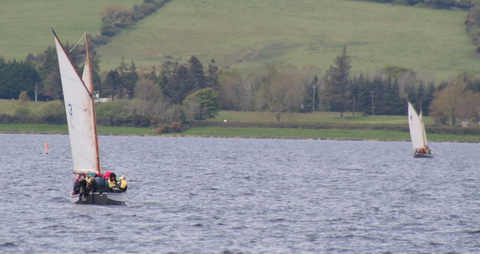
Vlets upstream of Killaloe

Skew arch bridges

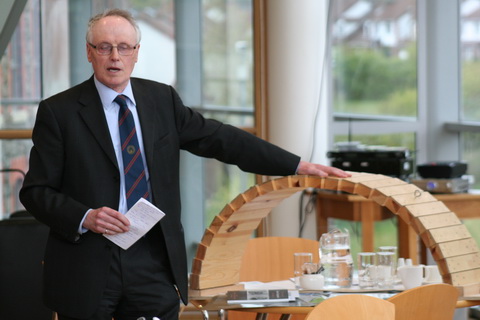
The IHAI AGM at the weekend, in Newtownabbey Borough Council’s splendidly restored Mossley Mill,  included a tour of the premises and its museum. Then Professor Adrian Long of Queen’s University Belfast gave a short talk about the FlexiArch bridge, which his team have been developing since the 1990s.

Professor Adrian Long with a wooden model of the FlexiArch bridge

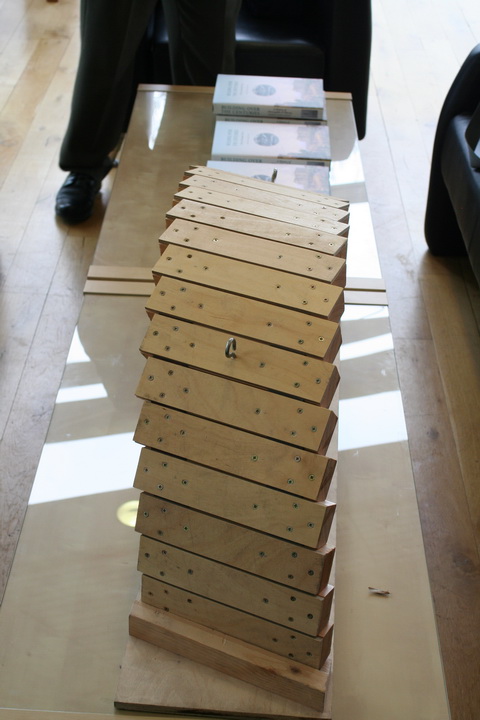
He said that their work started by asking why nobody built arched bridges any more; they developed a system that used pre-cast voussoirs (the wedge-shaped blocks) linked by a polymeric flexible membrane. The voussoirs for any bridge are cast to give the correct taper for the span and rise required for that bridge.

Arch rings arrive on site stowed flat on the back of a truck; when they are lifted off, they fall into the correct shape and are lowered into position on previously-installed footings. Each arch ring is 1m wide; several of them can be placed side by side to give whatever width is required. The end walls are added and the structure is filled and given the appropriate surface (eg tarmac).

FlexiArch is manufactured by Macrete of Toomebridge (beside Lough Neagh); their website shows several examples of installation including one at a name familiar on Irish waterways. There is a brochure [PDF] and there is a video showing the installation of a 15-metre bridge.

Wooden model as a skew arch

No, I haven’t any shares in it. I just thought it was interesting, for three reasons: first, the speed of construction is very impressive; second, there is a link to Lough Neagh; third, it might encourage the construction of more skew arch bridges over canals.


Royal water

Here is a page about feeders to the Royal Canal. My confidence in the accuracy of this list is low, so comments would be welcome.

Grand water

Here is a page about the feeders that supplied water to the Grand Canal. There will soon be a page about the Royal Canal feeders; these will lead to an examination of the current and proposed supply of water to the Royal.