Category Archives: Irish waterways general

Commenting on waterways budgets

DCAL writes:

Following the Executive’s Draft Budget, the Department of Culture, Arts and  Leisure (DCAL) published a consultation paper on its own spending and saving proposals over the period 2011-15 on 31 December 2010. The public consultation period on these ran in tandem with the wider consultation on the Executive’s Draft Budget.

The document records all the representations it received about specific business areas. So which body was the only one to make a representation about the budget for Waterways Ireland?

The Royal Society for the Protection of Birds, which

Supported the continued funding of Inland  Waterways and Inland Fisheries.

DCAL, DAHG and WI

I was interested to see that DCAL has its own research programme [DOC file], but also makes use of other research services including the NI Continuous Household Survey:

To monitor engagement in culture and sport in Northern Ireland

The Continuous Household Survey (CHS) and the Young People Behaviour and Attitudes Survey (YPBAS) will continue to monitor engagement in sport, arts, museums and libraries in Northern Irelandfor adults and children. The CHS will also capture engagement by people in Northern Irelandat fisheries and waterways under DCAL’s control as well as engagement in Irish and Ulster-Scots languages and events. The barriers and benefits to engagement will also be explored.

DCAL and non-navigaBLE Waterways

I don’t know whether “waterways under DCAL’s control” are deemed to include those managed by Waterways Ireland as well as those directly controlled by DCAL:

The Department also has ownership of, and custodial responsibility for, those remaining sections of the Lagan and Coalisland Canals that remain in Government ownership following abandonment of navigation in the 1950s. An ongoing programme is in place for each of these highly popular towpaths to upgrade access for pedestrians, cyclists and disabled access.

I don’t suppose it would make much sense to ask questions about just two derelict waterways while ignoring those that are navigable, but the results are not shown on the CHS web pages: interested folk must ask DCAL direct.

I note that the DCAL Resource Accounts for the year ended 31 March 2011 [PDF] show that DCAL “Estimates provided for expenditure on […] certain inland waterways (including payments to the Rivers Agency), Waterways Ireland, […].” Later, we read:

Inland Waterways

DCAL manages and maintains 11 miles of the Lagan Towpath from Stranmillis to  Sprucefield; 3.5 miles of towpath at Soldierstown, Aghalee; 4.5 miles of towpath on the  Coalisland Canal; 22 water recreation sites; and shooting rights over the foreshore of Lough Erne. Work on the development of a policy on the re-opening of abandoned canals is in the preliminary stages.

Given that DCAL can own and run waterways, I wonder why the supporters of the Newry Canal did not seek to have it taken over by DCAL rather than by Waterways Ireland.

Water recreation

The non-navigable waterways are the second of DCAL’s three main activities. The first is this:

We are committed to developing the recreational potential of inland waterways through our Province-wide Water Recreation Programme.

Applicants, such as Local Authorities, are encouraged to work in partnership with the Department in providing and promoting water recreation facilities such as riverside paths and boat moorings for public use. Wherever practicable, works will incorporate disabled access facilities.

Again, the DCAL Resource Accounts for the year ended 31 March 2011 [PDF] provide more details:

Inland Waterways

[…] The Department continued to administer an annual Water Recreation Programme, amounting to £430k in 2010-11, aimed at developing the recreation and navigational potential of Northern Ireland’s Inland Waterways. Applicant organisations, primarily local authorities, were encouraged to work in partnership with the Department in the provision of water recreation facilities, such as riverside paths and canoe trails, complementing the Department’s continued commitment to upgrading the Lagan and Coalisland Canal towpaths for shared pedestrian and cyclist use. 9 new projects were completed during 2010-11. Funded projects were required to have an identifiable strategic value and where possible, contribute to the Department’s commitment to provide at least 5 kilometres of new or improved access for disabled persons each year.

This too would cover cooperation with the four local authorities who control the Newry Canal.

Oddly enough, inland waterways and fisheries are grouped together on DCAL’s website but they are in two separate divisions: waterways, for some reason, are in Culture whereas inland fisheries come under Sport, Museums and Recreation. DCAL does not, however, put waterways under southnorthery.

DCAL and DAHG

There is a useful contrast here with DAHG, which thinks that waterways exist purely to serve northsouthery: despite what WI thinks it is for

Waterways Ireland has responsibility for the management, maintenance, development and restoration of inland navigable waterways principally for recreational purposes.

… DAHG does not appear to have adopted the view that waterways are for recreation. Perhaps if it gained responsibility for some waterways outside WI’s scope, it would develop a policy on recreational use of waterways. That would mean that, like DCAL

The Department is also the sponsor department in Northern Ireland for Waterways Ireland which is the Cross-Border Body responsible for the management, maintenance, development and restoration of operational waterways throughout the island of Ireland.

… DAHG would be the department responsible for recreation on waterways, one (large) set of which are managed by WI, which in turn is controlled by the two departments.

The difficulty with DAHG’s current arrangements is that there is a division between theory and reality, but DAHG has organised its functions on the basis of theory. In reality, waterways are for recreation (or, if you prefer, leisure), but DAHG insists that they’re for northsouthery. Because that’s now been successfully routinised, waterways receive relatively little attention and are not, as far as I can see, considered as part of state provision for leisure or recreation. There can be no proper policy-making for the sector unless it’s grounded in reality.

More on WI’s non-houseboat policy

A year ago, in March 2011, I wrote about Waterways Ireland’s attempt to reorganise the liveaboard boats on the Grand Canal at Sallins. That attempt ultimately failed, and WI’s provision of houseboat moorings at Shannon Harbour was likewise unsuccessful: usually reliable sources tell me that two spaces have been allocated, but to non-residential boats.

Amongst the concentrations of boats parked on the Grand Canal (most of them disregarding the five-day rule), the proportions of residential boats are [I think: I know of no reliable statistics] higher at Hazelhatch and Sallins, both at the eastern end, rather lower at Lowtown and lowest at Tullamore and Shannon Harbour.

It seems that WI’s focus has shifted away from the residential boats, which it tried to tackle last year, to the non-residential boats: it has recently issued Marine Notices warning that the five-day rule will be enforced at hard-edged [ie the best] moorings on Tullamore’s “spur line” and between the 35th Lock and Griffith Bridge at Shannon Harbour. However, no notices have so far been issued about Lowtown, Sallins or Hazelhatch.

I think WI is right to separate the residential issue from the parking, but it will be interesting to see what is planned for the eastern end of the canal.

Incidentally, all of this smacks of Kremlinology, trying to deduce policy positions from minor clues, and is necessarily speculative. It would be really nice if WI published policy proposals on its website, invited comments and then formally promulgated the final policies.


Monitoring Waterways Ireland

The Department of Culture, Arts and Leisure is the Northern Ireland department that shares with the Department of Arts, Heritage and the Gaeltacht the responsibility for two north–south bodies, one of which is Waterways Ireland. DCAL’s organisation is described here. And on this page, you can find the minutes of departmental board meetings.

In the minutes of the meeting held on 14 December 2011, we read:

6.0       N/S Bodies Governance (Arthur Scott) (DB 90-11)

6.1       Arthur Scott spoke to paper DB 90-11 which highlights the key differences between the DCAL Sponsorship Manual and the Financial Memorandum for N/S [North/South] Bodies and the challenges this presents for DCAL officials in seeking to draw appropriate levels of assurance for the DCAL Accounting Officer (AO).  The Board were asked to note the key actions being taken to address these challenges.  These included:

6.1.1   Ongoing work with Department of Arts, Heritage and the Gaeltacht (DAHG) to change the focus / nature of Waterways Ireland (WI) monitoring meetings.

6.1.2   Introduction of additional meetings between sponsor departments and the N/S Bodies to gain a better understanding of key issues and to be able to probe officials from the bodies about these.

6.1.3   A commitment by both AO’s to attend meetings about priority issues.

6.1.4   Briefing Ministers about key issues ahead of N/S Ministerial Council meetings.

6.2       The Board discussed governance and accountability arrangements and whether the Sponsorship Manual should apply the same way to N/S Bodies as it does with DCAL’s ALBs [arms-length bodies, I presume].  The Board agreed that the ALB Sponsorship Manual for DCAL, as it stands, should not apply to N/S Bodies.  Instead, a separate document is required with a starting point being the Financial Memorandum.

Action: Sinead McCartan to remove references to N/S Bodies from Sponsorship Manual.

6.3       Rosalie Flanagan said she would meet with her counterpart in DAHG, Joe Hamill, to discuss the Financial Memorandum and how DAHG draw their required assurances from it.

And in those for the following meeting, held on 21 January 2012, we read:

11.0    Quarterly Assurance Statements (Sinead McCartan – DB 7-12) […]

11.3    In relation to the delayed progress on the risk assessment exercise for N/S Bodies as highlighted on the Corporate Services Division QAS, Rosalie Flanagan confirmed that she has met with counterparts in the South and it is proposed that a new governance framework will be prepared for Ministers’ consideration.

Action:  Arthur Scott to incorporate the findings of the N/S risk assessment into the development of a new governance framework.

It seems that DCAL is pushing for tighter control over Waterways Ireland. If DAHG published its minutes [if it does, I can’t find them], we might be able to see what it feels about the matter.


Lough Derg water

The lake level seems to be down about a foot. Two rumours purport to account for this: either (a) the powers-that-be want us to get used to a new, lower level, so that we won’t notice when Dublin starts extracting water, or (b) the ESB is generating as much electricity as it can before it starts getting charged for water. Such charges would be covered by the same European Commission reasoned opinion as that mentioned here that might see Waterways Ireland being charged to fill the Grand, Royal and SEW.

Or, of course, it could just be that there hasn’t been much rain. According to Met Éireann’s seasonal summary for winter 2012 [two-page PDF]:

Majority of rainfall totals were below normal for winter across the southern half of the country and in some parts of the east. Rainfall totals were below average in the majority of these parts during December and January, while all stations reported dry conditions in February. Most stations the east and south reported a below average number of wetdays (days with 1 mm or more) and the driest winter since 2006 (6 years).

Ardnacrusha usually runs fewer turbines in summer.

How much Dáil time …

… is wasted in asking and answering questions over and over again? I’d have thought that Caoimhghín Ó Caoláin TD (Cavan-Monaghan, Sinn Fein) would have realised that the government has discovered neither oil nor a crock of gold and that there is no money for a canal to Clones. The task of finding some is to be delegated to an “inter-agency group”, poor dears. I’d have thought it might be better to give the job to people with experience of unconventional fund-raising; there must be some such people around.

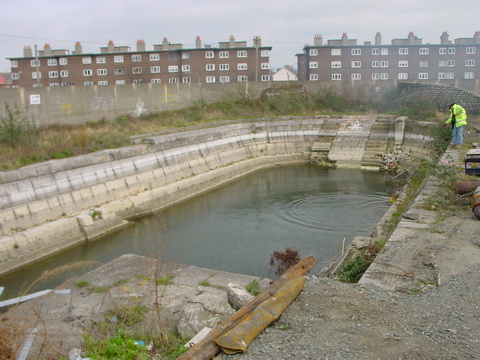
NAMA, DDDA and the Grand Canal Basin graving dock

One of the graving docks


Interesting contextual material from Nama Wine Lake here. IWAI Dublin Branch page on the graving docks here.

Public sector cutbacks

The Department of Arts, Heritage and the Gaeltacht, which is ultimately in charge of waterways, has published an organisation chart [one-page PDF]. It shows that the department has a minister and a minister of state and a secretary general.

At the next level down there are five main divisions:

  • Corporate Affairs
  • Arts, Film, Music, Cultural Institutions
  • Heritage
  • Gaeilge, Gaeltacht & Islands
  • Central Translation Unit & Placenames.

Each of the first three is headed by an assistant secretary; the fourth has a Director of Irish and the fifth a plain director. The department is spread between offices in Galway, Killarney, Wexford and four locations in Dublin.

So where, I hear you ask, are waterways looked after? We have to come down to the next level, the principal officers, to find out. And there, we find that Corporate Affairs has three POs, one of whom is responsible for

HR, Strategic Planning, Corporate Governance, N/S Co-ordination & Waterways Irl.

That’s quite a lot of things for one person to be responsible for.


Date

Killaloe & Ballina are having one of Waterways Ireland’s Discover Days on Sunday 29 April 2012.

Includes “visitor attractions, water activities, arts and crafts, face painting, live music, a historical walking tour, boat trips and other land and water activities”.

More info as it becomes available.

Barrow Corridor Study

The Barrow Corridor Study is now available on the Waterways Ireland — in twelve separate chapters, alas. Catering for folk with two-stroke modems is a good thing, but what about catering as well for those of us with broadband and pains in our mouses?