
Category Archives: Natural heritage

Royal water

The summit level of the Royal Canal has been closed until further notice because of shortage of water and the 34th and 35th levels have been closed until 20 April for emergency repairs. Marine Notices here, along with a general waarning about low water levels.

Met Éireann’s Monthly Summary for March 2012 [PDF] says:

Rainfall totals were relatively low for the time of year, with percentage of normal values below 50% in most locations. Mullingar [which is on the summit level of the Royal Canal] reported its driest March since 1961 (51 years), while most other stations reported their driest March in at least 7 years. Number of wet days recorded (days with 1 mm or more) was below average everywhere, with most stations measuring their lowest March maximum daily rainfall in seven to 39 years.

Can we have our normal weather back please? Or will that be coming in the “summer” months?
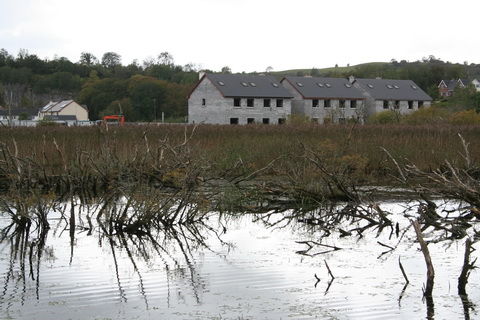
Lough Neagh

An interesting point.

On the occasion of Her Majesty’s Diamond Jubilee …

… (that is, of course, Her Late Victorian Majesty), F E Prothero suspended his explorations of Irish waterways after he had descended the Nore, from Abbeyleix to New Ross, in May 1897. Here is his account of that trip.

Prothero

This site includes several extracts from F E Prothero’s 1896 and 1898 accounts of small-boat trips on Irish waterways. This short page shows what I know about Mr Prothero; I would welcome further information.

Waterways trees

Nama to Nature has been planting trees at Keshcarrigan on the Shannon–Erne Waterway, along which far too many developers wanted to sell houses that would have fast boats parked outside. I don’t know whether my photo shows the Waterways estate or a different one.

Keshcarrigan September 2011


h/t Ireland after NAMA.

Weed

I said recently that the water level on Lough Derg was low, as a result of a dry winter. Barge Hawthorn now reports that the weir at Clondra (Cloondara) is dry and Waterways Ireland has now issued a Marine Notice (23/2012: not yet on the WI website, but it may be there by the time you check) saying:

Waterways Ireland wishes to advise all masters and users of the Erne System that following a period of dry weather the water levels on Lower Lough Erne are below those normally experienced at this time of year.

WI Conver weed boat (and dinghy) in dry dock at Shannon Harbour

Reliable and authoritative sources tell me that the water levels in themselves are not the only problem. The dry, warm winter is likely to encourage the growth of weed, especially on the shallower waterways, including the canals and Upper Lough Erne. It seems that chemical methods can no longer be used so mechanical cutting and harvesting is the only method available. That means machinery and manpower. And with reduced resources, it’s going to be hard to keep the weeds down.

It may be wise to practise a rain dance.

Polluting the water

Mr Hogan said he had been negotiating with the European Commission in 2011 and 2012 to minimise the impact of new septic tank regulations.

That’s from this article in the Irish Times.

Why does this chap want to minimise the impact of his own department’s regulations? Is he not at all interested in water quality?

Angela, would you mind invading please?


Sunset on the Lower Shannon

A poem by Sir Aubrey de Vere, father of the more famous Aubrey Thomas de Vere. The family estates were at Curraghchase, now a forest park, on the south side of the Shannon estuary and now best known as the home of Caroline Rigney, producer of some of Ireland’s best bacon. Sir Aubrey’s wife was one Mary Rice, of the Mount Trenchard family, one of whose members had a major role in the development of the Shannon in the 1840s.

Sunset on the Lower Shannon

How beautiful the tints of closing even!
The dark blue hills, the crimson glow of heaven,
The shadows purpling o’er the wat’ry scene,
Now streaked with gold — now tinged with tender green;
And yon bright path that burns along the deep,
Ere the sun sinks behind his western steep,
Soft fades the parting glory through the sky,
Commingling with the cool aerial dye;
While every cloud still kindling in the beam,
In mirrored beauty prints the waveless stream,
Light barques, with dusky sails, scarce seen to glide,
Bend their brown shadows o’er the glowing tide;
And hark! at intervals the sound of oars
Comes, faint from distance, to the silent shores,
Blent with the plaintive cadence of the song
Of boatmen, chanting as they drift along.
But see the radiant orb now sinks apace —
Gradual and slow, he stoops his glorious face;
And now — but half his swelling disk appears —
And now, how quickly gone! he scarcely rears
One burning point above the mountain’s head —
And now, the last expiring beam has fled.

Sir Aubrey de Vere in The Dublin Penny Journal Vol 1 No 17
October 20 1832

The “light barques” probably included some turf boats.

There are more poems by Sir Aubrey here.

Prothero on the lakes of Galway and Mayo

The oarsman F E Prothero did not reach the west of Ireland, so his account of the lakes of Galway and Mayo is based on guidebooks. Here it is.

Commenting on waterways budgets

DCAL writes:

Following the Executive’s Draft Budget, the Department of Culture, Arts and  Leisure (DCAL) published a consultation paper on its own spending and saving proposals over the period 2011-15 on 31 December 2010. The public consultation period on these ran in tandem with the wider consultation on the Executive’s Draft Budget.

The document records all the representations it received about specific business areas. So which body was the only one to make a representation about the budget for Waterways Ireland?

The Royal Society for the Protection of Birds, which

Supported the continued funding of Inland  Waterways and Inland Fisheries.