Category Archives: Non-waterway

Astonishing news

The Western Rail Corridor has attracted rather fewer passengers than the, er, “business case” proposed. Well I never. I wonder whether there is any news about the religious affiliations of the Bishop of Rome.

A recent enquiry had me revisiting my page about the Tralee Ship Canal, another major waste of public money.

But governments (or at least their civil servants) never give in: it seems that the present crowd is determined to build an unnecessarily lavish road in the United Kingdom. Perhaps it would be cheaper to move the Limerick–Galway railway line up there. [The Alternative A5 Alliance could add that idea to the Wikipedia entry on the A5, which doesn’t seem to reflect their views.]

While responsibility for waterways has moved from Craggy Island to the Department of Tourism, Culture and Sport, it is entirely possible that existing policies will be implemented. It’s impossible to have any confidence that reason will prevail and that the planned Clones Canal will be dumped, although I continue to hope that there is an influential economist somewhere in the department.

Meanwhile, the Clones Dudes are trying hard to get people to invest in waterways businesses: they organised visits to some of the surviving businesses along the Erne and the Shannon–Erne Waterway and they’re having a workshop on 23 June 2011 to tell people how to set up boat-repair, marina and water activity businesses.

Still, at least they’ve stopped referring to it as the Ulster Canal: they’ve now adopted the term Clones Canal, which suggests that they’ve accepted that the thing will never get beyond Clones. Perhaps there is a limit to the willingness even of Irish governments to waste public money (or ECB money) on pointless projects.


Transports of delight

While this site is about waterways transport, a railway or two has sneaked in, and so it may be permissible to mention road transport too. The transport museum at Howth is looking after as aspect of our heritage that the National Museum has ignored: the preservation of old road vehicles. Its collection includes commercial, passenger, military, utility and fire & emergency vehicles, and the museum needs (and deserves) support.

The National Museum

Why at least three quarters of its items should be dumped.

The Broadstone pontoon

On my page about the Broadstone Line of the Royal Canal, I say this:

In 1845, the Midland Great Western Railway Company (MGWR) bought the Royal Canal. Doing so allowed it to run its lines beside the canal, which it did most of the way to Mullingar, without having to conduct lengthy negotiations about wayleaves with individual landowners. The company built a terminus at the Broadstone, with a pontoon bridge (which was moved out of the way when boats entered or left the harbour) to provide passengers with access to the station.

I have found a picture of the arrangement. Here it is.

The Broadstone, from The Tourist's Illustrated Hand-Book for Ireland 3rd ed David Bryce, London 1854

The pontoon looks rather solid, but there is a canal-boat heading for it and the canal clearly continues on the far side.

I have added the pic to the Broadstone page.

Fry’s Irish delight

Railway heads may wish to boogie on over to this site to look at a fifteen-minute video of the Fry Model Railway, which is to be evicted from its home at Malahide Castle.

The National Museum thinks saving the Fry isn’t really quite its sort of thing; no doubt it’s busy with its collection of frocks. It appears to possess one model steam railway locomotive; it has no steam engine, no diesel engine, but lots of stamps and coins.

The Fry includes some waterways items.


Kensal Green

The way to Paradise.

Diesel, gas, turf or battery?

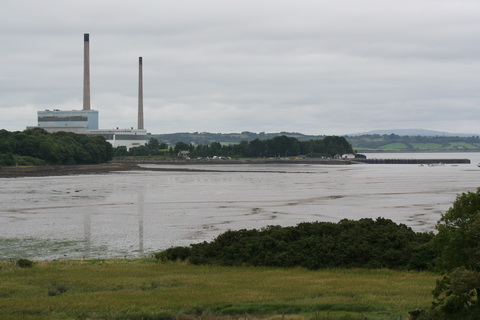
The Irish Times tells us that Endesa, a Spanish company, intends to sell its Irish operations. They include two water-side sites, at Great Island in Co Wexford and Tarbert in Co Kerry, as well as a near miss in Rhode, Co Offaly, and a fourth in Co Mayo.

The Great Island power station on the Suir opposite Cheekpoint

The Irish Times says that Endesa had intended to change Great Island and Tarbert from diesel to natural gas. The Tarbert project received planning permission in December 2010; the Irish Times report was probably inaccurate in suggesting that a submarine cable from Tarbert would supply the ESB generating station at Moneypoint which, being a generating station, would be able to generate its own.

The old Tarbert power station

However, I had heard that Tarbert might have received its natural gas from the proposed storage plant at Ballylongford, near Saleen Pier whence Trinity College turf was sent to Limerick. A pipe from Tarbert might have supplied Moneypoint. I don’t think construction has yet begun.

The old Tarbert power station was built on the site of the Tarbert battery, the largest of the six Shannon estuary batteries and the only one to mount seven guns.


Saving the banks

The banks, the Fergus and the lost island of Islandavanna.

RVRC

It is necessary to draw public attention to a lamentable case of discrimination in Irish public policy and to announce the formation of a group to combat that discrimination and to ensure equal treatment for all.

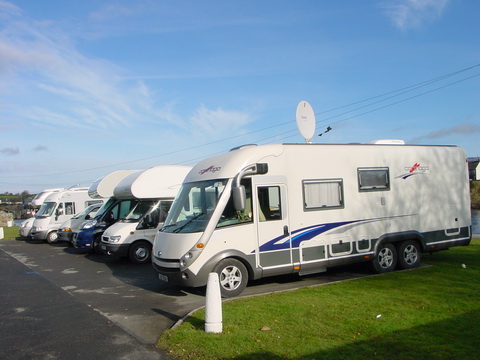
Suppose you like travelling around Ireland in a white plastic whatsit. You need places to park, preferably free, with something nice to look at. You need services like toilets, showers, water and rubbish bins. You like to park close to fellow travellers and to meet them, perhaps for a barbie and some beer.

Your whatsit is well equipped with television and other entertainment; indeed the general standard of furnishing and equipment is very high. You can even carry toys — perhaps a dinghy and some bicycles — around with you, for some fresh air and exercise when you’ve reached a suitable place.

If your white plastic whatsit floats in water, you have the services of a cross-border implementation body, Waterways Ireland, spending millions (and charging practically nothing) on your leisure activities. You have government departments north and south looking after you, with the southern department keen to spend money borrowed from Germany on providing you with more places to go. And you have all sorts of other free services, like Coastguard and lifeboats, to help you out.
White plastic whatsits at Portumna Castle Harbour

If your white plastic whatsit has wheels, though, you are a pariah. You have no cross-border boy, no government departments, no free services, although your needs are the same as those of your boating brethren.

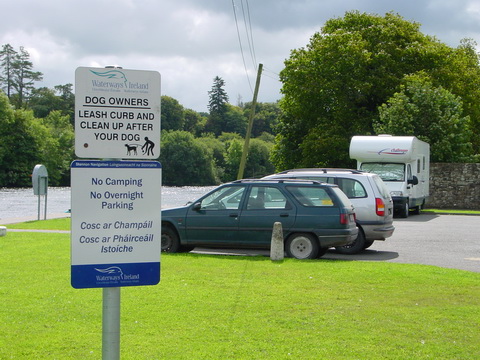
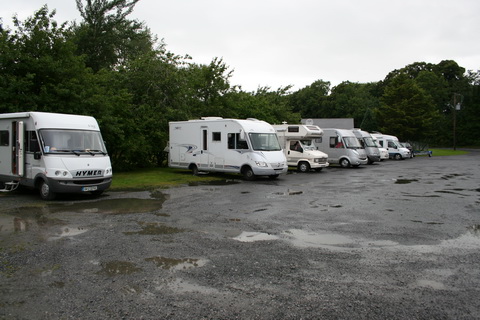
So owners of RVs (recreational vehicles, camper-vans, what you will) are forced to sneak in to Waterways Ireland harbours and to park inconspicuously along the edges. The best place to park is usually indicated by a sign.

Sign showing where to park at Killaloe

Parked beside Killaloe market

RVRC, the Recreational Vehicle Rights Campaign, seeks an end to this discrimination. We seek the provision of free facilities for camper-vans. We want a cross-border body of our own, RVways Ireland.

We have adopted Dana Lyons’s song RV as our anthem; you can listen to it free here (and while you’re at it see the animations of his best-known song here).

The Clones Canal

And this brings us, by a commodius vicus of recirculation, to Clones and the Craggy Island Canal. Boaters may like to see themselves as hardy mariners, sons of the sea who happen to be confined to inland waters, but economically they’re very similar to RVers. Many of them are older couples but some travel with children. They like going for weekends away; they need certain facilities; they don’t use hotels, B&Bs or other accommodation. They have enough equipment and supplies to prepare their own meals, but they do some shopping and may go to the pub or have a meal out.

As potential bringers of wealth, RVers have some advantages over boaters. You don’t have to spend €35 million to get them to your town; they are more mobile, so they’re not confined to a single site in the town; they can even park some distance outside and still get to the shops, pubs and restaurants. And RVers are hardy souls: in late February 2011 there was not a single boat in Portumna Castle Harbour but there were four RVs.
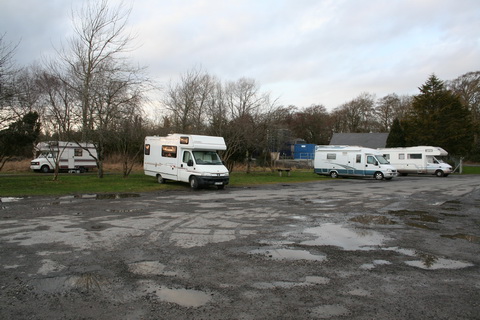
RVs in Portumna in February

So, given that Clones is an attractive destination, why is the Regeneration Partnership not now trying to attract camper-vans (and indeed campers and caravanners)? According to Discover Ireland, there is no caravan or camping site in Co Monaghan (although there could be sites whereof Discover Ireland is ignorant).

There are two points to this query. The first is that Clones could be doing something now to attract visitors, without waiting for Craggy Island to come up with €35 million. The second is that (assuming the blasted thing is ever built), after the excitement of having a canal dies down, Clones will have to do things to attract visitors. So why not start now?

The upper Barrow

Charlie Horan (of Go with the Flow, the canoe expedition specialists) left a comment on my post about Abbeyleix (below) saying

I have some very very interesting pictures of the Barrow near source in flood taken just two weeks ago ….

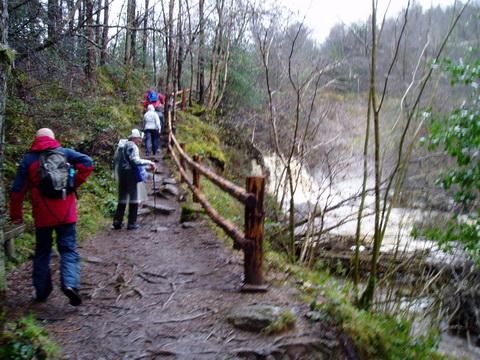
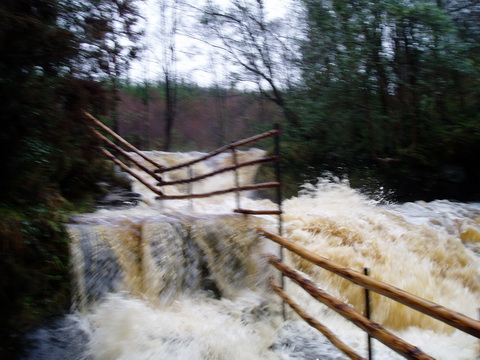
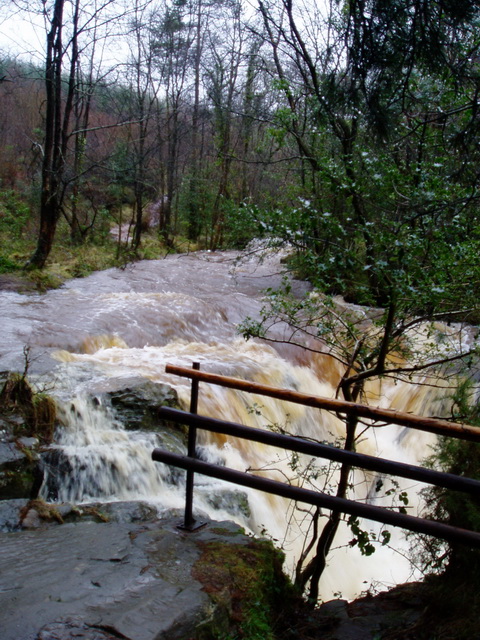
And here they are. They are indeed interesting!

White water (courtesy Eamonn and Charlie Horan)

Eek (courtesy Eamonn and Charlie Horan)

The burling Barrow brown (as Gerald Manley Hopkins called it) (courtesy Eamonn and Charlie Horan)

Even the indefatigable F E Prothero might have been put off …. He canoed down from Mountmellick to Athy in 1897, taking about eight and a half hours. Major Rowland Raven-Hart said that the Barrow had been canoed from a little above Portarlington (which is downstream of Mountmellick); there is a PDF of his book here.