Category Archives: Operations

Wasting sewage

An inquest has recently been held in Limerick, on the bodies of three seamen; and the jury gave a verdict, founded on the evidence of seamen and medical men, that the deaths had been caused by drinking the water of the Shannon, which the drainage of gas works and the common sewage had rendered poisonous. We trust that this unfortunate event, will induce the authorities of Limerick to take measures for applying sewage to the legitimate puspose of manuring the ground, instead of allowing a valuable material to go to waste, and to poison the waters of their river.

The Artizan July 1846

Fatal incident Lough Derg August 2012

On the morning of 2nd August 2012, Mr Patrick Danaher purchased fuel for his powerboat at New Line, Killaloe. That evening, the boat was seen floating partially submerged and overturned with the bow out of the water near Youghal Bay, Lough Derg. The boat had struck submerged rocks at high speed and suffered major damage to the outdrive allowing the free ingress of water into the boat. The boat was recovered that evening and Mr Danaher’s body was recovered from the lake the following day.

The Marine Casualty Investigation Board’s report is available here [PDF].

DUKWs and lifejackets

On 31 October 2013 I mentioned the UK Marine Accident Investigation Branch’s safety bulletin about the DUKW fire in London and the DUKW that sank in Liverpool. There is more on the London fire today with a Guardian report on proceedings at the London assembly’s Thames passenger boat investigation committee. The Guardian headline read …

Duck boat passengers not wearing lifejackets when jumping into Thames

… and the story reported the Maritime Coastguard Agency’s maritime safety and standards director as saying that wearing of lifejackets would not have been usual on “such boats” and that lifejackets were safely stowed above the seats. The story also said that

London Duck Tours’ managing director, John Bigos, said the Cleopatra had the required legal number of lifejackets on board and that it was company policy that lifejackets were not worn on tours. He went on: “We have our reasons for this (non-wearing) but they are not to do with commerciality.”

There is a different policy in Ireland, where the Dublin Viking Splash operation says

Lifejackets: At the water entry point, customers are required to put on a lifejacket after the driver delivers an outline about safety on the water. The lifejackets supplied by Viking Splash Tours are Solas and CE approved buoyancy aids […].

The point that strikes me is that, in both UK accidents, passengers had little time to don lifejackets and would have been trying to put them on in a confined space and under less than ideal conditions. It seems to me that Viking Splash’s policy is the right one.

Lusmites rejoice

P J Norris commented here on the need for a walkway across Meelick Weir. The excellent KildareStreet.com tells us that the drought will end, as a Dáil written answer on 22 October 2013 showed.

Michael Kitt [FF, Galway East] had asked the Minister for Arts, Heritage and the Gaeltacht

… when it is proposed to reopen the walkway which spans the weir on the River Shannon in Meelick, County Galway; if funding has been provided for this work; if his attention has been drawn to the fact that this is an important local and tourist amenity; and if he will make a statement on the matter.

Jimmy Deenihan [FG, Kerry North/West Limerick] said

I am informed by Waterways Ireland that it is currently preparing a submission for planning permission to construct a new walkway over the River Shannon at Meelick. Indeed, environmental studies are underway to support the planning application.

I must advise the Deputy that construction work may only commence when all necessary permits have been received. It is Waterways Ireland’s intention to undertake works at the weir during 2014, subject to the appropriate statutory approvals being granted and financial resources being available.

Financial resources, eh? Perhaps a coin- (or note-)operated toll-gate on the walkway would be best.

The cost of boating …

in the Americas. Maybe such inspection and decontamination charges would help Waterways Ireland to enforce the guidelines in its bio-security advice document [.docx].

London Docklands

Big it up for the Museum of London Docklands, near Canary Wharf. You can go there on the DLR, always a bonus, which will counteract the queasiness you feel at proximity to a large number of bankers, accountants and lawyers.

Apart from any temporary exhibitions, the Museum offers a chronological account of the ports of London from Roman times to the present day; you start on the third floor and work downwards. The timeline anchors the narrative, but there is no attempt to pretend that there is a single uncontested history: conflicts over slavery, dock labour schemes and modern redevelopment are all presented, using a mixture of text, displays of artefacts large and small, models, paintings, audio and video. Easy to spend several hours there; the Docklands at War section was particularly interesting.

And if you have time afterwards, nip around to The Grapes for bangers and mash (£6.50) [or whatever you like] and a pint of Timothy Taylor’s Landlord, which (weather permitting) you may be able to consume on the balcony overlooking the Thames, with the shingle below on which the mudlarks worked, while you remember all those Conrad novels and sing “Sweet Thames flow softly” .

Fun for anoraks

Lots of info on the WI website:

I liked the bit on this page:

Enforcement

Boats in non-compliance with the bye-laws will enter an enforcement process. Enforcement is undertaken by Authorised Officers and will begin with a notification in the form of a sticker and if non-compliance continues may result in the ​craft being removed from the navigation at the owners cost.

I wonder about investing in a crane company.


Like the Mary Ellen Carter …

rise againJust a few weeks ago the depth was around 1.7m at Athlone weir, about 7″ above the navigational minimum. But today the depth is over 2.4m and, with staff gauge zero at 35.360m above Poolbeg datum, the water level is 37.760 m above Poolbeg datum.

DUKWs

In June 2013 I reported on the sinking of a DUKW in Liverpool, the second of the year, and in September on the fire aboard a DUKW in London. Oddly enough, it seems that the two accidents had a common element: the foam added inside the hulls to improve buoyancy.

The UK’s Marine Accident Investigation Branch has found that the DUKWs in the Liverpool fleet had not been fitted with enough foam to provide 110% buoyancy, enough to keep the vessel afloat when flooded. MAIB’s tests on the Liverpool vessels

… raised serious questions about whether the operators of DUKWs could fit sufficient foam internally to comply with the current requirement for 110% buoyancy without compromising the safe operation and the practical day to day maintenance of these vehicles.

The “safe operation” part affected the London vessels. In July 2013, a DUKW had to be towed in after a drive shaft universal coupling failed when it overheated and ran dry of lubrication: engine bay temperatures were too high because of the volume of foam inserted. And a report commissioned by the London Fire Brigade into the September fire concluded that:

… the most likely cause of fire was the action of the rotating drive shaft (or other moving parts) on the oil contaminated surfaces of the buoyancy foam blocks.

MAIB has issued a safety bulletin [four-page PDF] with this conclusion:

The MAIB identified significant difficulties in fitting a DUKW with the volume of foam required to meet the buoyancy standards set out in MSN 1699 (M). Further, the nature of these old amphibious vessels, specifically their weight in relation to their size and the complexity of their propulsion arrangements, makes it difficult for operators to comply with the standards applicable to more conventional craft by solely using internal foam buoyancy. An alternative standard, ensuring that DUKWs have the necessary level of damage survivability, therefore needs to be established if they are to be operated safely.

It has recommended that the Maritime and Coastguard Agency should

… ensure that the means used by DUKW operators to achieve the required standard of buoyancy and stability for their vessels does not adversely impact on their safe operation. Furthermore, these vessels should not be permitted to operate until satisfactory levels of safety can be assured under all feasible operating conditions.

The Maritime and Coastguard Agency’s website doesn’t seem to be working, but there is a BBC report here quoting an MCA person as saying

We will not be permitting the vessels to operate until we are satisfied that the necessary safety measures have been achieved.
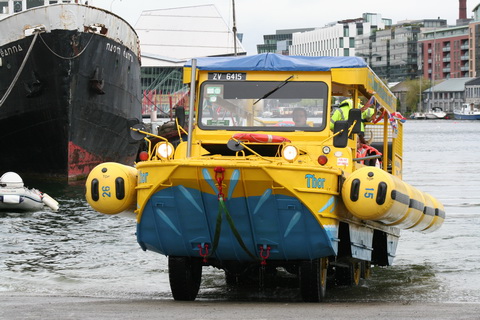
VikingSplash DUKW in Dublin

VikingSplash DUKW in Dublin

All of this may help to explain why the VikingSplash DUKWs operating in Dublin are fitted with additional external buoyancy.

Sailing up the Liffey (not)

While in Blighty I read a brief but entertaining piece in [HM] Independent newspaper [a piece that doesn’t seem to be available online] saying that the Sean O’Casey pedestrian bridge, which spans the Liffey in Dublin, cannot be opened because the remote control has been missing since 2010.

The story doesn’t seem to have had much coverage in Ireland, but The Journal seems to have originated it; it has been picked up by MSN and there is discussion at boards.ie, although I don’t know that many people will be inconvenienced by the inability to get tall vessels into a relatively short stretch of water.