Category Archives: People

Clare hurling

The hurling matches, called goals, are very injurious to the morals and industry of the younger classes; after performing feats of activity, that would astonish a bread and cheese Englishman, they too often adjourn to the whiskey-house, both men and women, and spend the night in dancing, singing, and drinking until perhaps morning, and too often quarrels and broken heads are the effects of this inebriety; matches are often made between the partners at the dance; but it frequently happens that they do not wait for the priest’s blessing, and the fair one must apply to a magistrate, who generally obliges the faithless Strephon to make an honest woman of her.

Hely Dutton Statistical Survey of the County of Clare, with observations on the means of improvement; drawn up for the consideration, and by direction of the Dublin Society The Dublin Society, Dublin 1808

Plus ça change …?
The crimefighting Shannon steamer

Limerick, May 26. This morning the Lady of the Shannon steam yacht towed up, in grand style, the Fox cutter, captured by the Vandeleur Revenue cruizer, Capt Hopkins, as stated in our last. She lies at the Custom-house quay, is a very fine vessel, clinker built, pierced for eight guns, which were thrown overboard, in chase, and is remarkably well found. Her cargo is supposed to consist of 1000 gallons of highly rectified Geneva, in 10 gallon casks — 20 hogsheads of tobacco, in bales and half-bales — and a large quantity of teas — amount not yet ascertained.

Public Ledger and Daily Advertiser 5 June 1818 [quoting Irish Papers]. From the British Newspaper Archive run by Findmypast Newspaper Archive Limited, in partnership with the British Library.

Eccentricity by steam

Folk interested in eccentric early steam inventions, such as that described on my page about chain haulage, might also be interested in the invention of Captain George Beadon RN, as described on the invaluable Grace’s Guide site.

Her late Majesty Queen Victoria, by the Grace of God of the United Kingdom of Great Britain and Ireland Queen, had the foresight to acquire a photograph of Captain Beadon’s vessel and to make it available on tinterweb.

Captain Beadon’s route to London took him through Keynsham: that’s K-E-Y-N-S-H-A-M.

Tralee Ship Canal

The principal export trade of Tralee is in grain, cattle, and pork; they are sent to Cork by land. The harbour is exceedingly bad and dangerous, and, at the time of my visit, a ship-canal was in process of cutting from the bay. By some men of intelligence and experience, a railway was considered preferable.[1]

[1] Jonathan Binns The Miseries and Beauties of Ireland Longman, Orme, Brown and Co, London 1837

Mr Mullins’s steamer

Here is a little information about the steamer Cupid, which was owned or used by the contractor Bernard Mullins on the Shannon in the 1840s.

A Grand Canal mystery

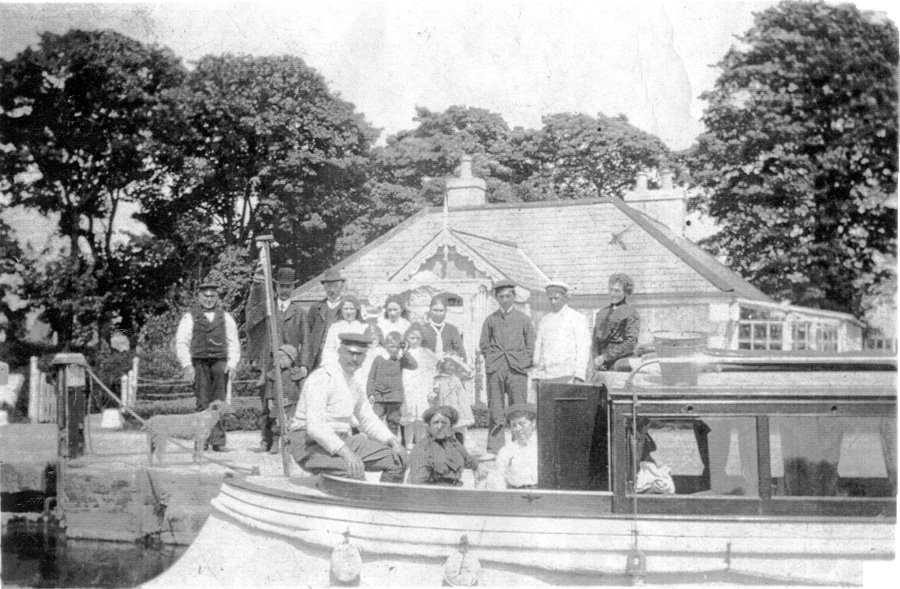
Passenger boat over lock1

Boat at Lowtown

Alan Lindley has very kindly sent me, and permitted me to publish, this photograph.

It was taken at Lowtown lock, on the Grand Canal, in 1911 or 1912.

Alan says that the man on the left of the group — with cap, waistcoat and watch-chain, and with a dog standing in front of him — is the lock keeper, Murtagh Murphy, the great-grandfather of the present incumbent, James (Jimmy) Conroy. Murtagh was born in Ballycowan, near Tullamore, Co Offaly, in 1849 and, after working on a Grand Canal Company boat, married a Kildare girl and took the job at Lowtown.

The boat had been described as a passenger flyboat but, as the Grand Canal Company had ceased carrying passengers in 1852, that seems unlikely. And the boat looks much more like a pleasure vessel than a working boat.

If the Grand Canal Company had an inspection launch, this might be it, but I have found nothing to indicate that it did. The boat does, though, seem to have been designed for canal travel: it seems (from the twenty feet or so we can see) to have straight sides and to be well equipped with fenders. It might therefore have been designed to travel on the canals (as well as on other waters).

At least one director of the Grand Canal Company, Henry Samuel (aka Harry Samuel) Sankey, of Fort Frederic, Virginia, Cavan and of 64 Wellington Road, Dublin, did have a launch or pleasure craft on the canal, the Aja, which you can read about here. Incidentally Mr Sankey, who died on 5 December 1925, directed “that no Roman Catholic shall take any benefit” under his will.

Further information about the boat and the people shown in the photograph, and about Mr Sankey’s launch, would be very welcome; please leave a Comment below.

The disappointed steamer

For one brief moment it seemed that the humble steamer Ballymurtagh might have a glittering future as a passenger vessel. Alas, it was not to be.

FPP (lapsed)

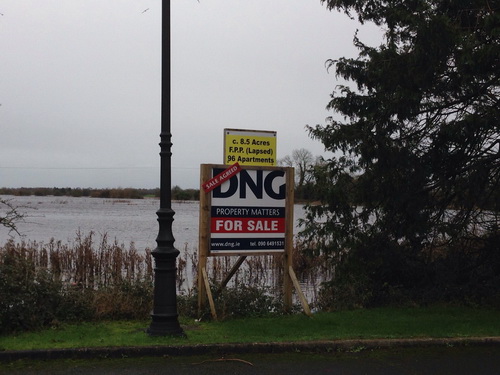
I mentioned flooded fields, zoned for housing, here. Michael Geraghty has very kindly sent on this photo, taken recently in Athlone.

Athlone Michael Geraghty 01_resize

FPP (lapsed)

How nice to have a waterfront apartment. Though it may be a bit much to have it waterback, waterside, watertop and waterbottom as well.

If there is an award for sales skills amongst auctioneers, I wish to nominate Messrs DNG.

For certain values …

In the Irish Times of 5 January 2016 Fintan O’Toole has an article headed “Genuine local democracy part of the solution to flooding“. He points out that

  • in 2004 the Irish Times property supplement showed a photograph [we are not told whether it was part of an ad or advertorial or of a critique of property development] showing a sign advertising for sale a flooded field that had been zoned for residential use
  • in 1997 a resident of Clonmel detailed how the town’s natural flood defences had been destroyed
  • in 1999 a man in Ennis blamed the flooding of his house on the granting of too many planning permissions
  • in 2000 3500 Clonmel residents objected to building on flood plains
  • nitwitted local councillors didn’t care.

He concludes that

As flooding gets worse, we will have to spend enormous amounts of money on engineering solutions. But in fact one part of the solution doesn’t cost any money at all. It’s called listening. Or, to give it its political title, it’s called genuine local democracy. Top-down, very expensive technocratic measures may have to be part of the response. But they will only work in a political culture that has eyes to look at the land and ears to listen to what people know about it.

Well, up to a point, Lord Copper. The article provides no evidence that a majority of the citizens — in any local authority area, Dáil constituency or other political unit — shares the erudite and enlightened views of those who write letters to, or columns in, the Irish Times. In fact, given that the citizens have, over more than one hundred years, continued to elect large numbers of nitwits to the local authorities and, for almost a century, to the Dáil, it seems unlikely that democracy — genuine, local or otherwise — will ever produce the right answers.

Which may explain why so much power now resides elsewhere, in the hands of experts and courtiers, and why elected representatives are reduced to throwing the occasional tantrum, providing tea and sympathy and making empty promises that then come back to haunt them.


Managing the Shannon

Sometimes you have to wonder about politicians and their grasp of reality. Take, for instance, young Mr Adams, Sinn Féin TD for Louth. There he was in the Dáil the other day, talking about flooding on the Shannon, and saying (amongst other things):

No single agency is responsible for the management of the River Shannon. Will the Taoiseach give full responsibility to the OPW for management of the Shannon?

Can Mr Adams have forgotten that, under the Good Friday Agreement, a cross-border implementation body called Waterways Ireland, reporting jointly to the Minister for Fairytales in the republic and the Minister for Marching Bands [a Sinn Féin MLA] in Northern Ireland, is responsible for navigation on certain named waterways including the Shannon?

Giving the Office of Public Works full responsibility for the management of the Shannon would require renegotiation of the Good Friday Agreement [and perhaps some later agreements]. I gather that the members of HM Devolved Administration in Northern Ireland delight in doing that sort of thing, but reducing the powers of the largest of the cross-border implementation bodies might not be wise.