Category Archives: People

The good old English plan

Browsing the Dublin Morning Register of 1 August 1828, I came across this item, taken from the Waterford Mirror:

On Tuesday, John Purcell Fitzgerald, of London, Esq, entertained his numerous tenantry of this neighbourhood at dinner, at his ancient castle at the Little Island, in the river Suir, about two miles below Waterford, on the good old English plan, a plan which we would by no means be sorry to see in more general imitation in Ireland. About five hundred sat to table.

Here is Little Island in the Suir estuary below Waterford:
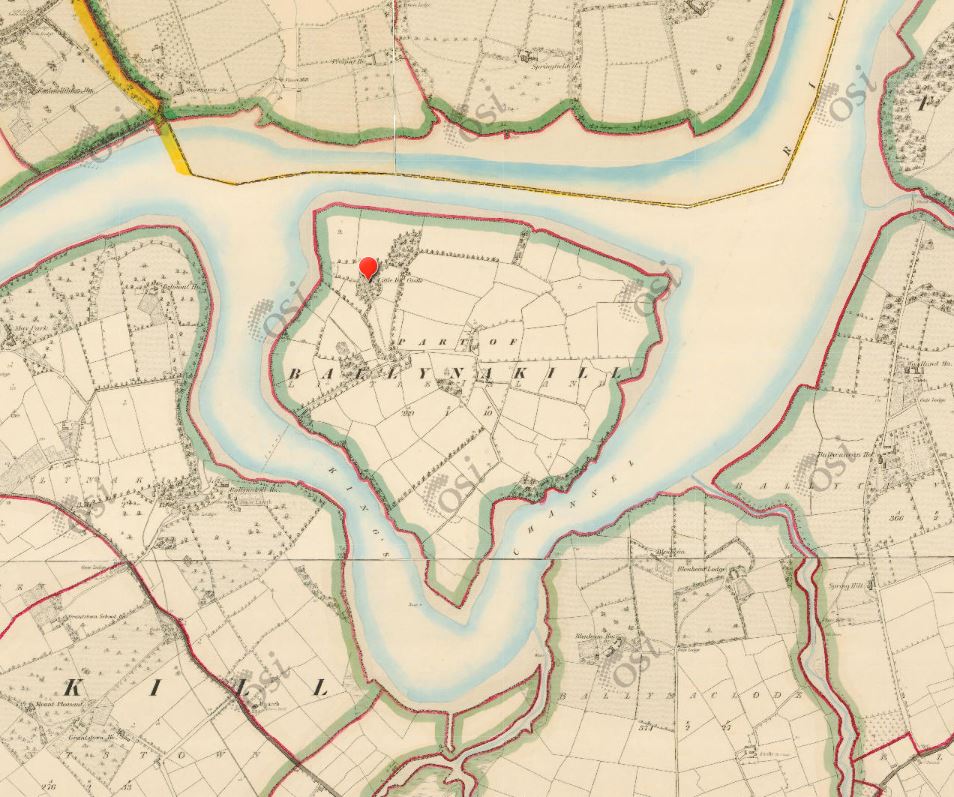
Waterford Castle (OSI 6″ ~1840)


It is now a hotel with activities (shooting, archery, croquet and the unmentionable (which involves mashie-niblicks, joggers and cleeks)).
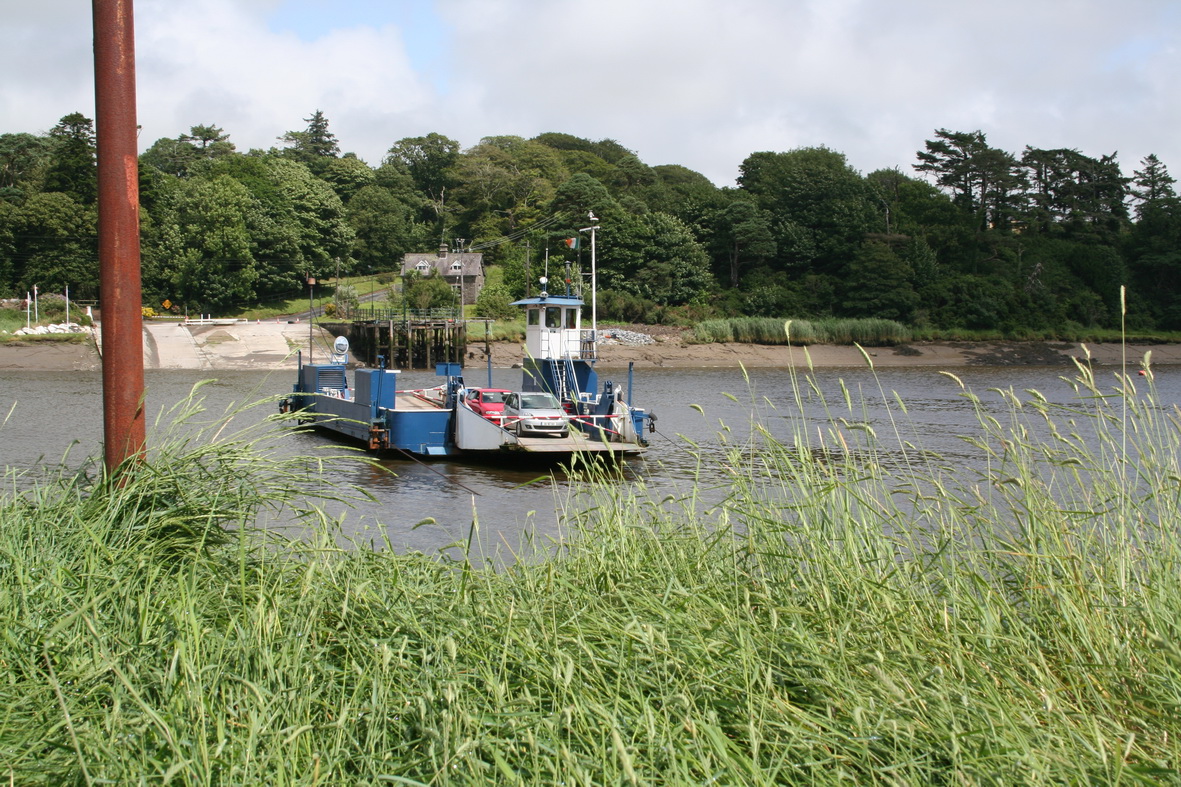
Waterford Castle car ferry (some years ago: I think there may be a new one now)

John Purcell Fitzgerald was born John Purcell, son of a Dublin doctor; he became a Fitzgerald when his already-wealthy wife became even wealthier on inheriting her father’s estates. His main achievement was fathering Edward Fitzgerald, translator of the Rubaiyat of Omar Khayyam.

Neither of them, though, was half as important as John’s brother Peter, the greatest mail-coach operator in Ireland, hotelier, coachbuilder, promoter of agricultural improvement, lobbyist for Catholic emancipation and against slavery, supporter of innumerable charities and first chairman of the Great Southern and Western Railway. He was one of a generation of supremely capable Irish transport entrepreneurs who managed the transition to steam power on land and water.

This is how the Dublin Weekly Nation of 30 May 1846 announced Purcell’s death:

DEATH OF PETER PURCELL ESQ

We regret to announce the death of this gentleman, which took place at his house, 3, Rutland-square, on Friday morning. He was a man of kind and generous nature; a good landlord, a liberal and considerate employer, and a practical philanthropist. His enterprise did nearly as much as that of Mr Bianconi in supplying facilities of intercourse on a great scale to this country.

He was the greatest coach proprietor, and one of the largest railway shareholders, in Ireland. The Agricultural Society, the Testimonial to Father Mathew, and other national projects in which he was engaged, and the liberal spirit in which he sustained similar movements, are evidences that he had a real and unselfish interest in the prosperity of Ireland.

He was an active member of the Precursor Society till his unhappy quarrel with O’Connell, to which this is not a moment to allude further. In the estimation of his fellow-citizens he occupied a creditable place, and the grief for his death is deep and general.

The Mail of last night, generously oblivious of the political differences between it and Mr Purcell, says:

“As a man of business, whether as a government contractor, or as a proprietor and cultivator of land, he bore the character of a man of energy, enterprise, and honesty; punctual in his engagements — liberal in his expenditure — judicious in his management — a great employer of labour — a charitable benefactor of poverty and distress.

“In the private relations of friendship and family affections, he won all hearts by the homeliness and sincerity of his manner — the unaffected simplicity of his tastes — the hospitality of his table — and the genuine kindliness of his domestic dispositions.

“Strong good sense and natural good humour were his distinguishing qualities in his intercourse with the world. Many a good joke we have run upon him as a public man, in this journal; and we must do him justice to say, they were taken by him, as meant by us, as effusions of a tolerant spirit, which, while it must condemn the exertions of opponent parties, is still willing to soften the acerbities of political strife by as much good humour as can be thrown into the political cauldron.

“We wish we had many such to deal with as Peter Purcell — was.

“We write the word with sorrow. He departed this life — we trust for a better — at an early hour this morning, at his residence in Rutland-square.”

And a few lines from the Dublin Evening Packet and Correspondent of the same day:

From Mr Purcell we differed in political opinion, and we have frequently in this journal felt it our duty to comment with freedom on his public conduct, but we never did, and never could deny that he was a fair, straightforward, honorable, and manly opponent, to whose personal character no exception could be taken, and whose sincerity in whatever views he advocated was unquestionable.

Purcell — who worked for Catholic Emancipation but did not want the Act of Union to be repealed — was, for a few years, active in local politics in Dublin. His quarrel with Daniel O’Connell came when he found that the funds of the Precursor Society were lodged in O’Connell’s own bank account. O’Connell promised Purcell several times that he would put them under the control of the society’s trustees but did not honour his promise. Purcell eventually felt that he had no option but to resign and to make public his reasons for doing so.

There is a memorial to Peter Purcell (by John Hogan) in the Pro-Cathedral in Dublin.

Esquires

Thom’s Directory for 1850 [Thom’s Irish Almanac and Official Directory, with the Post Office Dublin City and County Directory, for the year 1850 Alexander Thom, Dublin 1850] lists the more important employees of the Grand Canal Company:

Secretary John M’Mullen esq
Bankers D La Touche & Co esqrs
Superintendent of Trade and Passage Boats Samuel Healy esq
Land Agent and Paymaster Thos J Thornhill esq
Book-keeper Francis Bray esq
Collectors: at James’s-street Richard Davis esq, at First Lock Mr Thomas M’Ghee
Accountant Mr Thomas Brady
Storekeeper Mr William Talbot
Broker Mr William Warham.

So the Collector at James’s Street, like all those listed before him, was an esquire but his colleague at First Lock, like all those listed after him, was a mere mister.

Wikipedia’s nineteenth-century definitions of “esquire” are of interest. The Grand Canal Company might have sung with the Gorbals Die-Hards …

Class-conscious are we, and class-conscious wull be

… but perhaps not the next line

Till our fit’s on the neck of the Boorjoyzee.


The mysterious capitalist

In 1847 George Lewis Smyth wrote [in Ireland: Historical and Statistical Vol II Whittaker and Co, London 1847 Chapter 14]

Another favourite object of praise and assistance is the Dublin and Kingstown Railway. The large sums lent to this railway and to the Ulster Canal are represented in certain circles in Dublin to have been matters of personal obligation. A capitalist holding a considerable interest in both undertakings is familiarly described as always carrying a commissioner in his breeches pocket.

Who was the capitalist in question? One possibility is Peirce [or Pierce] Mahony, solicitor to both the Dublin and Kingstown Railway and the Ulster Canal Company, but perhaps “capitalist” in not quite the mot juste for him. Another is James Perry, quondam director of the railway and Managing Director of the Ulster Canal Steam Carrying Company, which was owned (from 1843) by William Dargan, the contractor who built the Dublin and Kingstown Railway.

Perry had fingers in many other pies, including the Ringsend Iron Works which, in 1842, built an iron steamer for the use of the City of Dublin Steam Packet Company on the Shannon. The steamer was named the Lady Burgoyne.


Tom Nolan, Grand Canal Company boatman

At its August meeting, the Killaloe–Ballina Local History Society presented “a selection of oral history recordings taken over 25 years ago of some of Killaloe’s and Ballina’s most elderly residents”; you can read about the event here.

Most of the recordings were made in 1992. One was an interview with Tom Nolan, formerly of the Grand Canal Company, and you can read a transcription of the interview here.

Costs on the Royal and the Grand 1843 and 1844

The second half-yearly meeting of the Grand Canal Company in 1844 seems to have been an extended affair. It was adjourned to allow the directors to amend their report on “the state of the company’s works” and, when it reassembled on Saturday 23 November, there was an unusually large attendance and a fractious debate, with several criticisms of the accounts and their “ambiguity and unintelligible nature”. The inconclusive meeting was eventually adjourned until 14 December, to allow proprietors [shareholders] to examine the accounts.

Amongst the critics of the directors was Mr H Bruce, who was unhappy with several aspects of the management of the company, one of them the extravagance of the directors. He said

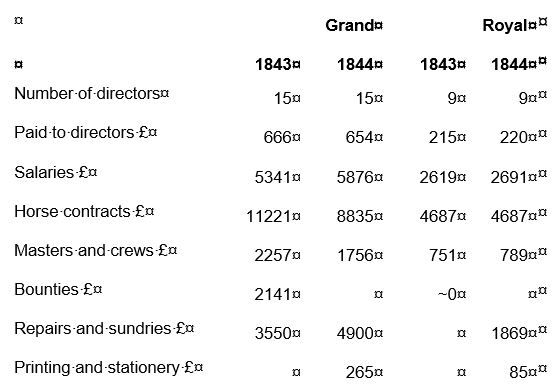
He had taken the trouble of comparing the Grand Canal with the Royal Canal Company for two consecutive years, and he would give the meeting the result of that comparison.

Here are the elements of that comparison in tabular format.

Those with a keen interest in the Royal Canal Company will no doubt have been surprised to find its management being complimented for anything, but the comparison is interesting even if, as Sir John Kingston James pointed out, the Royal Canal Company had fewer [passenger-carrying] boats “and consequently they had to pay less for horse power”: it would have been fairer to compare the costs per mile.

On repairs, Mr Bruce said that

Every one knew that the Royal Canal was a much more perishable canal than the Grand Canal, for instead of being excavated, a great part of it was built. No canal was more liable to the danger of an outbreak on the country, and of being bored through, than the Royal Canal, consequently it required more money to keep it in repair than the Grand Canal […]. Yet, what was the amount charged for repairing the Royal Canal in 1844, though in that year a serious breach took place in it? — why, only £1869.

Note that salaries cost considerably more than did the boat crews and that horse contracts, for hauling the boats, were about four times the cost of masters and crew on the Grand and aboout six times that cost on the Royal.

Dublin Evening Post 26 November 1844

Spencer Harbour

Excellent article about the Lough Allen Clay Company on the Dromahair Heritage website, though the schoolboy speculation on the naming of the harbour is not, I think, to be relied upon: the fifth Earl Spencer, twice Lord Lieutenant of Ireland, is I think the source of the name.

h/t COM for the link

Jamestown and the Longford

Jamestown [Co Leitrim] Heritage Festival starts on Friday 25 May and runs until Sunday 3 June 2018. The programme is here.

Apart from the presence of numerous barges and other vessels, the festival will feature these events of historical interest:

  • Saturday 26 May: talk by Alf Monaghan on Doon to Diesel, a review of the importance of Drumsna and Jamestown in Transport History
  • Sunday 27 May: talk on the sinking of the Royal Canal passage-boat Longford [in which fifteen people died] in 1845
  • Monday 28 May: bus trip to Arigna Mining Experience
  • Tuesday 29 May: talk by Alf Monaghan on Monastic Ireland — a gift from the Nile and display by Carrick-on-Shannon Historical Society
  • Wednesday 30 May: walking tour of Jamestown led by historian Mary Butler
  • Saturday 2 June: talk by Donal Boland on The Shannon’s hidden locations and gems and, in the afternoon, “traditional method demonstrations”.


Hotel boats

The Shannon Princess wants a general assistant.

More houseboats

From the Indo

h/t Redmond O’Brien

What shall we do with the drunken sailor?

Liverpool Police. Saturday, Feb 17 [1827]

William Brown, the Sailor:
— a romance in real life

On Saturday last, as the Commerce steam packet, belonging to the City of Dublin Company, was starting from George’s Pier Head, Batchelor, the police constable on duty, called out to the commander of the vessel to hold on for a few minutes, and instantly went on board with two of his assistants, and after a few minutes’ search they returned on shore with one of the passengers in custody, who was dressed in sailor’s clothes, and passed by the name of Wm Brown.

The case of this person’s apprehension was a report which had been communicated to the Constable that a female in a disguise, the description of which corresponded with this person’s attire, had taken a passage for Dublin by the Commerce, which awakened in his mind, not unnaturally, a suspicion that it was some woman who had either escaped from prison, or had been engaged in some robbery, and was flying to evade detection, whom it was therefore his duty to detain for examination before a Magistrate. The dress had been so minutely described, that it was impossible to mistake the person, notwithstanding the addition of a still deeper disguise of intoxication, in which the party was found at the time of making the capture.

When safely lodged in Bridewell and about to undergo a personal examination by Mrs Clayton, the wife of the keeper, finding detection inevitable, the prisoner confessed the fact of her sex and disguise.

In the evening, when perfectly sobered, she stated her name to be Selina Augusta Hamilton. Inquiries which had been made in the interim led to the discovery of the house in which she had been lodging by the Old Dock, and one of the constables was engaged, in the course of the evening, in conversation with the landlady for the purpose of tracing her history, when a respectably dressed man entered the room, to whom the landlady pointed and said “here’s the very gentleman as can tell you all about her”. The gentleman in question proved to be the master of the brig Laura, of New York, lying in Prince’s Dock, whose name we have been told is Duffey.

From the account given by this person, who, we believe, was the cause of her detention, as well as from her own statement, the following particulars of this extraordinary being have been collected.

Her father is said to be a merchant in London, and owner, wholly or in part, of several vessels, one of which was stated to be now lying in George’s Dock. He was said, as we understood it, to have a counting-house at Topham’s (query Topping’s?) Wharf, and a dwelling-house at Shadwell. From his house, it appears that she absconded about three years ago, to follow a young man with whom she had fallen in love. He was the mate of a vessel in the North American trade; and hearing that he had sailed for St John’s, New Brunswick, she came down to Liverpool, and took her passage in a  vessel bound to that place. This part of her story is confirmed by several persons in this town, who recollect having seen her at that period, when they describe her to have been a young lady of fashionable appearance, elegantly dressed, and ladylike in her deportment.

On her arrival at St John’s, she found that the vessel to which her lover belonged had gone to Quebec; thither she therefore followed him, and there she learned that he had been drowned in the passage up the river St Lawrence.

Her determination was immediately taken to become a sailor for his sake, and, doffing her woman’s gear, of which she found means to dispose, and submitting the luxuriant tresses of her flaxen hair to the sheers, in the attire befitting a youth of the station which she assumed, she engaged herself as cook and steward to the master of a vessel bound for London, with whom she remained upwards of twelve months. While the vessel lay in the Thames, she met her father one day in the street, and touched her hat to him as she passed, but so completely was she altered as to defy recognition. In that vessel she served upwards of twelve months, and would still have continued in her, but that the Master, suspecting her secret, at length succeeded in extorting from her an acknowledgement of the truth, and afterwards wished her to remain with him, upon terms to which she would not submit.

Her assumption of the habits of a sailor, it seems, has by no means been limited to the “jacket and trowsers blue”, but the grog and the “backee”, and “the pretty girls to boot”, have all contributed their share towards the completion of the matamorphosis [sic]. Of the grog there was abundant evidence in her condition at the time of her being apprehended; of the tobacco, a token appeared in a well-filled box in her jacket pocket; and for the girls, she has unquestionably been humming them with a few adventures a la Paddingtoni. To one young woman she performed the honours of a regular courtship, underwent the threefold publication of the banns of marriage, and was only prevented from undergoing the ceremony itself, by a timely discovery of the parish officers, that the bride elect was in a condition very shortly to become a mother, when the creature was upon the point of declaring our heroine to be the father of her expected offspring; and then, says the latter, “you know I could not go any further”, and therefore the connection ended.

Since her arrival in Liverpool she has bamboozled more than one of the frail portion of its female inhabitants by affecting a serious attachment; and one night partaking too deeply of the potations to which she invited one of the beauties of Bridge-street, whom she had treated “to the play”, she was robbed by her of the greater part of her earnings by her last voyage.

The discovery of her sex on that occasion secured impunity to the plunderer, who afterwards buzzed it about; and to escape from the disagreeable consequences which the adventure had entailed upon her, she determined to go to Ireland in hopes of being able there to embark in one of the first vessels for British America, that being the trade to which she has attached herself in memory of her lover, William Brown, whose name she had assumed. She has stated since she has been in custody that she will have a fortune of £4000 at her own disposal when she comes of age — she is now not quite nineteen — and that she intends to lay it out in the purchase and equipment of a vessel, of which she expects by that time to have qualified herself to take the command.

She is in person of the ordinary stature of women, but rather stoutly made, and inclining to embonpoint; of fair complexion, with light hair and grey eyes, round face, features by no means handsome, though not unpleasing for a boy.

Yesterday, she was brought up for examination at the Town-hall, before Mr Alderman Peter Bourne, to whom a brief outline of her history had been sketched, the Mr Duffey, of the brig Laura, before named, appearing to state the grounds of her detention, in which, we must say, that for some reason or other, he cut as foolish a figure as any man could desire to do.

Before the lady made her appearance, Mr Duffey stated to the Magistrate that he had become acquainted with the prisoner from seeing her several times in her walk, near her father’s residence, but that he had no acquaintance with her father, whom, however, he knew to be a man of considerable property, as described above.

The prisoner, on being questioned by the Magistrate, said she knew that gentleman (Mr Duffey) very well, having often seen him at her father’s house.

The Magistrate then asked Mr Duffey if he had any thing to say against her; to which he replied, that he wished her to be given into his charge, that he might restore her to her father.

A look of something like surprise was the only comment of the girl upon this application; and the answer was, that he had no authority to give her into his charge. He, however, advised the girl to give up her present mode of life and return to her father.

She said she had made her own choice of her present mode of life, and she did not know why any one should wish to make her leave it. The Magistrate said he had no authority to prevent her from following her inclination, nor to detain her. She was therefore discharged.

Southern Reporter and Cork Commercial Courier 22 February 1827